week 5: within measures ANOVAS
 Studied by 0 people
 Call with Kai
 Learn
Learn Practice Test
 Spaced Repetition
 Match
Match Flashcards
 Knowt Play
1/14

There's no tags or description
Looks like no tags are added yet.
Name | Mastery | Learn | Test | Matching | Spaced | Call with Kai |
|---|
No analytics yet
Send a link to your students to track their progress
15 Terms
Repeated measures design
There are many situations in which we might want to study the same individual under several different conditions. Experimental design of this kind are called Repeated Measures Design (or related design or within-participants design).
within measures ANOVA
or related, and not independent groups
also referred to as a within-subjects ANOVA
advantages of within measures design
it increases statistical power-the design removes the effects of individual differences
fewer participants are needed for most experiments-a big advantage if data is difficult to obtain because we cannot find the participants for our experiment
disadvantages of within measures design
the independent variable may be confounded with order of testing or carry over effects:
1. Practice Effects
subjects get better at the task over time because of practice, so that they perform best in the later conditions
2. Fatigue Effects
subjects get worse at a task over time because of fatigue, so they perform worse in the later conditions
3. Contrast Effects
a noisy condition experienced after a quiet condition might be perceived as even noisier than it normally would be.
4. Demand Characteristics
being in more than one condition makes it clear to subjects what the independent variable is. They may behave how they think you want them to in later conditions
missing data
solutions to order effects
Randomising the order of testing
Counterbalancing order of testing
F calculation
between-groups variance (with indiv. diffs. removed)/within groups variance (with indiv.. diffs. removed)
ANOVA assumptions
The Dependent Variable (DV) comprises data measured at interval/ratio level.
Use Kolmogorov-Smirnov or Shapiro-Wilk tests to confirm normal distribution.
At least three (or more) measurements from the different conditions/treatment isrequired.
All participants the provide score for all the conditions/treatments.
Homogeneity of Variance- Use Mauchly’s Test of Sphericity (within measures design).
sphericity
Sphericity means that the variances of the differences between all combinations of related groups (levels) are equal/same.
Violation of sphericity is when the variances of the differences between all combinations of related groups are not equal/same.
Sphericity replaces the homogeneity of variance assumption in independent measures ANOVA
if the assumption of sphericity is not met, All is not lost. SPSS gives us some other decisions….. We have estimate of sphericity.
Greenhouse-Geisser – conservative (if epsilon is < 0.75).
Huynh-Feldt – least conservative (if epsilon is > 0.75).
Lower-bound – most conservative (least reported).
most commonly use greenhouse-geisser
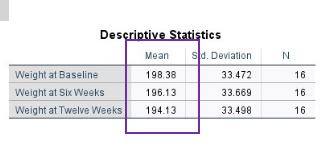
descriptives
A quick glance at the Descriptives Statistics shows us that there is a linear trend in weight loss over the twelve-week period.
The mean weight decreases from 198.38(Weight at Baseline) to 196.13 (Weight at Six Weeks) to 194.13 (Weight at the end of period).
degrees of freedom
weight df=no. of conditions-1
error (weight) df=(no. of observations-1)-(no. of participants-1)-(no. of conditions -1)
mean square
mean square=sum of squares/degrees of freedom
error mean square=error sum of squares/error df
F ratio
mean square/error mean square
evalaute null hypothesis
e.g. =35, the observed variance is 35 times which is a substantial difference
effect size
eta squared
planned comparisons
we have hypothesised in advanced which meanswill differ from one another before we start the experiment.
In this example, we hypothesised that there will be a difference in the body weight over the 12-week period.
Furthermore, we predicted that there would be a difference between
(a) Baseline and Mid-Point (six weeks) and
(b) Mid-Point (six weeks) and End Period (twelve weeks).
Planned contrasts showed that there was a significant difference between the mean weight at Baseline whencompared to mid-point (6 Weeks), F(1, 15) = 13.65, p=0.002, partial ŋ2 = 0.48 indicating a difference of 48% in theweight loss between the Baseline and six weeks. This is large effect size.
unplanned (post-hoc) comparisons
If this was a speculative study and it was not possible to predefine your hypothesis, you could conduct a post-hoc comparison of all the mean differences in SPSS.
Remember that unplanned tests are less scientifically rigorous.
Give the means, SDs and significance levels for mean comparisons
Unplanned contrasts with Bonferroni adjustment identified that mean weight was significantly lowerat Week Six (M= 196.13, SD = 33.67) than at Baseline (M=198.38, SD=33.47, p=0.006) and Week 12(M=194.13, SD = 33.50) than at Baseline (M=198.38, SD=33.47, p<0.001) and Week 12 (M=194.13,SD=33.50) than Week Six (M=196.13, SD=33.67, p=0.001)
also report effect sizes (cohen’s d)
 Note
Note  Flashcards (114)