Religion and Life ATAR Unit 1 Booklets 1 & 2
Booklet 1: Search for Meaning and Purpose in Life
Syllabus point:
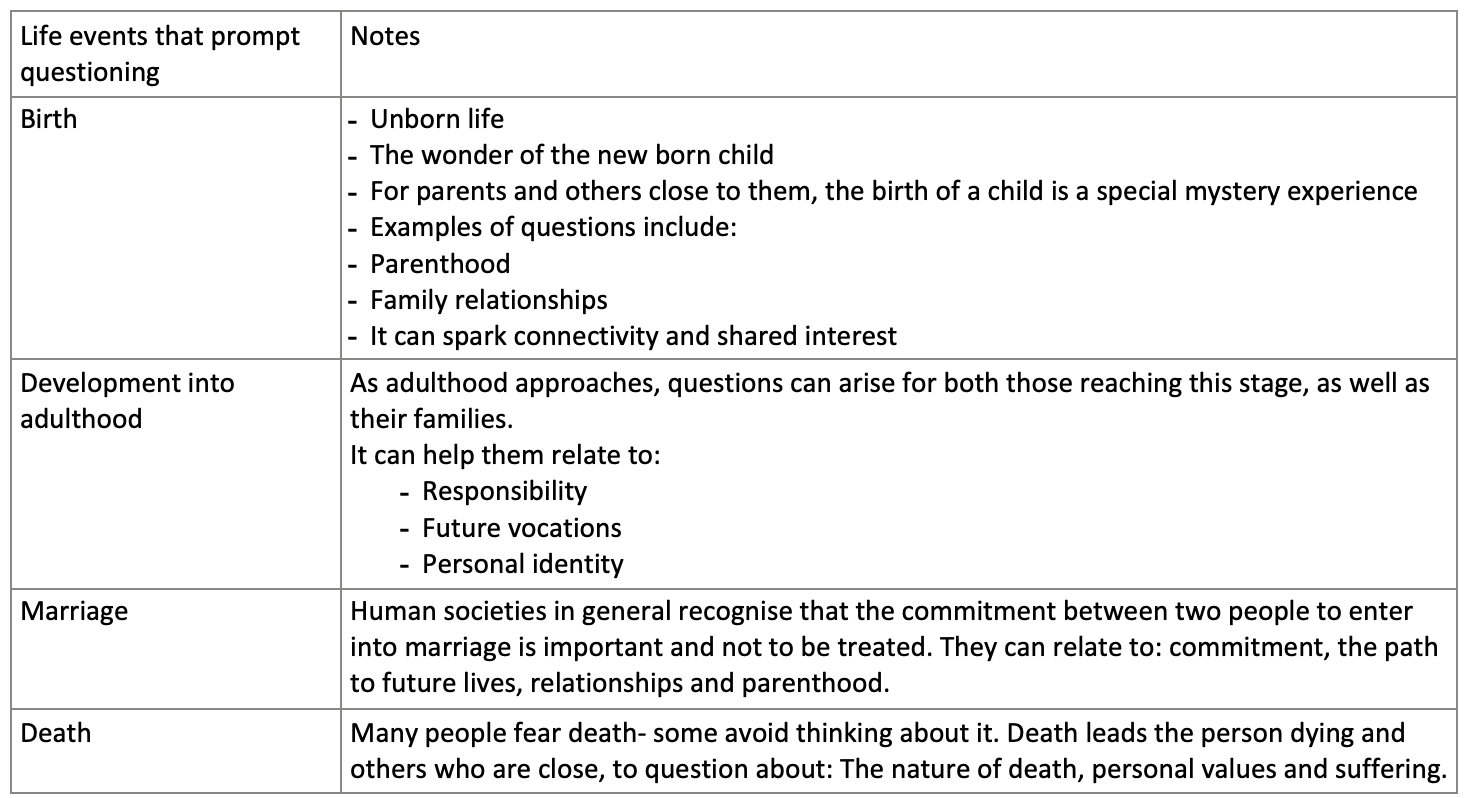
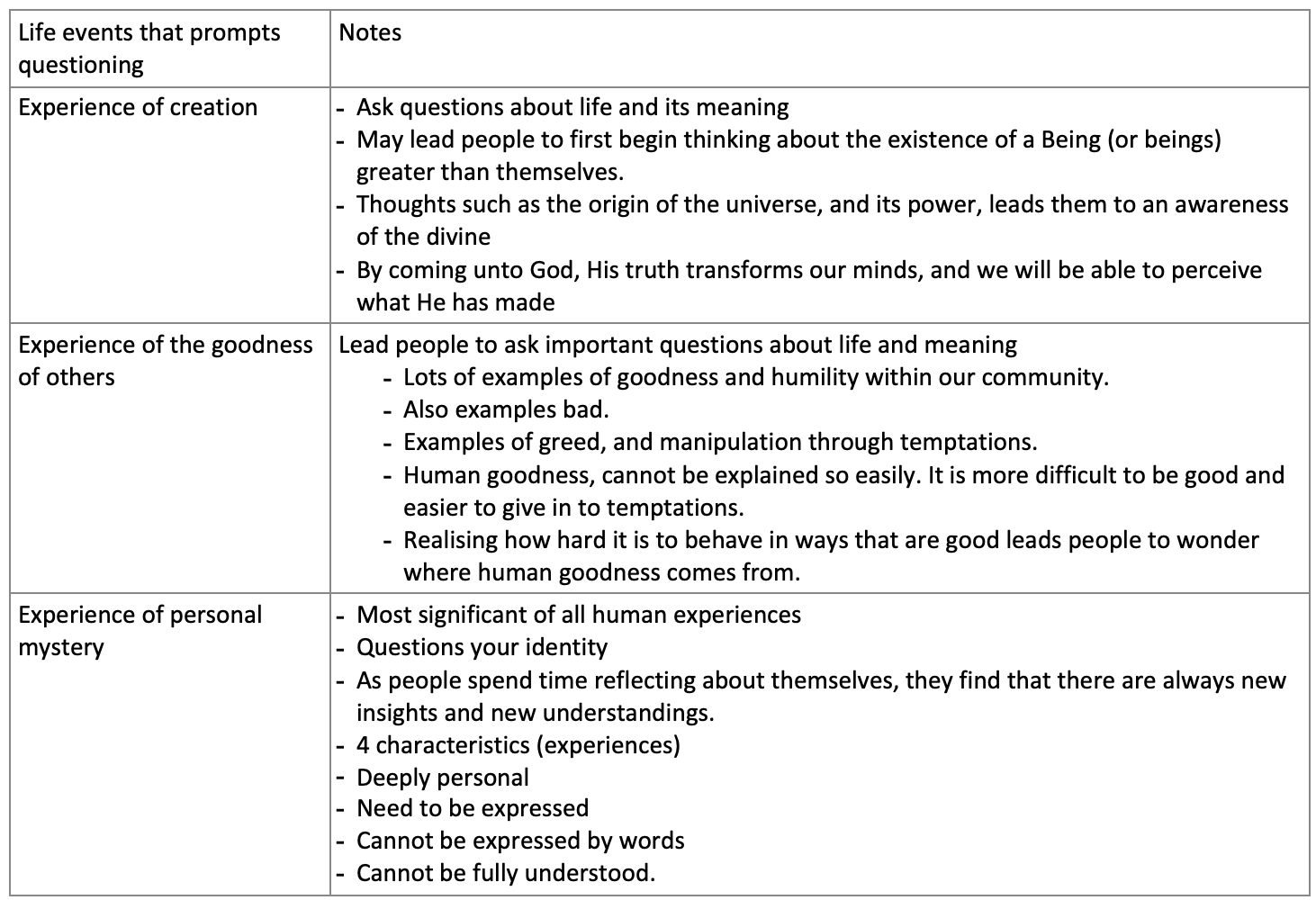
The relationship between important life events and the questions people ask about meaning and purpose in their lives
Key Terms:
Event- An experience; it can hold some significance in your own life (eg. marriage, birth etc)
Meaning- holds value
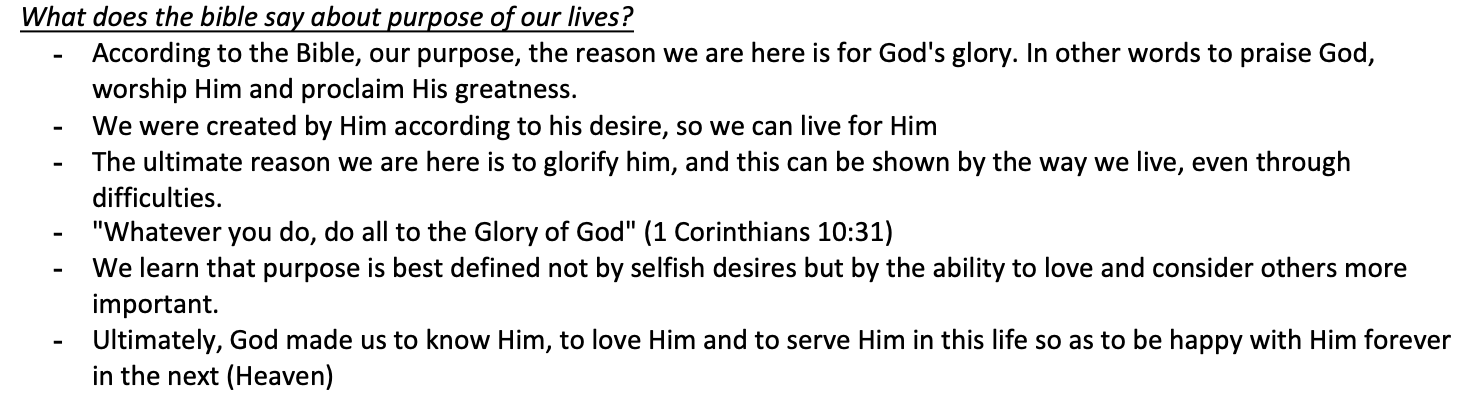
Purpose- How the value of life are being lived out.
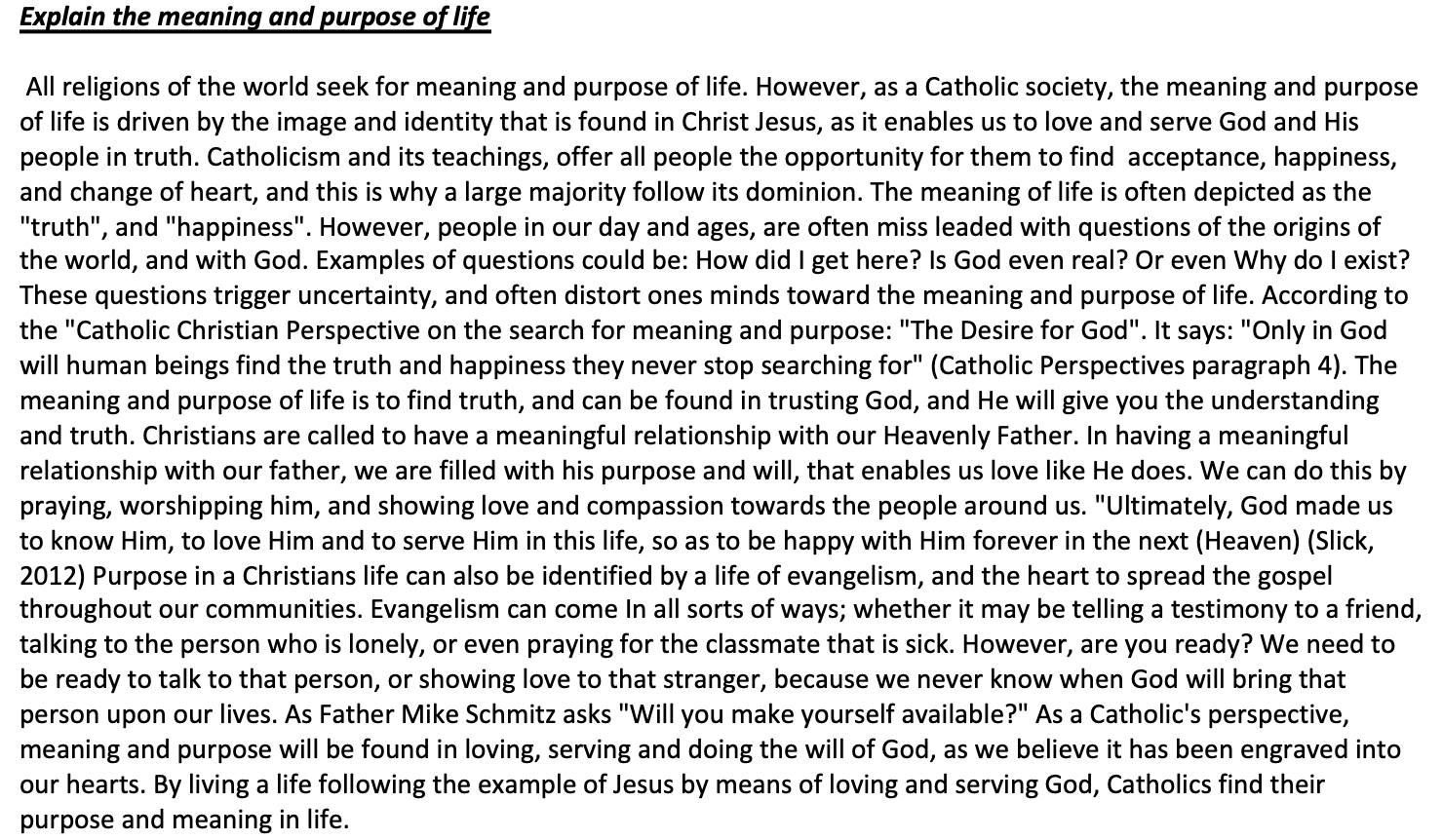
How can people search for meaning and purpose in their lives
Going on pilgrimages
Stepping out of your comfort zone
Deliberate exercises
Self reflection
Talking to yourself
Being intentional
Personal questions
Who am I?
What are my likes and dislikes?
Relationship questions
What do I see in a future partner?
How can I become a better friend?
How can I become a better spouse?
Questions about the future
What do I want to do in the future?
What do I want to do after year 12?
Questions about God
Is God real?
How do I know that God loves me?
How did God let that happen

Booklet 2: Religion and Religiosity
Syllabus point:
The concept of religion and being religious
Key Terms
Religious identity: formation of self within a particular religion or part of a religious group. Religiosity refers to both the value of religious group memberships as well as participation in religious events.
Religious Adherence: Believe in and follow the practices of a particular religion
Religious Affiliation: The self-identified association of a group with a religion, denomination or sub- denominational religious group
Atheist: Someone that does not believe in the existence of God
Theist: Someone who believes in the existence of God, or spiritual being
Agnostic: Someone who can’t prove the existence of God, but believes there is a God.
Religion- A system of beliefs, including belief in the existence of a higher being. A religion is a set of beliefs and practices and are often organised around a supernatural being. It is expressed through worship, and prayer, and has values. It involves community.
Spirituality- a sense of self and of relationships that is “greater than self”, as they find meaning and purpose in life. The belief in the supernatural spiritual dimension, and is not necessaryily associated with religion.
The Concept of Religion
Definition: Religion involves the belief in a higher power or a divine being/s. Religion typically have a system of beliefs, sacred texts, set practices, a moral code, and some form of leadership.
There are two types of religions: natural religions and revealed religions
Natural religions are generally considered as “man made”, and are not linked to a founder but a collective memory of stories which explains the origin of life.
They are based on human wisdom
Examples include Greek Mythology, Hinduism, Buddhism, Australian Aboriginal Spirituality
Revealed Religions have a founder who made the claim to have received some revelations from God. They are considered to have come directly from God.
Historically there are three main revealed religions: Judaism, Christianity and Islam
These religions are called “monotheistic” religions since they come directly from God
All religions share some common characteristics:
Sacred texts (expressing their beliefs)
Forms of worship (expressing a connection with the divine/God)
Leadership
A code of ethics (on the good to be done and the evil to be avoided)
Religion is also a place of community where people of faith are able to find common ground in their share religious experience and support each other in their way of life.
The Concept of Religion (specific to Catholicism)
A sacred text (The Bible/Scriptures)
Beliefs and teachings (eg. the belief in the Holy Trinity)
Rituals, practices, events and celebrations (eg. the Holy mass is a practice that contains rituals.)
Leadership (the Magisterium, which is the teaching authority of the Church consisting of the Pope and Bishop)
A code of ethics (eg. the 10 commandments/moral teaching of the Church which are based on 10 commandments)
Customs and tradition (eg. having designated days to honour saints, martyrs etc.)
People who are religious seek sense and think about the meaning and purpose in life according to do the religion they adhere to.
Being religious is also deeply personal matter. Any effort to describe what it means to be religious can only describe some aspects of what it means to be religious.
Can be described in terms of:
What and how frequently a person practices elements of a religious way of life.
What a person says they believe in, and going further, how their behaviour matches
There are people who are:
Spiritual but not religious (believing in a higher power/ energy and ordering one’s life according to this belief, yet not affiliating with any particular religion in belief or practice)
Neither spiritual nor religious, yet affiliate them with a religion.
Neither spiritual nor religious.