MBAN 504 Notes LEC 2
 Call Kai
 Learn
Learn Practice Test
 Spaced Repetition
 Match
Match Flashcards
 Knowt Play
1/28

There's no tags or description
Looks like no tags are added yet.
Name | Mastery | Learn | Test | Matching | Spaced | Call with Kai |
|---|
No analytics yet
Send a link to your students to track their progress
29 Terms
k-anonymity
Idea for datasets that a person must be identical to at least k other records;
Large vs Small K anon
Larger is not as secure; Smaller is more secure; but want to be in between of small and large
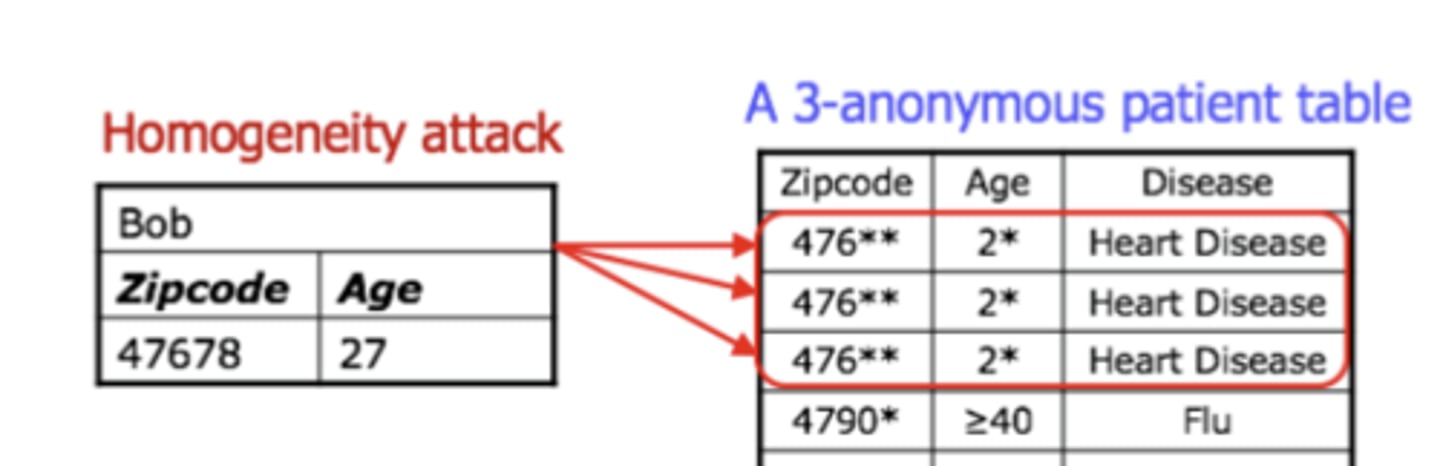
Homogeneity Attack
A privacy breach occurring when anonymized data contains a group of individuals who share the same sensitive attribute
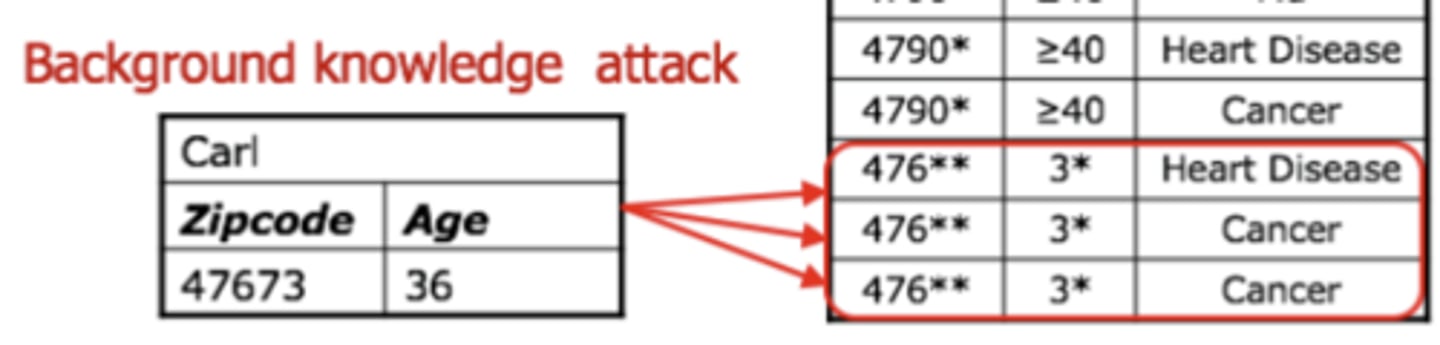
Background Knowledge Attack
Adversary combines released anonymized data with external/public/known information to re identify individuals and reveal sensitive data
Differential privacy
compromise between data protection
(providing plausible deniability to users) and utility of data
What are "Neighboring Datasets" (the input part)?
Two datasets (D and Dprime) that are identical except for the record of one single individual
What is the "Mechanism" (M)?
Randomized algorithm that adds "noise" to the data before it is released to protect privacy
Loose Definition of Differential Privacy
A mechanism is differentially private if exclusion/inclusion of any individual in the input
dataset does not change significantly the output of the mechanism.
If M(D) aproxx M(D'), what does that imply?
An observer cannot determine if a specific person was part of the OG dataset or not
What does D'=D mean?
Dataset D' is equal to dataset D minus the individual
What is the trade off?
Privacy vs Utility. More noise means more privacy but less accurate results
Randomized response
Ensures differential privacy for binary outcomes
Epsilon = 0
Full Privacy D[0] <= D'[0']
Epsilon = 1
Not as private but middle D[0] <= 2.7D'[0']
Epsilon = ∞
No Privacy D[0] <= ∞
Laplace
A way to hide individuals value by adding a specific amount of random noise to the final anwser
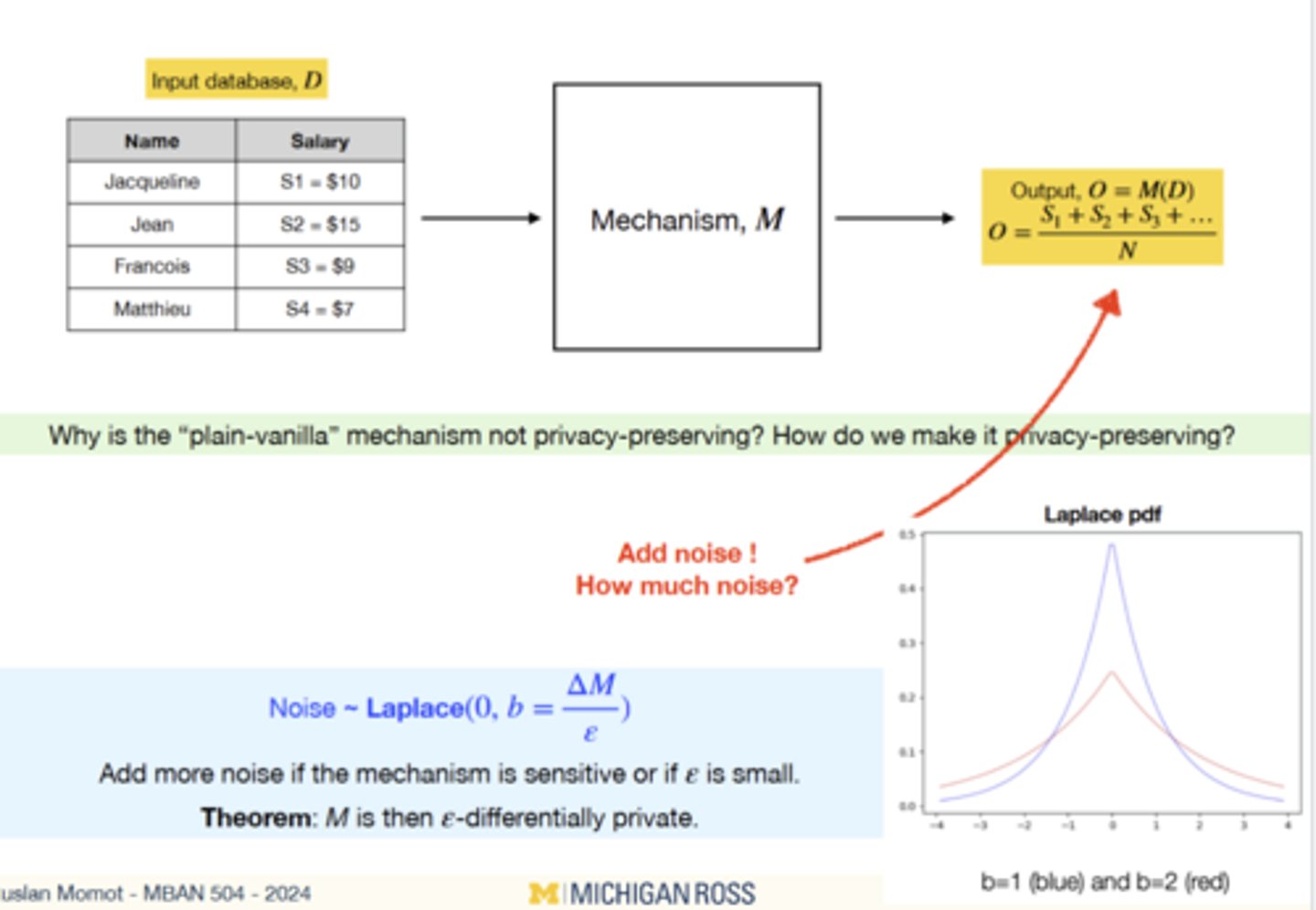
Increase Epsilon
The noise decreases. (Larger epsilon less privacy = more accuracy).
High sensitivity
The noise increases. High sensitivity requires more "fuzz" to hide an individual's impact.
Problems with differential privacy
Adversary can query the mechanism
multiple (many) times, the average of the
outputs will be the true answer.
Local DP
Adding noise to raw info; More secure but less useful
Central DP
Adding noise to the output; Less secure but more useful
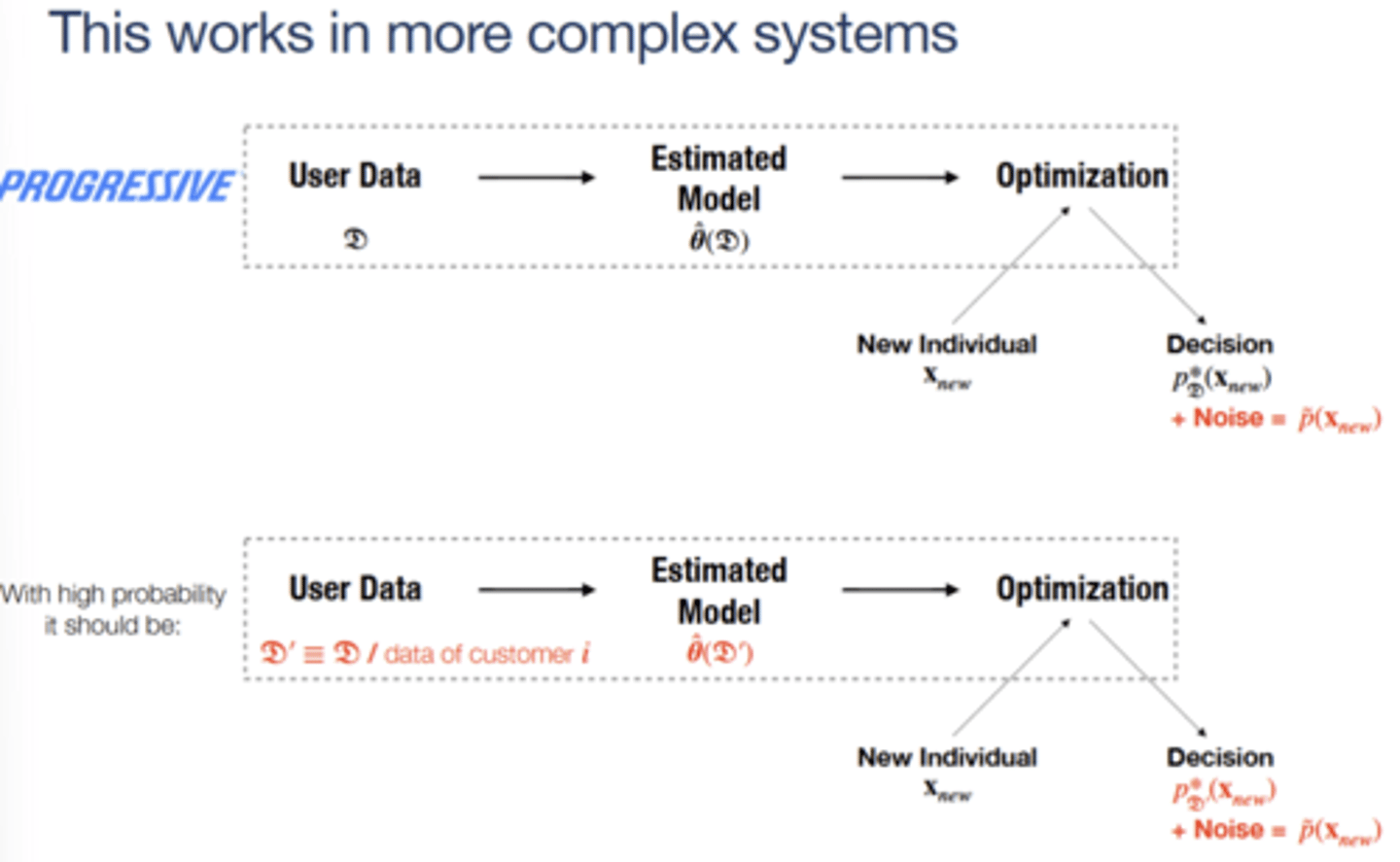
What does this progressive example show?
DP works for Machine learning/optimization not just averages
Why is traditional attribution a privacy issue?
Requires tracking a user’s exact path across multiple different apps and websites.
How does Pinterest protect privacy in attribution?
use Local Differential Privacy
How to protect users' data if we have many devices, many
datasets, etc (if our system is complex)?
Layered defense
User Device
Local Differential Privacy; Prevents raw data from ever leaving the user
Data Transit
Federated Learning;Avoids the risk of "Massive Data Lakes" being hacked.
Data Analysis
Laplace Mechanism;Ensures internal employees can't accidentally see private info.
System Wide
epsilon -composition;Prevents "linking" users across different datasets.
Explore top notes

