Exam 1A
 Studied by 0 people
 Call Kai
 Learn
Learn Practice Test
 Spaced Repetition
 Match
Match Flashcards
 Knowt Play
1/69

There's no tags or description
Looks like no tags are added yet.
Name | Mastery | Learn | Test | Matching | Spaced | Call with Kai |
|---|
No analytics yet
Send a link to your students to track their progress
70 Terms
Which of the following is not one of the "major characteristics of electron beams" discussed early in the electron therapy lecture? (list them instead) (3)
Sharp fall off of dose
Though this characteristic tends to fade with increasing energy
No exit dose
skin sparring is only modest or non-existent
This term is defined as "the rate of energy loss per gram per centimeter squared
Mass Stopping Power
FYI: rate of E loss/ gram/ cm²
Energy is speed.
↑ Speed = ↑ Energy
X-rays travel at the speed of light, e- travel at sub-light speeds
↑ e- interact with stuff = ↑ slow down = they lose Energy
Mass Stopping Power relates to how much Energy (speed) is lost as electrons interact with matter
17
Electrons scattered with enough energy to cause further ionization and excitations and other atoms can be referred to as
Delta Rays
FYI: An atom is ionized creating a recoil e-, if the recoil e- has enough E to cause other interactions in other atoms, then that recoil e- has a new name: Delta Ray
The rate of energy loss for electron beams is approximately ___________ in soft tissue and water
2 MeV/ cm
FYI:
how much energy will a 12 Mev electron have at
0 cm in tissue
1 cm in tissue
2 cm in tissue
3 cm in tissue
4 cm in tissue
5 cm in tissue
6 cm in tissue
12 MeV
10 MeV
8 MeV
6 MeV
4 MeV
2 MeV
0 MeV
FYI:
Rules of Thumb Regarding Electron Beam Range
What are the 2 types of ranges?
Practical Range aka Penetrating Power
Useful Range aka Therapeutic Range
FYI:
term. Useful Range aka Therapeutic Range
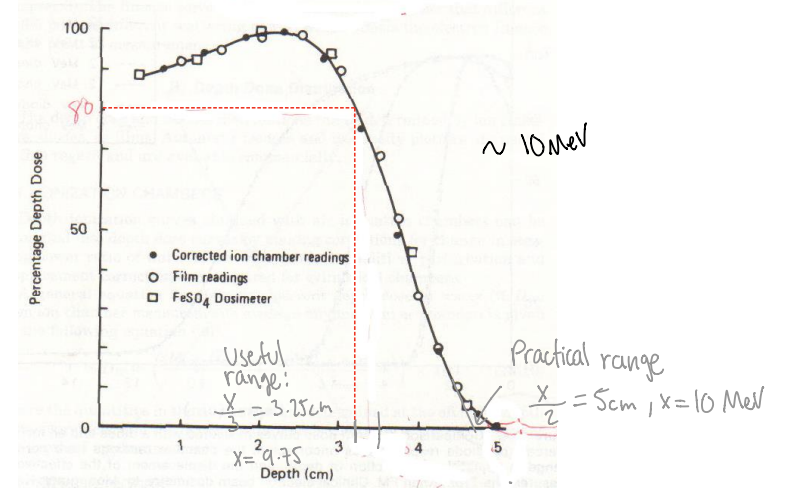
def. the depth where the dose is 80%
FYI: after 80% the dose falls off to 0 pretty rapidly
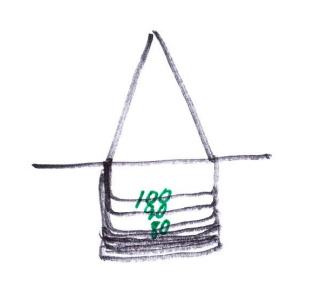
FYI:
Practical Range/ Penetrating Power follows the ___ rule
Useful Range/ Therapeutic Range follows the __ rule
Practical Range follows the 1/2 rule
Useful Range follows the 1/3 rule
Define the following:
(Practical Range follows the) 1/2 rule
(Useful Range follows the) 1/3 rule

Electron beam "Practical Range" follows which rule of thumb?
one half
The "penetrating power" of a 16 MeV electron beam is approximately how deep in tissue?
Practical Range = ½ Rule = 16/2 = 8 cm
The "therapeutic range" of an electron beam most commonly follows what percent isodose curve line?
80%
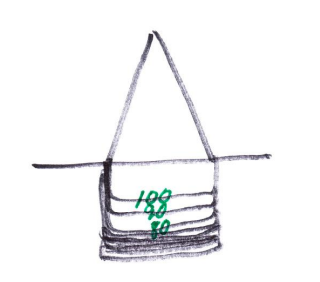
The "useful range" of a 12 MeV electron beam is approximately how many centimeters deep in tissue?
Useful Range = 1/3 Rule = 12/3 = 4 cm
If a cancerous lymph node is found 2 centimeters deep in tissue, what would be the most appropriate electron beam energy according to the lecture notes?
Useful Range = 1/3 Rule
1/3= 2 cm → 2 × 3 = 6 MeV
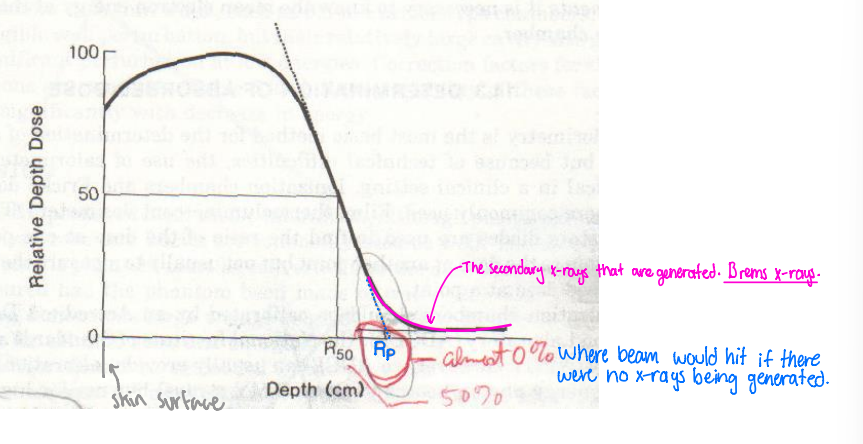
A Brems Tail is indicative of:
Secondary x-ray contamination from collimation system
true/false: electron beams interact via elastic and inelastic collisions
True
Which of the following machines is NOT capable of producing a therapeutic electron beam? (list them instead)
Van de Graaff
Linacs
Betatrons
FYI: NOT cyclotrons
The most useful energy range for electron beam therapy is:
6-20 MeV
A major advantage of electron beam therapy is:
a. sharp edge gradient
b. gives higher doses than KV x-ray therapy
c. more cost efficient
d. no exit dose
d. No exit dose
the rest are false
FYI:
What sites are commonly treated with electron therapy?
Mnemonic: CHi BS
Chest wall for breast
some H&N ca’s:
Parotid salivary gland
Boost dose for superficial nodes or scars
Skin & lip
Which of the following H&N cancers is LEAST LIKELY to be effectively treated with electron therapy:
A Maxillary sinus
B Parotid
C Lip
D All of these are equally effectively treated with electron therapy
A Maxillary sinus
Which of the following non H&N site is least likely to be treated effectively with electron beam therapy?
A Chest Wall
B Superficial Nodes
C Orbit (eye)
D Scars
E All of these, according to the lecture, can be effectively treated with electron therapy
C Orbit (eye)
Electrons interact via ________ collisions.
elastic & inelastic (w. nuclei & outer shell electrons)
The rate of energy loss per gram per cm squared defines:
Mass Stopping Power
Scattering foils are made of
↑ Z# materials, like lead
FYI:
high z# materials = fewer e-/ gram
e- beams depend mostly on collisions with other e- (as opposed to photon beams)
high z# materials = e- more tightly bound = less available for interactions
e- from e- beam have to knock out e- in patient’s body, and that’s how dose is deposited
Big atoms create a pinball effect, e- bounce all over the place, which scatters the beam. The scattered beam get’s down to the patient more uniformly rather than having an unscattered pencil beam.
high z# scatters the dose (e- bounce around)
low z# absorbs the dose (e- from beam interact with other e-)
Analogy: Atoms are body guards(bouncers), bigger z number = more bouncers guarding electrons, they so incoming electrons cannot interact with other electrons`
Many accelerators have a:
A dual scattering foil system
B single emulsion foil
C tungsten foil
D topographic electron scanning system
A
C is false cuz its lead not tungsten
Another option is a : Magnetically scanned beam
An electron beam loses roughly _______ MeV/cm of tissue.
2
Electron beam practical range generally follows the ___rule of thumb.
1/2
Electron beam therapeutic range generally follows the ___ rule of thumb.
1/3
Electron beam penetrating power generally follows the ____ rule of thumb.
1/2
The useful range of an electron beam is usually described as being equal to the ___% isodose line(s) and above (if applicable).
A. 100
B. 80-90
C. 70-80
D 70
E 50
B 80-90 (80 is more common but 90 can be used too)
Electron beam energy and surface dose show a ________ relationship.
A. Direct
B Inverse
C Not related at all
A. Direct
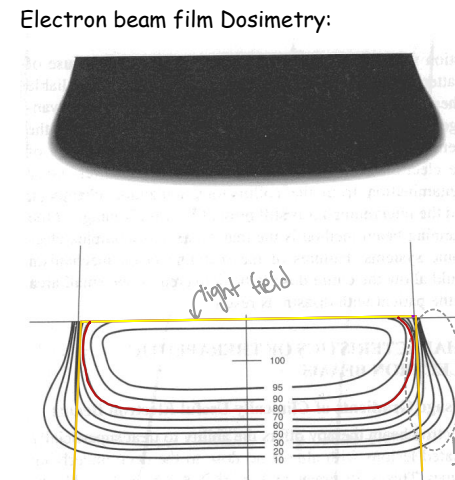
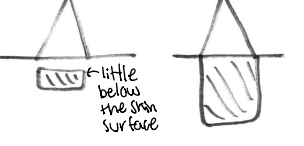
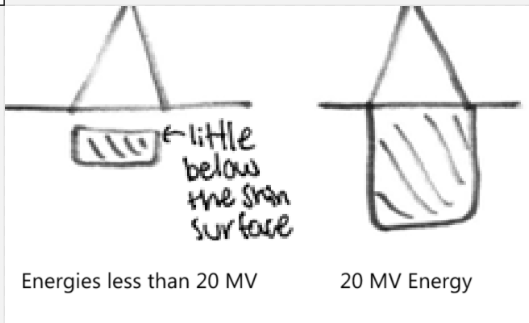
fyi: the highest energy 20 MV has no skin sparring at all
Electron beam energy is characterized at:
the skin surface
(i.e. it measured at the skin surface and that’s where we call it, 6 MV, 9MV, 20MV etc.)
Electron beam absorbed dose data is most commonly determined by using:
ion chambers & chemical dosimeters
double check
Which electron beam has the maximum dose on the skin surface?
20 MeV
FYI: 20 MeV, the skin dose is 100%
Image: Right is 20 MeV
condenser type for energies less than 10MeV;
thimble or parallel plate chambers for energies above 10MeV
condenser type for energies greater than 10MeV
A 1,3
B 1,4
C 2,3
D 2,4
Correct: 1,3 (hint: this is the answer) B 1,4 C 2,3 D 2,4
What is the preferred material for electron calibration?
Water (like the phantoms have)
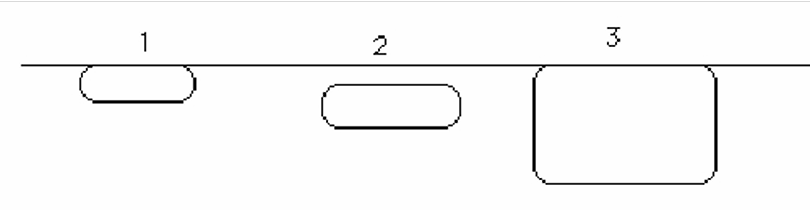
Which of the following electron beam curves best illustrates the MAXIMUM dose range (around 100%) of a 9 MeV beam (as drawn in the study guide)?
2
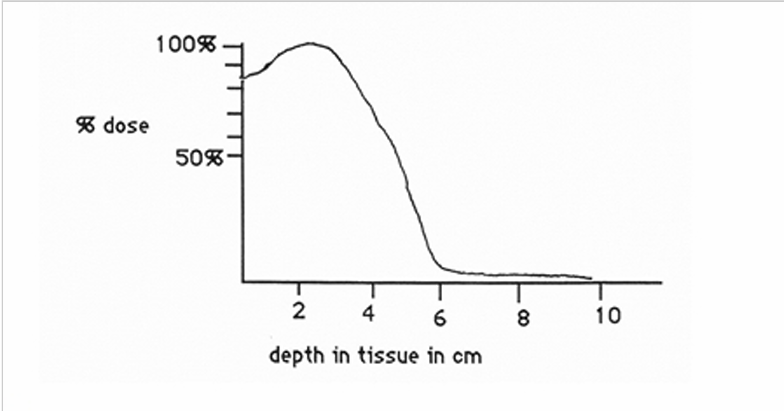
What is the electron beam energy of the beam showed on the following beam profile?
12 MeV
Practical Range = ½ Rule →
6 cm = Beam Energy/2→ Beam Energy = 6 × 2 = 12 MeV
Which of the following is an advantage of magnetically scanned electron beams? (list advantages and disadvantages instead
Advantage: Less Brems contamination (they have no scattering foil which creates some Brems x-ray contamination)
Disadvantage: much more complex
Actual patient doses for TSI techniques are most commonly verified using:
TLD
(you track doses in different parts of the body using TLDs)
TSI techniques are generally given with SSD's of about:`
400 cm (4 meters)
FYI: Techniques for TSI (2 of them)
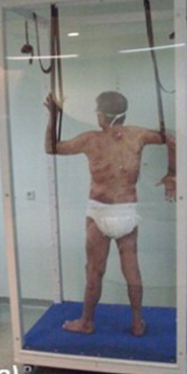
Translational Technique
Large Field Technique (more common)
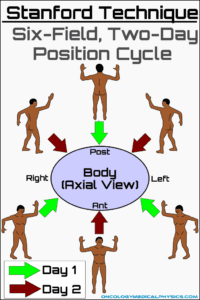
Stanford technique- 6 angles
Memorial Technique-4 angles
Multiple arc Technique
The TSI technique that utilizes only 4 treatment angles is:
Memorial
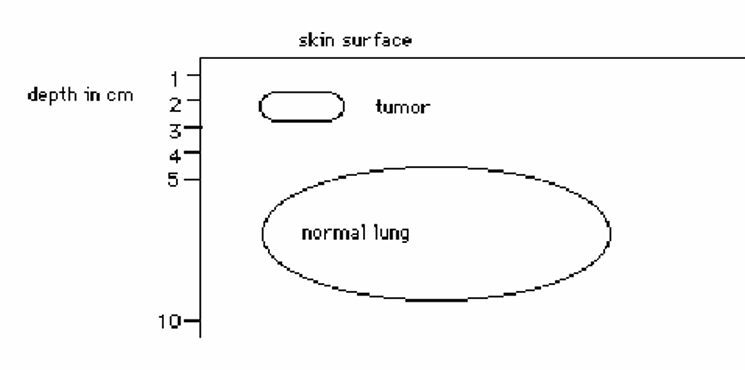
What electron beam energy would be appropriate for treating the following, providing adequate dose throughout the entire tumor volume:
Useful Range = 1/3 Rule
3 cm = Beam Energy / 3 → Beam E = 3×3 = 9 MeV
These angles in a typical TSI are usually how far apart in degrees?
60
FYI:
Typical TSI = Stanford Technique
Which is 6 fields are 60 degrees apart
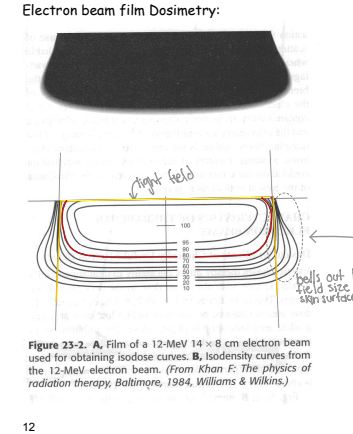
Film dosimetry is sometimes employed in electron beam dosimetry due to its:
convenience
FYI:
It is a fast way of getting the entire beam’s isodose summation, but it’s only good enough for a spot check
Electrons scattered with enough energy to cause further ionization and excitations in other atoms are called:
Delta Rays
The intersection point of the back projections along the most probable direction of electron motion defines what term related to electron beam therapy?
Virtual Source
FYI: the point where the electron beam starts scattering before reaching the scattering foil
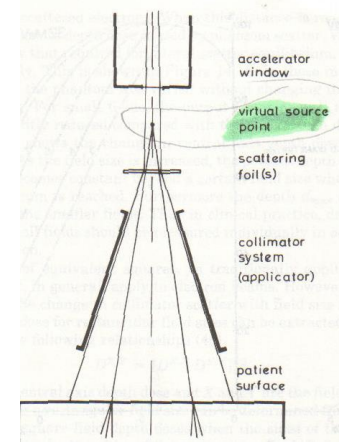
Electron beams start to ‘unravel’ and pull apart at what location?
A before the scattering foil but after the bending magnet (beam transport system)
B between the collimator system and the patients skin
C between the accelerator waveguide and the bending magnet
D between the collimator and the shadow tray
A before the scattering foil but after the bending magnet (beam transport system)
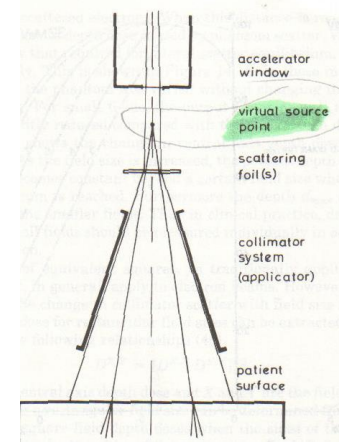
T / F Inverse square corrections are valid and useful for calculating dose rates for electron beams.
False: You can’t use a strict application of the inverse square corrections to calculate electron beam calcs
T / F Equivalent square formula is valid and useful for calculating doses for electron beams.
False
To degrade a 9 MeV electron-beam to 6 MeV, what thickness of tissue equivalent material would typically be required?
1.5 cm
FYI:
Mass Stopping Power 2 MeV/ cm
9MeV-6MeV = 3 MeV
3 MeV x 1cm/ 2 Mev = 1.5 cm
According to Khan, a plate of low Z# material that is used to reduce the energy of an electron beam is referred to as a beam______________________.
Beam decelerator (degrader)
Internal shielding with electron therapy can be used for tx of the lip, buccal mucosa and eyelid to protect normal structures beyond the target volume. For this shielding, a high Z# material should be used, which is coated by a ___________ material.
low z#
FYI:
low z# material, cuz it’s an electron absorber (it has more e-/gram)
wax coating
more commonly; dental acrylic
Electron arc therapy is useful for what body areas? 1. Chestwall; 2. TSI; 3. Ribs; 4. limbs
A 1,3
B 1,2,3
C 1,3,4
D 2,3,4
C 1,3,4
Electron arc is used for superficial curved surface:
chest wall
an entire limb (extremity)
What is the best available treatment for large chestwall sites?
Electron arc therapy
TSI is typically performed with what electron energy range (in MeV)?
2-9MeV
FYI: why such a high energy if we just wanna give dose to the skin? Cuz we degrade the beam by making the patient stand far away.
Conformal therapy (where the table moves during treatment) is used in TSI in this technique:
Translational
The most commonly used TSI technique, developed at a University in northern California, is called:
Stanford Technique
The Stanford technique utilizes how many different treatment angles?
6
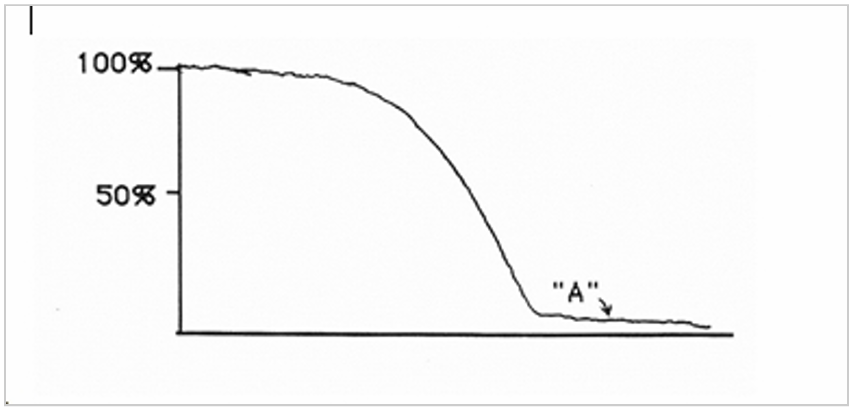
What is the approximate electron beam energy for the following beam profile?
20 MeV
FYI: cuz there is no buildup region at the surface skin dose is 100%
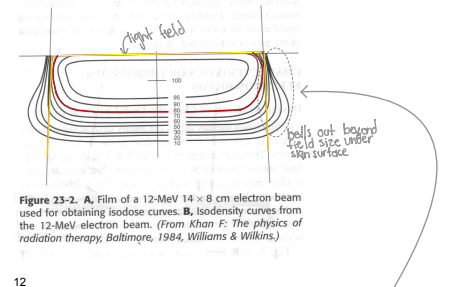
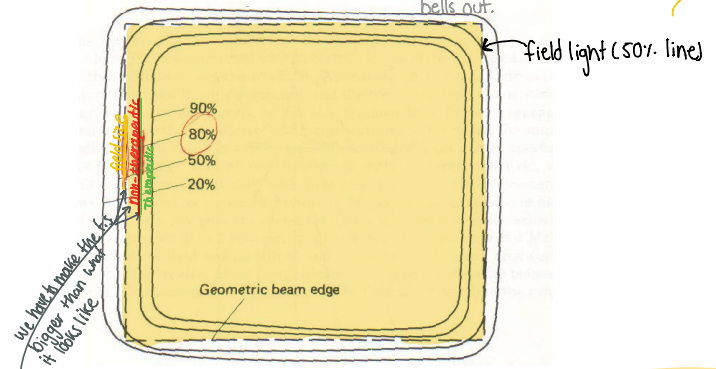
True/False: Fields for electron therapy should be set bigger than the lesion (plus normal margin) to be treated
True
FYI:
in order to adequately cover a surface area, you must make the field size bigger than it appears from the field light by a margin of 1 cm between the field light and the target volume
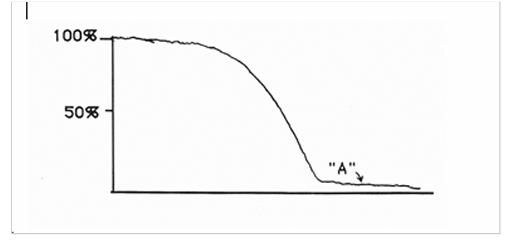
What is the name of the area labeled as “A”?
Brems Tail
What, exactly, does a Brems Trail represent?
Secondary x-ray contamination
FYI: Secondary x-ray production from the collimation system and the patient's tissue. It is undesirable.
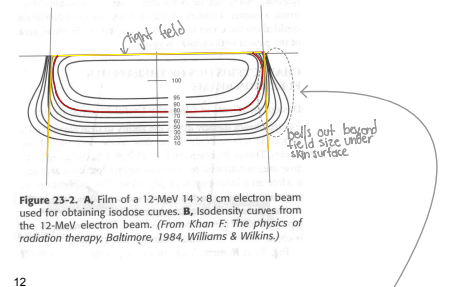
electron beam isodose curves generally form what shape?
Bell Shape
Name two areas of the body that would typically need "boosts" after total skin in radiation treatment (list the 4 instead)
bottoms of feet
Inframammary fold
Perineum
Skin Folds
PIS BF
List two uses of bolus in electron therapy, as described in class lecture
Tissue compensator
Increase surface (skin) dose (except for 20 MeV electron beam since dose is already 100% at the surface)
Decrease dose under the skin, protecting sensitive tissues
FYI: for #3, For someone with a very thin chest wall that is 1 cm deep, even using a 6MeV energy, 6 MeV is zero at 3 cm. Not good cuz you’d radiate the lung. So use 1 cm bolus so by the time it gets to the lung the dose is 0.
two reasons why the mass stopping power is greater for low Z number materials than for high Z number of materials
Lower z# = more electrons per gram
Greater z# = electrons are more tightly bound, (and therefore less available for interaction)
two diseases (spelled correctly) that are commonly treated with TSI
1. Mycosis fungoides
2. Cutaneous lymphoma
 Note
Note  Flashcards (88)