Chapter 7 - ECOSYSTEM CHANGES AND CONSERVATION STRATEGIES FOR BIODIVERSITY
 Call Kai
 Learn
Learn Practice Test
 Spaced Repetition
 Match
Match Flashcards
 Knowt Play
1/55

There's no tags or description
Looks like no tags are added yet.
Name | Mastery | Learn | Test | Matching | Spaced | Call with Kai |
|---|
No analytics yet
Send a link to your students to track their progress
56 Terms
phytophthora
a group of microorganisms that are important plant pathogens
renewable and non-renewable resources.
Conservation strategies that are used to maintain biodiversity can be classified into three types:
genetic, environmental and management strategies. The most important conservation strategies focus on population protection, growth and habitat.
Human activities
Human activities threaten biodiversity. Damage to ecosystems is a major global crisis because of the high rate of species being made extinct.
Urbanisation
Urbanisation is the extreme modification of an ecosystem by humans to support a human population of gradually increasing density; often, this happens as more people migrate to towns and cities from rural areas. Urban ecosystems have reduced biodiversity and are dominated by people. There is little recycling of matter between the community (the living things present) and the non-living surroundings. Additional inputs of energy and matter are needed from other ecosystems to maintain modern standards of living, especially in cities. There is an increase in output of gaseous and material wastes of many kinds, and these are disposed of into our atmosphere, onto the land and into the water of other ecosystems, which in turn are also altered.
Habitat fragmentation
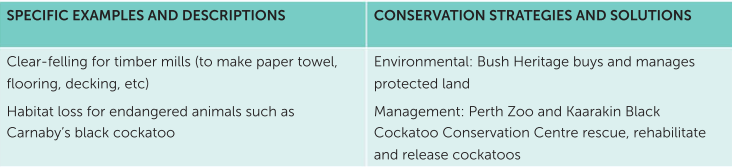
Habitat fragmentation occurs when some parts of the habitat of an ecosystem are separated into isolated sections. This can be a result of land clearing for agriculture, construction of roads, urbanisation or other human activities. Habitat fragmentation isolates groups of organisms that were once part of a larger population. The smaller subpopulations cannot interbreed; therefore, they cannot share their genetic biodiversity. When faced with adverse conditions in the environment, the smaller subpopulations no longer possess the resilience to adapt or survive, which can mean they die out and become locally extinct.
seed bank
A seed bank is a reservoir for plant genetic material, especially for species threatened with extinction. If a population or species did become extinct, seeds from the seed bank could be used to reintroduce it to its habitat.
Gene banks
Gene banks are a modern and important genetic strategy used for agricultural insurance. As diversity in crop species continues to drop, with farmers selectively breeding the best strains of crop only, the risk is that the rest of a species’ gene pool could be lost. To prevent the loss of genetic diversity, gene banks store seeds that contain the genetic material which may contain genes that will help species survive future changes in the environment.
Environmental conservation strategy: revegetation and bush corridors
Regeneration of land and bush corridors between isolated habitats can be an effective way of returning habitat to populations and enabling subpopulations to interbreed. As farmland is restored to bush, animals can once again move freely between populations, maintaining and increasing biodiversity. To achieve this goal, a team of people created a conservation action plan that included priority areas where focused protection of remaining habitats and restoration was needed. Eventually, three large national parks will be connected as one ecological strip. Already, over 6000 ha of land has been restored, mostly by planting in strategic locations. The environmental strategy’s main goal is to restore the ecosystems to a state where they can thrive and survive changes in the environment, independent of human intervention in the future; this will represent the restoration of resilience.
Management conservation strategy: protected areas and standards
The national recovery plan for Carnaby’s cockatoo outlines actions that are being taken to improve conservation of the species. These actions include:
• protecting important habitat, including feeding, breeding and non-breeding habitats
• regularly monitoring nest hollows and non-breeding factors (i.e. roost sites, feeding habitat), and using citizen science to count population numbers (the ‘Great Cocky Count’)
• conducting research into areas such as population demographics and health, movements and feeding, roosting behaviour, and modelling of climate change
• monitoring and managing the effects of car collisions, shooting, poaching and illegal habitat destruction
• promoting community awareness, understanding and involvement in conservation actions
• communicating with decision-makers to increase their understanding of conservation.
Management, environmental and genetic conservation
Genetic conservation strategies include storing seeds in a seed bank. Environmental conservation strategies include regenerating land and bush corridors between isolated habitats, to return habitat to populations and enable subpopulations to interbreed. Management conservation strategies include having rules governing human activities such as harvesting, research and use of certain species, so the negative impacts of such activities are minimised.
Soil structure
Past land clearance practices, the move to shallow-rooted pastoral grasses and the overuse of fertilisers that have affected soil organisms have all placed enormous pressures on the structure of the soil and the ability of the land to hold its topsoil. Farming practices that rely on large and heavy machinery for efficiency can add to the problem by compacting soil, as is evident when removal of topsoil by wind or water exposes the deep, hard ruts in paddocks. Modern agricultural practices can cause rapid changes to the abiotic components of the ecosystem, in turn rapidly changing the biotic components. If there is significant change or loss of topsoil, the ecosystem may be permanently changed. However, in recent years practices known as regenerative agriculture are beginning to be thoughtfully applied, leading to healthier nutrient recycling, increased biodiversity and more stable and resilient ecosystems. Such practices include preserving ground cover and soil stability, ground water management, land-use planning and grazing management; all of these practices reduce land and soil degradation.
Dryland salinity
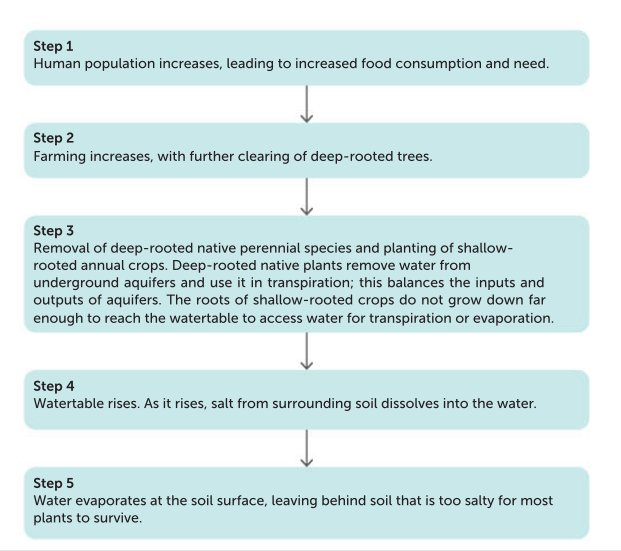
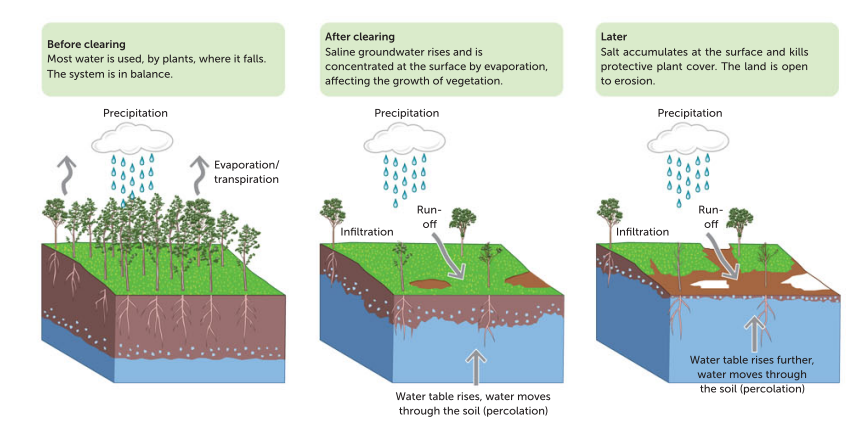
Dryland salination is the process of salts normally found under the surface of soil being transported to the soil surface by a rising watertable. In many agricultural areas of WA, the underlying reason behind the rising watertable is the removal of deep-rooted, perennial (longlived), usually native, vegetation. Salinity refers to the concentration of salt in the soil. If the concentration of salt in soil becomes too high, plants such as crops will no longer grow and the soil is infertile
Introduced species
Introduced species are species that have been moved by humans to new ecological regions where they lack natural predators, parasites and pathogens. They are described as invasive species or pests if they establish populations and outcompete native species.
The use of chemical pesticides (chemical control)
is a quick and effective method of getting rid of pests, but there is a downside: pesticides can be ecologically damaging as well as costly. Landowners in WA use baits to protect their animals, farms and agriculture from invasive species such as foxes, rabbits and feral pigs. 1080 and strychnine are the most common active ingredients in vertebrate pest bait. There is a code of practice for the safe use of poisons and baits.
Biological control
a biological control agent, is used to control the population of another (pest) species. Scientists now favour the use of such biological control agents, which exploit relationships between organisms, or an integrated approach (using two or more measures) when rapid response is needed in the early stages of a pest reaching a new area. The combined approach is also known as integrated pest management. It combines the use of biological measures with the use of chemicals limited to narrow-spectrum agents that target specific species.
Four kinds of biological control agents
1 general predators: a species that consumes a great variety of pest species; for example, ladybirds target aphids, caterpillars, mites and small beetles
2 specialised predators: a species that targets one pest species, such as dragonflies that target a species of mosquito, at all life stages
3 parasites: species such as wasps or flies that lay their eggs in the bodies of hosts; when the eggs hatch, the larvae feed on the body of the host (moths and caterpillars), causing the host’s death
4 microbial diseases: caused by bacteria, fungi and viruses that target particular species and cause death through illness; examples include the virus myxomatosis, which was introduced to Australia to control rabbit populations.
Chemical and Biological control
Chemical control of pests is effective but can be ecologically damaging and costly. Biological control is when a species is used to control the population of a pest species. It can only be used after field trials rule out any risks.
biological control must only
Scientists must take precautions before releasing a biological control into an ecosystem. Field trials must be conducted in an isolated area to discover any unexpected effects before wide release, especially to check the risk of the biological control species becoming a pest itself. To be released more widely, the biological control species must:
• only target the pest species and not impact on other populations
• decrease in number as the pest species decreases in number
• not compete with native species for a resource (e.g. food or habitat)
• be reproductively self-sustaining in the new environment.
culling
The thought of culling populations of particular species that are pushing their ecosystem beyond its carrying capacity is controversial. Populations of some species of kangaroos have increased and expanded enormously since European colonisation, which changed land use dramatically and affected many endemic species of plants and animals. The Australian red and grey kangaroos have thrived in areas where permanent water is made available for cattle. As populations of these kangaroos have increased, there has been increased competition for resources. Each year, more than 2 million kangaroos are culled under strict regulations. The kangaroo industry is worth more than $200 million each year. A small proportion of the meat is processed for human consumption, most of it for export. Culling has also been used to manage other invasive species, including camels and horses.
Reintroducing populations
Devastation of native populations has often followed from the invasion of introduced species. For example, Galaxias is a genus of native freshwater fish whose numbers have suffered since the introduction of the mosquitofish. Mosquitofish were introduced to Australia to reduce mosquitoes but in fact do very little to impact their numbers. The reduction in numbers of Galaxias has led to associated drops in the population numbers of native frogs and other aquatic species such as native insects. Galaxias do not lay eggs – they give birth to live young, which are easily devoured by the pest species. The numbers of Galaxias have dropped to such low levels that some wild populations are no longer self-sustaining. However, they are relatively easy to breed in captivity. To reintroduce Galaxias successfully to the wild, the mosquitofish must be eradicated or absent from the release area. Eradication is a difficult process, so currently the only means of introducing Galaxias back into the wild is through finding uninfested waterways or artificially created ponds that have no links with infested ponds, lakes, streams or rivers.
Unsustainable use
Unsustainable use of natural resources – using resources more quickly than they can naturally be restored – has a huge effect on biodiversity. For example, overharvesting means harvesting a species at a rate that exceeds the replenishing rate of the population. Organisms that have low reproductive rates, such as the African elephants (often poached for their ivory tusks), are especially vulnerable to overharvesting. This is because the sum of new individuals from births and immigration does not exceed the total individuals lost to death plus emigration. To combat this, conservation biologists have developed genetic tools and techniques to track the origin of elephant tusks. A genetic match between a tusk and a poached elephant can lead to criminal charges. Biotechnology (DNA fingerprinting) has helped conservationists and law enforcement teams in the US identify three major cartels that dominate the elephant ivory-smuggling market. Humans historically exploit resources for short-term profit. If the resource proves to be profitable, the harvester will develop more efficient ways of harvesting the resource, depleting reserves. This is currently a major issue in the fishing and logging industries. When demand is higher than supply, and the use of the resource is not controlled, resources become unsustainable.
Unsustainable use
Unsustainable use of natural resources means using resources more quickly than they can naturally be restored; for example, overharvesting means harvesting a species faster than the replenishment rate of the population. Unsustainable use of natural resources has a huge effect on biodiversity
Sustainability and fishing
The reduction in populations of these and other fish affects other species through disruptions to food chains. Penguins and seals, for example, now compete with the fishing industry for food. In the Southern Ocean, penguins account for 80% of the biomass of all sea birds, and birds are major predators on marine creatures that live in the surface layers. Tension exists between conserving penguins and sustaining fish yields.
Biomagnification
Biomagnification occurs when successively higher concentrations of non-biodegradable chemicals build up in the tissues of organisms in the higher trophic levels of a food chain. Human activities release many toxic chemicals into the environment. Organisms acquire toxins from their environment, along with nutrients and water. Some toxins are excreted; others are stored in tissue because the organism is unable to excrete or metabolise them. Often such substances are stored in fat cells. When these organisms are consumed, the chemical accumulates in the next trophic level, becoming more concentrated. This is repeated for each trophic level. Each trophic level needs to consume relatively large amounts of matter compared to the level below, leading to increasing concentrations of the chemical. DDT is an insecticide that was widely used in the 1900s to kill mosquitoes, in order to combat malaria. The persistence of DDT in the environment and the biomagnification of this compound through trophic levels has led to serious health effects in many organisms. In humans, studies have shown that DDT may be associated with higher incidences of cancer, infertility, miscarriage and diabetes. DDT has been linked to the population decline of bird species high on the food chain in the US, such as the bald eagle and peregrine falcon, because it causes affected individuals to produce thinner eggshells. Both species rebounded after the US put limits on the use of DDT in 1972.
Plastic
Large amounts of the world’s plastic rubbish enter waterways, where many aquatic animals sometimes mistake plastic for food. Turtles frequently ingest plastic bags, confusing them with their prey, jellyfish. Scientists have found at least 56 species of sea birds confuse fish eggs and crustaceans with polystyrene balls and plastic buoys. Animals such as seabirds can die from stomach or intestinal blockages from ingested plastic or from injuries received when pierced by sharp plastic. Plastic rubbish has been found in many groups of animals, ranging from whales, to sea turtles, to tiny crustaceans.
Climate
Climate is the average, long-term, predictable atmospheric weather conditions at a site over a period ranging from months to many thousands of years. Climate is made up of variables such as rainfall (precipitation), temperature, intensity of sunlight, and wind.
Weather
Weather is the atmospheric conditions in an area over a short time, usually 2–3 days. Weather forecasts or predictions can be very unreliable. Weather is not a gauge for climate change, because it is short term. Experiencing
Climate change
Climate change is a significant change in the global climate that can be identified by changes in the average and the variability of such features as temperature and precipitation, and that lasts for a long time, typically decades or longer.
Climate change
Climate change is a significant long-term change in global climate that includes changes in the average and variability of, for example, temperature and precipitation.
Evidence for global warming
Comparing past and present climates is the best way to find evidence for a change in climate. In lieu of being present to measure atmospheric conditions thousands of years ago, scientists are able to analyse samples from ancient ice cores extracted from polar ice. The layers of ice in the ice core contain bubbles of gas trapped long ago that reveal data about past carbon dioxide levels and temperature. As scientists measure variables in each layer, they compare these variables and track changes over relative time. The lower the layer, the earlier the time period. Scientists have been able to collect and analyse data from Antarctic ice cores to calculate estimates of average global temperatures and carbon dioxide levels spanning 400 000 years.
greenhouse gases
(gases that trap heat) are probably the most significant drivers of our climate. Climate variables affect the geographic distribution of organisms and therefore any significant change in climate has a significant effect on the biosphere. The human activities of burning fossil fuels and deforestation are increasing the concentrations of carbon dioxide and other greenhouse gases in the atmosphere. Greenhouse gases are released from natural The greenhouse effect Read the information and watch the video to reinforce your knowledge and understanding of the greenhouse effect and its link to temperature and climate change. sources (e.g. living things, volcanoes, fires) and industrial processes. They are gases that trap heat in Earth’s atmosphere. Greenhouse gases include the major gases carbon dioxide, nitrous oxide, water and methane, as well as industrial products such as perfluorocarbons, hydrofluorocarbons and sulfur hexafluoride
The greenhouse effect
The greenhouse effect is the insulating effect of these gases in the atmosphere. Incoming solar radiation is in the form of shortwave ultraviolet (UV) radiation and visible light. This radiation heats Earth and its atmosphere, and is re-emitted as long-wave, infrared radiation (heat) (Figure 7.28). The greenhouse gases trap and absorb some of the heat originating from the Sun, keeping Earth warm. The natural greenhouse effect is essential for maintaining Earth’s average global temperature within a range that is warm enough for life on Earth to survive.
enhanced greenhouse effect
The enhanced greenhouse effect is occurring because the concentrations of greenhouse gases have increased and too much heat is being retained. Human activities such as fossil fuel combustion, the release of methane and other gases from agricultural practices, and deforestation have increased the concentration of greenhouse gases in the atmosphere. It is the enhanced greenhouse effect that is causing an increase in average global temperatures.
Global warming
s the steady rise in global average temperature in recent decades, which experts believe is largely caused by human-generated greenhouse gas emissions. The long-term trend in global temperatures continues upwards.
Fossil fuels
Fossil fuels are natural energy sources, such as coal, oil and natural gas, which contain hydrocarbons (organic compounds). Fossil fuels are formed from fossilised living things, usually in sedimentary rock, over millions of years. They produce carbon dioxide when burned. They are burned for fuel and food to meet human demands, which are increasing as the human population increases. An alternative energy source that emits much less greenhouse gas is wind energy. Wind energy systems are found in a few areas of WA, such as the Coral Bay Wind-Diesel System.
Deforestation
is the permanent removal of standing forests and it can lead to significant levels of carbon dioxide emissions. Forests are cut or burned for human benefit; to clear land for agriculture and to make various products. Forests usually act as carbon sinks (they store carbon). When they are removed, the carbon dioxide that they would normally use for photosynthesis remains in the atmosphere. Intense wildfires can also remove forests and release carbon. Fires such as the Australian bushfires of 2019–20 have made scientists deeply concerned. With a hotter, drier climate in the future, intense bushfires may cause forests like the Amazon to become carbon sources instead of carbon sinks. Agriculture also contributes significantly to greenhouse gas emissions because it
The enhanced greenhouse effect
The enhanced greenhouse effect is when higher concentrations of greenhouse gases in the atmosphere cause excess heat to be retained, causing an increase in average global temperatures







Climate change in WA wetlands
Climate change is making large areas of WA hotter and drier. Many species and ecosystems are enduring abiotic conditions that are changing faster than they are able to adapt, increasing their risk of becoming endangered or extinct. Wetland ecosystems such as those in Perth are some of the most vulnerable to climate change, because higher temperatures and decreased rainfall cannot be tolerated by many wetland species. Wetlands are important because they can help reduce both the level of greenhouse gas emissions and the adverse effects of global warming. Some wetlands hold large stores of carbon; they are carbon sinks. Protecting them from damage and destruction can prevent the release of a significant store of greenhouse gases into the atmosphere. There is other evidence that WA animals are being affected by climate change. Birds such as the red-tailed tropicbird are expanding their range by flying further south because of changes in ocean temperatures and climate. Some migratory birds are arriving at feeding sites earlier in the season compared to a decade ago.












Habitat destruction: urbanisation, agriculture or landfill
Habitat fragmentation

Habitat degradation
