Approaches
 Call Kai
 Learn
Learn Practice Test
 Spaced Repetition
 Match
Match Flashcards
 Knowt Play
1/47

There's no tags or description
Looks like no tags are added yet.
Name | Mastery | Learn | Test | Matching | Spaced | Call with Kai | Chat |
|---|
No analytics yet
Send a link to your students to track their progress
48 Terms
Defining features of the behaviourist approach made by Pavlov and Skinner
Stimulus - response mechanism: behaviourists argue it is only possible to investigate what can be directly observed and measured (like a stimulus and its resulting behaviour response)
Rejection of internal mental processes = as mind cannot be directly observed, behaviourists say it is a black box, not suitable for scientific study
Environmental determinism = they argue behaviour is the result of experience and can be controlled by manipulating the environment
What is science?
Systematic = using a controlled method, gives researcher confidence they they measured what they planned to, make it easy to replicate
Objectivity = no bias in research improves reliability of outcome and conclusions
Empiricism = scientists must test their ideas and modify hypotheses
What did Freud contribute to history of psychology - after Wundt
Created psychodynamics
Developed concepts of unconscious mind
Structure of personality - id, ego superego
Psychosexual stages
What did behaviourist Pavlov and Skinner contribute to psychology? - after Freud
Considered mind is a black box, only behaviour could be measures objectives and scientifically
Explain behaviour as stimulus response mechanisms
Rejected introspective methods
What did Bandura contribute to psychology?
Agree with behaviourism but argued
There is mediational process: attention, retention, reproduction and motivation
Role models are observed and imitated
Outlines pavlova research into classical conditioning and the findings
Two stimuli = neutral stimulus that did not produce a response, and an unconditioned stimuli, food that naturally produced a response in dogs
Procedure = he paired the NS with US several times
Findings = dog began to salivate in response to NS, showed dog learned to associate NS with food
Outline skinner's research into operant conditioning
Learning by reinforcement
Skinner made boxes to give electric shock through cage wires, when animal pushed lever, shock stopped
Positive reinforcement = adding pleasant stimukus to encourage a desired behaviour
Negative reinforcement = removing unpleasant stimulus to encourage the behaviour
Describe the features of punishment, extinction and behaviour shaping in skinner’s operant conditioning
Positive punishment = discourage behaviour by adding an unpleasant stimulus
Negative punishment = removed pleasant strikes to discourage behaviour
Extinction = reinforcing consequences stop, animal stops doing the behaviour
Behaviours shaping = train animals to perform complex behaviours
What is congruence
Carl roger argued congruence is essential for self actualisation
Alignment between one perceived self and ones ideal self
When there is a gap between these 2 selves, person experiences incongruence and cant achieve self actualisation
Evaluate the behaviourist approach
Strengths
Scientific = studies stimulus - response mechanisms that establish cause and effect relationships
Highly controlled experiments, standardised procedure allow for replication
Practical application = counter conditioning techniques for classroom management
Weaknesses
Not generalisable to human behaviour as humans have greater intelligence than simple stimulus - response mechanisms
Behaviourist attempt to explain behaviour due to simplistic stimulus response is reductionist, as human behaviour like self sacrifice is too complex to describe as the result of reinforcement
Define features of social learning theory - Bandura
Observing others is a template for out actions
Vicarious reinforcement = we see someone rewarded for behaviour we are more likely to mimic it
Vicarious punishment = witnessing someone punished for an action makes us less likely to adopt that behaviour
Modelling = indivuals we observe are models, like family members and movie characters
Identification = not all models have same likelihood of being imitated, more likely to imitate models with similar characteristics, like age and gender or people we deem attractive or high status
What is a mediational factor SLT
Social learning theorists argued that human behaviour cant be fully understood without including cognitive processes that happen between stimuli and response
These are attention, retention, reproduction, motivation and MUST happen between observation a model perform a behaviour and imitating that behaviour
Describe the role of mediational factors in social learning theory
Attention = to learn from a model, individual must pay attention on behaviour of it
Retention = remembering the observed behaviours into memory
Reproduction = belief in the ability to replicate the behaviour demonstrated by model
Motivation = willingness to perform behaviour, which is influenced by expected out comes, like punishment / rewards
These processes explain why individuals don’t automatically mimic every behaviour they observe
Outline banduras research into SLT
Procedure = children aged 3 to 6 , divided into 2 groups
First group watched adult have physical and verbal aggression to the toy
Second group watched adult interact non - aggressively with toy
One way mirror recorded children’s physical and verbal behaviour
Findings = children exposed to aggressive model were aggressive themselves
Highlighted role of identification - boys more likely to mimic aggression after observing male model compared to female model
Evaluate the strengths and weakness of the social learning theory
Strength = supported by evidence, boob doll has high internal validity due to laboratory setting and environmental control, same room
Less reductionist approach, more detailed understanding of human behaviour and uses role of consciousness
Weaknesses = banduras researcj only showed short term learning: aggression may not be imitated months later
Bobo doll study relied on inference from behaviour of child participants
What is an internal mental process
How information is processed in the mind, including conscious and unconscious thoughts
Areas of research could be attention, perception and memory
Cannot be directly observed = so researchers have to use inference to make assumptions about the internal mental processes that produced the participants behaviour response
Strength and weakness of the cognitive approach
Strength
Scientific approach, due to highly controlled experiments so has high internal validity
Weaknesses
Relies on inference, so can be viewed as less scientific
What is a schema?
Mental frameworks, with basic knowledge built from previous experience with the world
Work as mental shortcuts = use them to understand interact with people / objects
What two things do schema help with?
Process environmental information = we can engage with world without being overwhelmed when we assign object to a schema
Predict future = because they are based on past experiences, they allow us to make assumptions about what people will do in similar situations
How do schemas cause problems?
They lead to inaccurate recall = assumptions can influence memory
Negative schema lead to poor mental health = think badly about themselves
Outline the use of computer model as an explanation of mental process
Operationalised of a CPU is similar to human brain conducting internal mental process
Suggests both systems receive input and generate output
Criticised for being machine reductionists = overly simplistic but human Brian is very complex
Outline the theoretical model as a explanation of mental processes
Flow chart representations of steps of mental process
Shows how short term memory can progress to long term memory
Generate testable hypotheses, so each assumption can be scientifically tested
Explain the emergence of cognitive emergence
Cognitive neuroscience examines neurological structures of brain linked to internal mental processes
Emergence = due to development of brain scanning techniques, researcher ask participant to do cognitive tasks can observe activity in different areas in brain
How has cognitive neuroscience been supported?
Tan could only say Tan due to speech production issues
After he died, autopsy showed damage in Broca’s area
Broca’s area activates in language production
Define the biological approach:
Behaviour is a result of biological structures and processes like hormonal and nervous system that influence human behaviour
What is the influence of biological structures on behaviour
Endocrine system has gland that release hormones
Fight or flight response = brain signals adrenal gland to release adrenaline, enchanted blood flow to to brain and muscles to prioritise reflexes and attention
Hormones =
Outline the influence of neurochemistry on behaviour
Neurotransmitters have many roles in influencing behaviour
Serotonin = well being and happiness
Dopamine = reward nuerotransmitter linked to pleasure
Noradrenaline related to attention
Describe what happens in the synapses
Presynaptic neuron contains neurotransmitters in vesicles
Electrical signal called action potential triggers release of neurotransmitters into synaptic cleft
Neurotransmitters bind to recorptis in post synaptic neuron
They can be excitatory, increasing the likelihood of new action potential or inhibitory, decreasing it
Outline the influence of genes on behaviour
Instructions / blueprints for how the brain forms and functions
Psychologists study genetic inheritance of behaviour with concordance rates, higher concordance rates among generically closer relatives suggests genetic influence
What are genotypes and phenotypes
Genotypes = genetic code in DNA for characteristics of organisms
Phenotype - physical expression of genotype
Genotypes and phenotype dont match, someone can have genotype to be talll, but be short as they didnt receive nutrition in childhood
Outline the relationship between evolution and behaviour
Darwins theory on natural selection argues that organism with traits that enhance survival are more likely to pass these advantageous characteristics to their offspring
They argue that innate behaviours with survival advantages are more common in further gernation species
E.g male aggression used for hunting
Strengths and weakness of biological approach
Strengths
Theories that argue that biological structure neurochemsity and genes influence behaviour are backed up by MRI scans
Practical application = develop drug therapies for OCD, depression
scientific = advanced tools like MRI scans
Weakness
Diathesis stress model, we inherit genetic vulnerability which is later triggered by a stressor, factors like childhood or trauma
Biological determinism = belief that actions are predetermined by biological factors is problematic - criminals could say they have a criminal gene
What is psychodynamics and the psychodynamic theory
Study of the unconscious mind and unconscious mental drives in childhood
Psychodynamic theory = the psyche (mind) is a complex system that consists of three distinct parts conscious, preconscious and the unconscious
Describe the role of the unconscious
Our behaviours are shaped by unresolved unconscious conflicts and experiences in psychosexual stages
Problems cause by this is fixation, where individual remains stuck in a particular stage and expresses negative personality traits
Projects the conscious mind from harmful traumatic memories and fears so reduces anxiety by using defence mechanisms
Describe the conscious, preconscious and the unconscious
Conscious = thoughts we are aware of snd can tall about (emotions and ideas)
Preconscious = not immediately accessible but can be brought into cosnouis awareness
Unconscious = Freud believed it was largest part of the mind, hold memories that are not accessible to awareness but influence behaviours and feelings - desires, repulses
Describe the ID part of the personality - psychodynamics
Newborn infant = psyche consists only of Id, selfish aspect of mind focused on satisfying personal needs
Operates on pleasure principle
Describe the ego part of personality - psychodynamics
18 months, begins to form
Conscious part of personality
Uses rational thinking to manage id demands
Individual is able to interact with world in more balanced manner
Describe the superego part of personality - psychodynamics
Age 3, child develops this unconscious component of their personality
Morality principle = influences behaviour by inducing guilt when actions conflict with strict standards
Moderates behaviour according to moral / social expectations
Outline the psychosexual stages of development - psychodynamics
(If a child is unable to resolve a stage, they will become fixated and this will alter their personality and may results in mental disorders)
Oral stage - 0-1 years, baby receives pleasure from breastfeeding, when weaning, baby learn it doesn’t control environment And develops delayed gratification
Fixation = immature personality
Anal stage = 1-3 years = child gets pleasure from holding on and expelling faeces
If parents are too strict with potty mistakes, this results in fixation = overly organised adult
Phallic stage = 3-5 years = libido (sexual drive) focused on gentians
Boys have Oedipus complex = sexual desire for mother and have castration anxiety, fear father find out and will removes his genitals
Boy realises eventually he compete with his father and imitate him, developing a male gender identity
Electra complex for girls
Latency stage = 6-12 years = sexual energy y(libido) is dispersed across body’s and desires from childhood are repressed into unconscious
Genital stage = puberty and sexual desire are conscious
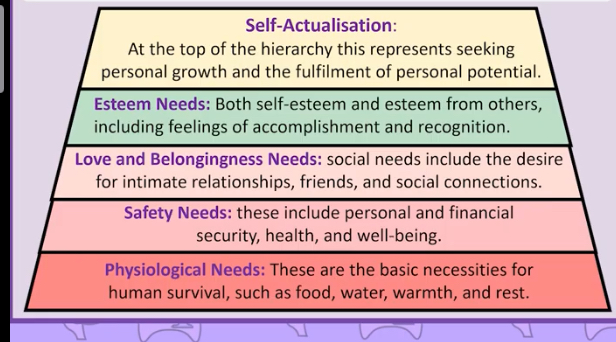
Outline Maslow hierarchy of needs
Sequence of human needs
Certain foundational needs must be met before you can achieve self actualisation
First - physiological needs = food, warmth, water
Safety = security, well being and health
Love = social needs, desire for connections and relationships
Esteem = self esteem and esteem from others
Self actualisation
Define term defence mechanism
Strategies involving unconscious mind that ego uses to manage unresolvable conflicts
These reuce conflict between id and superego
Gives examples of defence mechanisms
Denial = refusal to accept regality of situatio
Displacement = strong emotion is moved from the source and placed onto a substitute target
Repression = unpleasant mmeory is placed into unconscious mind and no longer accessible to conscious
Strengths and weakness of psychodynamic approach
Strength
It has practical application, psychoanalyst if therapy (talking therapy) many people have been treated, so it must be valid
Intuitive appeal = boys often have stronger attachment to mother, early trauma can influence anxiety
Weakness
Lack scientific credibility = he intercepted his clients memories, dreams
His theories and definitions were untestable nd lacked falsifiability
Define features of the humanistic approach
Reject scientific method - say tat human. Behaviour is too complex to study scientifically, which only test simple cause and effect relationships
Free will = say external causes dont set behaviours and we have personal agency
Holistic approach = include every factor
What does the humanistic focus focus on
Mental health = unlike other approaches stat focus on how mind malfunctions, they explore personal growth and self actualisation (humans achieving highestt potential and performing the best)
Non experimental methods, only case studies because they are rich in detail and dpeth of human experience
Outline the assumptions of self - actualisation
Highest level of psychological development, realising your full potential
Individual deeply understand themselves and their values and purpose in life
How to become congruent
Adopt more realistic ideal self = often, peoples ideal selves are shaped by conditions of worth, expectation from others that one must meet to earn their approval
Conditions of worth leads to ideal self that is unattainably perfect
Enhance perceived self = helped by receiving positive regard from others, like acceptance and love and support
Strengths and weakness of humanistic psychology/approach
Strengths
Captures complexity of human behaviour, e.g diathesis stress response, both environmental and biological elements interact
Practical application = client centred therapy, improve outcomes
Weaknesses
Non scientific due to reliance on case studies and non experimental method, lack of evidence
Culturally biased towards western cultures, emphasis self actualisation as personal success which contrasts collectivist value of cultures where group harmony is prioritised