11 Bio - Mod 1 (2)
 Call Kai
 Learn
Learn Practice Test
 Spaced Repetition
 Match
Match Flashcards
 Knowt Play
1/17

Earn XP
Description and Tags
Cell Function
Name | Mastery | Learn | Test | Matching | Spaced | Call with Kai |
|---|
No analytics yet
Send a link to your students to track their progress
18 Terms
Substances required by cells
Gases (oxygen, carbon dioxide), nutrients (sugars, glycerol, amino acids, fatty acids), water (main solvent) and mineral salts that are dissolved in water.
Waste in cells
Urea, uric acid and excess carbon dioxide are substances that must leave the cell as waste. Can also be secreted by the cell to coat the outside (mucus) or to pass onto other cells (hormones).
Permeability of molecules
The permeability of a molecule through the cell membrane depends on its size, electrical charge and lipid solubility. Smaller particles can move through easier. Hydrophilic (water-soluble) particles cannot penetrate, lipid-soluble molecules can, the tails of the lipids within the phospholipid bilayer enhance their movement. Neutrally-charged molecules have a high lipid solubility making them permeable. Water can enter through the tiny, hydrophilic pores called aquaporins by the process of osmosis.
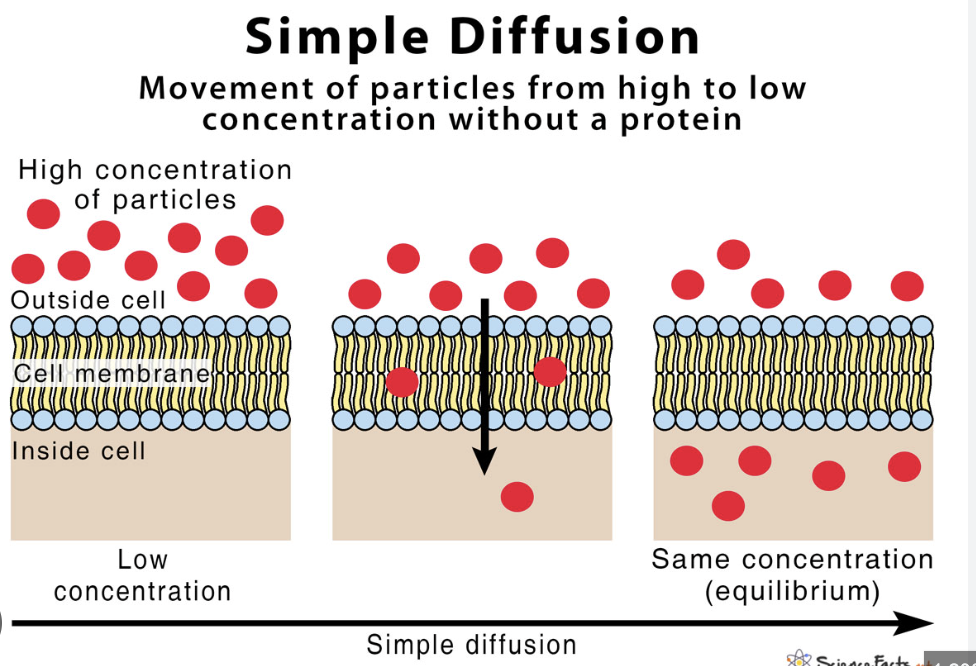
Diffusion
Diffusion is a passive movement (requires no energy) of materials in and out of cells. The movement of particles from an area of high to low concentration until an equilibrium is reached. The rate of diffusion depends on the concentration gradient. If there is a greater difference in the concentration of substances, the slope will be steeper and diffusion will occur faster. Heat increases the rate of diffusion as the kinetic energy of particles increases. e.g oxygen is used for respiration within the cell, which means its concentration is low inside the cell, promoting diffusion from the outside.
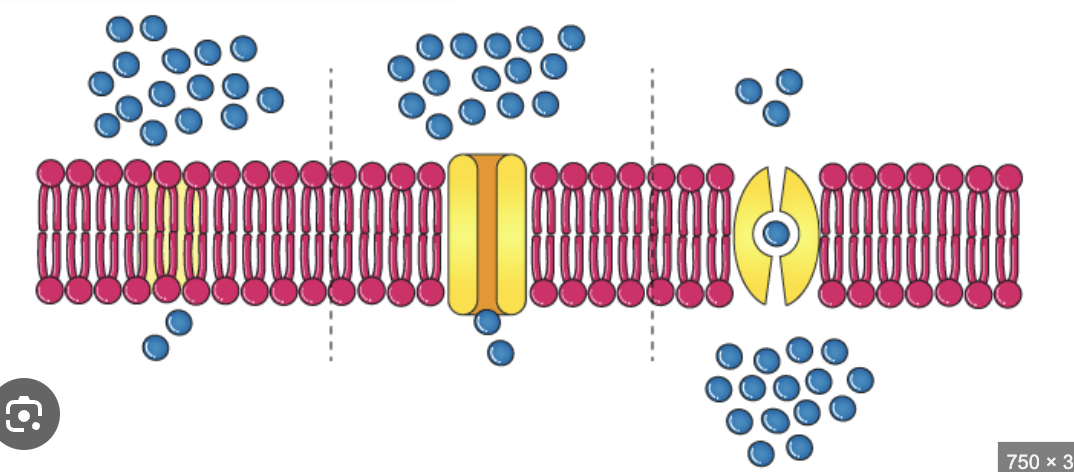
Facilitated diffusion
Large or charged particles require assistance to pass through the cell membrane. Require proteins known as carrier or channel proteins. For large particles, carrier proteins bind to one side of the membrane, change shape and then release the substance onto the other side, depending on the concentration gradient. For charged particles, channel proteins are used, these are particular for each ion.
Osmosis
The process in which water moves through the cell membrane, not through the lipid bilayer, but by through tiny protein channels known as aquaporins or water pores. When water enters the cell it swells up, when it leaves the cell it shrinks. The pressure created by water moving through the membrane is known as osmotic pressure. If the solute concentration of water is equal on both sides it is isotonic. When the higher concentration is the external solution it is hypotonic to the cell content and the water moves in, vice versa is known as hypertonic.
Osmosis - animal cells
The cells of unicellular eukaryotes are enveloped by one cell membrane. The cells are not exposed to the external environment but are surrounded by isotonic extracellular fluid, this means that cells can function efficiently because water diffuses equally in both directions, resulting in no movement of water. Water moving into an animal cell can cause the cell to swell, burst the cell membrane and eventually kill the organism. The water concentration needs to be kept constant within animal cells to help with biochemical reactions.
Osmosis - plant cells
Plant cells contain vacuoles which have cell sap, with a low concentration of water. When a hypotonic solution surrounds a plant cell, water molecules move into the vacuole. This causes the vacuole to swell, pushing the cell membrane against the cell wall. However the cell wall is tough and avoids bursting, it stretches until its maximum until no more water can enter, the cell is now known as turgid. Vice versa, the vacuole would shrink and cause the cell membrane to move away from the cell wall, known as plasmolysis.
Active transportation
The movement of particles from an area of low concentration to an area of high concentration, requiring an input of energy. It goes against the concentration gradient and requires a carrier protein which spans the membrane to actively move chemicals with the help of cellular energy.
Endocytosis
When a large molecule has to move into a cell, the cell membrane can change shape to surround the particle and then engulf it. If it is a solid particle, it is phagocytosis (cell-eating). If it is a fluid, it is pinocytosis (cell-drinking). e.g phagocytosis can occur when a unicellular amoeba feeds on a smaller organism. It sends out membrane projections, filled with cytoplasm, which when meet the prey form a vesicle which stores and transports the material. Fat droplets found in the small intestine move into the cell in the same way for pinocytosis.
Exocytosis
Specialised cells in animals and plants produce substances such as neurotransmitters, antibodies and enzymes that are required in other areas of the organism. These are contained in vesicles within the cell which are then transferred out of the cells into the external environment of the cells, known as exocytosis. A membrane-bound vesicle moves towards the cell membrane, fuses itself together then releasing its products outside of the cell, the vesicle membrane then becomes a part of the cell membrane. Cells also create waste products which are meant to be transferred outside.
Surface area : volume
The ratio of SA:V affects the movement of substances in and out of the cell membrane. The SA is the area of the surrounding cell membrane, V is the space taken up by the internal contents. A cell needs to have a large enough SA to supply its volume with nutrients and remove waste. Smaller cells have a larger surface area compared to volume, a higher SA:V. This allows for faster movement of substances and wastes between the surface of the cell and its centre. Vice versa, a large cell has a lower SA:V which means its efficiency decreases as it increases in size. When a cell reaches a size where it is no longer able to provide substances fast enough for its volume, it divides itself. Long, flat cells have a higher SA:V compared to spherical ones. Some cells have special features which increase its SA:V, e.g tiny hairs on the surface through which mineral and nutrients can be absorbed.
Inorganic substances
Inorganic substances are used as a source of stored energy in the cell and as building blocks from which cells and living tissue are created. These are part of the abiotic world and do not contain carbon or hydrogen in long chains. These include gases, minerals and water. e.g gases (oxygen, carbon dioxide) are used in photosynthesis and cellular respiration. Minerals are used for tissue and macromolecule synthesis, such as calcium in bones and iron in blood. Sodium and chlorine ions are used to ensure water balance as well as nerve, muscle cells and cell membrane functioning. Water is used as a solvent within the cell, it is also a medium in which all reactions take place.
Organic substances
Organic substances provide cells with nutrients including glucose, amino acids, fatty acids, vitamins and nucleotides. These are synthesised by living things, containing both hydrogen and carbon atoms. Every cell requires large organic molecules to maintain biochemical processes called biomacromolecules. There are four main types, separated by the their chemical composition: lipids, complex carbohydrates, proteins and nucleic acids. Living organisms which undergo photosynthesis absorb these nutrients from the soil or air. Organisms which do not undergo photosynthesis have to ingest food to obtain these substances.
Carbohydrates - organic substances
A group of organic molecules which are composed of carbon, hydrogen and oxygen (1:2:1). Carbohydrates can be classified as monosaccharides, disaccharides or polysaccharides depending on the number of monomers linked. A monomer is a building block which link together to form a long-chain known as a polymer. Monosaccharides are a source of ‘quick energy’ in cells, these consist of a single monomer. Disaccharides consist of two and polysaccharides consist of up to five to hundreds of monomers linked together. These are known as starch (stored energy in plant cells), cellulose (structural part of cell walls) and glycogen (stored energy in animal cells).
Lipids - organic substances
These contain may carbons and hydrogens however only a few oxygens. The fats and oils within cells are mainly composed of triglyceride molecules which are a form of stored energy in cells of plants and animals. It is made up of one molecule of glycerol (colourless, sweet alcohol) and three fatty acids which are attached to it. Lipids are used to store twice the amount of energy as carbohydrates, the structural component of membranes and hormones.
Proteins - organic substances
Elements such as carbon, hydrogen, oxygen, nitrogen and sulfur can combine and create amino acids, the building blocks of proteins. There are approximately 20 different types of amino acids which can create chains of up to 300 to form polypeptides. Proteins are made up of one or more polypeptide chain twisted into a distinct shape. DNA in the nucleus controls the sequence and arrangement of the amino acids and creates a relevant protein. Proteins are one of the structural components of tissue, cell membranes and cells, they combine with other macromolecules and form important parts of membrane or have important functional roles such as enzymes which control metabolic reactions.
Nucleic acids - organic substances
These are very large biomacromolecules that contain carbon, hydrogen, oxygen, nitrogen and phosphorous. The two main types of nucleic acid areDNA (deoxyribonucleic acid) and RNA (ribonucleic acid). DNA is a double-stranded molecule which stores information that controls the cell, found in the mitochondria, nucleus and chloroplast. RNA is mainly found in the cytoplasm, made of small blocks known as nucleotides which are made of sugar, phosphate and a base. Both contain adenine, guanine and cytosine, while DNA has thymine and RNA has uracil. DNA nucleotides are required for cell replication, RNA nucleotides are required for ribosome production so that proteins can be created.

