Genetics Exam 2
 Call Kai
 Learn
Learn Practice Test
 Spaced Repetition
 Match
Match Flashcards
 Knowt Play
1/134

There's no tags or description
Looks like no tags are added yet.
Name | Mastery | Learn | Test | Matching | Spaced | Call with Kai |
|---|
No analytics yet
Send a link to your students to track their progress
135 Terms
Central Dogma
DNA (DNA replication) - information is stored here
Transcription converts DNA into RNA - information is used by transcribing DNA to make RNA
Translation converts RNA into a protein
Eukaryotic DNA
Linear and organized into chromosomes; Tertiary structure (complex packaging of DNA - chromatin); Hierarchical folding of chromosome; Contains nucleosome (DNA wrapped around histone proteins)
DNA Structure
Two complementary and antiparallel nucleotide strands form a double helix
DNA Secondary Structure
Stable 3D structure; Watson and Crick’s helical structure
DNA Primary Structure
String of nucleotides joined together by phosphodiester linkages
The Human Genome is _____ Base Pairs in Length
3.2 billion
Nucleic Acids
Linear molecules made up of repeating subunits called nucleotides
Components of Nucleotides
Contain a nitrogenous base (purines and pyrimidines), phosphate group (negative charge), and either Ribose (RNA) or Deoxyribose (DNA)
Nucleotides are covalently linked together by ____
Phosphodiester Bonds (between 3’ OH and the phosphate group)
Deoxyribose
OH group on the 3’ carbon; Phosphate group on the 5’ carbon
Ribose
OH group on the 2’ and 3’ carbon; Phosphate group on the 5’ carbon
Adenosine Nucleoside
Ribose + Nitrogenous Base (no phosphate)
Adenosine Monophosphate (Nucleotide)
One phosphate group, Ribose, Nitrogenous Base
Adenosine Diphosphate (Nucleotide)
Two phosphates, Ribose, Nitrogenous Base
Adenosine Triphosphate (Nucleotide)
Three phosphate groups, Ribose, Nitrogenous Base
Nucleotides are linked in ____
Strands
dsDNA
Double stranded DNA; Two strands are not identical but are complimentary (A - T, G - C)
Complementary base pairs interact/bind to each other through ____
Hydrogen bonds; Hydrogen bonds are low energy and stabilize the molecule, but can also be disrupted by enzymes, or with the input of energy (ex. heat)
A and T have ___ hydrogen bonds between them
Two
G and C have ____ hydrogen bonds between them
Three
Antiparallel dsDNA
Polynucleotide strands run in opposite directions to each other; One side goes 5’ to 3’ while the other goes 3’ to 5’
One nucleotide is about ___ long
0.34nm
One complete turn is about ___ long
3.4nm
DNA’s double helix is about ___ wide
2nm
Two Types of Double Helix Models
Ball and stick model; Space-filling model
B DNA
Shape DNA takes in an aqueous environment; Double helix; What we know as DNA
Z DNA
Previously thought of as a rare form in desiccated organisms; Now seems to be in more places
4 Types of RNA Loops
Bulge loop, Internal loop, Multi-branched loop, Sternum loop
Structure of RNA Molecules
Almost always single-stranded (don’t have same stability as DNA); Finds complementary base pairing with itself to help stabilize it, which causes it to fold up, creating loops; Added hydroxyl group on every nucleotide (more reactive and unstable)
Nucleotides are synthesized in the ___ direction
5’ to 3’; Form bond between 3’ OH group and 5’ phosphate group and make a phosphodiester bond
Structure of a Transfer RNA
Many factors contribute to RNA’s tertiary structure; Base-pairing and base stacking within the RNA itself; Interactions with ions, small molecules, and large proteins
Genetic Material Criteria
Must contain information necessary to make an entire organism
Must be passed from parent to offspring (transmission)
Must be copied in order to be passed from parent to offspring (replication)
Must be capable of changes to account for known phenotypic variation in each species
In search of the genetic material, Griffith discovered the principle of ___
Transformation
Griffith
Isolated two strains of Strep. pneumoniae; One strain was virulent and had a polysaccharide coat that made colonies appear smooth; Virulent forms sometimes mutated into non-virulent forms and lost the coat, therefore appearing to be rough; When the Strep. was injected into mice, Rough / Non-virulent mice lived, and Smooth/Virulent mice died; In a mouse with heat that killed the smooth type, the mouse lived; In a mouse with heat that killed the smooth type mixed with rough type, the mouse died, and virulent bacteria was recovered in the autopsy
Avery, McCloud, and McCarty show ____ is DNA
Transforming principle; Showed that only DNA had the ability to transform
Hershey-Chase Experiment Basis
Confirmation that DNA is the genetic material; Bacteriophage T2 infects E.Coli and has a DNA genome with phosphorous, and a protein coat with sulfur;
Phage Life Cycle - Hershey and Chase
Phage attaches to E.Coli and injects its chromosome
Bacterial chromosome breaks down and phage chromosome replicates
Expression of phage genes produces phage structural components (proteins and DNA)
Progeny phage particles assemble
Bacterial wall lyses, releasing progeny phage
Isotope
Radioactive form of an element
Hershey-Chase Radioactive Labeling
Used this technique to track molecule of interest; Incorporated radioactive P in DNA and radioactive S in proteins
Hershey-Chase Experiment Findings
After centrifuging, 35S was found in empty viral coats, not bacterial cells, and new phages from cells had NO 35S; 32P was found in bacterial cells, not empty viral coats, and new phages WERE radioactive with 32P; DNA from infecting phages was passed on to progeny, NOT protein
Chargaff’s Rule
Found that the amounts of the 4 bases varied between species, but their ratios did not; A=T and C=G
Rosalind Franklin
Performed X-ray Diffraction on DNA Fibers; Diffraction pattern is interpreted using mathematical theory to provide information concerning the structure of a molecule
Watson and Crick
Discovered the 3D structure of DNA in 1953; Used existing data (including Franklin’s), molecular models, and knowledge of structural chemistry; Watson recognized an A could bond with a T and a G could bond with a C (this accounted for Chargaff’s rule)
Deoxyribonuleotide Triphosphates (dNTPs)
Essential building blocks and energy source for DNA
DNA Replication is ____
Semiconservative; Each strand of the DNA acts as a template to recreate the other strand through complementary base pairing
In DNA, one ____ is used to make two ____ of DNA
One double strand → Two identical strands
3 Models of DNA Replication
Conservative Model, Semiconservative Model (correct), and Dispersive Model
Conservative Model
Original strand acts as a template but an entirely new strand is made and the old strand remains intact; After the second round, the original strand is still used as a template, and the new strand is used as its own template to replicate (results in 1 old + 3 new)
Semiconservative Model
One strand is original and one is newly synthesized on both sides; After second round results in 2 half/half and 2 completely new
Dispersive Model
Old DNA would get broken up, act as a template to make new strands, and then would get “put back together”; Results in 4 half/half
In DNA Replication ____ is where we add a new nucleotide, and ____ is the building block
3’ OH, 3-phosphate group
Evidence that DNA is Semiconservative
Cells were first grown in media with heavy nitrogen (N15)
Cells were then grown in media with light nitrogen (N14)
Cells divided every 30 minutes
DNA was assessed with centrifugation to determine how much heavy and light nitrogen was in the DNA
There was one band of heavy nitrogen 15 and after letting bacteria grow (after 1 full found) all DNA was half heavy and half light because it was made with nitrogen 14 as well (half and half band)
After the second round, the half and half acted as a template, and light-only DNA started accumulating (equal amounts of half and half and just light bands)
Bacterial Chromosome Replication
Replication starts at the origin of replication; The replication fork is where the strands of DNA are separating; Replication occurs bidirectionally
DNA Helicase
Unwinds DNA and creates torsional strain
DNA Gyrase
Has topoisomerase activity; Called gyrase in bacteria and topoisomerase in eukaryotes; “Nips” the backbone and allows tension to unwind and reseals the backbone; Relieves torsional strain so DNA can continue replicating (without topoisomerase, DNA replication is stalled)
Single-Strand Binding Protein
Prevents DNA from re-annealing
DNA Ligase
Seals Okazaki fragments on the lagging strand and fixes breaks
Primase
Essential RNA polymerase enzyme that synthesizes short RNA primers on single-stranded DNA templates; Provides necessary 3’ OH group for DNA polymerase to initiate synthesis
DNA Polymerase can attach nucleotides only in the ___ direction
5’ to 3’
DNA Polymerase
Cannot initiate DNA synthesis by linking two nucleotides on a bare template strand; Needs a 3’OH (problem is overcome by RNA primers synthesized by primase); Two strands are anti-parallel and go in opposite directions (problem is overcome by synthesizing the new strands both toward and away from the replication fork)
Identifying Leading and Lagging Strands
Leading strand is synthesized towards the replication fork; Lagging strand is synthesized away from the replication fork
Primosome
Complex formed when DNA helicase and primase physically bind to each other; Physically associated with two DNA polymerase holoenzymes to form the replisome
DNA Polymerase Proofreading Function
Can identify a mismatched nucleotide and remove it from the daughter strand; Uses 3’ to 5’ exonuclease activity to digest the newly made strand until the mismatched nucleotide is removed; DNA synthesis then resumes in the 5’ to 3’ direction
Why is DNA replication fidelity high? (few mistakes are made)
Stability of base pairing
Structure of the DNA polymerase active site
Proofreading function of DNA polymerase
Replication of Eukaryotic Chromosomes
Similar to bacteria but more complex; Large linear chromosomes; Chromatin is tightly packed within nucleosomes; More complicated cell cycle regulation; Replication bubbles from multiple origins merge into completely replicated chromosomes
DNA Polymerases in Eukaryotes
Mammalian cells contain well over a dozen different DNA polymerases; Four have the primary function of replicating DNA (Alpha, Delta, Epsilon, and Gamma); Many are translesion-replicating polymerases
Translesion-Replicating Polymerases
Involved in the replication of damaged DNA; Can synthesize a complementary strand over the abnormal region
Alpha DNA Polymerase
Initiates DNA replication in conjunction with primase
Epsilon DNA Polymerase
Replication of the leading strand
Delta DNA Polymerase
Replication of the lagging strand
Gamma DNA Polymerase
Replication of mitochondrial DNA
Removal of an RNA Primer
Distinct from prokaryotic replication; Delta polymerase runs into a primer of adjacent Okazaki fragment and pushes a portion of primer into a short flap; Flap endonuclease then removes the primer; If the flap is too long, it is cleaved by DNA2 nuclease/helicase which cuts the long flap into a short flap; DNA ligase seals the two fragments
Telomeres
The complex of telomeric DNA sequences and bound proteins; Sequences consist of moderately repetitive tandem arrays (3’ overhang that is 12-16 nucleotides long); Typically consist of several G nucleotides and many T nucleotides; Linear eukaryotic chromosomes have telomeres at both ends
Replication Problem at Ends of Linear Chromosomes
At the 3’ ends of linear chromosomes, the end of the strand can’t be replicated because DNA Polymerases only synthesize DNA in the 5’ to 3’ direction and cannot initiate DNA synthesis on a bare DNA strand; The cell solves this problem by adding DNA sequences to the ends of telomeres through a mechanism catalyzed by telomerase
Telomerase Structure
Contains protein and RNA; The RNA is complementary to the DNA sequence found in the telomeric repeat, allowing the telomerase to bind to the 3’ overhang
Telomere Length in Cancer and Aging
Telomeres tend to shorten in actively dividing cells; Telomere DNA is about 8,000 base pairs at birth and can shorten to 1,500 base pairs in an elderly person; Cells become senescent when telomeres are short (lose their ability to divide); Insertion of highly active telomerase can block senescence; Cancer cells commonly carry mutations which increase activity of telomerase, which prevents telomere shortening and senescence (may be a target for anti-cancer drug treatments)
RNA Synthesis and Transport (steps)
All RNAs are synthesized in the nucleus; mRNA is exported to the cytoplasm and then translated into a protein
Central Dogma
Information is stored in DNA, that information is used when DNA is transcribed into RNA, and RNA is translated into a protein
Gene Expression
Using DNA to make a functional product (RNA or protein)
Regulatory Elements
Site for the binding of regulatory transcription factor proteins
Promoter
Site for RNA Polymerase binding; DNA sequences that “promote” gene expression; Direct the exact location for the initiation of transcription; Typically located just upstream of the site where transcription of a gene actually begins; Bases in a promoter sequence are numbered in relation to the transcriptional start site
Terminator
Signals the end of transcription
Codons
3-nucleotide sequences within the mRNA that specific particular amino acids
Template Strand
DNA strand actually transcribed/used as a template; Complementary to the RNA transcript
Coding Strand
Sense Strand/Non-template strand; Identical to RNA base sequence (except for the substitution of Uracil in RNA for Thymine in DNA)
Transcription - Initiation
Promoter functions as a recognition site for the transcription factors; The transcription factors enable RNA Polymerase to bind to the promoter; After binding, the DNA is denatured into an open transcription bubble
Transcription - Elongation/Synthesis of the RNA transcript
RNA polymerase slides along the DNA in an open complex to synthesize RNA
Transcription - Termination
A terminator is reached that causes RNA polymerase and the RNA transcript to dissociate from the DNA (in bacteria)
Are template strands all the same?
No; Each gene uses one DNA strand as a template, but the template strand used is not always the same
A ___ specifies the direction of transcription
Promoter; With regard to adjacent genes along a chromosome, some promoters direct transcription in one direction and others direct transcription in the opposite direction
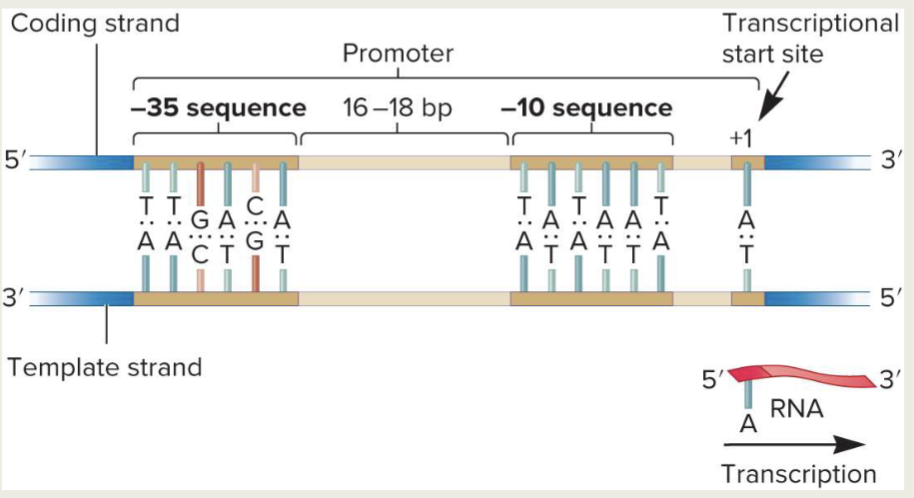
-35 and -10 Sequences
Promoters in bacteria vary at the -35 and -10 sequences
Consensus Sequence
The most common promoter sequence; Likely to result in a high level of transcription; Sequences that deviate from the consensus sequence typically result in lower levels of transcription
Core Promoter
Relatively short; Typically consists of the TATA box (a Transcriptional Start Site) and one or more downstream promoter elements (DPEs); TATA box is not always present, but it is important in determining the precise start point for transcription
Enhancers
Usually 50-1000 base pairs and contain one or more regulatory elements; Can vary widely in their locations but are often found in the -50 to -100 region
Regulatory Transcription Factors
Bind to regulatory elements and influence the rate of transcription; Activators stimulate transcription and Repressors inhibit transcription
Proteins Needed for Transcription in Eukaryotes
1, RNA Polymerase 2 (catalyzes linkage of nucleotides in the 5’ to 3’ direction)
Six different proteins called General Transcription Factors (GTFs)
A protein complex called the mediator
Preinitiation Complex
Formed by the general transcription factors, mediator, and RNA polymerase 2, which assemble at the promoter of a gene (often containing a TATA box)
Without enhancers, the core promoter produces ___
Basal transcription (a very low level of transcription)
RNA Transcript Synthesis (Elongation)
RNA polymerase slides along the DNA, creating an open complex as it moves; RNA Polymerase slides along the template in a 3’ to 5’ direction, and synthesizes RNA in a 5’ to 3’ direction using nucleoside triphosphates as precursors
RNA Polymerase 1
Transcribes all rRNA genes (Except for the 5S rRNA)

