Eco Evo 3
 Call Kai
 Learn
Learn Practice Test
 Spaced Repetition
 Match
Match Flashcards
 Knowt Play
1/256

There's no tags or description
Looks like no tags are added yet.
Name | Mastery | Learn | Test | Matching | Spaced | Call with Kai |
|---|
No analytics yet
Send a link to your students to track their progress
257 Terms
What are life history traits?
The timing and allocation of resources to growth, maintenance, and reproduction throughout an organism’s life.
delete
delete
Why are life history traits under strong natural selection?
They directly influence an organism’s fitness by affecting survival and reproduction.
What are the three main categories of energy allocation in organisms?
Growth, maintenance which supports survival, and reproduction.
What does the principle “there is no free lunch” mean in life history theory?
Energy is limited, so investing more in one function such as reproduction reduces the energy available for other functions like growth or survival.
What is a life history trade-off?
Occurs when an increase in one trait leads to a decrease in another due to limited resources.
What is semelparity?
A life history strategy in which an organism reproduces only once and then dies.
What is iteroparity?
A life history strategy in which an organism reproduces multiple times over its lifetime.
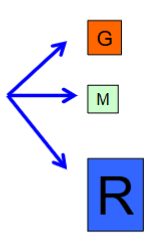
What is an example of a semelparous organism?
Salmon
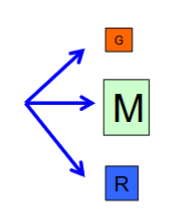
What is an example of an iteroparous organism?
Bristlecone pine
How do annual plants typically allocate energy to reproduction?
They allocate a large proportion of their energy to reproduction in a single event, often producing large, showy flowers to attract pollinators.
How do perennial plants differ from annual plants in energy allocation?
They allocate energy more gradually across multiple reproductive events, investing less per event but surviving longer.
What is the reproduction-survival trade-off?
It describes how investing more energy in reproduction can reduce an organism’s survival.
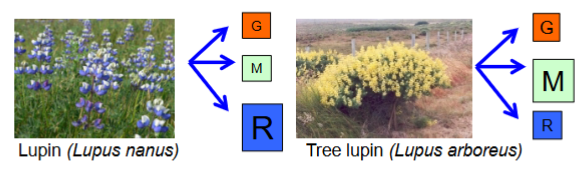
In the lupin example, how does energy allocation differ between semelparous and iteroparous species?
The semelparous lupin allocates a much higher percentage of energy to seeds in a single event, while the iteroparous species allocates less energy per year but survives to reproduce again.
What is pleiotropy?
A single gene affects multiple traits.
If a mutation increases clutch size (the total set of eggs laid by a female bird during a single nesting attempt) in birds, what other traits might be affected?
It can lead to smaller offspring, reduced survival of offspring, lower adult survival, and reduced future reproduction.
What is the offspring quantity versus quality trade-off?
Producing many small offspring with lower survival chances versus fewer large offspring with higher survival chances.
What is the current versus future reproduction trade-off?
Investing heavily in reproduction now reduces the ability to survive and reproduce in the future.
What is the trade-off between age and size at maturity?
Organisms can reproduce early at a smaller size to reduce the risk of dying before reproduction, or delay reproduction to grow larger and potentially produce more offspring.
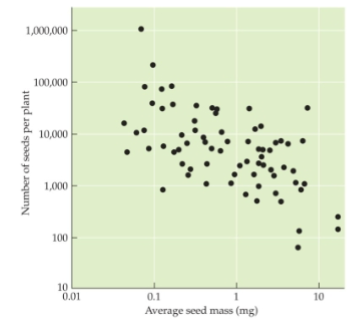
In the seed size vs. number graph, which plants invest the most in reproduction?
Plants of all seed sizes invest approximately equally in reproduction because there is a trade-off between seed size and number that balances total reproductive investment.
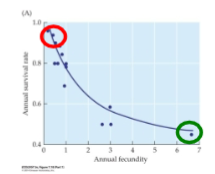
What is the relationship between number of eggs per year and survival in birds?
There is a negative correlation between the number of eggs produced per year and the probability of survival.
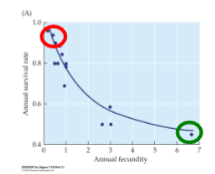
Why do albatrosses produce fewer eggs than sparrows each year?
They invest more in survival and long lifespan, whereas sparrows invest in producing many offspring due to lower survival.
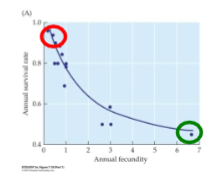
How does lifetime reproductive output compare between albatrosses and sparrows?
Albatrosses and sparrows produce approximately the same number of eggs over their lifetimes because albatrosses reproduce over many years while sparrows reproduce quickly over a short lifespan.
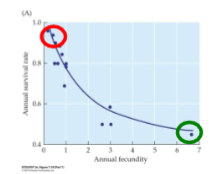
What does the bird graph demonstrate about life history strategies?
Different strategies can result in similar lifetime fitness due to trade-offs between survival and reproduction.
Why is correlation alone insufficient to prove life history trade-offs?
It does not establish causation, so experimental evidence is needed to confirm that trade-offs are driven by natural selection.
What was the main question of the guppy transplant experiment?
Whether differences in life history traits were caused by predation pressure.
What was done in the guppy transplant experiment?
Researchers moved guppies from high-predation environments to predator-free environments and observed them over time.
What happened to guppies in low-predation environments in nature in the guppy transplant experiment?
In low-predation environments, guppies evolved to produce fewer offspring that were larger in size.
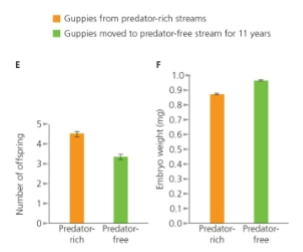
What were the results of the guppy transplant experiment?
The transplanted guppies evolved to match natural low-predation populations by producing fewer and larger offspring.
What does the guppy transplant experiment demonstrate about evolution?
Predation pressure can drive rapid evolution of life history traits.
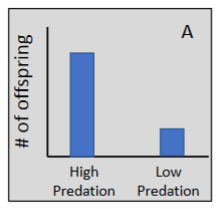
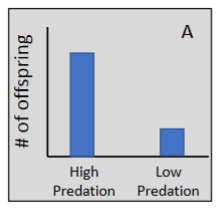
In the guppy graphs, how does predation level affect the number of offspring?
Higher predation leads to more offspring being produced, while lower predation leads to fewer offspring.
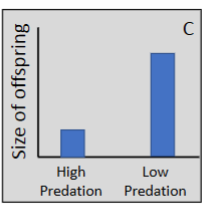
In the guppy graphs, how does predation level affect offspring size?
Higher predation leads to smaller offspring, while lower predation leads to larger offspring.
Why might high predation favor producing many small offspring?
The likelihood of survival is low, so producing more increases the chance that some survive.
Why might low predation favor producing fewer large offspring?
Survival is higher, so investing more in each offspring increases their success.
free
free
Why do life history strategies vary across environments?
Different environmental conditions, such as predation or resource availability, create different selective pressures.
What is senescence?
The deterioration of biological function with age.
Why is it surprising that organisms are not immortal from an evolutionary perspective?
Natural selection should favor traits that increase survival and reproduction, so longer lifespan would seem advantageous unless constrained by trade-offs.
What is the main life history explanation for why organisms are not immortal?
Energy is allocated to reproduction and other functions, which reduces investment in maintenance and leads to aging and death.
How is lifespan related to energy allocation?
It’s related to how much energy is allocated to maintenance, with greater investment in maintenance generally leading to longer lifespan.
Why do bristlecone pines show little to no senescence?
They invest heavily in maintenance and grow very slowly, allowing them to maintain function for thousands of years.
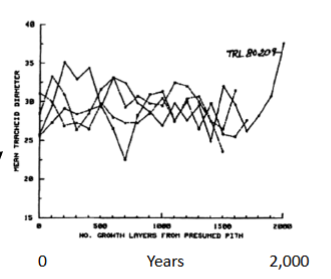
What does the graph demonstrate about bristlecone pines?
Bristlecone pines do not exhibit a decline in function over time, indicating little or no senescence even over thousands of years.
Why is the idea that organisms die “for the good of the species” incorrect?
Natural selection acts on individuals, not for the benefit of the species, so traits that increase individual fitness are favored.
What trade-off explains senescence according to life history theory?
A trade-off between reproduction and maintenance, where investing more in reproduction reduces investment in repair and survival.
Who conducted the fruit fly lifespan experiment testing reproduction vs. maintenance trade-offs?
Dame Linda Partridge
What was the design of the fruit fly experiment?
Male fruit flies were placed with either virgin females, which encouraged high reproductive effort, or previously mated females, which reduced reproductive effort.
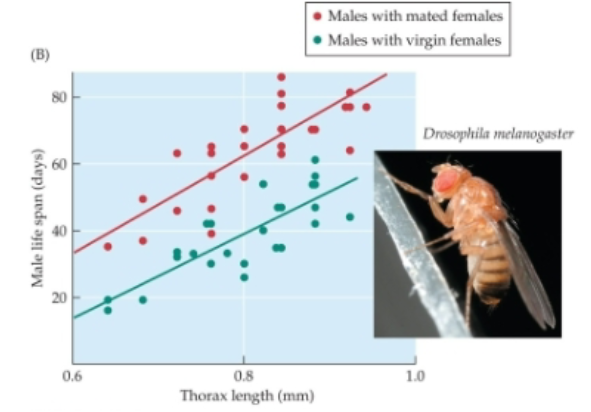
What is the prediction based on the reproduction-maintenance trade-off?
Males paired with virgin females are expected to have shorter lifespans than males paired with previously mated females because they invest more energy in reproduction.
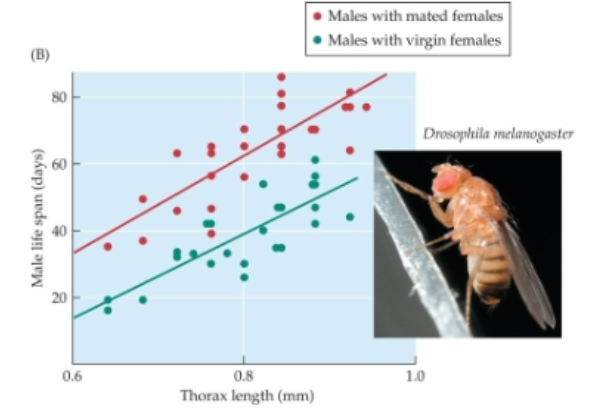
What variable had to be controlled in the experiment?
Body size measured as thorax length had to be controlled because larger males naturally tend to live longer.
What result in the fruit fly experiment demonstrates the reproduction-maintenance trade-off?
Males investing more in reproduction have consistently lower lifespan values.
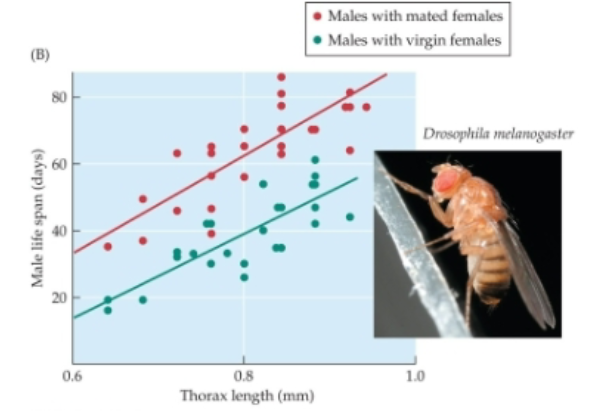
What is the main takeaway from the fruit fly experiment?
Increasing reproductive effort reduces lifespan, providing direct evidence of a trade-off between reproduction and maintenance.
How does caloric restriction affect lifespan?
It increases lifespan by reducing insulin signaling and shifting energy toward maintenance rather than reproduction.
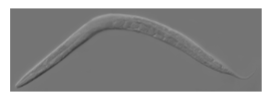
What organism is commonly used as a model for aging studies?
Caenorhabditis elegans
What does the daf-2 gene do in C. elegans?
It encodes a receptor similar to the insulin receptor and plays a role in regulating lifespan.
What happens when the daf-2 gene is mutated?
It can dramatically increase lifespan, sometimes doubling or even increasing it fivefold under certain conditions.
Why are daf-2 mutants not common in nature?
They have reduced early-life reproduction, which lowers their overall fitness despite longer lifespan
What does the daf-2 example demonstrate about evolution?
Natural selection favors traits that increase early reproduction, even if they reduce lifespan.
What is antagonistic pleiotropy?
It occurs when a single allele has beneficial effects early in life but harmful effects later in life.
How does antagonistic pleiotropy explain aging?
It suggests that genes that improve early-life reproduction are favored even if they cause deterioration or disease later in life.
What are some examples of antagonistic pleiotropy in human disease?
Genes associated with Alzheimer’s or cancer that may increase reproductive success earlier in life but cause disease later.
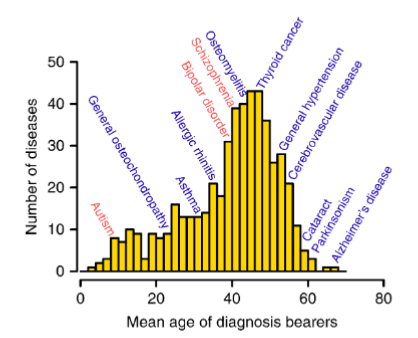
What is the relationship between age of onset and strength of selection?
Selection is strongest against diseases that occur early in life and weakest against diseases that occur after reproduction.
Why is selection weak against late-onset diseases?
These diseases occur after reproduction, so they do not significantly affect an individual’s fitness.
What is the mutation-accumulation hypothesis?
Harmful mutations that affect individuals later in life accumulate because natural selection is weak against them.
How does mutation accumulation explain aging?
The result of accumulated late-acting harmful mutations that are not effectively removed by natural selection.
How do antagonistic pleiotropy and mutation accumulation differ?
Antagonistic pleiotropy involves genes with both beneficial and harmful effects, while mutation accumulation involves genes that are only harmful but expressed late in life.
Can both antagonistic pleiotropy and mutation accumulation theories explain aging simultaneously?
Yes, both mechanisms can operate together and are not mutually exclusive.
What is menopause in humans?
The cessation of reproduction in females, typically occurring around age 51 in humans.
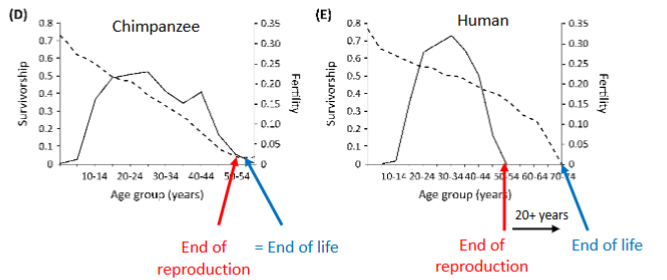
What is the key difference between humans and chimpanzees?
Humans have a long post-reproductive lifespan, while chimpanzees reproduce until near the end of life.
What is the average post-reproductive lifespan in humans?
20 to 30 years
Which species are known to exhibit menopause?
Humans and certain whale species such as killer whales, belugas, narwhals, and pilot whales.
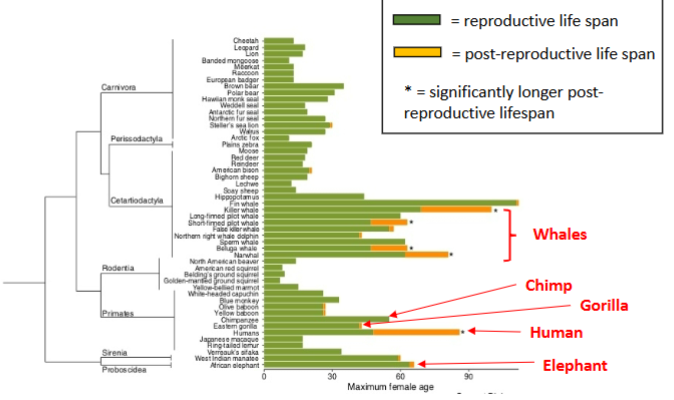
What pattern is shown about species with menopause?
They tend to have a significant post-reproductive lifespan compared to closely related species without menopause.
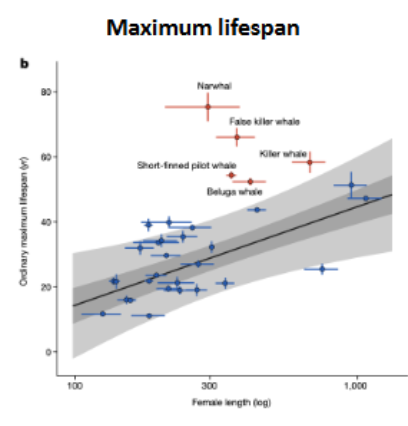
How do species with menopause differ from others?
They have longer lifespans than expected for their body size.
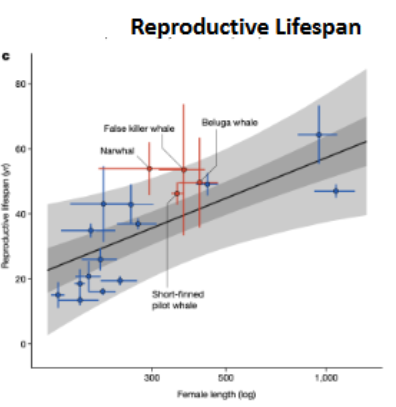
What does this graph show?
Species with menopause have similar reproductive lifespans to other species, meaning their longer total lifespan is due to extended post-reproductive life.
What does the menopause data suggest about life history evolution?
Extended post-reproductive lifespan may provide indirect fitness benefits, such as helping relatives survive and reproduce.
True or False: Recombination can create new beneficial alleles.
False
Which gender experiences stronger sexual selection?
The gender that exhibits greater variance in reproductive success experiences stronger sexual selection.
Why is “the more competitive sex” not the correct answer for sexual selection?
It’s a consequence rather than the underlying cause.
True or False: Males experience stronger sexual selection because they are larger.
False
What defines a monophyletic group?
They include a common ancestor and all of its descendants.
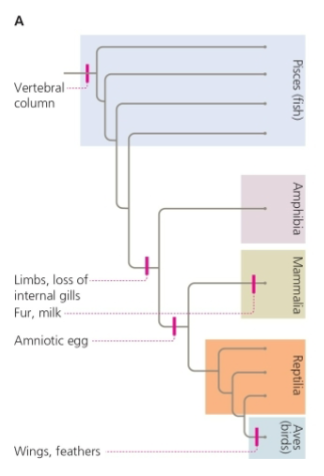
Which group is NOT monophyletic?
Reptiles are not monophyletic because they exclude birds, which share the same common ancestor.
Why is menopause considered an evolutionary puzzle?
It ends reproduction while individuals continue to live for many years, seemingly reducing reproductive output.
delete
delete
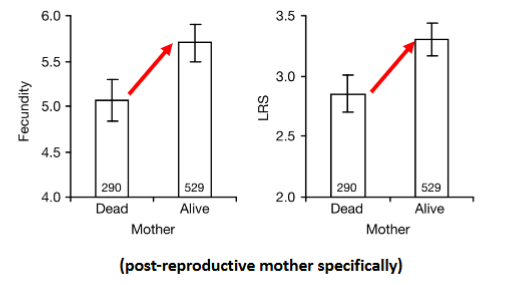
What was the main conclusion of Ladenperä et al. (2004)?
Post-reproductive females increase the reproductive success of their descendants, supporting the grandmother hypothesis.
How do post-reproductive mothers affect fecundity?
Individuals have more children when a post-reproductive mother is alive.
How do post-reproductive mothers affect lifetime reproductive success?
Families successfully raise more offspring to reproductive age when a post-reproductive mother is present.
How does the presence of a post-reproductive mother affect age at first reproduction?
Individuals tend to reproduce earlier when a post-reproductive mother is alive.
Why is the grandmother hypothesis not just due to modern medicine?
The supporting data comes from historical populations before modern medicine, indicating the effect is evolutionary.
What is the grandmother hypothesis?
Selection favors menopause because post-reproductive females increase the survival and reproduction of their grandchildren
What is unique about killer whale social structure?
Killer whales live in tight-knit pods where both males and females remain with their natal group.
Why is low dispersal important in killer whales?
It increases relatedness within the group, making helping relatives more beneficial for inclusive fitness.
What role do post-reproductive female killer whales play?
They often act as leaders and contribute important knowledge to the group.
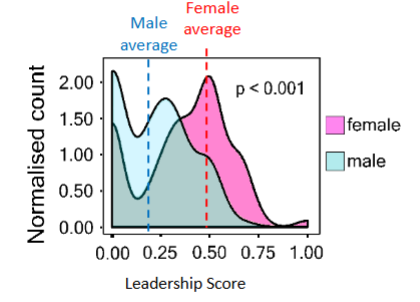
What does the graph show?
Females lead more than males, and post-reproductive females lead more than reproductive females.
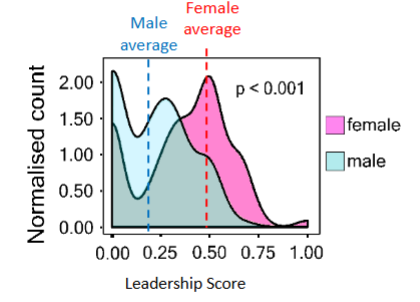
What does this leadership pattern suggest?
Older females provide important ecological knowledge that benefits the group.
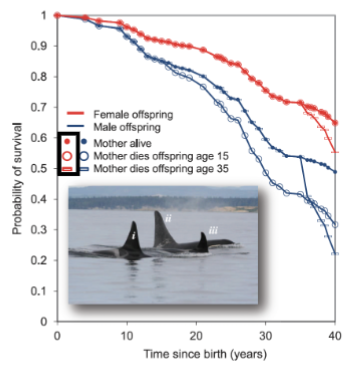
What is the effect of male survival after losing a mother?
Male survival decreases significantly when their mother dies, especially at older ages.
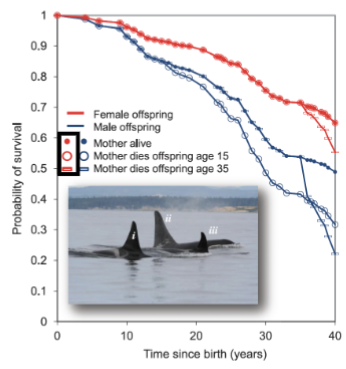
At what age does losing a mother have a strong effect on male survival?
Around age 35 causes a sharp decline.
How does losing a mother at a younger age affect males?
It reduces survival, though the pattern differs from losing an older mother.
How does maternal loss affect daughters?
The effect is weaker but still present, especially later in life.
True or False: Losing an older mother is worse than losing a young mother.
True
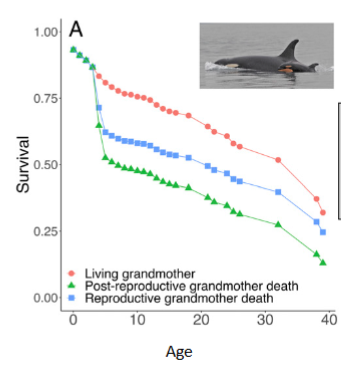
What is shown?
Offspring survival is higher when a grandmother is present.
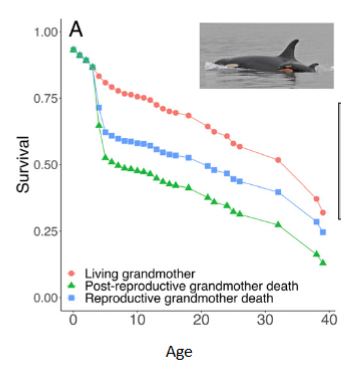
What happens when a grandmother dies?
Survival of offspring declines sharply.
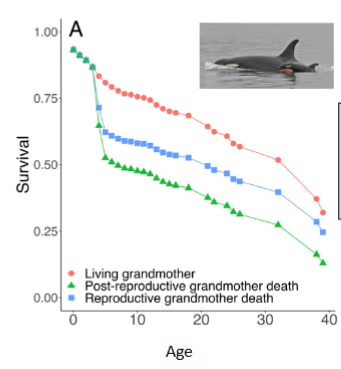
Is losing an older grandmother worse than losing a younger one?
Yes, losing an older grandmother results in a larger decline in survival.
Explore top notes

Explore top flashcards
