QnA - Human Eye
 Studied by 0 people
 Call Kai
 Learn
Learn Practice Test
 Spaced Repetition
 Match
Match Flashcards
 Knowt Play
1/9

There's no tags or description
Looks like no tags are added yet.
Name | Mastery | Learn | Test | Matching | Spaced | Call with Kai |
|---|
No analytics yet
Send a link to your students to track their progress
10 Terms

They are point-sized sources. Atmospheric refraction causes the path of light to vary slightly, and the amount of light entering the eye flickers, causing twinkling.
Planets: They are extended sources (collection of points). The twinkling effect from different points cancels out, resulting in a steady average brightness.
To see nearby objects, the ciliary muscles contract, increasing the curvature (thickness) of the lens. This decreases the focal length to focus the image on the retina.

11. (a) Power of Accommodation: The ability of the eye lens to adjust its focal length to see both near and distant objects clearly.
(b) Scattering:
Blue Sky: Fine atmospheric particles scatter short wavelengths (blue) more strongly.
Red Sunrise: At sunrise, light travels a longer distance through the atmosphere. Blue light is scattered away, leaving mostly longer wavelengths (red/orange) to reach our eyes.
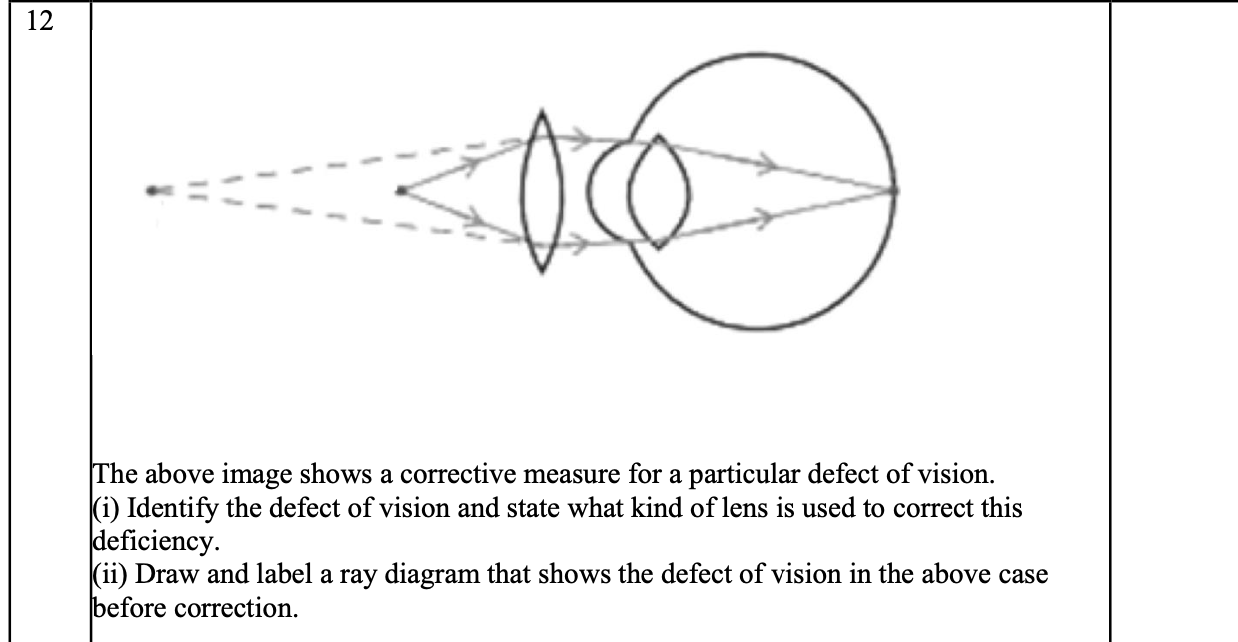
It is a convex lens and the defect is hypermetropia
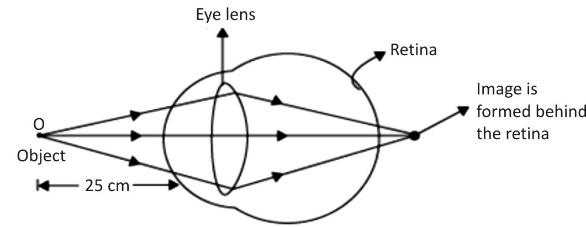

Advanced Sunrise: Atmospheric refraction bends light from the sun below the horizon, making it visible about 2 mins before actual sunrise.
1. Twinkling of Stars
Stars twinkle due to atmospheric refraction. Since stars are distant point-sized sources, their light passes through shifting atmospheric layers with changing densities. This causes the path of light to fluctuate, making the star's apparent position shake and its brightness flicker (appear bright then dim) to our eyes.
2. Delayed Sunset
Delayed sunset is caused by atmospheric refraction. Air layers near the earth are denser than those above. When sunlight enters the atmosphere, it bends downwards. This makes the Sun visible to us for about 2 minutes even after it has actually dipped below the horizon.

i) Dispersion: Splitting of white light into its constituent seven coluors.
(ii) Condition: Happens when light passes through a medium where refractive index depends on wavelength (like a prism).
(iii) Presbyopia Cause: Gradual weakening of ciliary muscles and diminishing flexibility of the eye lens due to aging.
16. Rupal's Case (Myopia & Cataract):
(a) Image formation: In front of the retina.
(b) Lens: Concave lens.
(c) Disadvantage of artificial lens: The fixed focal length lens leads to a loss of power of accommodation. She cannot adjust focus for different distances naturally.
(d) Parts: (i) Ciliary muscles (ii) Cornea (iii) Pupil (iv) Retina.

Cornea: Refracts light entering the eye.
Iris: Controls the size of the pupil.
Lens: Focuses light on the retina.
Ciliary Muscles: Adjust focal length of lens.
Retina: Screen capturing image; contains light-sensitive cells (rods/cones).
(b) Old Age Defect: Presbyopia. Corrected using Bifocal lenses (upper concave for distance, lower convex for reading).
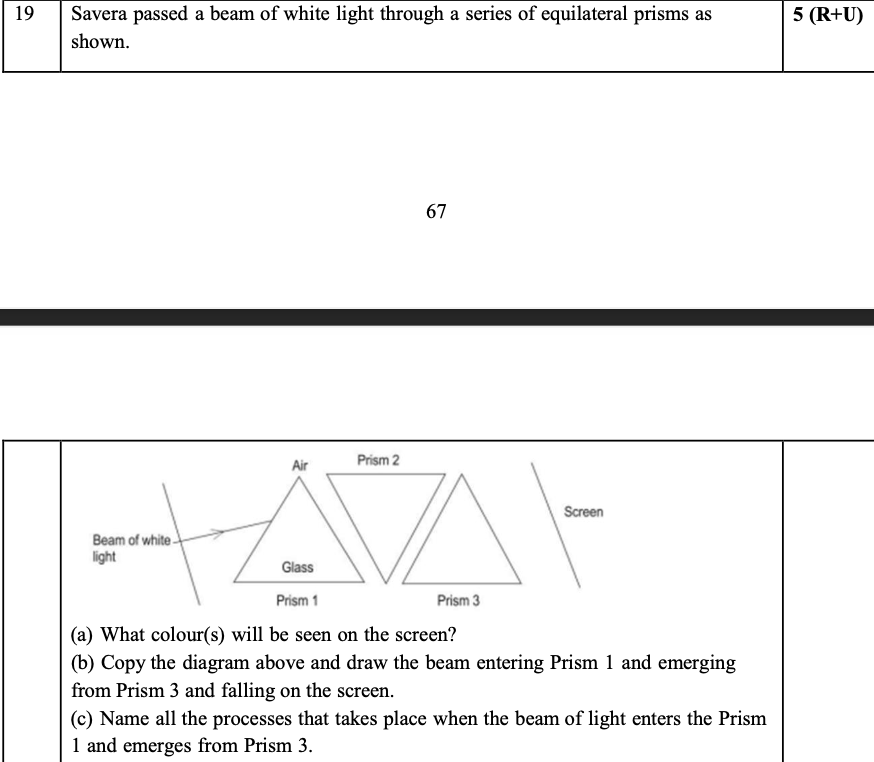
The processes involved are:
Refraction: The bending of light as it passes from air to glass and glass to air at the boundaries of all prisms.
Dispersion: The splitting of white light into its constituent seven colours (Happens in Prism 1 and Prism 3).
Recombination: The combining of the spectrum of colours back into white light (Happens in Prism 2).
VIBGYOR will be seen on the screen
 Note
Note  Flashcards (229)