bio130 pt.1
 Call Kai
 Learn
Learn Practice Test
 Spaced Repetition
 Match
Match Flashcards
 Knowt Play
1/220

Earn XP
Description and Tags
section 1, fill in the blanks
Name | Mastery | Learn | Test | Matching | Spaced | Call with Kai |
|---|
No analytics yet
Send a link to your students to track their progress
221 Terms
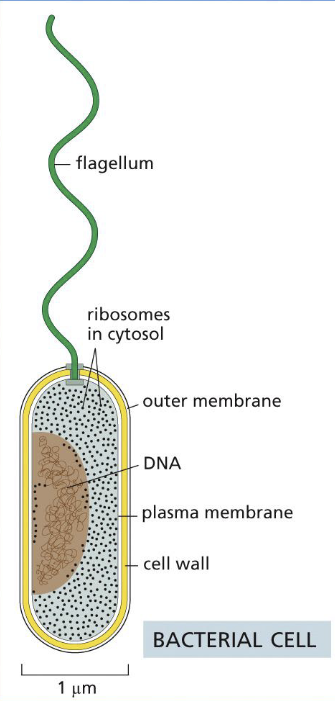
____/__ have no nuclei, no membrane bound organisms, single celled, include bacteria and archaea
prokaryotic cells
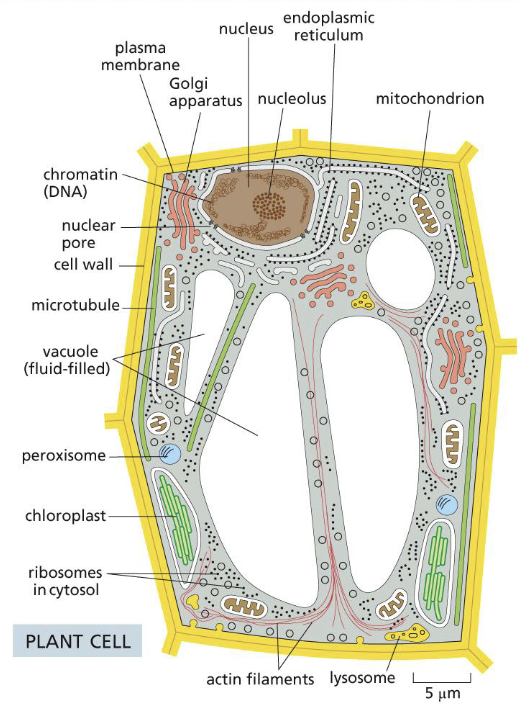
_____/___ have a nuclei, membrane bound organelles, single or multicellular, and make up plants, fungi, animals, humans
eukaryotic cells
ectosymbiosis is a form of symbiotic behaviour in which an organism ___/_/__/___ of another organism
lives on body surface
the ____ is an organelle in eukaryotes that can use oxygen to generate ATP in a process known as ___/____
mitochondria, aerobic respiration
mitochondria were originally bacterial endosymbionts, or ___/___/____ able to use O2 to help generate ATP
free living prokaryotes
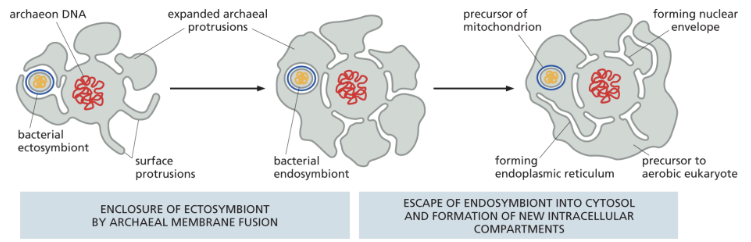
The entangle-engulf-endogenize (E3) model includes an ancient anaerobic ____ cell, an ancient aerobic bacterium, and over evolutionary time, a symbiotic relationship between the two
archaeal
an ____ is a cell that lives inside another with mutual benefit
endosymbiont
mitochondria and chloroplasts still have remnants of their own ___ and ____/____ that resemble modern-day prokaryotes
genomes, genetic systems
a ___/____ is a living thing selected for intensive study as a representative of a larger group of species (model for other things)
model organism
general attributes of model organisms include:
___/____ w short life cycles
__ adult (reproductive) size
readily availble
easily ___ or ____
understandable genetics (simliar/simpler to understand)
rapid development, small, manipulated, modified
The Central Dogma of molecular biology states that information flow in the cell goes from
___ (transcription) → RNA (____)→ ___
DNA, translation, protein
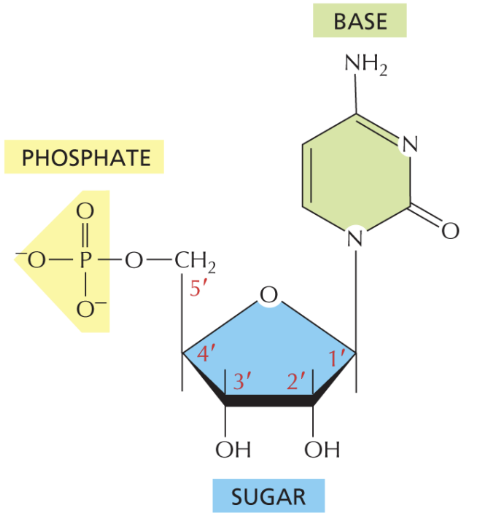
a nucleotide consists of a ______ + ______ + ______
nitrogen containing base, 5 carbon (pentose) sugar (scaffold for base), phosphate group (backbone, 1 2 or 3)
nucleotides are the subunits of ___/____
nucleic acids
Cytosine (C), thymine (T), and uracil (U) are called ____ because they’re derived from a 6 membered ____ ring
Pyrimadines
U C The PYramids
guanine (G) and adenine (A), are ___ which bear a second five-membered ring fused to the six membered ring
purines
a nucleoside contains a ___ + ____
nitrogenous base + sugar
adenosine is a ___ which consists of a sugar + a base
nucleoside
nucleoside diphosphate is a ____ which consists of a sugar + base + 2P
nucleotide
DNA is synthesized from deoxyribonucleoside ___, otherwise konwn as dNTPs
triphosphate → made from 3 phosphate groups
note DNA has no oxygen on 2’ C in pentose sugar
RNA is synthesized from _____ triphosphates, or NTPs
ribonucleoside → has an O on 2’ of pentose sugar
Nucleotides are linked by ____ bonds
phosphodiester
a _____ bond links the 3’C of one nucloside triphosphate to the 5'C of the next
phosphodiester
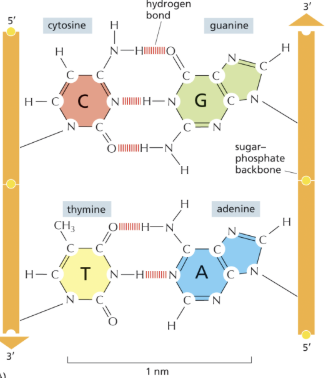
Base pairing holds the DNA double helix together, with A - T forming _ hydrogen bonds, and G - C forming _ hydrogen bonds
2, 3, G - C is more “sticky” than A-T (takes more energy to break)
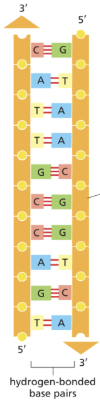
DNA is arranged ____, meaning the two strands are oriented with opposite chemical polarities to each other
antiparallel
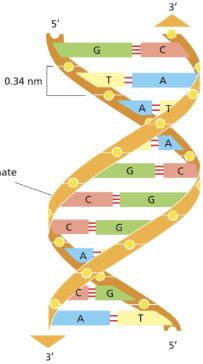
the double helix of DNA contains 10 base pairs/helical turn, and has ___ grooves followed by ___ grooves making the conformation of DNA energetically favourable, and allowing proteins to recognize and make contact with specific DNA sequences
major, minor
*most protein interactions are made in major group as minor group is too narrow
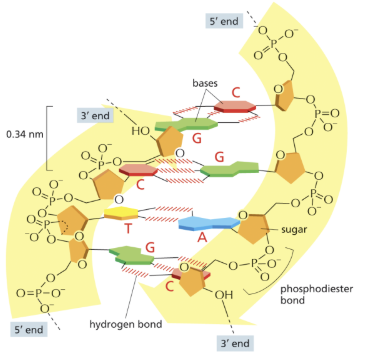
Three forces that keep the DNA strands together are hydrogen bonds, ___ interactions and __/__/___ attractions (LD forces)
hydrophobic, van der waals
The sequence of the two DNA strands are ____
complementary
DNA strands can be ___, which is important for DNA replication and RNA synthesis
unzipped
The strands in a double helix are antiparallel, which means one strand is __ → __, while the other is __→__
5’ → 3’, 3’ → 5’
the 5’ end of DNA has a ___ group (-PO4) while the 3’ end contains a hydroxyl group (OH)
phosphate
separating and rejoining DNA strands is a ___/___ that is performed by proteins in the cell, and with heat in the lab
reversible process
the study of model organisms helps us to understand humans because we share fundamental ___/___ and it’s easier to study and pool research on simpler species
cellular processes
human biologi can be explored more directly using ___/__/___ (in vitro) and in direct-care methods (in vivo)
human cell cultures
mitochondria and chloroplasts have kept some of their ___ and ___ synthesis components
protein, DNA
membranes in mitochondria and chloroplasts often ____ to those in prokaryotes and appear to have been derived from engulfed bacterial ancestor
similar
the position of amino acids that forms a protein determines its __/___, which is stabilized by noncovalent interactions between different parts of the molecule
3D confomation
a protein molecule is made from a long chain of amino acid, covalently held together by ____/___
peptide bonds
proteins are also referred to as ____ or ____ chains
polypeptides
the ___/___/___ refers to the unique order in which amino acids are presented in a protein, this is the same from on molec to the next.
amino acid sequence
The ____ is the end of the peptide chain carrying the amino group (NH2). Polypeptide chains start with the amino group.
N-terminus
The ____ is the end of the peptide chain carrying the carboxyl group (COOH). Polypeptide chains will end with a carboxyl group
C-terminus
side chains of the amino acid are not involved in forming ___/____, but give each amino acid it’s unique properties, e.g. (+)/(-) charged, polar uncharged, or nonpolar
peptide bonds
The amino acid __/___, or R group, is variable, and determines the type of amino acid
side chain
the α helix and β sheet are common due to the ____/__ that form between the N-H and C=O groups in the polypeptide backbones
hydrogen bonds
in an α helix, a hydrogen bond is made between every ____ amino acid, linking the C=O of one peptide bond to the N-H of another within the same segment of pp chain. This causes a complete turn every 3.6 amino acids
fourth
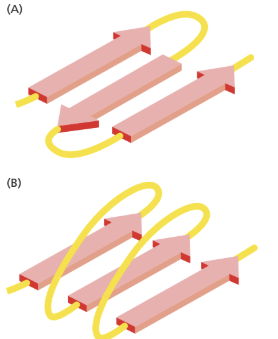
a β sheet is made when H-bonding between C=O of 1 amino acid and N-H of another in ____/___.
there are parallel, and antiparallel β sheets.
neighbouring strands/different segments
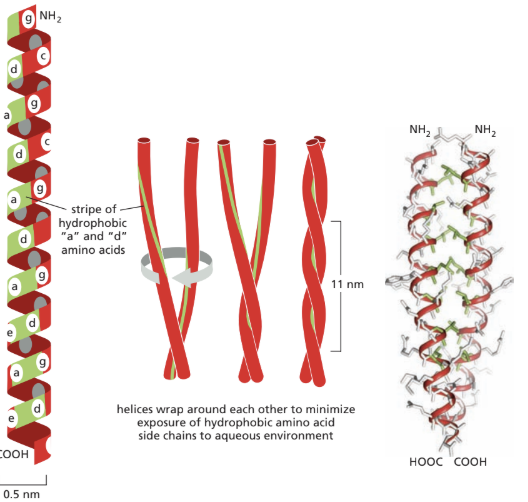
a coiled coil forms when 2 or 3 α helices wrap around each other and form a more stable, amphipathic structure, minimizing exposure of ___ aa side chains to aq environment
hydrophobic
the primary structure of a protein consists of its ___/__/____
amino acid sequence
the ___ structure of protein consists of α helices and β sheets
secondary
the tertiary structure of a protein consists of the full, __/____ formed by an entire polypeptide chain
3D conformation
The ___ structure of a protein refers to protein molecules existing as a complex of more than one polypeptide chain
quaternary
The first three structures of a protein refer to a ___ polypeptide chain, while the fourth refers to more than one.
single
proteins will fold into the shape dictated by their amino acid sequence, but ____/____ make the folding process more efficient and reliable. e.g. hsp60, hsp70 (heat-shock proteins)
chaperone proteins
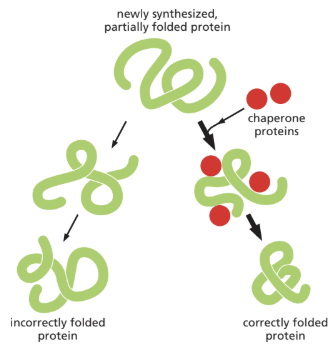
proteins will generally fold into a conformation that is most ____/____, where free energy (G) is minimized
energetically favourable
A ____/___ is a segment of a polypeptide chain that can independently fold into a stable structure and serves as (unique) purpose
Protein domain
Eukaryotic ____ often have 2 or more domains connected by intrinsically disordered sequences (no specific shape, not part of either domain)
Proteins
Protein families are groups of proteins that have a __/____ and an ____/__/____ that closely resemble those of other family members
3D conformation, amino acid sequence
A ___ is a molecule made up of smaller similar or identical subunits linked together
Dimer
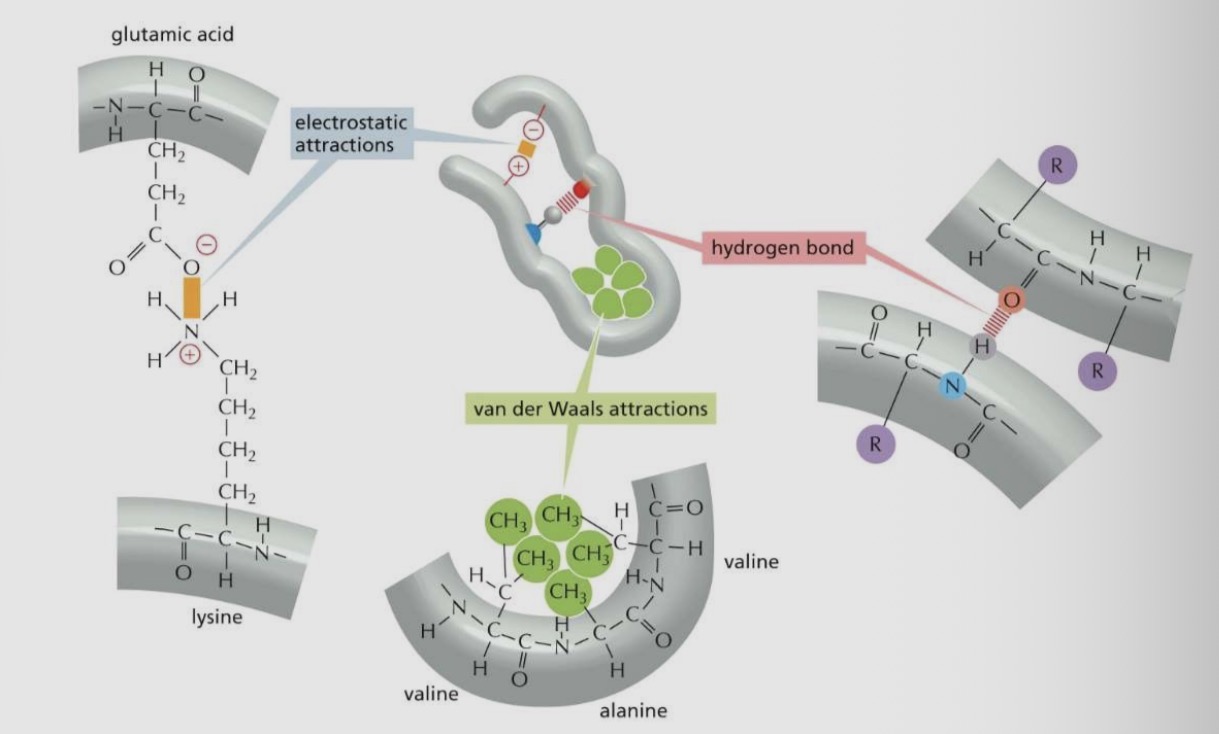
The overall 3D structure of a protein is held together by _____ interactions, non-covalent bonds, and covalent ____/___
Hydrophobic, disulfide bonds
Cysteine is characterized by its R chain: _____, which can form disulfide bonds to adjacent cysteine side chains
CH2SH
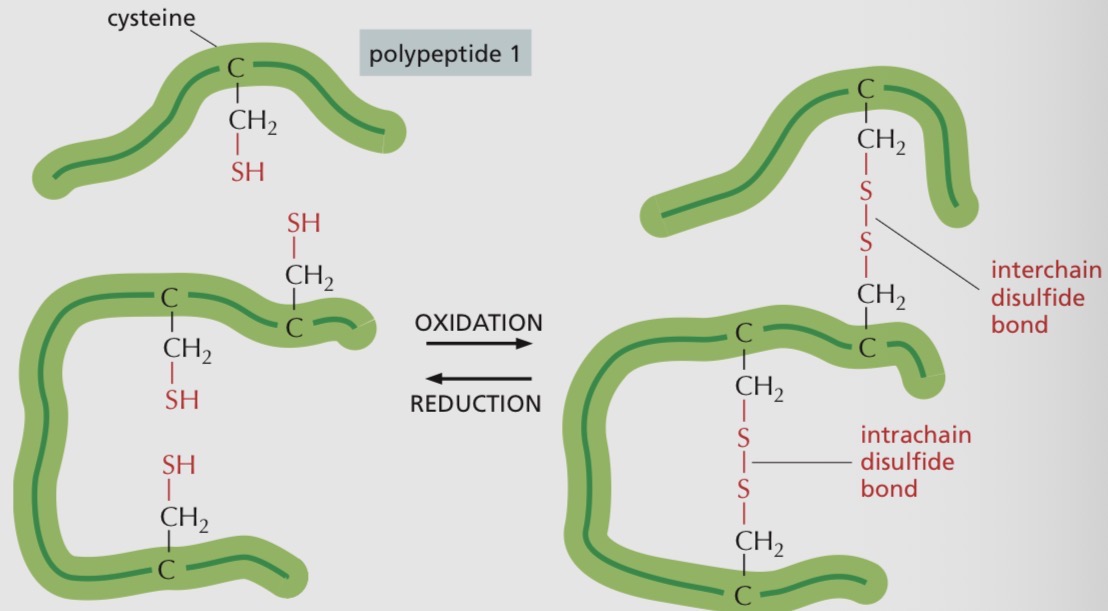
Disulphide bonds do not form in cell cytosol (high conc. of ____ agents) but will form in the endoplasmic reticulum or outside the cell
Reducing
Multi protein complexes and molecular machines can be:
many ___ subunits
_____ of different proteins and DNA/RNA
Very dynamic assemblies of proteins to form molecular machines
Identical, mixtures
To study proteins,
Purify protein(s) of interest using ____ and affinity _____
Determine amino acid sequence, e.g. mass spec.
Discover precise 3D structure using X-ray crystallography, NMR, cryogenic-electron microscopy, etc
Electrophoresis, chromatography
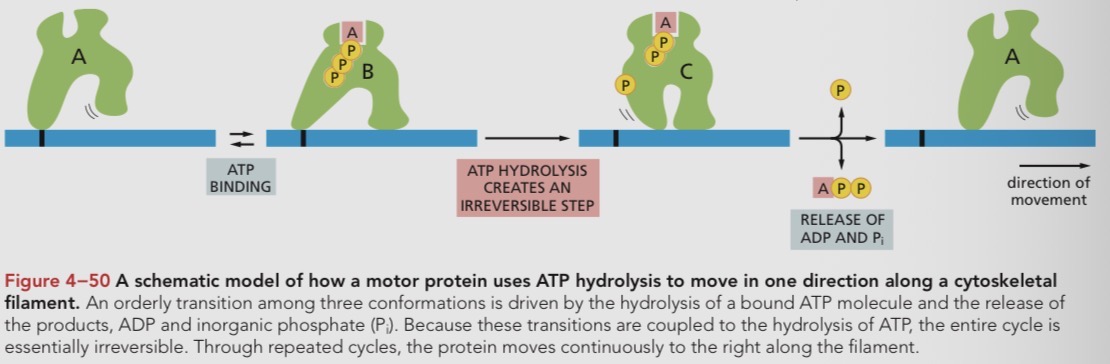
______ changes by ATP/GTP also enable certain specialized proteins to drive directed movements of cells and their components
Conformational
in humans, there are ___ billion base pairs per genome, with a standard cell having 2 genomes
three
genomes size is not always correlated with number of genes, organisms ___, or organisms ___
complexity, size
50% of human genome is ___ DNA, with less than 1% coding for proteins
repetitive
LINEs
long interspersed nuclear elements, >500 bp
SINEs
short interspersed nuclear elements, <500 bp
____/____/____ (selfish genetic elements): can move around in a genome, sometimes spliced out of DNA, copied, and/or pasted back in (over an evolutionary period). e.g. LINEs, SINEs, retrotransposons, DNA-only transposons
mobile genetic elements
protein-coding exons are segments of gene that are ____ and ____
transcribed, translated'
introns are ____ but spliced out of final RNA
transcribed
____/___ is a structure in prokaryotic cells that contains DNA and proteins in a folded manner
prokaryotic nucleoid
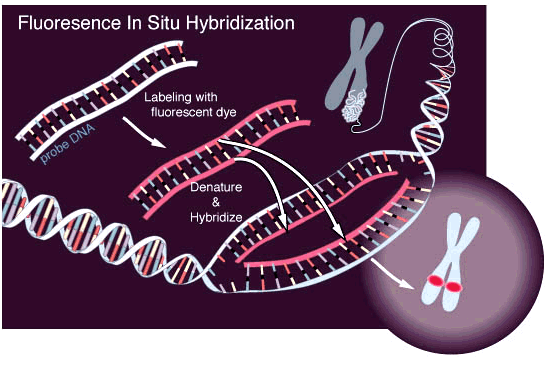
_____/_/__/____ (FISH): diagnostic technique for testing presence of a particular sequence
fluorescence in situ hybridization
obtain probe sequence, binds to sequence you want to detect
label w/ dye
take sample from patient
denature DNA, mix, renature, if sequence is present there will be fluorescence, else, no sequence
____ is a single, long, linear DNA molecule and associated proteins
chromatin
chromatin is tightly packed, and ____, BUT the DNA must remain _____ for transcription, replication, and repair
dynamic (can become more/less condensed), accessible
a _____ is an arrangement of chromosomes lined up
karyotype
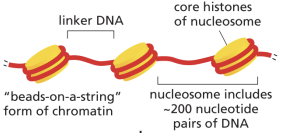
DNA wraps around a nucleosome ____ times/turn, ~147 bp long
5/3
_____ = histone octamer core + double stranded DNA wrapped around + linker DNA + H1 linker histone
nucleosome
a chromatin fiber of packed nucleosomes is ___ long
30nm
In ____, not all but a lot of DNA is 30nm chromatin fiber
interphase
____ are small proteins rich in lysine and arginine, positive charge neutralizes negative charge of DNA
histones
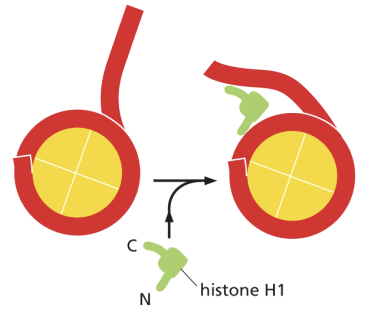
pair of ___ histone proteins (H2A, H2B, H3, H4) form an octamer core.
four
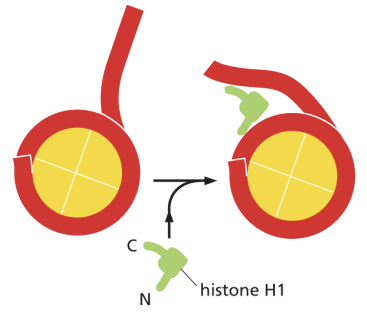
ONE ___/___ (H1) binds to outside of octamer core, helps chromatin be more compact (kinda like paperclip, NECESSARY)
linker histone
____/____/____ = histone octamer + DNA wrapped around
nucleosome core particle, DOES NOT include linker DNA & H1 linker histone
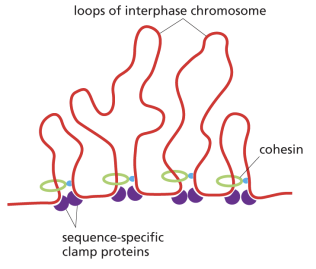
the ___ (structural maintenance of chromosomes) proteins forms rings to package chomatin fibers into series of loops
SMC
____ is the SMC ring complex that organizes the structure of interphase chromosomes into loops
cohesin
____ and ____/____/____/____ regulate the size of chromatin loops
cohesin, sequence-specific clamp proteins
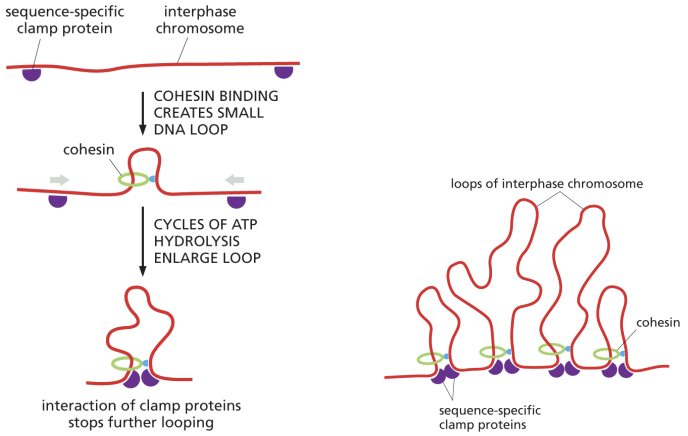
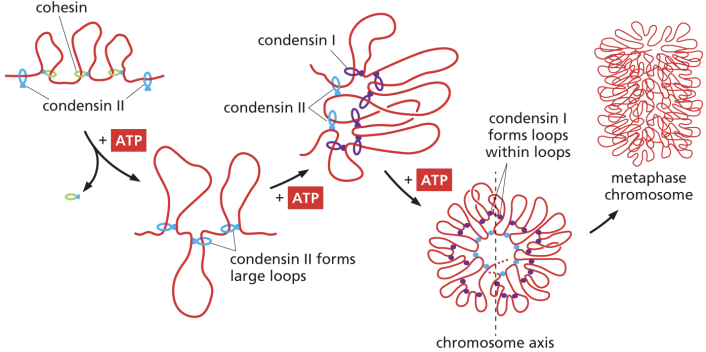
as cells enter mitosis, ____ replace cohesins to form loops within loops to fold mitotic chromosome into more compact configuration
condensins
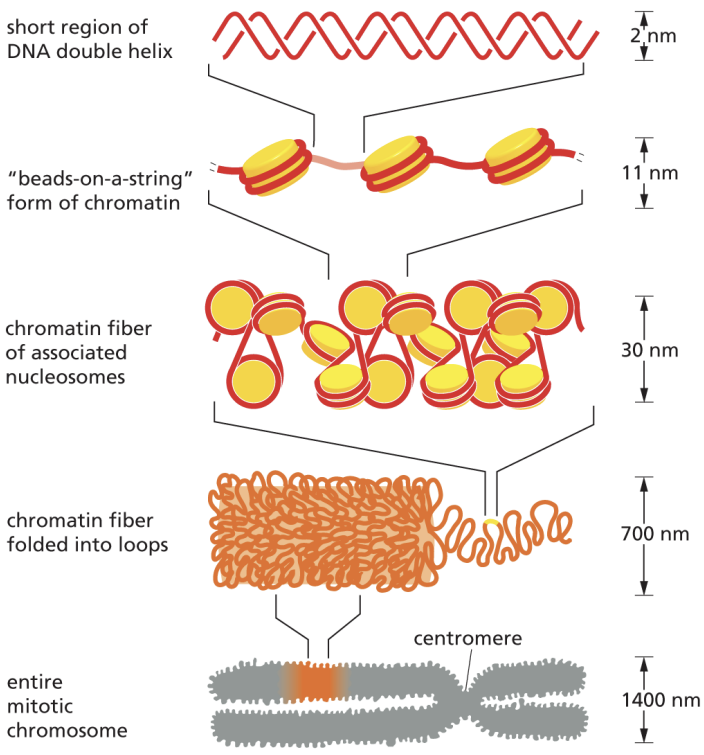
Each DNA molec is packaged into ____/_____ that is 10,000x shorter than fully extended length, packing/unpacking requires energy (ATP)
mitotic chromosome
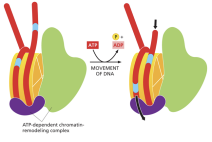
_____/____/____ can reposition the DNA wrapped around nucleosomes to make it more/less accessible to other proteins in cell
protein-modeling complexes
____/____/____ and chromatin remodeling complexes are examples of proteins that can make changes in chromatin structure and alter access to DNA for replication or transcription
histone modifying enzymes
____ are the most highly condensed form of interphase chromatin
heterochromatin
____ is the chromatin that exists in a less condensed state than heterochromatin
euchromatin
_____ heterochromatin in the centromere and telomeres remain permanently condensed
constitutive
_____ heterochromatin is condensed temporarily
facultative
heterochromatic regions of interphase chromosomes are areas where gene expression is _____
suppressed
____ euchromatin are stretches of the gene are inactive
quiescent
_____ euchromatic regions of interphase chromosomes are areas where genes tend to be expressed
active

localized covalent modification of histones, presence of chromatin remodeling complexes, and RNA polymerase (transcription) complexes modulate the reversible switching from ______ to ______ regions along chromosomes
euchromatic, heterochromatic

