AOS 2 Human Resource Management
 Call Kai
 Learn
Learn Practice Test
 Spaced Repetition
 Match
Match Flashcards
 Knowt Play
1/98

There's no tags or description
Looks like no tags are added yet.
Name | Mastery | Learn | Test | Matching | Spaced | Call with Kai |
|---|
No analytics yet
Send a link to your students to track their progress
99 Terms
Human Resource Management
An individual or group manages the relationship between an employer and employee to achieve the overall strategic goals and objectives of a business.
Can do this by looking after employment cycle by establishing, maintaining, and terminating employees.
7 Business Objectives
To make a profit, increase market share, fulfil a market need, fulfil a social need, improve effectiveness, improve efficiency, meet shareholder expectations
Relationship between Human Resource Management and Business Objectives
The successful management of employees through implementing strategies such as motivation
strategies, training, and performance management should lead to employees being more inclined to
put effort into the work they do.
This helps achieve business objectives, such as making a profit or fulfilling market needs.
HR Management and Responsibilities
Recruitment and Selection
Induction of Policies and procedures
Motivation
Training
Performance Management
Termination Management
Awards and Agreements
Culture
3 Motivational Theories
Maslow’s Hierarchy of Needs
Goal Setting Theory (Locke and Latham)
Four Drive Theory (Lawrence and Nohria)
Maslow’s Hierarchy of Needs (Ninja Acronym)
SA- Self Actualization
E- Esteem needs
SO- Social Needs
SA- Safety and Security Needs
Physio- Physiological needs
Maslow’s Hierarchy in Business Context
BOTTOM TO TOP
Physio- Job and income for necessities
Safety and Security Needs- Pay, safety at job site, job security ex, 11 National Employment Standards, OHS steady income
Social Needs- Teamwork and social activities, functions ex, Staff dinner birthdays
Esteem Needs- Recognition of work, delegation, ex, employee of month
Self Actualization- Opportunities for Advancement, ex, promotion,
S & W Of Maslow’s Hierarchy Of Needs
Allows management to develop an understanding of individual needs, as employees are different and have specific needs
Allows management to be aware that employees will be at different stages of development and will need to be motivated by a variety of methods
Easy to understand with a more set, implement and do strategy to progress higher up hierachy.
Not supported by empirical evidence, and the stages do not apply to all individuals
A manager may struggle to identify which stage employees are in, making it difficult to determine which strategy to use to motivate each employee
Hierarchy is very simplistic, and one motivation strategy can cater to nearly all needs at the same time
4 Drive Theory
An interpretation of human behaviour that covers all the emotions and motivations of humans. Encompassing
The drive to acquire, to bond, and to learn are all active, whereas the drive to defend is only active in the face of threat.
To Drive to acquire
includes both material and non-material items, such as status and influence.
Important for managers to set up recognition and reward programs to help employees work towards their goal of acquiring more material possessions.
Example tying monetary rewards to performance
Drive to bond
Involves building relationships and connections with other human beings and colleagues.
Collaboration and teamwork should be vauled to develop a positive culture and improve job satisfaction.
Example teambuilding events, employee dinners
Drive to learn
Work environments that stimulate curiosity and allow for exploration and developing understanding.
Manager needs to ensure that employees are constantly challenged so that tasks to not become routine.
For example ongoing trainning and opportunities to learn new skills
To defend
The desire to remove threats to our safety and security and to protect what we regard as ours.
Can be applied to the workplace by making the workplace welcoming and supportive, treat employees fairly
Not using intimidation as a management technique.
S & W Of 4 Drive Theory
The drives work independently, allowing management and employees to be flexible in the behaviours or strategies selected or implemented.
Four Drive Theory is very adaptable to complicated environments or situations.
The Four Drives will convert into effort that is directed at improving behaviour, thereby improving business performance and achieving objectives.
Other drives besides the four outlined may exist, but the drives don’t explain all the individual characteristics that motivate a person.
Some of the workplace applications involve competition between employees, which can have detrimental effects.
For example, a workplace can have a lack of cooperation or a lack of information sharing due to.
Goal Setting Theory
The theory that employees are motivated by clear goals and appropriate feedback regarding their achievement.
5 Principals of Goal Setting theory
Clarity- Employees must be able to know what is to be achieved and how it is measured
Challenge- Goals need to be able to extend employees’ skillset with current training, so they work hard, but not too ambitious to where the goal feels beyond reach/
Commitment- Employees are more likely to do or achieve a goal if they have input into it, as it is more likely to serve as motivation.
Feedback- provides an opportunity for adjustments to be made to the goal, and if needed, to break the goal down into smaller milestones and direct employees. It also helps to provide recognition to the employee
Task Complexity- tasks should not be overwhelming for the employee and should be straightforward enough that they can achieve them. Additionally trainning may be required for an employee to be able to complete tasks
S & W of Goal Setting Theory
Setting a goal is clear and specific for an individual employee, and will motivate contributing to business objectives
Increased staff performance due to clear and specific goals, increasing the rate of productivity
Better relationships between management and employees will occur as managers work with employees to collaboratively set goals and provide feedback
Setting goals that are vaugue can lead to poor performance and not challenging can become demotivaitng
Employee goals may clash with each other or with business objectives, or may not support the attainment of business objectives
Employees may only focus on attainment of foals and ignore other aspects of the job such as collaboration and communication.
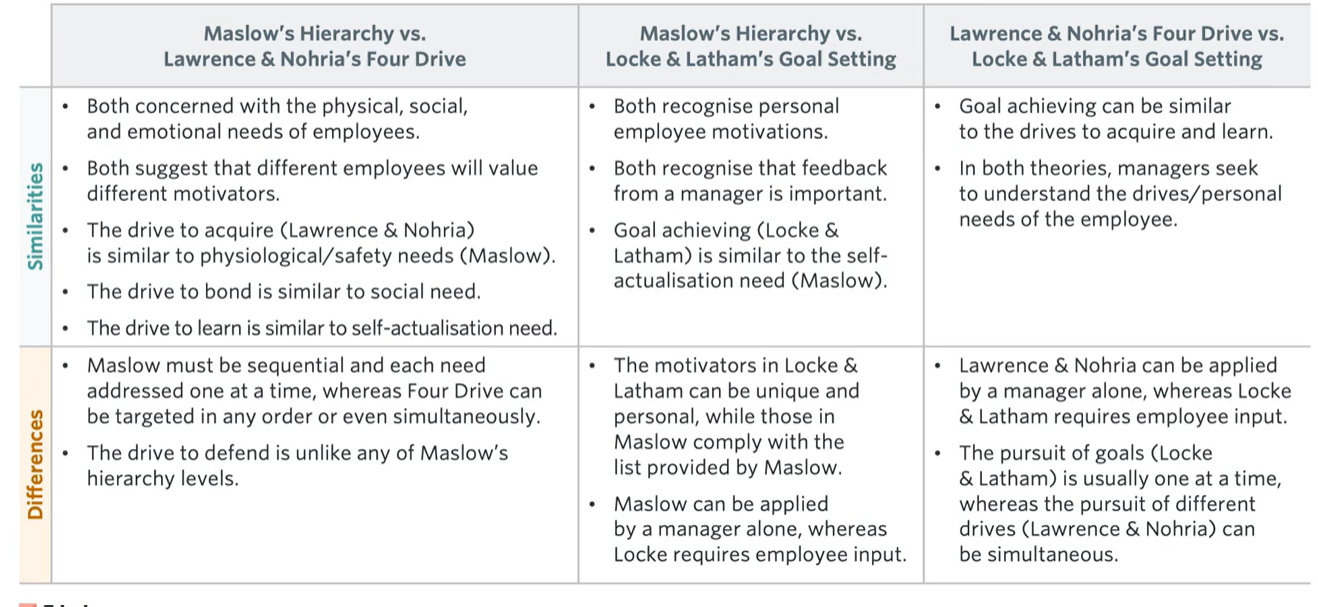
Compare Maslow’s Hierarchy and 4 Drive Theory
Both are concerned with physical, social and emotional needs of employees.
This is seen with the physiological needs of maslow’s hierarchy and to the drive to acquire, and social needs and drive to bond which are closely related.
Both suggest different employees will value different motivators.
As Maslow’s hierarchy has 5 factors in a rigid pyramid scheme while 4 drive theory has 4 sub branches of motivation
Maslow’s theory must be in sequential order where one is addressed at a time, whereas the four drives can be targeted in any order and even simultaneously.
The drive to defend is unlike any of the levels in the hierarchy as it is only applied when a person feels threatened
Compare Maslow’s Hierarchy and Goal Setting Theory
Both recognize personal employee motivations.
Seen as in Maslow’s each employee is motivated by progressive stage on hierarch and in goal setting they set specific and measurable goals that challenge them.
Both recognize feedback from manager is important as feedback allows employees to know how they are progressing to goal and as well as improvements that need to be made.
Both aims to improve performance and productivity of employees by motivating them to work more efficiently
Motivators in Goal setting can be unique and personal as manager will decide with employee and has no set foundation, while Maslow’ hierarchy is already provided and set by manager.
Maslow’s can be applied from manager alone, while Goal Setting theory requires employee input
Compare Four Drive and Goal setting theory
Goal achieving can be similar to the drive to learn and acquire, plus both theories recognize these personal drives and objectives are important for employees.
Both recognize feedback from manager is important as feedback allows employees to know how they are progressing to goal and as well as improvements that need to be made.
Both aims to improve performance and productivity of employees by motivating them to work more efficiently
4 drive motivation is based from 4 innate biological factors, while goal setting motivation is a specific and challenging goal directed by employee and manager choice.
The pursuit of goals is normally gone one at a time while the drive theory can be done simultaneously.
Comparing All Motivation Theories (image)
Motivation
A persons individual and internal processes that direct and energies a persons behavior.
Motivation can be intrinsic or extrinsic
5 Main Motivational Strategies
Performance related pay
Career advancement
Investment in training
Support
Sanction
Performance Related pay (Extrinsic)
The wages and pay provided to employees according to set standards.
Extrinsic motivator as employees strive to receive financial rewards.
S & W of Performance Related Pay (Extrinsic)
Helps attract highly skilled employees that believe they can comfortably achieve targets to be rewarded.
Goals and targets are normally clear and specific.
Potential to weed out lazy workers, improving efficiency of workforce by only having high performing workeres
Assessment can be subjective, employees can feel demotivated if their is bias or are not fairly assessed
Can create competition based culture, causing conflict
Performance Related Pay S&L Motivational Effects
Short term- Employees powerfully motivated to seek financial rewards
Long Term- can also provide long-term motivation as gainsharing, profit sharing and share plans are rewarded over many years.
However employees can feel demotivated if constantly competing for financial rewards
Career Advancement (Motivational Strategy)
The assignment of more responsibility or authority to an employee such as increased salary, and increases responsibilities
S & W Of Career Advancement
Can provide a means of retaining valuable employees
Promoted employees is likely to feel that they can contribute more to the business, improving productivity, and the commitment to the business
Will satisfy employees who desire a sense of
achievement or extra responsibility.
Employees may have to compete for a limited number of promotions positions available which can create some conflict.
Employees may not be interested in the increased responsibility of a career advancement
Employees may be promoted beyond their
capacity
Career advancement S&L Motivational Effects
Short term- employees are powerfully motivated due to, career advancement providing a pay rise and greater job security.
Long Term- Employees can be motivated to position themselves for future roles
Investment in Training (Motivational Strategy)
The direction of finances, or resources such as time, into the teaching of skills to employees.
This can be on the job such as mentoring or off the job such as attending external workshops.
S & W Of Investment in Training
Benefits business by improving skills of employee meaning they are better at their jobs and achieving business objectives
Has potential to create long term motivation by creating better cooperate culture filled by upskilling and learning.
Can satisfy higher level needs in Maslow’s hierarchy such as self actualization as well as for goal setting and some of 4 drive theory.
Unless there are sufficient jobs within the business requiring higher level skills, training may be wasted
Loss of productivity when employees are being trained, decreasing business output
The business may pay cost for training only for employee to leave for a position in another job, can increase staff turnover rate.
Investment In Training S&L Motivational Effects
Short Term Effects- Employees can be motivated by an opportunity to upskill
However can be demotivated if training is seen as an interruption to their work deadlines
Long Term Effects- undergoing training
provides employees with a sense of accomplishment, and gaining new skills can assist with personal growth
Support (Motivational Strategy)
The assistance and encouragement given to employees to cope with difficulties that may minder performance
S & W of Support
Many forms of support such as encouragement,
can be provided with little to no cost
Support and encouragement can positively influence employee attitudes and help them to improve in confidence, improving motivation
It can be difficult to find reasons to support and encourage some employees
Requires the business to have a positive
corporate culture.
Support S&L on Motivation
Short term- Employees feel cared and concerned about
Can Motivate employees to perform better in workplace
Long Term-
Employees feel nurtured and supported by encouraging culture of workplace
Encourages a sense of loyalty and willingness to remain in the work environment
Sanction (Motivational Strategy)
A form of penalty or discipline imposed on an employee for poor performance such as termination or demotion
S & W Sanction
Can remove poor behaviour in the workplace
can motivate some workers to improve their
work performance.
May quickly stop inappropriate behaviour of
some employees.
Excessive emphasize on sanctions can reduce employees sense of belonging, negative impact on motivators
Resentment can be caused resulting in conflicts between management and staff
Only a short term motivator.
Sanction S&L on Motivation
Short Term- Employees are powerfully motivated to avoid further sanctions
Long Term- Employees can begin to feel demotivated by a negative and fearful working environment
Can create a negative fearful work culture
Training
The process of teaching staff how to do their job efficiently and effectively by boosting their knowledge and skills.
Can be on the job such as mentoring and off the job such as attending workshops
2 types of training
On the job and off the job trainning
On the Job Training
When employees learn a specific set of skills to perform particular tasks in the workplace.
Can be informal where employees mentor employees or formal which is more structured training.
Off the job trainning
When employees learn skills away from their regular workplace.
This normally involves sending workers to external institutions such as lectures and conferences to gain skills.
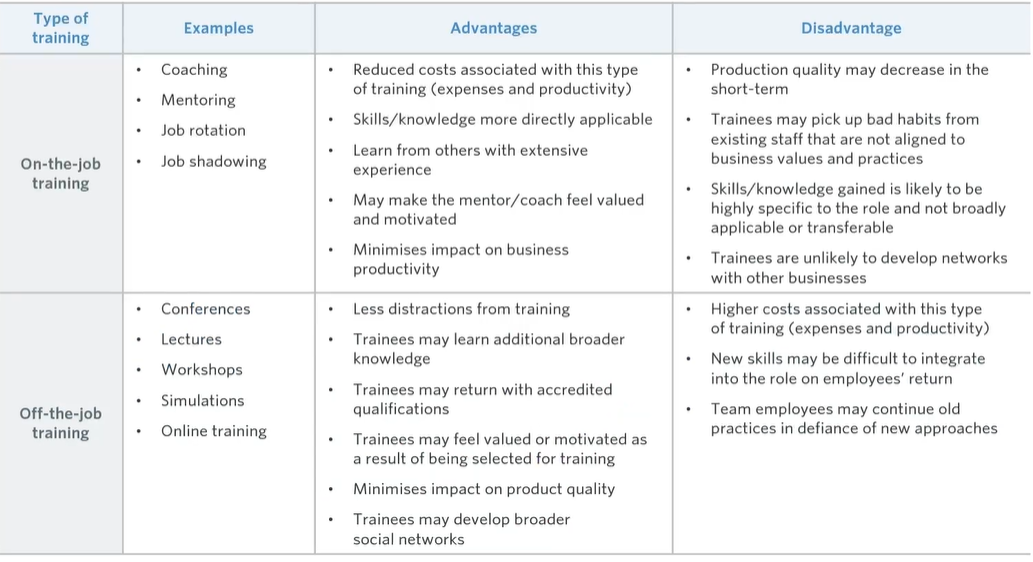
S & W On The Job Training
Cost effective due to no extra expenses such as travel
Employees work while training, so productivity is not excessively hindered as production is still occurring
Employees are in familiar environment with collogues they are used to working with, more comfortable and willing to be trainned
Quality of trainer may vary, as not everyone can teach or be a mentor
Bad habits of employees may transfer to newer staff.
Trainer may be put out of the workforce to mentor reducing labor force.
S & W Off the job training
Availability of a wider range of skills and
qualifications than those in the workplace
Outside experts can provide broader experiences to gain skills, and can be more structured and organized with professionals.
Can give formal qualifications for employees
More expensive due to increases expenses such as fees and transport
Lost working time due to employees being absent from workplace
The skills gained may not relate to the exact skills needed in workplace.
Training Summary Table
Development Not Needed
The process designed to develop knowledge and skills necessary for future work activities and responsibilities.
Helps retain employees and motivates them as they take on new responsibilities
Performance management
Performance management is a system where managers and employees work together to assess and improve an employee’s performance. It involves setting goals aligned with business objectives and using strategies/feedback to identify areas for improvement and support future performance.
Performance Appraisal
The formal assessment how well employees are efficient and effective employees are working to pre determined standards.
S & W Performance Appraisal
Facilitates communication and allows positive relationships to develop between management and employees
Feedback can help employees improve their performance due to clear areas of improvement
Information from an appraisal can assist managers when making decisions about pay or termination
Can be time consuming if the meeting cycles become shorter such as weekly
Can be stressful for both manager and employees due to unwillingness to critique or discuss performance
Staff who meet performance standards may expect a rise or promotion which is expensive for the business
Management by objectives (MBO)
A strategy that aims achieve business objectives with goals agreed by management and employees.
Processes include setting clear and specific goals with regular feedback to employees.
S & W Management by objectives
Employees are involved in setting goals and choosing a course of action to achieve them. Thus more likely to work productivity and fulfil their responsibility.
Collaborative setting of goals helps build relationships between management
Information from feedback from objective management can assist managers when making decisions about pay or termination.
Can be time consuming due to added responsibilities to employees.
Extra workload can cause stress onto workers, demoralizing them and decreasing productivity.
Staff who meet objectives may expect a pay rise or promotion, which is expensive for business.
Self Evaluation
Form of self assessment where employees evaluate their own preface against set objectives.
Allows employees to see and document their strengths and weaknesses for development
S & W Self Evaluation
Allows employees to be actively involved in their performance reviews assisting them in understanding of role in business.
Helps managers to get an insight not how employees are viewing their performance and addressing training required.
Open communication setting can help build relationships between management and employees.
Employees can overstate their own performance leading to dishonestly in evaluation
People may also be too harsh on assessment leading to manager to think less of performance
Extra workload and responsibilities can cause stress onto workers, demoralizing them and decreasing productivity.
Employee Observation
Where an employee is being monitored or assessed to give a comprehensive picture of past and present performances.
Provides a broader view of strength and weaknesses and training needs workers.
S & W Employee Observation
Allows management to gain a broad range of observations on an employee from variety of different sources, providing bigger picture of employee performance
Helps managers pinpoint areas for improvement and training needs.
Information from employee observation can help assist in decisions for pay increases or termination.
Not as useful for assessing skills or the achievement of objectives as observants may not fully understand business processes.
Can be damaging to peoples self esteem and team cohesion due to fearful stress in workplace
Staff who receive positive feedback may expect a pay rise or promotion, which is expensive for business.
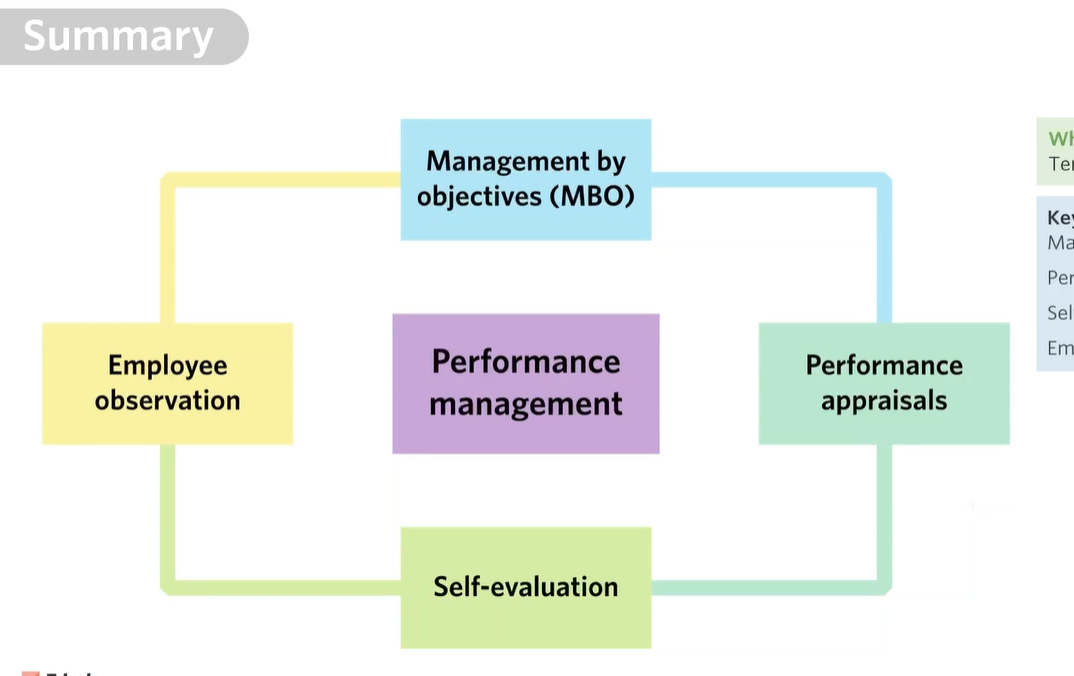
4 Types of Performance Management
Management by objectives, Performance appraisals, self evaluation, employee observation
6 Types of Termination management
Retirement, redundancy, resignation, dismissal, entitlement considerations, transition considerations
Termination
The process where a business and worker end their employee contract.
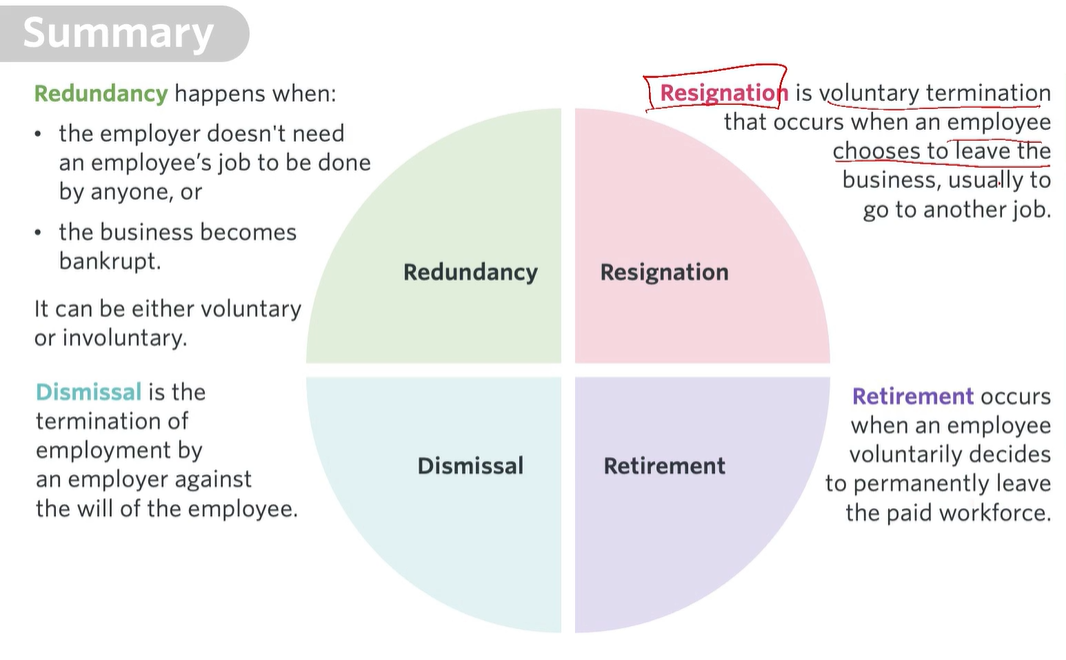
Retirement
The voluntary form of termination where a worker decides to leave workforce.
Redundancy
The involuntary termination of an employee when a job no longer exists usually due to technological changes or a business restructure
Resignation
the voluntary termination of employment when a worker decides to leave the business
Dismissal
The involuntary termination of an employees contract.
Unfair Dismissal
The unjust termination of an employee contract.
Entitlement Considerations
The legal requirements that employees have when leaving the workplace, either on a voluntary
or involuntary basis, such as owing wages
Transition Considerations
Concerns associated with changing jobs or working conditions that are addressed above the beyond the legal requirement for a business, such as outplacement services.
Termination management table
6 Main Participants in a workplace and definition
Employees- Individuals who work for a business and receive a form of pay in exchange for physical or mental labor
Unions- Organizations whose role is to represent and protect the rights of employees in a particular industry
Employer- Someone who assigns work to employees in order to achieve business objectives
Employer Associations- Organizations that represent and assist employer groups, upholding their legal obligations
Human Resource Managers (HRM)- Individuals plan, direct, and coordinate an organization's workforce, bridging staff and management objectives
Fair Work Commission- Australia's national workplace tribunal, with power to carry out a range of functions to create fair and safe workplaces.
Workplace Relations
The interactions between employers and employees or their representatives within a business’ internal environment
Employees Role in Business
Perform duties with care and diligence
Improve Productivity to achieve business objectives
Unions Role in Business
Representation and Advice in large numbers for employees
Help to resolve workplace issues, acting as an advocate for employees
Employer Role In Business
Ensure pay and working conditions meet national requirements.
Provide a safe and healthy workspace.
Employer Associations Role In Business
Develop workplace policies and manage records of claims served on their members by unions.
Keep members informed of policy changes from workplace agreements or updated legislations that could affect business.
HRM Role in Business
Recruiting staff and organize training
Negotiating employment agreements with employees and their representatives, such as pay and working conditions
Maintain positive working conditions so chances for disputes are reduced
Fair Work Commission Role in Business
Deal with applications of unfair dismissals
Set minimum wage and minimum wage in awards
Administer regulation of industrial action
Employee Contract
A legally binding document that outlines the terms and conditions of employment set by employers.
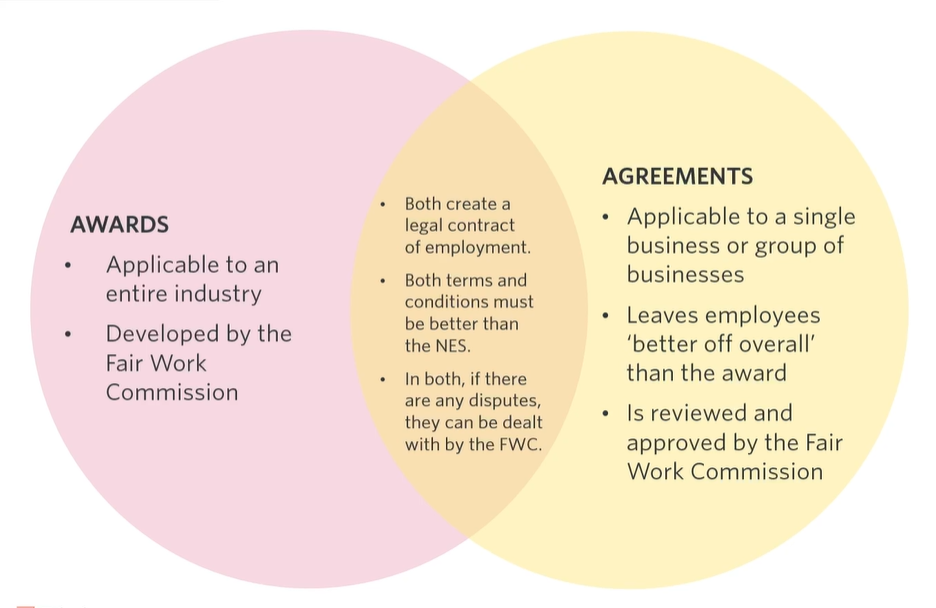
Awards
Awards are legally binding documents set by the Fair Work Commission that outline minimum wages and conditions across an entire industry.
Distinguish between Employee Contracts/ Agreements and Awards
Employee contracts are legally binding documents that outline the terms and conditions of employment set internally by a company for an individual employee.
Awards are legally binding documents set by the Fair Work Commission that outline minimum wages and conditions across an entire industry.
While employee contracts set company-specific terms and conditions, awards provide the national minimum standards that all employees must receive.
National Employment Standards
11 employment entitlements that must be provided to all employees, such as 38 hours per week maximum, annual and sick leaves.
S&W Awards
Wage equality and transparency across industry for workers, as consistent throughout
Less Costly for the business as already created by FWC
Provides less flexibility as it cannot be to the needs of a workplace
Strong unions can exert enormous influence on the award
Modern awards can be complex
Agreements
A legally binding document that outlines the wages and conditions for an employee at a particular business
S&W Agreements
More flexible as t&c’s can be tailored to business needs
Improves relationships with employees as t&c’s are negotiated
May be used to attract talented or highly skilled employees to the business
There is less wage equality and transparency across the industry
Time consuming to negotiate as employees must be consulted during enterprise bargaining.
Awards and Agreements summary table
Dispute
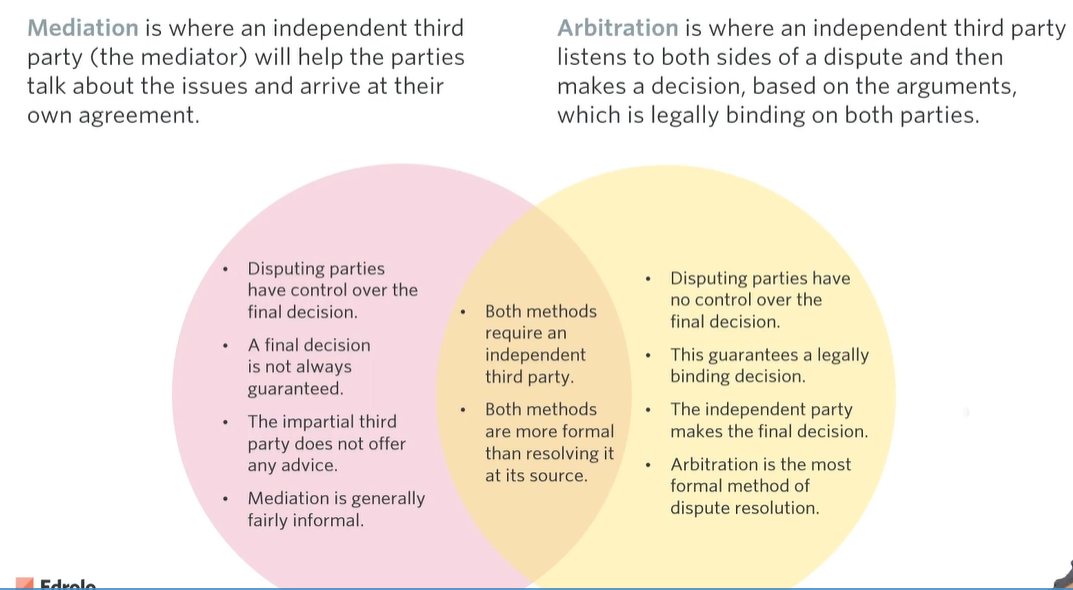
A conflict that occurs in any a businessdue to an unsolved disagreement
Mediation
A method of dispute resolution where a third party (mediator) helps the parties in dispute to arrive at their own agreement.
S&W Mediation
Promotes positive working conditions as the parties often make decision together
More cost effective less time consuming and formal than arbitration.
Mediator is likely to prevent parties relationship from breaking down
No guarantee that an agreement to dispute will be achieved
Decision may not be legally binding, which could be dismissed in the future
Arbitration
A method of dispute resolution where a third party such as FWC listens to both parties arguments and makes a legally binding order to how it must be resolved.
S&W Arbitration
There is a guarantee that dispute will be solved as decision will have a winner or loser.
Legally binding, meaning both parties must adhere to it
Can destroy positive working conditions due to win/loss nature of decision
More formal time consuming and expensive than mediation
Dispute resolutions summary
Extrinsic Rewards
Extrinsic Motivation
behaviour driven by external rewards such as money, often as a short term motivator
Intrinsic Motivation
Whereby the employees are motivated from within to enhance their career, often long term motivator

