Erythrocytes (Red Blood Cells)
 Call Kai
 Learn
Learn Practice Test
 Spaced Repetition
 Match
Match Flashcards
 Knowt Play
1/60

There's no tags or description
Looks like no tags are added yet.
Name | Mastery | Learn | Test | Matching | Spaced | Call with Kai |
|---|
No analytics yet
Send a link to your students to track their progress
61 Terms
____ is a person trained to draw blood from a patient for clinical or medical testing, transfusions, donations, or resesarch
phlebotomist
blood is a type of ____ tissue
connective
2 basic components of blood
cells and plasma
rbc, wbc, and platelets are
blood cells
water, proteins, vitamins, hormones, electrolytes, amino acids and cellular wastes are
blood plasma
blood cell percentage
45
blood plasma percentage
55
to determine the percentages, blood is placed in a _____. _____ cells settle to the bottom of the sample
centrifuge, heavier
hematocrit
percentage of blood and plasma
hematocrit tube from top to bottom
plasma, wbc, rbc
erythrocytes
red blood cells
leukocytes
white blood cells
thrombocytes
platelets
shape of red blood cells
biconcave discs
red blood cells count per drop
5 million
_____ lack a nucleus
red blood cells
hematopoesis
formation of blood cells
hematopoiesis occurs in the
bone marrow
old blood cells are destroyed by the ____ and ____ through ____
liver, spleen, phagocytosis
4 trace elements of erythrocyte production
iron, copper, zinc, b vitamins
iron:
less than ___ percent of the ion we consume is absorbed. heme iron (from animal foods) is absorbed ____ efficiently than non-heme iron (plant foods)
20, more
iron:
_____ transports the iron across the ____ cell plasma membranes and from its storage sites into ____ where it enters the blood
ferroproteins, intestinal, tissue fluid
iron:
when ____ stimulates the production of erythrocytes, iron is released from ____, bound to ____, and carried to the ____ where it attaches to ____
erythropoietin, storage, transferrin, red marrow, erythrocyte precursors
copper:
enable to ____ of iron from Fe2+ to Fe3+, a form in which it can be bound to its transport protein, ____
oxidation, transferrin
copper:
component of two plasma proteins
hephaestin and ceruloplasmin
copper:
hephaestin enables ____ to be absorbed by ____ cells
iron, intestinal
copper:
ceruloplasmin transports ____
copper
copper:
in a state of copper deficiency, the transport of iron for heme synthesis ____, and iron can ____ in tissues, where it can eventually lead to ____
decreases, accumulate, organ damage
zinc:
functions as a ____ that facilitates the synthesis of the ____ portion of hemoglobin
coenzyme, heme
b vitamins include (2)
folate and vitamin b12
b vitamins:
function as ____ that facilitate ____
coenzymes, DNA synthesis
erythrocytes live up to ___ days in the circulation
120
erythrocytes removed by a ____ located primarily within the (3)
macrophage, bone marrow, liver, spleen
the components of the degraded erythrocytes’ ____ are recycled
hemoglobin
the components of the degraded erythrocytes’ hemoglobin are recycled:
____ is broken down into ____, which can be sent back to the bone marrow to be used in the production of new erythrocytes
globin, amino acids
the components of the degraded erythrocytes’ hemoglobin are recycled:
____ that is not ____ is broken down in the circulation, releasing ____ and ____ chains that are removed by circulation by the ____
hemoglobin, phagocytized, alpha, beta, kidneys
the components of the degraded erythrocytes’ hemoglobin are recycled:
the ____ contained the heme portion of the hemoglobin may be stored in the ____ or ____, primarily in the form of ____ or ____. it can also be carried through the bloodstream by _____ to the red bone marrow for recycling into new erythrocytes
iron, liver, spleen, ferritin, hemosiderin, transferrin
the components of the degraded erythrocytes’ hemoglobin are recycled:
the _____ portion of the heme is degraded into the waste product ____ and then into ____
non-iron, biliverdin, bilirubin
the components of the degraded erythrocytes’ hemoglobin are recycled:
bilirubin binds to ____ and travels in the blood to the ____, which uses it in the manufacture of ____
albumin, liver, bile
the components of the degraded erythrocytes’ hemoglobin are recycled:
bacteria breaks the ____ apart from the bile and converts it to ____ and then into ____. it is then eliminated from the body in the feces
bilirubin, urobilinogen, stercobilin
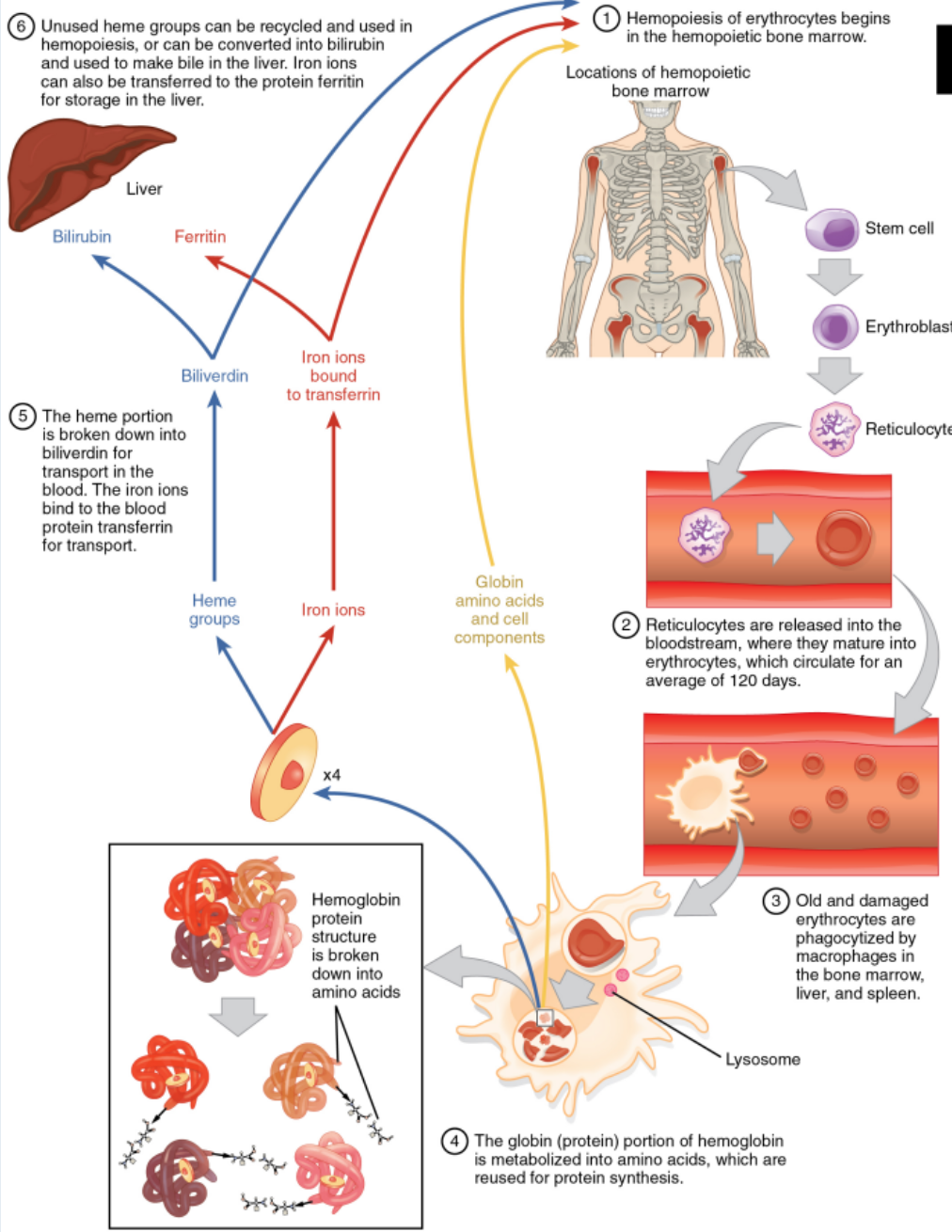
(1) hemopoiesis of erythrocytes begins in the hemopoietic _____
(2) ____ are released into the bloodstream, where they mature into erythrocytes, which circulate for an average of 120 days
(3) old and damaged erythrocytes are ____ by macrophages in the bone marrow, liver, and spleen
(4) the globin (protein) portion of hemoglobin is metabolized into ____, which are reused for ____
(5) the heme portion is broken down into ____ for transport in the blood. the iron ions bind to the blood protein ____ for transport
(6) unused heme groups can be recycled and used in _____, or can be converted into ____ and can be used to make bile in the liver. iron ions can also be transferred to the protein ____ for storage in the liver
bone marrow
reticulocytes
phagocytized
amino acids, protein synthesis
biliverdin, transferrin
hemopoiesis, bilirubin, ferritin
broad-spectrum ____ typically eliminate these bacteria as well and may alter the ____ of feces
antibiotics, color
the ____ also remove any circulating ____ and other related metabolic byproducts such as ____ and secrete them into ____
kidneys, bilirubin, urobilin, urine
____ within the feces produce the typical brown color associated with its waste
stercobilins
the components of the degraded erythrocytes’ hemoglobin are recycled:
the yellow of urine is associated with the ____
urobilins
the breakdown of ____ formed from the destruction of ____ can be seen in a variety of situations such as bruising
pigments, hemoglobin
with a failing liver, ____ cannot be removed effectively from circulation and causes the body to assume a yellowish tinge associated with ____
bilirubin, jaundice
____ is a hormone that increases production of RBCs
erythropoietin
EPO raises your ____ level, ____ the blood, increasing the risk of ____
hematocrit, thickening, stroke
2 functions of rbc
transport oxygen and remove carbon dioxide
hemoglobin
protein that combines with o2
iron
binding site of oxygen
hemoglobin is a large molecule made up of ____ and ____
proteins and ions (alpha 1 and 2; beta 1 and 2)
hemoglobin:
each of these globin molecules is bound to a ____, which contains an ion of ____
heme, iron (Fe2+)
hemoglobin:
each iron ion in the heme can bind to ____ oxygen molecule; therefore, each hemoglobin can transport ____ oxygen molecules
one, four
hemoglobin:
an individual erythrocyte may contain about ____ million hemoglobin molecules, and therefore can bind to and transport up to ___ billion oxygen molecules
300, 1.2
oxyhemoglobin (oxygen and color)
plenty of oxygen and bright red
deoxyhemoglobin (oxygen and color)
low in oxygen and dark red
it is a myth that deoxygenated blood appears ____
blue
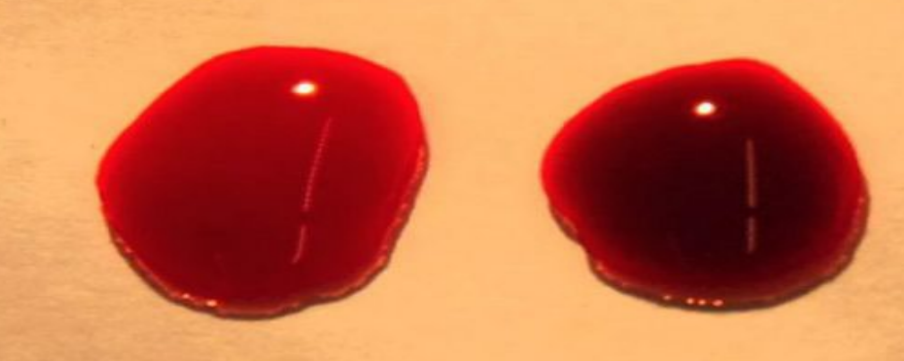
left oxygenated or deoxygenated
oxygenated
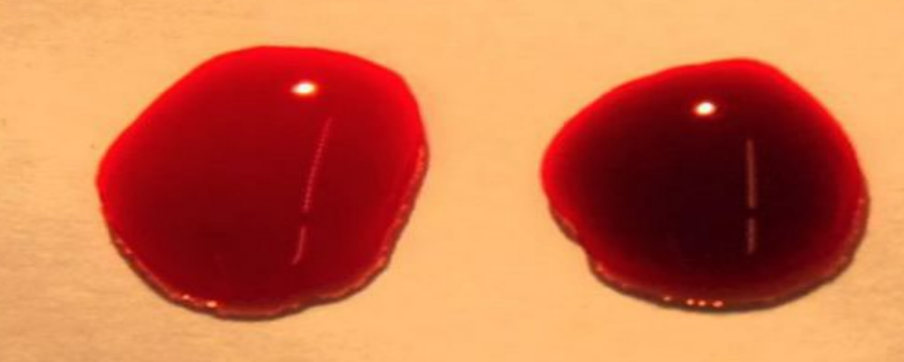
right oxygenated or deoxygenated
deoxygenated

