2.4.1 Production, Productivity & Efficiency
 Call Kai
 Learn
Learn Practice Test
 Spaced Repetition
 Match
Match Flashcards
 Knowt Play
1/30

There's no tags or description
Looks like no tags are added yet.
Name | Mastery | Learn | Test | Matching | Spaced | Call with Kai |
|---|
No analytics yet
Send a link to your students to track their progress
31 Terms
What is production?
Production is the total number of units of goods produced in a given period of time
What are the 4 main methods of production?
Job production
Flow production
Batch production
Cell production
What is job production?
Job production is producing one item at a time, as ordered by the customer
Advantages of job production
High-quality product
Motivated and highly skilled workers
Customised products can be produced
Disadvantages of job production
Production is slow
Labour costs are high
What is batch production?
Batch production is when groups of the same product are produced before moving in to a group of different products
Advantages of batch production
Workers can specialise
Cost saving can be achieved by buying in bulk
Production can take place as the previous batch starts running out
Disadvantages of batch production
Requires careful coordination to avoid shortages
There is less flexibility for customers, compared with job production, as they can only select from a range of standardised output
Money is tied up in stock, as completed products need to be stored
What is flow (mass) production
Flow production is continuous manufacturing if standardised products usually on a production line
Advantages of flow (mass) production
Low shiny costs due to economies of scale
Rapid production
Usually highly automated (capital intensive)
Consistent quality
Disadvantages of flow (mass) production
Customisation is difficult
Capital equipment can be expensive to purchase
Mistakes or problems can shut down the whole process
Staff can become easily demotivated as the tasks they perform are not challenging, unexciting and repetitive
What is cell production?
Cell production involves workers being organised into multi-skilled teams, with each team responsible for a particular part of the production process
Advantages of cell production
Often more efficient than other methods, as workers share their skills and expertise
Motivation is usually high, as employees work as a team
Disadvantages of cell production
Requires extensive reorganisation of production processes
Teams’ efficiency may be reduced by weaker workers
Company may need to invest in new materials for handling and ordering new systems and technology
What is productivity?
Productivity is a measure of a firm’s efficiency level in terms of how well things are done within the organisation
Calculation of productivity
Outputs / inputs per time period
Calculation of labour productivity
Outputs / number of employees
Calculation of capital productivity
Outputs / number of machines
What are the factors that influence productivity
Employee motivation (motivated workers tend to be more productive, financial incentives lined to output may increase worker productivity, non-financial incentives like including workers in decision making)
Skills, eduction and training staff (well-trained and educated workers are likely to be able to make useful contributions to decisions that improve productivity)
Business organisation and working practices (flexible and adaptable workplaces can improve the commitment of workers and allow a business to respond to changes in demand, hours and locations of work can be adapted to better meet the needs of workers and the demand)
Investment in capital equipment (increased automation can improve levels of output and quality, well-chosen machinery is less likely to make mistakes than humans, machinery and technology can operate for long periods without a break, as long as they are properly maintained)
What is the link between productivity and competitiveness?
Competitiveness refers to the ability of a business to maintain or grow its sales and market share, given the presence and actions of rivals
Businesses that increase their level of productivity are likely to be more competitive
What is efficiency?
Efficiency involves maximising the output achieved from given inputs including machinery, materials and people.
Calculation of average cost per unit
Total costs / Number of units
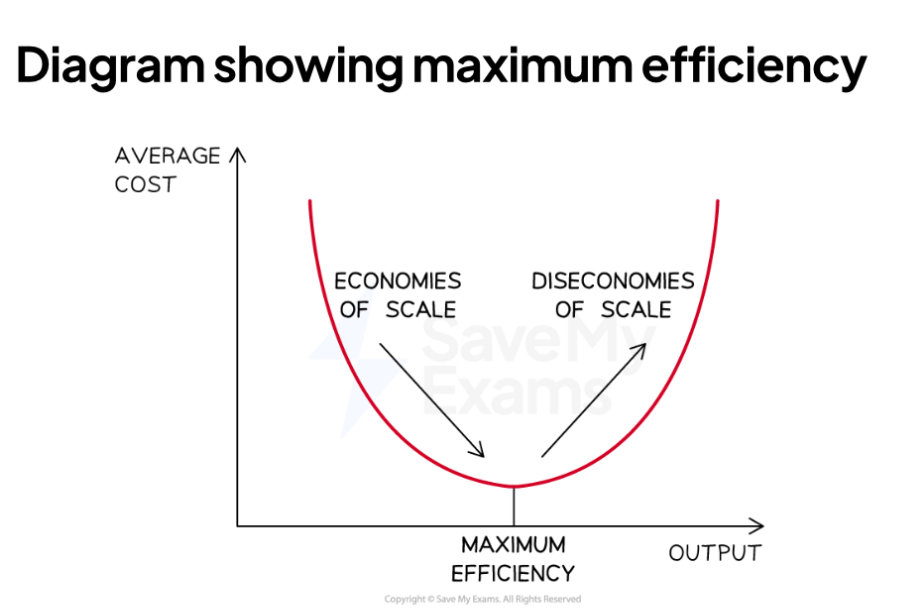
What is maximum efficiency?
When the cost per unit is at its lowest
What is the diagram showing maximum efficiency
The most efficient level of production is achieved when:
Economies of scale are maximised
Total costs are spread across an optimum level of output
Diseconomies of scale are minimised
What are the factors that can influence efficiency?
Standardisation of the production process (occurs when all staff use the same components and techniques in the production process, training of workers is minimised, bulk buying of components reduces variable costs, production lead time is reduced)
Relocation or downsizing (moving production to a cheaper or smaller location can reduce fixed costs, labour intensive businesses may look for lower-wage locations, having capital-intensive locations may mean looking for lower rents or land costs, however relocation is very disruptive and will incur significant short-term costs)
Investment in capital equipment (purchasing or upgrading machinery and technology can increase the rate of output, lower costs and improve quality)
Organisational restructuring (reducing the level of staff or reorganising staff can better match labour to output needs, delayering reduces labour costs as levels of management are removed, redeployment can motivate workers by providing opportunities for staff to take on a new role, which will develop their skills and experience)
Outsourcing (tasks may be given to other specialist businesses that can complete them at a lower cost, outsourcing allows businesses to focus on improving the efficiency of its core competencies)
Adoption of lean production techniques (an approach to production that involves the reduction of all types of wastage, Kaizen means that improvements are made continuously, Just-in-time involves holding little or no stick, which minimises storage costs)
What is labour intensive production?
Labour-intensive production is when an organisation relies on physical labour in the production of goods/services, rather than machinery or capital equipment.
The delivery of services is usually more labour intensive than manufacturing
in countries where labour costs are low (e.g Bangladesh), labour-intensive production is common
Small-scale production is likely to be labour-intensive
What is capital-intensive production?
Capital-intensive production relies more on machinery and technology in the production of goods and services, rather than labour.
Large-scale production of standardised products is likely to be capital-intensive
Manufacturing in developed countries where labour costs are relatively high, is likely to be capital-intensive
Advantages of capital intensive production
Low-cost production, where output is high
Machines are usually consistent and precise
Machine can run without breaks
Disadvantages of capital-intensive labour
Significant set-up and maintenance costs
Breakdowns can severely delay production
May not provide flexibility in production
Advantages of labour-intensive production
Low-cost production where labour costs are low
Provides opportunities for workers to be creative
Workers are flexible, they can be retrained
Disadvantages of labour-intensive production
Workers may be unreliable and need regular breaks
Incentives may be needed to motivate staff
Training costs can be significant

