exam 2 a&p2
 Studied by 0 people
 Call Kai
 Learn
Learn Practice Test
 Spaced Repetition
 Match
Match Flashcards
 Knowt Play
1/184

There's no tags or description
Looks like no tags are added yet.
Name | Mastery | Learn | Test | Matching | Spaced | Call with Kai |
|---|
No analytics yet
Send a link to your students to track their progress
185 Terms
Which heart chamber receives blood from the lungs?
left atrium
What superficial landmark identifies the boundary between the left and right ventricles?
anterior interventricular sulcus
The function of the atrium is to
collect blood and pump blood to the ventricle.
The normal pacemaker of the heart is located in
the sinoatrial node.
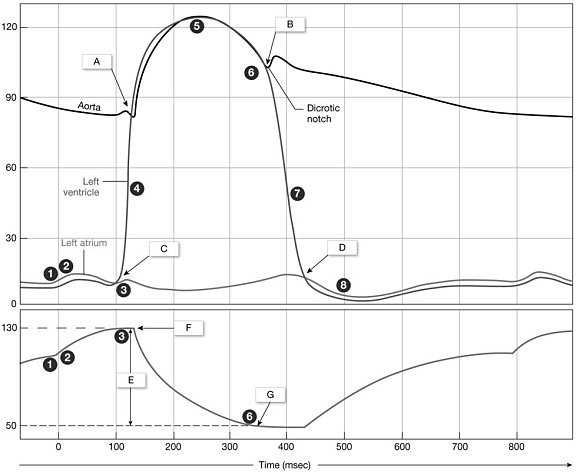
What occurs at "B" on the graph?
semilunar valve closes
Define heart failure. (Module 18.16A)
Heart failure is a condition where the heart can no longer meet the oxygen and nutrient demands of peripheral tissues.
The right ventricle pumps blood to the
right and left lungs
Which part of the conduction system initiates the depolarizing impulse, which spreads throughout the heart?
SA node
What does the ECG wave tracing represent?
electrical activity in the heart
What does the QRS complex represent in the ECG wave tracing?
ventricular depolarization
Contraction of the atria results from which wave of depolarization on the ECG tracing?
P wave
Which part of the intrinsic conduction system delays the impulse briefly before it moves on to the ventricles?
AV node
The T wave on an ECG tracing represents
ventricular repolarization
A slower-than-normal heart rate is called
bradycardia.
Why does tetany not occur in cardiac muscle? (Module 18.11A)
Tetany does not occur because cardiac muscle has a long refractory period that continues until relaxation is well under way so summation cannot occur, and thus tetany cannot occur.
Give the alternate terms for heart contraction and heart relaxation. (Module 18.9B)
The alternate term for heart contraction is systole and the alternate term for heart relaxation is diastole.
Define cardiac cycle. (Module 18.9A)
Cardiac cycle is the period between the start of one heartbeat and the beginning of the next.
Blood is supplied to the myocardium by
the coronary arteries.
The ________ deliver(s) blood to the myocardium.
right coronary artery and left coronary artery
The heart is actually (one, two, or three) pumps?
two pumps
Which chamber receives blood from the superior and inferior venae cavae?
right atrium
Which heart chamber receives blood from the pulmonary veins?
left atrium
Which heart chamber pumps oxygen-poor blood out the pulmonary trunk?
right ventricle
Which chamber pumps oxygenated blood out the aorta to the systemic circuit?
left ventricle
The ________ has a greater workload than the ________.
left ventricle; right ventricle
The first heart sound ("lubb") is associated with
closing of the mitral valve.
The pulmonary arteries carry blood to the
lungs.
The pulmonary semilunar valve prevents backward flow into the
right ventricle.
The ________ separate(s) the two ventricles.
interventricular septum
Identify the most muscular chamber.
Left ventricle
Name the inner lining of the heart.
Endocardium
Identify the valve found between the left atrium and left ventricle.
Bicuspid (mitral) valve
What heart chamber pushes blood through the aortic semilunar valve?
Left ventricle
Name the irregular ridges of muscle lining the ventricles that are not indirectly connected to the atrioventricular valves.
Trabeculae carneae
What fibrous structure functions to anchor the atrioventricular valves in a closed position?
Chordae tendineae
Blood on the right never mixes with blood on the left, once the heart is fully developed.
True
At a heart rate of 60 beats/minute, a cardiac cycle lasts
1 second.
________ is to contraction as ________ is to relaxation.
Systole; diastole
Name the ridged bundles of muscle found projecting inside the right atrium.
Pectinate muscles
Identify the right atrioventricular valve.
Tricuspid valve
Identfiy the valve located at the exit of the right ventricle.
Pulmonary semilunar valve
The moderator band is found on both the right and left side of the heart.
False
Oxygenated blood flows through the right side of the heart.
False
The portion of the tracing of an electrocardiogram, ECG, that represents ventricular depolarization is the __________.
QRS complex
What is the function of the coronary circulation?
Provide a blood supply to the heart
What is the ligamentum arteriosum?
A remnant of the ductus arteriosus
Which chamber of the heart exits into the pulmonary trunk?
Right ventricle
Identify the ear like flaps that are attached to the top chambers of the heart.
Auricle
The first branch off the arch of the aorta is the brachiocephalic artery in both the sheep and the human.
True
The base of the heart is located at the bottom of the heart.
False
List the phases of the cardiac cycle. (Module 18.10A)
atrial systole, atrial diastole, ventricular systole, ventricular diastole
The pulmonary veins carry blood to the
heart.
Which of the following does NOT contribute to the partial or complete blockage of the coronary arteries that causes coronary ischemia?
a stent
The left ventricle pumps blood to the
aorta.
Name the four chambers of the heart. (Module 18.1C)
left atrium, left ventricle, right atrium, right ventricle
A faster-than-normal heart rate is called
tachycardia
The superior portion of the heart where major blood vessels enter and exit is the
base.
Blood returning to the heart from the pulmonary circuit first enters the
left atrium.
Define autorhythmicity. (Module 18.12A)
Autorhythmicity is the ability of the heart to contract without neural or hormonal stimulation.
Blood returning to the heart from the systemic circuit first enters the
right atrium.
Which part of the intrinsic conduction system normally initiates the depolarizing impulse that causes a heartbeat?
SA node
Which of these structures conduct(s) action potentials the slowest?
AV node
Why is ventricular fibrillation fatal? (Module 18.13C)
Ventricular fibrillation is fatal because the ventricles quiver and do not pump blood to the systemic circulation.
Which pathology is described as a thickening and toughening of arterial walls?
arteriosclerosis
The inferior point of the heart is called the
apex.
Coronary veins empty into the
right atrium.
The ________ valve prevents backward flow into the left atrium.
bicuspid
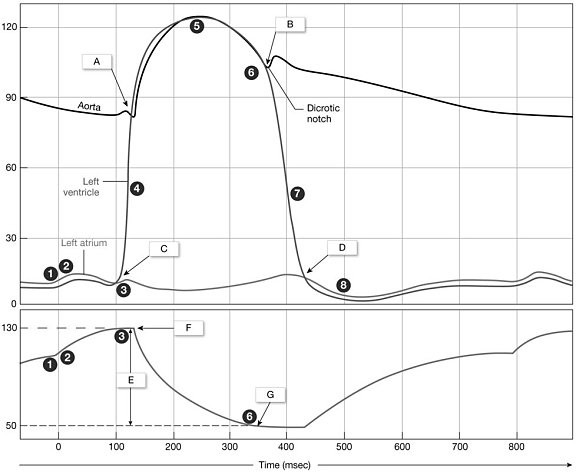
What occurs at "A" on the graph?
aortic semilunar valve opens
The heart beats approximately ________ times each day.
100,000
There are ________ pulmonary veins
4
Compared to the right ventricle, the left ventricle has all the following characteristics except that it
pumps a greater volume.
The heart pumps approximately ________ milliliters of blood each minute
6,000
________ is to slow heart rate as ________ is to fast heart rate.
Bradycardia; tachycardia
The first blood vessels to branch from the aorta are the ________ arteries.
coronary
The total volume of blood in the body of an adult male is approximately ________ liters.
5 to 6
Red blood cell production is regulated by the hormone ________ which is mostly produced in the ________.
erythropoietin; kidneys
White blood cells that are increased in individuals with allergic reactions are the
eosinophils.
How does a treatment with anti-Rh antibodies (RhoGAM) prevent hemolytic disease of the newborn (HDN)?
It destroys fetal RBCs that enter the maternal circulation.
The function of hemoglobin is to
carry oxygen.
Define hemostasis. (Module 17.10A)
Hemostasis is the process of stopping bleeding.
Which of the following are the most abundant of the formed elements?
erythrocytes
A cancer involving neutrophils, eosinophils, or basophils is called a
myeloid leukemia.
Whole blood for testing in a clinical laboratory is usually collected from
a superficial vein.
When a person who lives at sea level vacations in the Rocky Mountains, you would expect
All of the answers are correct.
Which of the following is NOT a function of the blood?
generates body temperature
Platelets are pinched off from giant multinucleated cells in the bone marrow called
megakaryocytes.
Hemolytic disease of the newborn may result if
an Rh-negative mother carries an Rh-positive fetus.
Plasma is closest in ionic composition to
interstitial fluid.
A person's blood type is determined largely by the
presence of specific glycoproteins on the cell membrane.
Most of the iron that is removed from degraded hemoglobin is
recycled to red bone marrow.
During a bacterial infection you would expect to see increased numbers of
neutrophils
All of the following are components of the cardiovascular system except
lymph vessels.
The normal pH of blood is
slightly alkaline.
The combination of plasma and formed elements is called
whole blood.
Why can't a person with type A blood safely receive blood from a person with type B blood? (Module 17.7D)
A person with type A blood will have anti-B antibodies that will agglutinate with type B blood.
Which of the following is not a function of blood?
produce hormones
Which blood disorder involves a deficiency of Vitamin B12?
pernicious anemia
Formed elements make up about what percentage of blood?
45 percent
The process of red blood cell production is called
erythropoiesis.
People with type AB blood are considered the "universal recipient" for transfusions because
their blood lacks A or B antibodies.
 Note
Note  Flashcards (28)