BISC 333 Midterm 1 - Drosophilla
 Call Kai
 Learn
Learn Practice Test
 Spaced Repetition
 Match
Match Flashcards
 Knowt Play
1/34

There's no tags or description
Looks like no tags are added yet.
Name | Mastery | Learn | Test | Matching | Spaced | Call with Kai |
|---|
No analytics yet
Send a link to your students to track their progress
35 Terms
Imaginal Discs
-Give rise to adult structures
-Patterened during embryogenesis
-Don't appera till later so if anything goes wrong in patterening it will affect the final product
Cleavge divisions
-Are rapid and synchronous
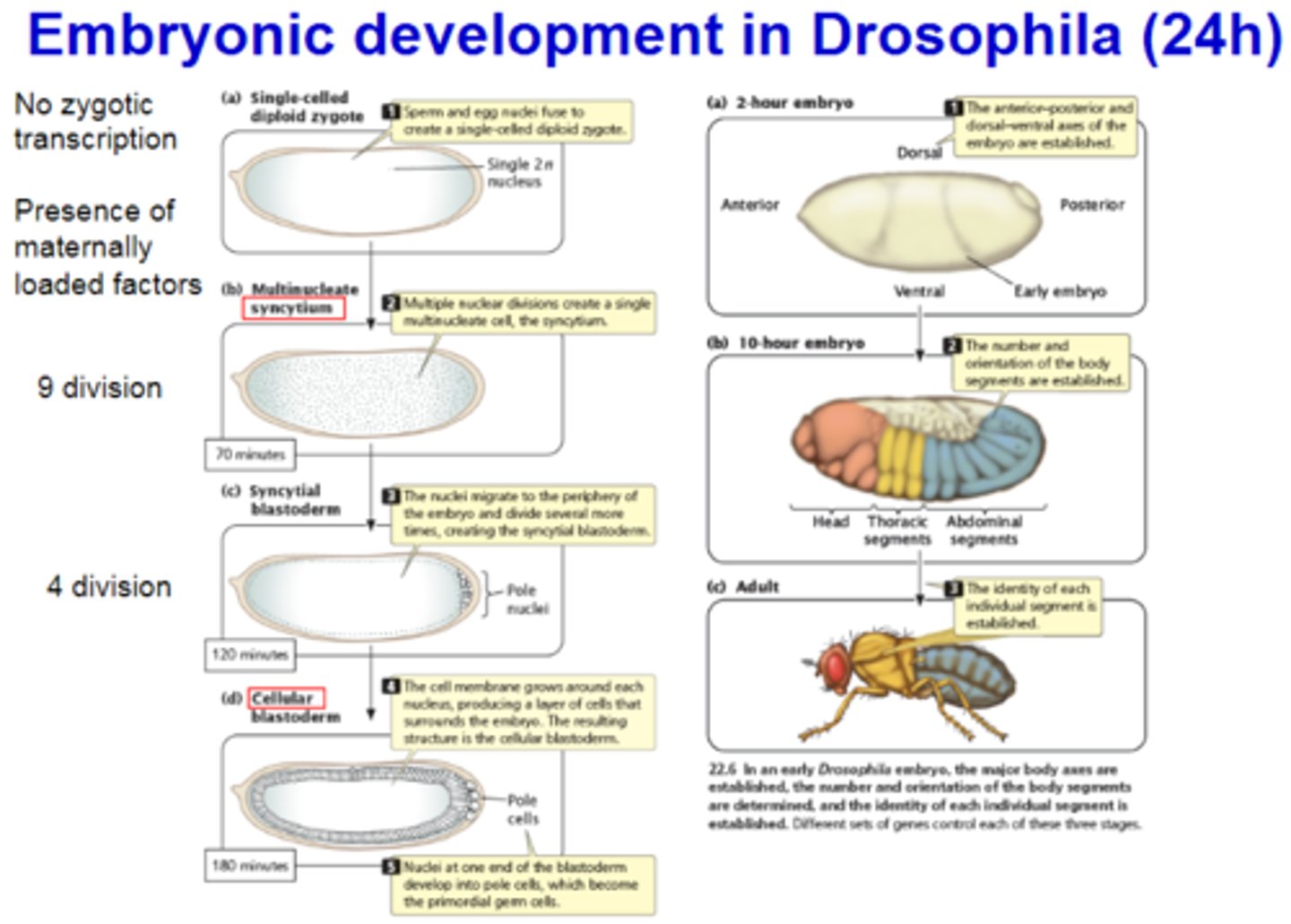
-Occur in syncytium ( only nuclei diivde)
9 divisions
nuclei move to periphery
12 divisions
-membranes grown in from the periphery and the blastoderm becomes cellular after 13 rounds
-15 pole cells at posterior are set aside and will later form germ cells
Gastrulation
-Mesoderm invaginates on ventral side, fist forminga tube
-gut form 2 invagination on both sides of embryo
Neuroblasts
-Nervous system starts to form when neuroblasts delaminate from ventral ecyoderm
What are the 2 major axis
Anterior-Posterior
Dorsal-Ventral
Segments
3- thoracic
8 -Abdominal
Oocyte
-egg chamber
-signals from older egg chamber polarize younger ones
Bicoid mRNA
-Produced by nurse cells
-Localized to anterior end
Nanos mRNA
-Produced by nurse cells
-Localized to posterior end
Maternal effect genes
-The genotype of the mother determines the phenotype of the embryo
Dorsal-Ventral axis formation
-Gurken prevents synthesis of pipe on the dorsal side
-The formation and activation (by cleaving) of the recptor toll
-Triggers the degradation of Cactus protein and allows the translocation of the dorsal protein into nucleus
What specifiec along the dorsal- ventral axis
Genes are activated/repressed by different concentration of dorsal protein, leading to different fates along the axis
What is a dorsalized/ventralized embryo
Dorsalized -dorsal structures where ventral structure would form
Ventralized- ventral strcuture where dorsal structure would be
Dorsal acts like a morphogen
-dorsal will act like a morphogen to establish different fates along d-v axis
-acts like a transcription factor and activates or represses different target genes at different concentrations specifying for mesoderm and neuroectoderm
Dorsal Morphogen gradients
High - Rhomboid and snail can both bind
(snail represses rhomboid)
Low Concen- Only high affinity sites are able to bind so (rhomboid)
Dpp
-protein and morphogen
-confined only to dorsal due to Dorsal protein and Sog
-Specifies form amnioserosa and dorsal ectoderm
Ventral fate
Controlled by dorsal protein
toll recptors bind to toll ligands which causes the degradation of catctus which releases dorsal protein into the nucleus which acts like a morphogen. when at high concensnail and rhomboid will bind but snail will repress rhomboid when low concentration only rhomboid will bind
Bicoid protein
Anterior protein
-Forms a gradient due to being able to diffuse freely through syncytium
-Bicoid causes the formation of anterior structure wherever it is placed
-prevents translation of Caudal
-transcription factor to activate anterior genes (hunchback)
-translational repressor to suppress posterior genes (caudal0
Caudual
Posterior protein
-responsible for the formation of abdominal structures
-form gradient with high concentration at the posterior end
-transcription factor and activates posterior genes
Nanos
Posterior protein
-Prevents translation of hunchback
-Translational repressor to suppress anterior genes
(hunchback )
Hunchback
-form gradients
-defines the expression of kruppel
Gradient to a stripe
-Hunchback forms a gradient as it diffuses toward the posterior end
-Hunchback can act as a repressor and activator for the same gene at different concentrations ( not activated when too high or low )
-Means kruppel is only specified in a specific window
Kruppel
-Gap gene
-helps establish the a-p segment patterning formation
-gap genes work together to activate pair rule genes
-Kruppel mutant embryos are missing, kruppel expression domains and this mutation is lethal
Even skipped
-pair rule gene
-expression is initally broad then becomes confine to 7 stripes
-activator and repressor confine the expression
-activators and repressors are generally maternal or gap genes
-Repressors limit the expression domain since activators are broadly expressed
-transiently expressed in developing embryo
-Even skipped display hal the number of denticle bands
Parasegments
-transient subdivisions that occur in the Drosophila embryo prior to the formation of segments
-One psterior part and one anterior part
How to make pair rule stripes
-activator and repressor binding sites for gap genes
-enchancer elements for each eve stripe
-LacZ=reporter gene
Gap genes activate primary pair rule which will activate secondary pair rule genes
parasegment border
-a feedback loop involving Wg and Hh signaling establishes the parasegment border
-Loss od Wg leads to the loss of segment polarity. genes normally expressed in posterior part of segment are lost means cells apodt and anterior fate
Wigngless signal tarnsduction pathway
when wnt is present them Bcatein degradation is inhibited and accumulates
Compartment
boundaries to restrict the movement of cells
Summary-Segment formation
-maternal genes activate gap genes
-gap genes in combination activate pair rule genes
-pair rule genes define parasegments and together with gap genes establish their identity
-Segmentation genes establish segment borders and fix them so they are permentantly expressed
Flow of a-p patterening genes
maternal -->gap genes -->pair rule genes-->segment polarity and segment identity
Hox genes
-specifify parasegemtn identty
- all hox genes are homebox transcription factors
-conserved throughout animals
-initial expression is established by gap and pair rule genes, maintainance of expression depends on Polycomb genes
The bithorax comples
-differences in expression levels in part determin parasegment indentity
-darker colour +higher expression
-Bithorax xomplex specifies PD 5-14
-The antennapedia comples specifies PS 1-4

