Lec 2 Part A - Genes, Environment, and Prenatal Development
 Studied by 0 people
 Call with Kai
 Learn
Learn Practice Test
 Spaced Repetition
 Match
Match Flashcards
 Knowt Play
1/21

Earn XP
Description and Tags
Flashcards covering key terms and concepts related to genes, environment, and developmental psychology.
Name | Mastery | Learn | Test | Matching | Spaced | Call with Kai |
|---|
No study sessions yet.
22 Terms
Behavioral Genetics
What are the three mechanisms of inheritance?
The study of the effects of genes and environment on behavior.
Single gene-pair: trait is influenced by ONE pair of genes e.g. eye color
Sex-linked: traits are influenced by genes located on sex chromosomes, typically X-linked. E.g. color blindness
Polygenetic: traits are influenced by multiple genes, resulting in a continuous range of phenotypes, such as height.
Heritability (in twin studies, what’s the equation?)
The proportion of variation in a trait in a population attributable to genetic differences, ranging from 0 to 1. (not a stable nor fixed number)
=> In twin studies, Total variance = Genes + Shared environment + Nonshared environment
Note: non-shared factors often explain more variation in adulthood as we age we get into more of these enviro.
Phenotype
The observable characteristics or traits of an organism resulting from the interaction of its genotype with the environment.
Twin Studies
Research comparing the similarity of identical twins to fraternal twins to understand genetic influence.
Core logic: if MZ twins have greater similarity, this suggests some level of genetic influence. Therefore, it can help separate nature and nurture.
Adoption Studies
Research comparing adopted children to their biological and adoptive parents to isolate genetic and environmental influences.
Similarity to biological parents suggest genetic effects
Whereas similarity to adoptive parents suggest environmental effects
Family studies: Core logic
Compare relatives with graded genetic similarity => full siblings (50%), half siblings (25%), step-siblings (0%)
Estimate both genetic and environmental contributions, cost-effective complement to twin and adoption studies
Molecular genetics studies
Link specific gene variants to traits and behaviors
Genome-wide association studies (GWAS) are used to identify risk variants
Estimates around 10% of variance can be explained be genetic influences
Intelligence: heritability key findings
General samples of overall heritability
Age trends
Moderation the effect of SES - is this found cross-culturally?
50%
Genetic influences with age as individuals select environments that fit their genes (overall fluctuation)
With high SES, there is high heritability (around 72%), but with low SES there is low heritability (around 10%)
Core logic: in an adequate environment (higher SES), we’re more likely to have adequate opportunities e.g. books. This helps our genetic potential to be reached => environmental limitations suppress genetic expression
BUT not all replication studies show similar results, Australia, for example, has a social welfare program, so the SES findings might not apply there
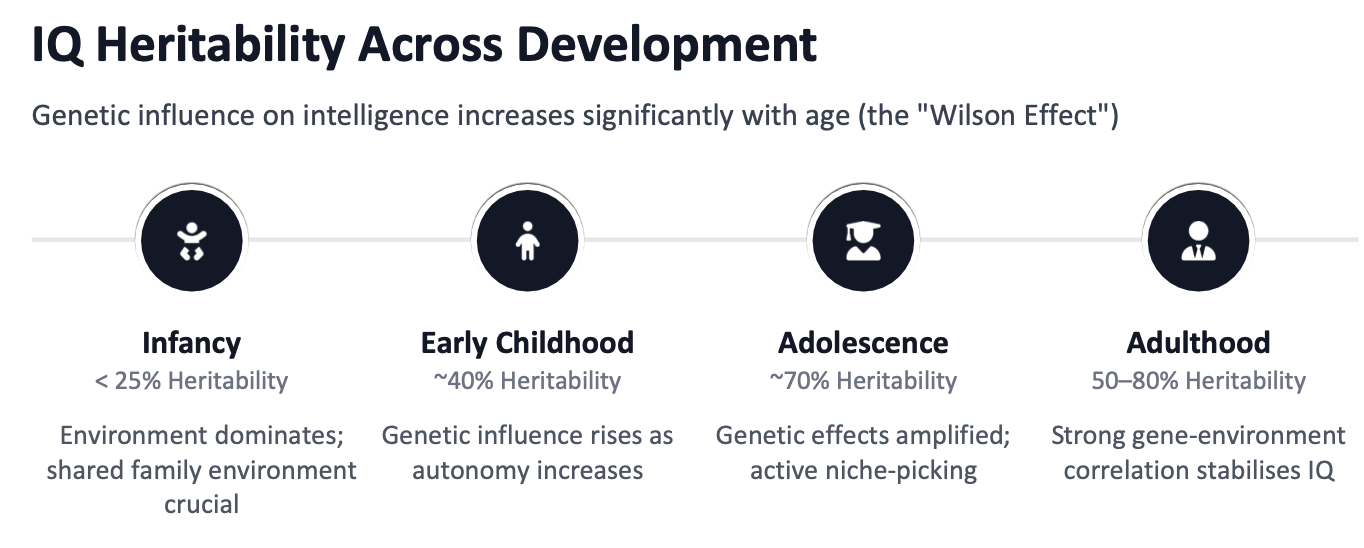
What is the Wilson effect?
Amplification
Niche-picking
Shared environment
Genetic influence on intelligence increases significantly with age
Genetic differences grow larger over time
Selecting environments that match genotype
Declining influence from childhood to adulthood
Temperament and Personality - Heritability
Genetic contribution
Nonshared environment
Shared environment
40% of the variation in major personality dimensions among adults is attributable to genetic differences
55% of unique life experiences account for the majority of personality variance
5% of common family experiences have a minimal effect on adult personality similarity
How much heritability do the Big 5 traits show?
What is the effect of temperament in infancy?
Overall, what dominates personality?
35-45% Stability increases with age, genes exert stronger influence
Temperament in infancy predicts adult personality (early biological programming - longitudinal studies) but life experiences e.g. accidents can shape personality throughout lifespan
Nonshared environment: unique life experiences create significant personality differences between siblings, e.g. peer groups, differential parental treatment or expectations, social niches.
Psychological conditions/disorders overview
What type of genetic liability and environmental tr_ggers
Does heritability vary widely by condition?
Is family history deterministic?
What is crucial for onset and course?
Polygenetic liability
Yes, by 20-80%
No, it only increases risk
Environmental factors
Case study: Schizophrenia
Heritability
Twin studies MZ vs DZ twins
Adoption studies
80%, one of the highest heritability rates among psychological disorders
48% for MZ twins vs 17% DZ twins (3x more likely for MZ twins)
Increased risk if a biological parent is affected, regardless of adoptive home environment
Other examples:
Depression
ADHD
Autism spectrum
40%, which stress trriggers
75%, neurodevelopmental
=> pharmological and behavioral support available
80%, neurodevelopmental (early identification can be useful_
Neurodevelopmental: in early development, something in the brain is already altered
Note: environmental support improves outcomes for many conditions
What is gene-environment interactions?
Genetic effects depend on environment context
Same gene variant can confer risk OR resilience depending on environment quality
High quality environments may compensate for potential genetic vulnerabilities
GxE
Diathesis-Stress Model
A model that explains how genetic predisposition and environmental stressors interact to produce mental disorders.
Diathesis - vulnerability, we all carry hidden genetic risk
Stress - the trigger, environmental stressor
Their interaction is the key => diathesis and stress together leading to an outcome
GxE
Differential susceptibility
Some individuals are more malleable to environmental quality
Some are highly sensitive to BOTH negative and positive environments
Some are more resilient and less affected by environmental variation
GxE
Study: Caspi et al. (2003)
Core finding
Alleles
Replication studies
Genetic vulnerability is conditional on environmental exposure
Short allele is the genetic vulnerability; under high stress, short-allele carriers had significantly higher rates of depression after childhood maltreatment. Under supportive environments/low stress, short allele carriers showed minimal or no increased risk (in comparison to long-allele carriers)
Genes create latent risk and environment affects the expression. Replication attempts have shown mixed results
Genetic Amplification
The phenomenon where genetic influence on traits becomes stronger as individuals grow older.
rGE (GxE correlations)
Passive Gene-Environment Correlations
Evocative Gene-Environment Correlations
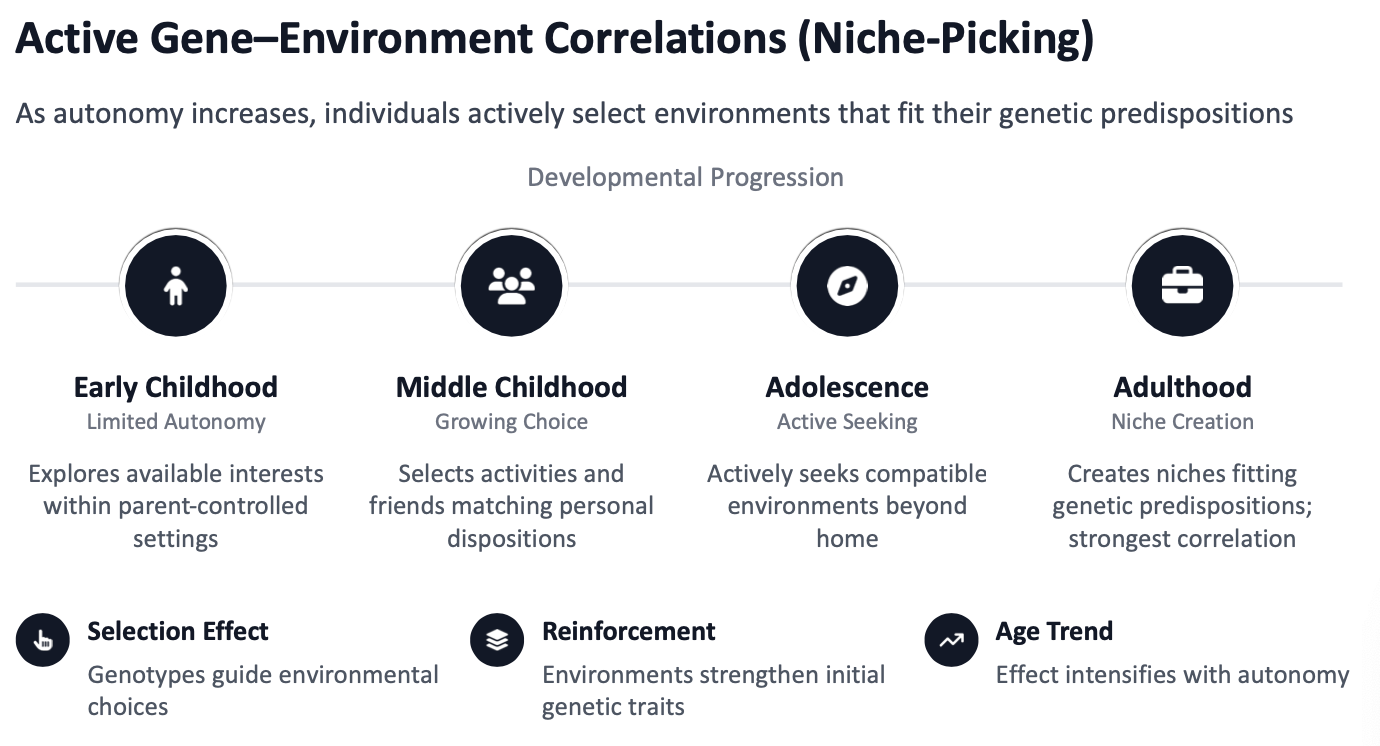
Active (niche-picking) Gene-Environment Correlations
Situation where parents provide genes and environments that match those genes.
Athletic parents passing athletic genes and creating a sports-oriented family culture (reinforces genetic predispositions => ice-hockey Hughes family)
When a person’s genetically influenced traits (personality) elicit specific responses from others in their environment.
A sociable infant receives more social engagement, is likeable and treated more positively
The process where individuals actively search for environments that suit their genetic predispositions.
Early childhood
Middle childhood (growing choice - select activities and friends)
Adolescence (active seeking - compatible enviro. beyond home)
Adulthood (niche - niches fitting genetic predispositions)
Epigenetics
DNA methylation
Histone modification
The study of changes in gene expression caused by environmental factors other than changes in the underlying DNA sequence.
=> diet, stress, toxins, social experiences
Silence DNA sequence by adding a small chemical tag
Can loosen or tighten genes
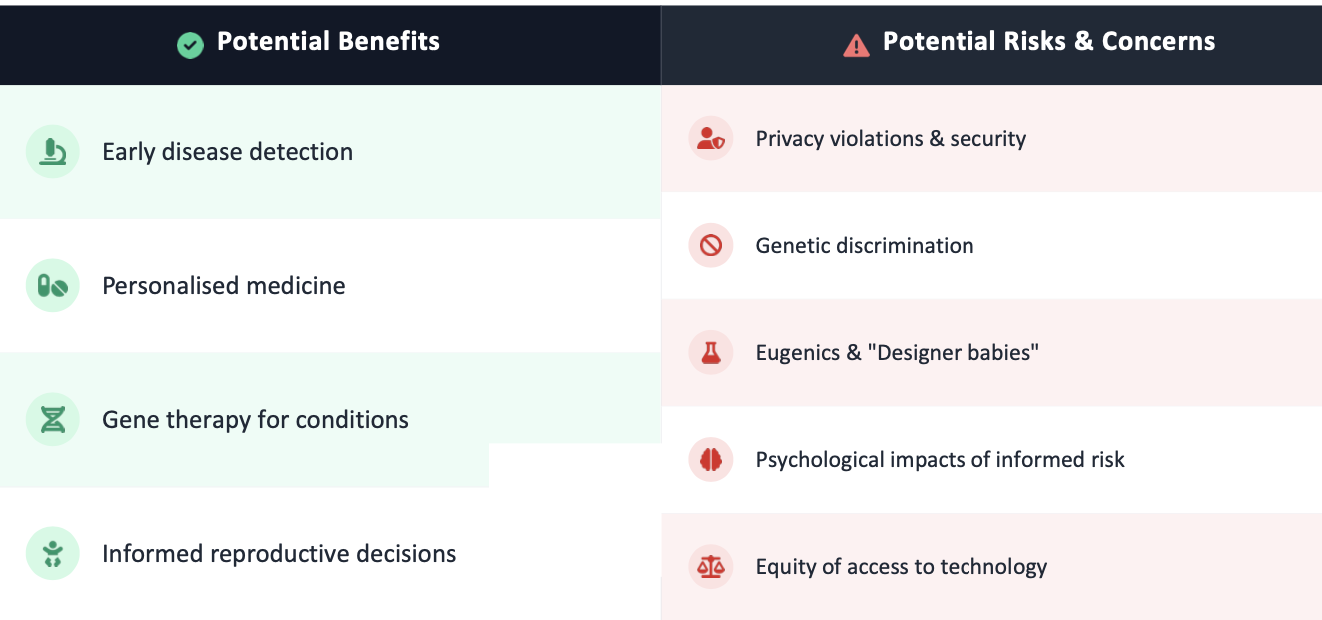
What are some implications and ethical issues in genetics?
 Note
Note  Flashcards (58)