Heritability and individual differences: Eating behaviour and weight
 Studied by 0 people
 Call Kai
 Learn
Learn Practice Test
 Spaced Repetition
 Match
Match Flashcards
 Knowt Play
1/20

There's no tags or description
Looks like no tags are added yet.
Name | Mastery | Learn | Test | Matching | Spaced | Call with Kai |
|---|
No analytics yet
Send a link to your students to track their progress
21 Terms
What is the heritability range of body weight?
50–90%.
What evidence shows weight is genetically influenced?
dentical (MZ) twins are much more similar in body weight than non‑identical (DZ) twins.
What were the TEDS heritability estimates for BMI and waist circumference at age 8–11?
BMI SDS heritability = 0.77
Waist circumference heritability = 0.76
How many genetic loci have been associated with BMI?
1000 loci.
Why can rising obesity rates NOT be explained by genetics alone?
The gene pool has not changed in 30 years — the environment must be responsible.
What is the “obesity paradox”?
Both genes and environment strongly determine obesity risk.
What factors contribute to an obesogenic food environment?
High availability & variety
Large portion sizes
Low cost
Advertising
High energy density
What factors contribute to an obesogenic activity environment?
Labour‑saving devices
Sedentary travel
Enjoyable sedentary activities
High ambient temperatures
Limited access to outdoor activity
What does Behavioural Susceptibility Theory (BST) propose?
Genes influence weight via appetite.
genetic predisposition for appetite traits determines how someone responds to food environment
LLewellyn & wardle 2015
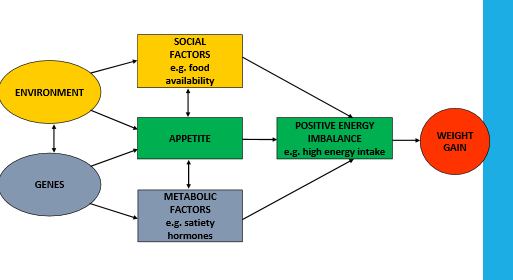
What are the two key appetite traits in BST?
Food Responsiveness (FR) - extent to which you want to eat something in response to seeing or smelling food
Satiety Sensitivity (SS) - the extent which you recognised the internal feelings of being full
Why are children ideal for appetite studies?
Less dieting
Less social desirability
Less long‑standing obesity
Enables cause–effect inference
How is appetite commonly measured in research?
Using the Child Eating Behaviour Questionnaire (CEBQ).
What study supports the high heritability of appetite?
The Gemini twin cohort — MZ twins showed much higher similarity in appetite traits than DZ twins.
What were the heritability values for appetite traits in the Gemini study?
Food Responsiveness: 0.59
Satiety Sensitivity: 0.72
How is appetite associated with weight in children?
Higher SS → lower BMI & waist
Higher FR → higher BMI & waist
From TEDS study
What does the meta‑analysis of 72 studies show?
Food Responsiveness → consistently linked to higher body weight
Satiety Sensitivity → consistently linked to lower body weight
How does appetite influence early weight gain?
Babies with bigger appetites gain more weight from birth to 15 months (~1 kg difference; 10%).
casual relationship
Give an example of G×E interaction described in the lecture
Two genetically predisposed individuals:
Healthy environment → genes NOT expressed
Obesogenic environment → genes ARE expressed
How has the heritability of BMI changed over time
It has increased across birth cohorts during the obesity epidemic.
What did the Home Environment Inventory study (2018) find?
BMI heritability is higher in more obesogenic home environments.
(Genetic effect: 0.86 vs 0.39; Environmental effect: 0.14 vs 0.61)
twins at 4 years own (gemini)
What is the key message summarised
Body weight results from genes interacting with the environment. People express genetic risk only in permissive (obesogenic) environments.
 Note
Note  Flashcards (20)