General IGCSE History - Core content
 Call Kai
 Learn
Learn Practice Test
 Spaced Repetition
 Match
Match Flashcards
 Knowt Play
1/97

There's no tags or description
Looks like no tags are added yet.
Name | Mastery | Learn | Test | Matching | Spaced | Call with Kai |
|---|
No analytics yet
Send a link to your students to track their progress
98 Terms
High Hopes for Peace
Looking back it may seem that the peacemakers in 1919 had an impossible job. But that is not how people saw it at the time. There was great optimism. One of the main reasons for these high hopes was the American President Woodrow Wilson. In 1918 Wilson made a speech outlining Fourteen Points (see Factfile), guidelines for a just and lasting peace treaty to end conflict. When he arrived in Europe for the Paris Peace Conference, Wilson was seen almost as a saintly figure. Newspaper reports described wounded soldiers in Italy trying to kiss the hem of his cloak and in France peasant families kneeling to pray as his train passed by.
Wilson’s ideas
Don’t be too harsh on Germany. Wilson did believe Germany should be punished. But he also believed that if Germany was treated harshly, some day it would recover and want revenge. He was also concerned that extremist groups, especially communists, might exploit resentment among the Germans and communists might even seize power in Germany as they had in Russia in 1917. ■ Strengthen democracy in defeated countries. For Wilson democracy was a key to peace in Europe. If leaders in defeated nations had to listen to the views of their people and win their votes those people would not let their leaders cause another war. ■ Give self-determination to small countries that had once been part of the European empires. He wanted the different peoples of eastern Europe (for example, Poles, Czechs and Slovaks) to rule themselves rather than be part of Austria–Hungary’s empire. ■ International co-operation. Wilson also believed that nations should co-operate to achieve world peace. This would be achieved through a ‘League of Nations’, Wilson’s most important of the Fourteen Points. You can see from these principles that Wilson was an idealist. However, he was not a politician who could be pushed around. For example, he refused to cancel the debts owed to the USA by Britain and its Allies so that he could put pressure on them to accept his ideas.
The Fourteen points
No secret treaties.
2 Free access to the seas in peacetime or wartime
. 3 Free trade between countries
. 4 all countries to work towards disarmament.
5 Colonies to have a say in their own future.
6 German troops to leave Russia.
7 Independence for Belgium.
8 France to regain alsace–Lorraine
. 9 Frontier between austria and Italy to be adjusted.
10 Self-determination for the peoples of eastern Europe(they should rule themselves and not be ruled by empires).
11 Serbia to have access to the sea
. 12 Self-determination for the people in the Turkish empire.
13 Poland to become an independent state with access to the sea.
14 League of Nations to be set up
Did everyone share Wilson’s viewpoint?
Not surprisingly, when Wilson talked about lasting peace and justice other leaders agreed with him. After all, who would want to stand up in public and say they were against a just and lasting peace?! However, many were doubtful about Wilson’s ideas for achieving it. For example, ‘self-determination’: it would be very difficult to give the peoples of eastern Europe the opportunity to rule themselves because they were scattered across many countries. Some people were bound to end up being ruled by people from another group with different customs and a different language. Some historians have pointed out that while Wilson talked a great deal about eastern and central Europe, he did not actually know very much about the area. There were other concerns as well. So let’s look at the aims and views of the other leaders at the Paris Peace Conference: David Lloyd George (from Britain) and Georges Clemenceau (from France).
Did Lloyd George agree with Wilson?
In public Lloyd George praised Wilson and his ideas. However, in private he was less positive. He complained to one of his officials that Wilson came to Paris like a missionary to rescue the Europeans with his little sermons and lectures. He agreed with Wilson on many issues, particularly that Germany should be punished but not too harshly. He did not want Germany to seek revenge in the future and possibly start another war. Like Wilson he was deeply concerned that a harsh treaty might lead to a communist revolution like the one in Russia in 1917. He also wanted Britain and Germany to begin trading with each other again. Before the war, Germany had been Britain’s second largest trading partner. British people might not like it, but the fact was that trade with Germany meant jobs in Britain. However, unlike Wilson, Lloyd George had the needs of the British empire in mind. He wanted Germany to lose its navy and its colonies because they threatened the British empire.
Pressures on Lloyd George
Lloyd George faced huge public pressures at home for a harsh treaty (see Source 2). People in Britain were not sympathetic to Germany in any way. They had suffered over 1 million casualties in the fighting, as well as food shortages and other hardships at home. They had been fed anti-German propaganda for four years. They had also seen how Germany had treated Russia in 1918 when Russia surrendered. Under the Treaty of Brest-Litovsk Germany had stripped Russia of 25 per cent of its population and huge areas of Russia’s best agricultural land. Lloyd George had just won the 1918 election in Britain by promising to ‘make Germany pay’, even though he realised the dangers of this course of action. So Lloyd George had to balance these pressures at home with his desire not to leave Germany wanting revenge.
Did Clemenceau agree with Wilson?
In public, Clemenceau of course agreed with Wilson’s aim for a fair and lasting peace. However, he found Wilson very hard to work with. While he did not publicly criticise the Fourteen Points, Clemenceau once pointed out that even God had only needed Ten Commandments! The major disagreement was over Germany. Clemenceau and other French leaders saw the Treaty as an opportunity to cripple Germany so that it could not attack France again. Pressures on Clemenceau France had suffered enormous damage to its land, industry, people – and self-confidence. Over two-thirds of the men who had served in the French army had been killed or wounded. The war affected almost an entire generation. By comparison, Germany seemed to many French people as powerful and threatening as ever. German land and industry had not been as badly damaged as France’s. France’s population (around 40 million) was in decline compared to Germany’s (around 75 million). The French people wanted a treaty that would punish Germany and weaken it as much as possible. The French President (Poincaré) even wanted Germany broken up into a collection of smaller states, but Clemenceau knew that the British and Americans would not agree to this. Clemenceau was a realist and knew he would probably be forced to compromise on some issues. However, he had to show he was aware of public opinion in France
Clemenceau clashed with Wilson over many issues.
The USA had not suffered nearly as badly as France in the war. Clemenceau resented Wilson’s more generous attitude to Germany. They disagreed over what to do about Germany’s Rhineland and coalfields in the Saar. In the end, Wilson had to give way on these issues. In return, Clemenceau and Lloyd George did give Wilson what he wanted in eastern Europe, despite their reservations about his idea of self-determination. However, this mainly affected the peace treaties with the other defeated countries rather than the Treaty of Versailles.
Clemenceau also clashed with Lloyd George
particularly over Lloyd George’s desire not to treat Germany too harshly. For example, Clemenceau said that ‘if the British are so anxious to appease Germany they should look overseas and make colonial, naval or commercial concessions’. Clemenceau felt that the British were quite happy to treat Germany fairly in Europe, where France rather than Britain was most under threat. However, they were less happy to allow Germany to keep its navy and colonies, which would be more of a threat to Britain.
Wilson and Lloyd George did not always agree either.
Lloyd George was particularly unhappy with point 2 of the Fourteen Points, allowing all nations access to the seas. Similarly, Wilson’s views on people ruling themselves were threatening to the British government, for the British empire ruled millions of people all across the world from London.
TOV - WAR GUILT
Article 231 of the Treaty was simple but was seen by the Germans as extremely harsh. Germany had to accept the blame for starting the war.
TOV - Reparations
The major powers agreed, without consulting Germany, that Germany had to pay reparations to the Allies for the damage caused by the war. The exact figure was not agreed until 1921 when it was set at £6,600 million (132 billion gold marks) – an enormous figure. If the terms of the payments had not later been changed under the Young Plan in 1929 (see page 38), Germany would not have finished paying this bill until 1984. ■ France also received the coal from the Saarland for fifteen years.
TOV - German territory and colonies
Germany’s European borders were very extensive, and the section dealing with German territory in Europe was a complicated part of the Treaty. You can see the detail in Figure 6. The Treaty also forbade Germany to join together (Anschluss) with its former ally Austria.
Germany’s overseas empire was taken away. It had been one of the causes of bad relations between Britain and Germany before the war. Former German colonies, such as Cameroon, became mandates controlled by the League of Nations, which effectively meant that France and Britain controlled them
TOV - German Armed forces
The size and power of the German army was a major concern, especially for France. The Treaty therefore restricted German armed forces to a level well below what they had been before the war. ■ The army was limited to 100,000 men
. ■ conscription was banned – soldiers had to be volunteers.
■ Germany was not allowed armoured vehicles, submarines or aircraft.
■ The navy could have only six battleships and 15,000 sailors.
■ The Rhineland became a demilitArised zone. This meant that no German troops were allowed into that area. The Rhineland was important because it was the border area between Germany and France (see Figure 6).
TOV - LON
Previous methods of keeping peace had failed and so the League of Nations was set up as an international ‘police force’. (You will study the League in detail in Chapter 2.) ■ Germany was not invited to join the League until it had shown that it was a peace-loving country.
General German reactions to the Treaty of Versailles
The government that took Germany to war in 1914 had been overthrown in a revolution and the new democratic government in Germany was hoping for fair and equal treatment from the Allies. When the terms were announced on 7 May the Germans were horrified. Their reasons are summarised in the diagram opposite. The new German government refused to sign the Treaty and the German navy sank its own ships in protest. At one point, it looked as though war might break out again. But what could the German leader Friedrich Ebert do? Germany would quickly be defeated if it tried to fight. Reluctantly, Ebert agreed to accept the terms of the Treaty and it was signed on 28 June 1919
German reaction to the treaty of versailles - War guilt and reparations
This ‘war guilt’ clause was particularly hated.
Germans did not feel they had started the
war. They felt at the very least that blame
should be shared.
• They were bitter that Germany was expected
to pay for all the damage caused by the war
even though the German economy was
severely weakened
German reaction to the treaty of versailles - Disarmament
Germans felt these terms were very unfair. An
army of 100,000 was very small for a country
of Germany’s size and the army was a symbol
of German pride.
Also, despite Wilson’s Fourteen Points calling for
disarmament, none of the Allies were being
asked or forced to disarm in the same way.
German reaction to the treaty of versailles - Territories
Germany certainly lost a lot
of territory.
• 10 per cent of its land in Europe
• All of its overseas colonies
• 12.5 per cent of its population
• 16 per cent of its coalfields and
almost half of its iron and steel
industry.
This was a major blow to German pride, and
to its economy. Both the Saar and Upper Silesia
were important industrial areas.
Meanwhile, as Germany was losing colonies,
the British and French were increasing their
empires by taking control of German territories
in Africa
German reaction to the treaty of versailles -The Fourteen Points
and the League of Nations
To most Germans, the treatment of Germany
was not in keeping with Wilson’s Fourteen
Points. For example, while self-determination
was given to countries such as Estonia,
Latvia and Lithuania, German-speaking
peoples were being hived off into new
countries such as Czechoslovakia to be ruled
by non-Germans. Anschluss (union) with
Austria was forbidden.
• Germany felt further insulted by not being
invited to join the League of Nation
German reaction to the treaty of versailles - Non representation
Germans were angry that their government was
not represented at the peace talks and that they
were being forced to accept a harsh treaty
without any choice or even comment. Germans
did not feel they had lost the war so they should
not have been treated as a defeated country.
Consequences of versailles for germany - General
The Treaty of Versailles had a profound effect on Germany for the next ten
years and more. The Treaty was universally resented. The historian Zara
Steiner argues that hatred of the Versailles Treaty was almost the only issue
which all Germans in this period agreed on.
Many Germans viewed the signing of the Treaty as a betrayal and a
humiliation. Right-wing groups referred to the Weimar politicians as the
‘November Criminals’ who had stabbed Germany in the back at the end of
the war. Territorial losses to France, Belgium, Denmark and Poland meant
many ethnic Germans now lived in different countries, which led to social
problems and even conflict. Also, the creation of the Polish Corridor had
split East Prussia from the rest of Germany causing many German families
to migrate back to mainland Germany. The military restrictions left German
citizens feeling defenceless and demoralised as the German army had been
a source of pride for many.
Consequences of versailles for germany - Political violence
Right-wing opponents of Ebert’s government protested against the Treaty. In
1920, bands of ex-soldiers called Freikorps were ordered to disband by the
government as their existence broke the military terms of the Treaty. Led
by Wolfgang Kapp, an uprising began in March 1920 to overthrow Ebert and
install a nationalist government. This rising, called the Kapp Putsch, was
defeated by a general strike by Berlin workers which paralysed essential
services such as power and transport. It saved Ebert’s government
but it added to the chaos in Germany – and the bitterness of Germans
towards the Treaty.
Although Kapp was defeated, political violence remained a constant
threat. There were numerous political assassinations or attempted
assassinations. In the summer of 1922 Germany’s foreign minister
Walther Rathenau was unalived by extremists. Then in November
1923 Adolf Hitler led an attempted rebellion in Munich, known as
the Munich Putsch (see page 236). Hitler’s rebellion was defeated
but he was let off lightly when he was put on trial and it was clear
many Germans shared his hatred of Versailles. Over the next ten years
he exploited German resentment of the Treaty of Versailles to gain
support for himself and his Nazi party
Consequences of versailles for germany - Conflict in the Ruhr
Under the Treaty Germany agreed to pay £6,600 million in reparations
to the Allies. The first instalment of £50 million was paid in 1921, but
in 1922 nothing was paid. Ebert tried to negotiate concessions from
the Allies, but the French ran out of patience. In 1923 French and
Belgian soldiers entered the Ruhr region and simply took what was
owed to them in the form of raw materials and goods. This was quite
legal under the Treaty of Versailles.
The results of the occupation of the Ruhr were disastrous for Germany.
The German government ordered the workers to go on strike so that
they were not producing anything for the French to take. The French
reacted harshly, killing over 100 workers and expelling over 100,000
protesters from the region. More importantly, the strike meant that
Germany had no goods to trade, and no money to buy things with.
Their response led, in turn, to hyperinflation
There is much debate about the developments in the Ruhr. Most Germans
believed that the crisis arose because the reparations were too high
and Germany was virtually bankrupted. Many commentators at the time
(including the British and French leaders) claimed that Germany was quite
able to afford reparations: it just did not want to pay! Some historians
argue that Germany stopped paying reparations in order to create a crisis
and force the international community to revise the terms of the Treaty.
The debate goes on, but there is no doubt that most Germans at the time
believed the Treaty was responsible for the crisis and that the reparations
were far too high.
Consequences of versailles for germany - Hyper inflation
The government solved the problem of not having enough money by simply
printing extra money, but this caused a new problem – hyperinflation. The
money was virtually worthless, so prices shot up. The price of goods could
rise between joining the back of a
queue in a shop and reaching the front
(see page XXX)! Wages began to be
paid daily instead of weekly.
Some Germans gained from this
disaster. The government and big
industrialists were able to pay off
their huge debts in worthless marks.
But others, especially pensioners,
were practically left penniless. A
prosperous middle-class family would
find that their savings, which might
have bought a house in 1921, by 1923
would not even buy a loaf of bread
Germany eventually recovered from this disaster, but it left a bitter
memory. The bitterness was directed towards the Treaty of Versailles. It is
no coincidence that when Germany faced economic problems again in 1929
many Germans believed Hitler’s claims that the Treaty was to blame and
they should support his plans to overturn it.
Others said the Treaty was fair! - TOV
At the time German complaints about the Treaty mostly fell on deaf ears.
There were celebrations in Britain and France. If ordinary people in Britain
had any reservations about the Treaty it was more likely to be that it was
not harsh enough.
n Many people felt that the Germans were themselves operating a double
standard. Their call for fairer treatment did not square with the harsh
way they had treated Russia in the Treaty of Brest-Litovsk in 1918.
Versailles was a much less harsh treaty than Brest-Litovsk. This is the
comment being made in the cartoon on page 4.
n There was also the fact that Germany’s economic problems, although
real, were partly self-inflicted. Other states had raised taxes to pay
for the war. The Kaiser’s government had not done this. It had simply
allowed debts to mount up because it had planned to pay Germany’s war
debts by extracting reparations from the defeated states.
The birth of the league + Planning & Hopes - LON
After the First World War everyone wanted to avoid repeating the mass
slaughter of the war that had just ended. They also agreed that a League
of Nations – an organisation that could solve international problems
without resorting to war – would help achieve this. However, there was
disagreement about what kind of organisation it should be.
n President Wilson wanted the League of Nations to be like a world
parliament where representatives of all nations could meet together
regularly to decide on any matters that affected them all.
n Many British leaders thought the best League would be a simple
organisation that would only meet in emergencies. An organisation like
this already existed – the ConfereNCe of Ambassadors.
n France proposed a strong League with its own army.
It was President Wilson who won. He insisted that discussions about a
League should be a major part of the peace treaties and by February 1919
he had drawn up a very ambitious plan for the League.
All the major nations would join the League. They would disarm. If they
had a dispute with another country, they would take it to the League. They
promised to accept the decision made by the League. They also promised
to protect one another if they were invaded. If any member did break the
Covenant (see page 30) and go to war, other members promised to stop
trading with it and to send troops if necessary to force it to stop fighting.
Wilson’s hope was that citizens of all countries would be so much against
another conflict that this would prevent their leaders from going to war.
The plan was prepared in a great hurry and critics suggested there was
some woolly thinking. Some people were angered by Wilson’s arrogant style.
He acted as if only he knew the solutions to Europe’s problems. Others were
worried by his idealism. Under threat of war, would the public really behave
in the way he suggested? Would countries really do what the League said?
Wilson glossed over what the League would do if they didn’t.
Even so, most people in Europe were prepared to give Wilson’s plans a try.
They hoped that no country would dare invade another if they knew that the
USA and other powerful nations of the world would stop trading with them
or send their armies to stop them. In 1919 hopes were high that the League,
with the United States in the driving seat, could be a powerful peacemaker.
A body blow to the league - THE USA - LON
Back in the USA Woodrow Wilson had problems. Before the USA could even
join the League, let alone take a leading role, he needed the approval of his
Congress (the American ‘Parliament’). And in the USA the idea of a League
was not at all popular, as you can see from Figure 5.
Together, the critics of Wilson’s plans (see Figure 5) put up powerful
opposition to the League. They were joined by Wilson’s many other political
opponents. Wilson’s Democratic Party had run the USA for eight troubled
years. Its opponents saw the League as an ideal opportunity to defeat
him. Wilson toured the USA to put his arguments to the people, but when
Congress voted in 1919 he was defeated. So, when the League opened for
business in January 1920, the American chair was empty.
Reasons for opposition to the League in the USA.
The League was supposed to
enforce the Treaty of Versailles
yet some Americans, particularly
the millions who had German
ancestors, hated the Treaty itself.—
If the League imposed sanctions
(e.g. stopping trade with a
country that was behaving
aggressively) it might be
American trade and business
that suffered most!
Some feared that joining the
League meant sending US
soldiers to settle every little
conflict around the world.
No one wanted that after the
casualties of the First World War.
Some feared that the League
would be dominated by Britain
or France – and would be called
to help defend their empires!
Many in the US were anti-
empires.
Wilson defeated - LON
In 1920 Wilson became seriously ill after a stroke. Despite that, he
continued to press for the USA to join the League. He took the proposal
back to Congress again in March 1920, but they defeated it by 49 votes
to 35.
Still the Democrats did not give up. They were convinced that if the USA did
not get involved in international affairs, another world war might follow. In
the 1920 election Wilson could not run for president – he was too ill – but
his successor made membership of the League a major part of the Democrat
campaign.
The Republican candidate, Warren Harding, on the other hand, campaigned
for America to be isolationist (i.e. not to get involved in international
alliances but follow its own policies and self-interest). His slogan was to
‘return to normalcy’, by which he meant life as it was before the war, with
the USA isolating itself from European affairs. Harding and the Republicans
won a landslide victory.
The USA never joined the League. This was a personal rebuff for Wilson and
the Democrats, but it was also a body blow to the League.
The aims of the league - LON
A Covenant set out the aims of the League of Nations. These were:
to discourage aggression from any nation
to encourage countries to co-operate, especially in business and trade
to encourage nations to disarm
to improve the living and working conditions of people in all parts of
the world.
LON factfile
The League of Nations
n The League’s home was in
Geneva in Switzerland.
n Despite it being the brainchild of
the US president, the USA was
never a member of the League.
n The most influential part of the
League was the Council – a small
group representing the most
powerful members. But it was
a vast organisation with lots of
different parts to fulfil
different functions (see chart
on pages 32–33).
n The League did not have its
own army. But it could call on
the armies of its members if
necessary.
n One of the jobs of the League was
to uphold and enforce the Treaty
of Versailles. This included
running some of the territories
(mandates) that had belonged to
the defeated countries.
n Forty-two countries joined the
League at the start. By the 1930s
it had 59 members.
Article 10 - Collective security
Article 10 = collective security
The Covenant set out 26 Articles or rules, which all members of the League
agreed to follow. Probably the most important Article was Article 10. It said:
‘The members of the League undertake to preserve against external
aggression the territory and existing independence of all members of the
League. In case of threat of danger the Council [of the League] shall advise
upon the means by which this obligation shall be fulfilled.’
Article 10 really meant collective security. By acting together (collectively),
the members of the League could prevent war by defending the lands and
interests of all nations, large or small
Membership of the league
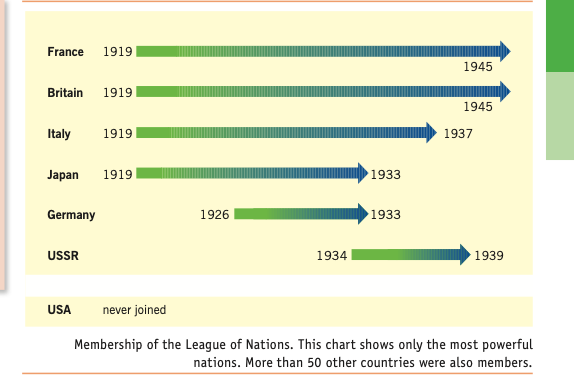
In the absence of the USA, Britain and France were the most powerful
countries in the League. Italy and Japan were also permanent members
of the Council. The League had 42 members when it was founded in
January 1920. Germany was not allowed to join until it could prove it was
a peaceful nation. It was allowed to join in 1926. The USSR was prevented
from joining until 1934 as many member states, including Britain and
France, did not trust communist states. Throughout the 1920s and 1930s it
was Britain and France who usually guided policy. Any action by the League
needed their support.
However, both countries were poorly placed to take on this role. Both
had been weakened by the First World War. Neither country was quite the
major power it had once been. Neither of them had the resources to fill
the gap left by the USA. Indeed, some British politicians said that if they
had foreseen the American decision, they would not have voted to join the
League either. They felt that the Americans were the only nation with the
resources or influence to make the League work. In particular, they felt
that trade sanctions would only work if the Americans applied them.
For the leaders of Britain and France the League posed a real problem. They
had to make it work, yet from the start they doubted how effective it could be.
Both countries had other priorities.
n British politicians, for example, were more interested in rebuilding
British trade and looking after the British empire than in being an
international police force.
n France’s main concern was still Germany. It was worried that without
an army of its own the League was too weak to protect France from its
powerful neighbour. It did not think Britain was likely to send an army
to help it. This made France quite prepared to bypass the League if
necessary in order to strengthen its position against Germany.
Organisation of the league - The Assembly
● This was the League’s ‘Parliament’.
● Every country in the League sent
a representative to the Assembly.
● The Assembly could recommend
action to the Council.
● It could also vote on admitting
new members to the League.
● The Assembly only met once a year.
● Decisions made by the Assembly
had to be unanimous – they had to
be agreed by all members of the
Assembly.
Organisation of the league - The Council
The Council was a smaller group than the Assembly, which met more often, usually about five times a year or more often in case of emergency. It included: ● permanent members. In 1920 these were Britain, France, Italy and Japan. ● temporary members. They were elected by the Assembly for three-year periods. ● Each of the permanent members of the Council had a veto. This meant that one permanent member could stop the Council acting even if all other members agreed. ● The main aim of the Council was to resolve disputes by talking. However, if this did not work, the Council could use a range of powers: ● Moral condemnation: they could decide which country was ‘the The Assembly aggressor’, and tell it to stop what it was doing. ● Economic and financial sanctions: members of the League could refuse to trade with the aggressor. ● Military force: the armed forces of member countries could be used against an aggressor.
Organisation of the league - The Secretariat
● The Secretariat was a sort of civil service serving all the other
bodies within the League.
● It kept records of League meetings and prepared reports.
● The Secretariat had a key role in
bringing together experts from across
the world on key issues such as health,
disarmament and economic matters.
Organisation of the league - The Permanent Court of
International Justice
● The Court was based at the Hague
in the Netherlands and was made
up of judges from the member
countries.
● This was meant to play a key role
in the League’s work by settling
disputes between countries
peacefully.
● If it was asked, the Court would
give a decision on a border
dispute between countries.
● However, the Court had no way
of making sure that countries
followed its rulings.
The International Labour Organization (ILO) -The International Labour Organization (ILO)
● The ILO brought together employers,
governments and workers’ representatives.
● Its aim was to improve the conditions
of working people throughout the world.
● It collected statistics and information about
working conditions and how to improve them
and it tried to persuade member countries to
adopt its suggestions.
The League of Nations Agencies and Commissions - The Mandates Commission
The First World War had led to many former colonies of
Germany and her allies ending up as League of Nations
mandates ruled by Britain and France on behalf of the
League. The Mandates Commission was made up of
teams of expert advisers whose job was to report to
the League on how people in the mandates were being
treated. Their aim was to make sure that Britain and
France acted in the interests of the people of that
territory, not its own interests.
The League of Nations Agencies and Commissions - The Slavery Commission
This Commission worked to abolish slavery around the
world. It was a particular issue in East Africa but slavery
was also a major concern in many other parts of the world.
There were also many workers who were not technically
slaves but were treated like slaves. The Commission tried
to help them too.
The League of Nations Agencies and Commissions - The Health Committee
The Health Committee attempted to deal with the problem of dangerous
diseases and to educate people about health and sanitation. The First World
War had brought about rapid developments in medicine and ideas about
public health and disease prevention. The Health Committee brought experts
together and worked with charities and many other independent agencies to
collect statistics about health issues, to spread the new ideas and to develop
programmes to fight disease.
The League of Nations Agencies and Commissions - The Refugees Committee
At the end of the First World War there were hundreds of
thousands of refugees who had fled from the areas of
conflict. Some were trying to get back to their homes;
others had no homes to go to. The most pressing problems
were in former Russian territories: the Balkans, Greece,
Armenia and Turkey. It was a huge task.
How successful were
the League's attempts at
peackeeping in the 1920s?
The treaties signed at the Paris Peace Conference had created new states and
changed the borders of others. Inevitably this led to disputes and it was
the job of the League to sort out border disputes. From the start there
was so much to do that some disputes were handled by the Conference of
Ambassadors. Strictly this was not a body of the League of Nations. But it
was made up of leading politicians from the main members of the League
– Britain, France and Italy – so it was very closely linked to the League. As
you can see from Figure 11 the 1920s was a busy time. This map only shows
a small selection of the disputes which involved the League in this period
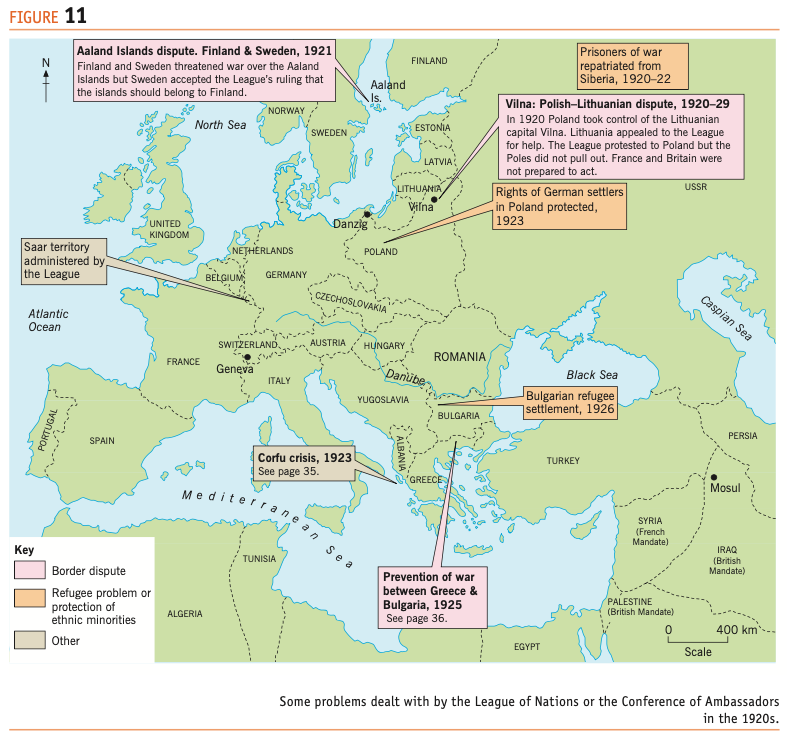
Vilna: Polish–Lithuanian dispute, 1920–29 - LON
Poland and Lithuania became independent states after the breakup of the
Russian Empire at the end of the war. There had already been some conflict
between the two states and the Soviet Union between 1918 and 1920.
But on 7 October 1920, Vilna, with its largely Polish-speaking population,
became the new seat of the Lithuanian government after negotiations
with the League and the withdrawal of Soviet troops. However, two days
later, Vilna was annexed by a Polish army and Lithuania appealed to the
League of Nations. The League ordered the Polish army to withdraw from
the region and wait for a plebiscite. Poland refused and the League was
powerless to stop the conflict. France and Britain were not prepared to
escalate the situation.
Aaland Islands dispute, 1921 -LON
The Aaland Islands, located in the Baltic Sea between Finland and Sweden,
was a Finnish territory but whose population was largely Swedish. Many
islanders wanted independence from Finland which almost led to conflict
between the two countries. The League investigated the dispute and
awarded the Aaland Islands to Finland but with protections for Swedish
Islanders, including the removal of Finnish troops. Both countries accepted
the League’s decisio
Corfu 1923 - LON
One of the boundaries that had to be sorted out after the war was the
border between Greece and Albania. The Conference of Ambassadors was
given this job and it appointed an Italian general called Tellini to supervise
it. On 27 August, while surveying the Greek side of the frontier area, Tellini
and his team were ambushed and killed. The Italian leader Mussolini was
furious and blamed the Greek Government for the murder. On 31 August
Mussolini bombarded and then occupied the Greek island of Corfu. Fifteen
people were killed.
Greece appealed to the League for help. Fortunately, the Council was
already in session, so the League acted swiftly. Articles 12 and 15 of the
League of Nations were designed for exactly this situation. They said that
when League members were in dispute and there was a danger of war,
members could take their dispute to the Council and get a judgement.
By 7 September it had prepared its judgement. It condemned Mussolini’s
actions. It also suggested that Greece pay compensation, but that this
would be held by the League to be paid to Italy if, and when, Tellini’s
killers were found.
Mussolini refused to let the matter rest. He insisted that this dispute had
to be settled by the Conference of Ambassadors because, he said, the
Council of the League was not competent to deal with the issue. He even
threatened to leave the League if this did not happen.
Mussolini would probably not have got his way if the British and French had
stood together. Records from the meetings show that the British did not
accept the Italian case and were prepared to send warships to force
Mussolini out of Corfu. However, the French completely disagreed and
backed the Italians, probably because their forces were tied up in the Ruhr
at this time (see page 16) and could not tackle a dispute with Italy as well.
The British were not prepared to act without the French and now argued
that Mussolini’s actions did not constitute an act of war
In the end Mussolini got his way and the Conference of Ambassadors made
the final ruling on the dispute. The League’s ruling was changed. Instead
of condemning Mussolini the Conference ordered that the Greeks apologise
and pay compensation directly to Italy. On 27 September, Mussolini
withdrew from Corfu, boasting of his triumph.
There was much anger in the League over the Ambassadors’ actions and
League lawyers challenged the decision. However, the ruling was never
changed. As historian Zara Steiner says, ‘the dispute showed that the
weakest of the great powers could get its way when Britain and France
agreed to sacrifice justice for co-operation’.
The Geneva Protocol - LON
The Corfu incident demonstrated how the League of Nations could be
undermined by its own members. Britain and France drew up the Geneva
Protocol in 1924, which said that if two members were in dispute they
would have to ask the League to sort out the disagreement and they would
have to accept the Council’s decision. They hoped this would strengthen
the League. But before the plan could be put into effect there was a
general election in Britain. The new Conservative government refused
to sign the Protocol, worried that Britain would be forced to agree to
something that was not in its own interests. So the Protocol, intended to
strengthen the League, in fact weakened it.
Bulgaria, 1925 - LON
Bulgaria, 1925
Two years after Corfu, the League was tested yet again. In October 1925,
Greek troops invaded Bulgaria after an incident on the border in which
some Greek soldiers were killed. Bulgaria appealed for help. It also sent
instructions to its army (see Source 14).
The secretary-general of the League acted quickly and decisively, calling a
meeting of the League Council in Paris. The League demanded both sides
stand their forces down and Greek forces withdraw from Bulgaria. Britain and
France solidly backed the League’s judgement (and it is worth remembering
they were negotiating the Locarno Treaties at the same time – see the Factfile
on page 38). The League sent observers to assess the situation and judged in
favour of the Bulgarians. Greece had to pay £45,000 in compensation and was
threatened with sanctions if it did not follow the ruling.
The Greeks obeyed, although they did complain that there seemed to be one
rule for the large states (such as Italy) and another for the smaller ones (such
as themselves). Nevertheless the incident was seen as a major success for the
League and many observers seemed to forget the shame of the Corfu incident
as optimism about the effectiveness of the League soared. Few pointed out
that it was not so much the effectiveness of the machinery of the League in
this dispute but the fact that the great powers were united in their decision.
LON - 1920’s - success or failure
The League’s most important aims were to try to prevent future wars and
to encourage cooperation and compromise between nations. As you can
see over the last few pages, the League cannot be considered a complete
failure. Even without the USA, Germany or the USSR as members, the
League did manage to intervene in border disputes and help different
countries avoid conflict by accepting its judgements.
However, it is important to remember that the League was often frustrated
by the actions of its own leading members. The League found it very
challenging to get more powerful countries, such as Italy, to accept its
decisions, especially when these countries were leading members of the
League’s Council. It was also increasingly clear to many that without
Britain and France being willing to act and enforce decisions, the League
became less effective and even failed to resolve disputes satisfactorily.
Britain and France were prepared to use the League to solve disputes as
long as it did not interfere with their national interests and priorities.
You will now look at the League’s record on disarmament and the climate of
economic recovery and internationalism that developed in the 1920s.
37
LON 1920’S - Disarmament
In the 1920s, the League largely failed to bring about disarmament. At the
Washington Conference in 1921 the USA, Japan, Britain and France agreed to
limit the size of their navies, but that was as far as disarmament ever got.
The failure of disarmament was particularly damaging to the League’s reputation
in Germany. Germany had disarmed. It had been forced to. But no other
countries had disarmed to the same extent. They were not prepared to give up
their own armies and they were certainly not prepared to be the first to disarm.
Even so, in the late 1920s, the League’s failure over disarmament did not
seem too serious because of a series of international agreements that
seemed to promise a more peaceful world (see Factfile).
International agreements of the 1920s - FACTFILE
1921 Washington Conference: USA, Britain, France and Japan agreed to limit the size of their navies.
1922 Rapallo Treaty: the ussr and Germany re-established diplomatic relations.
1924 The Dawes Plan: to avert a terrible economic crisis in Germany, the USA lent money to Germany to help it to pay its
reparations bill (see this page).
1925 Locarno treaties: Germany accepted its western borders as set out in the Treaty of Versailles. This was greeted with
great enthusiasm, especially in France. It paved the way for Germany to join the League of Nations.
1928 Kellogg–Briand Pact: 65 nations agreed not to use force to settle disputes. This is also known as the Pact of Paris.
1929 Young Plan: reduced Germany’s reparations payments.
LON 1920’S - Economic recovery
Another reason for optimism in 1928 was that, after the
difficult years of the early 1920s, the economies of the
European countries were once again recovering. The Dawes
Plan of 1924 had helped to sort out Germany’s economic
chaos and had also helped to get the economies of
Britain and France moving again (see Figure 19).
Increased trade between countries helped to reduce
political tension. That is why one of the aims of the
League had been to encourage trading links between the
countries. When countries trade with one another, they
are much less likely to go to war with each other.
LON 1920’s - Internationalism
Although Wilson’s version of the League never happened,
the League still achieved a lot in the 1920s. Perhaps most
important of all, the League became one of the ways in
which the world sorted out international disputes (even if
it was not the only way). Historian Zara Steiner has said
that ‘the League was very effective in handling the “small
change” of international diplomacy’. Her implication, of
course, is that the League could not deal with ‘big’ issues,
but it was not tested in this way in the 1920s.
Some historians believe that the biggest achievement
of the League was the way it helped develop an
‘internationalist mind-set’ among leaders – it encouraged them to think in
terms of collaborating rather than competing. One way it did this was simply
by existing! Great and small powers felt that it was worth sending their
ministers to League meetings throughout the 1920s and 1930s. This meant
they would often talk together when they might not have done so otherwise.
Even when powerful countries acted on their own (for example, over Corfu) it
was often after their ministers had discussed their plans at League meetings!
How important was the League's
humanitarian work? - Refugees
Refugees
It is estimated that in the first few years after the war, about 400,000
prisoners were returned to their homes by the League’s agencies. When war
led to a refugee crisis in Turkey in 1922, hundreds of thousands of people
had to be housed in refugee camps. The League acted quickly to stamp
out cholera, smallpox and dysentery in the camps. However, the Refugees
Committee was constantly short of funds and its work became more
difficult in the 1930s as the international situation became tenser and the
authority of the League declined
How important was the League's
humanitarian work? - Slavery and forced labour
It helped free 200,000 slaves in British-owned Sierra Leone. It organised
raids against slave owners and traders in Burma. It challenged the use of
forced labour to build the Tanganyika railway in Africa, where the death
rate among the African workers was a staggering 50 per cent. League
pressure brought this down to 4 per cent, which it said was ‘a much more
acceptable figure’.
How important was the League's
humanitarian work? - Working conditions
The International Labour Organization succeeded in banning poisonous
white lead from paint and in limiting the hours that small children were
allowed to work. It also campaigned strongly for employers to improve
working conditions. It introduced a resolution for a maximum 48-hour
week, and an eight-hour day, but a majority of members refused to adopt it
because they thought it would cost their industries too much. The ILO was
hampered by lack of funds and lack of power. It could not do much more
than ‘name and shame’ countries or organisations that broke its regulations.
How important was the League's
humanitarian work? - Health
As well as collecting statistical information and spreading good practice,
it sponsored research into infectious diseases at institutes in Singapore,
London and Denmark. These institutes helped develop vaccines and
medicines to fight deadly diseases such as leprosy and malaria. The Health
Committee is generally regarded as one of the most successful of the
League’s organisations and its work was continued after 1945 in the form of
the World Health Organization
How important was the League's
humanitarian work? - Other
Even in the areas where it could not remove social injustice the League
kept careful records of what was going on and provided information on
problems such as drug trafficking, prostitution and slavery. The League
blacklisted four large German, Dutch, French and Swiss companies
which were involved in the illegal drug trade. The League also made
recommendations on practical problems such as marking shipping lanes and
produced an international highway code for road users.
LON - 1930’s - economic depression
In the late 1920s international trade prospered. The USA, the world’s
richest nation, was a market for other countries to export to. It also helped
economic recovery with loans to many countries, particularly Germany.
In 1929 disaster struck. The Wall Street Crash in the USA started a long
depression that quickly caused economic problems throughout the rest of
the world (see Figure 2).
In the 1930s, as a result of the Depression, much of the goodwill of the
late 1920s evaporated.
n As US loans dried up, businesses in many countries went bankrupt,
leading to unemployment.
Some countries tried to protect their own industries by putting tariffs
on imports. But this just meant their trading partners did the same
thing and trade got even worse.
Many countries (including Germany, Japan, Italy and Britain) started to
rearm (build up their armed forces) as a way of trying to get industries
working and giving jobs to the unemployed. But these new armies
caused alarm and tension.
The internationalist spirit of the 1920s was replaced by a more nationalist
‘beggar my neighbour’ approach in the 1930s (protecting a country’s
interest at the expense of other countries).
LON 1930’S - how the depression effected many countries
The USA
One way that the League of
Nations could stop one
country invading another
was to use economic
sanctions. But the
Depression made the USA
unwilling to help in this
because economic
sanctions would make its
own economy even worse.
Japan
The Depression threatened to bankrupt Japan.
Its main export was silk to the USA, but the USA
was buying less silk. So Japan had less money
to buy food and raw materials. Its leaders were
all army generals. They decided to continue to
expand their empire by taking over weaker
countries that had the raw materials Japan
needed. They started by invading Manchuria
(part of China) in 1931.
Britain
Britain was one of the leaders of the
League of Nations. But, like the USA,
it was unwilling to help sort out
international disputes while its economy
was bad. For example, when Japan
invaded Manchuria it did nothing – it did
not support economic
sanctions against Japan
and did not send troops
to protect manchuria
Germany
The Depression hit Germany badly.
There was unemployment, poverty and
chaos. Germany’s weak leaders seemed
unable to do anything. Many Germans
began supporting the Nazi Party and
Hitler was appointed chancellor in 1933.
He was not good news for international
peace. He openly planned to invade
Germany’s neighbours and to win back
land that Germany had lost in the
Treaty of Versailles.
Italy
In Italy economic problems encouraged
Mussolini to try to build an overseas
empire to distract people’s attention from
the difficulties the government faced.
LON 1930’S Manchurian crisis - Background
Since 1900 Japan’s economy and population had been growing rapidly.
By the 1920s Japan was a major power with a powerful military, strong
industries and a growing empire (see Figure 3). But the Depression hit
Japan badly as China and the USA put up tariffs (trade barriers) against
Japanese goods. Army leaders in Japan were in no doubt about the solution
to Japan’s problems – Japan would not face these problems if it expanded
its empire to provide resources and markets for Japanese goods.
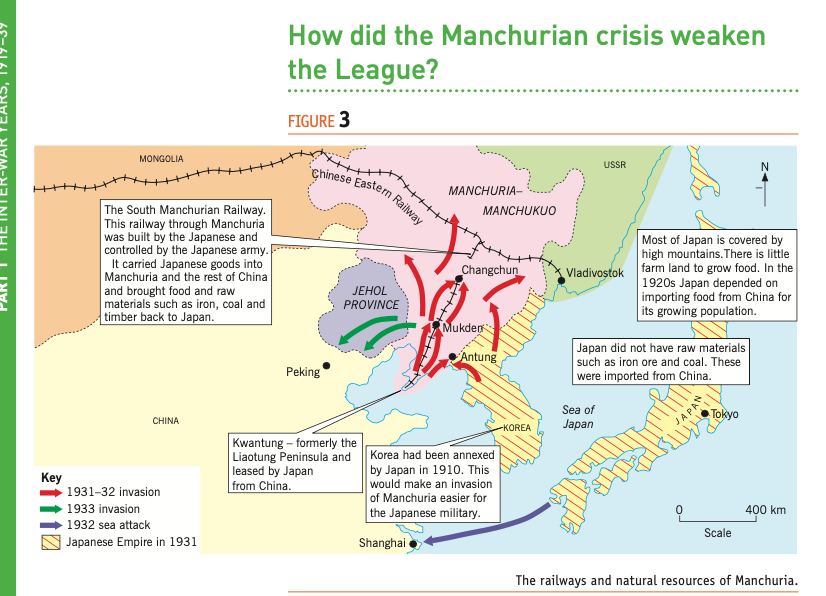
LON 1930’S Manchurian crisis - Invasion 1 1931
In 1931 an incident in Manchuria gave them an ideal opportunity. The
Japanese army controlled the South Manchurian Railway (see Figure 3).
When Chinese troops allegedly attacked the railway the Japanese armed
forces used this as an excuse to invade and set up a government in
Manchukuo (Manchuria), which they controlled. This was known as the
Mukden Incident. Japan’s civilian government protested but the military
were now in charge
LON 1930’S Manchurian crisis - China appeals
China appealed to the League. The Japanese argued that China was in such
a state of anarchy that they had to invade in self-defence to keep peace
in the area. For the League of Nations this was a serious test. Japan was a
leading member of the League. It needed careful handling. What should the
League do?
LON 1930’S Manchurian crisis - The lytton Report
Britain and France both had colonies in South-East Asia. They did not want
to provoke a war with Japan. Many European member states also viewed
the incident as a problem far away. Some members even believed that
Japanese rule would bring order to the region. Investigation of the Mukden
Incident was finally entrusted to Lord Lytton and the Lytton Commission.
It took them over a year to present the Lytton Report in September 1932.
It was detailed and balanced, but the judgement was very clear. Japan had
acted unlawfully. Manchuria should be returned to the Chinese.
LON 1930’S Manchurian crisis - Invasion 2 1933
However, in February 1933, instead of withdrawing from Manchuria the
Japanese announced that they intended to invade more of China. They
still argued that this was necessary in self-defence. On 24 February 1933
the report from the League’s officials was approved by 42 votes to 1 in
the Assembly. Only Japan voted against. Smarting at the insult, Japan
resigned from the League on 27 March 1933. The next week it invaded
Jehol (see Figure 3
LON 1930’S Manchurian crisis - The league responds
The League was powerless. It discussed economic sanctions, but without the
USA, Japan’s main trading partner, they would be meaningless. Besides, Britain
seemed more interested in keeping up a good relationship with Japan than in
agreeing to sanctions. The League also discussed banning arms sales to Japan,
but the member countries could not even agree about that. They were worried
that Japan would retaliate and the war would escalate.
There was no prospect at all of Britain and France risking their navies or
armies in a war with Japan. Only the USA and the USSR would have had the
resources to remove the Japanese from Manchuria by force and they were
not even members of the League.
LON 1930’S Manchurian crisis - Consequences
All sorts of excuses were offered for the failure of the League: Japan was
so far away; Japan was a special case; Japan did have a point when it said
that China was itself in the grip of anarchy.
However, the significance of the Manchurian
crisis was obvious. As many of its critics had
predicted, the League was powerless if a
strong nation decided to pursue an aggressive
policy and invade its neighbours. Japan had
committed blatant aggression and got away
with it. Back in Europe, both Hitler and
Mussolini looked on with interest. Within three
years they would both follow Japan’s example.
LON 1930’S - Disarmament conference
After the Manchurian crisis, members of the League realised the urgency of
the problem. In February 1932 the long-promised Disarmament Conference
finally got under way. By July 1932 it had produced resolutions to
prohibit bombing of civilian populations, limit the size of artillery, limit
the tonnage of tanks, and prohibit chemical warfare. But there was very
little in the resolutions to show how these limits would be achieved. For
example, the bombing of civilians was to be prohibited, but all attempts
to agree to abolish planes capable of bombing were defeated. Even the
proposal to ban the manufacture of chemical weapons was defeated.
LON 1930’S - German disarmament
It was not a promising start. However, there was a bigger problem facing
the Conference – what to do about Germany. The Germans had been in the
League for six years. Most people now accepted that they should be treated
more equally than under the Treaty of Versailles. The big question was
whether everyone else should disarm to the level that Germany had been
forced to, or whether the Germans should be allowed to rearm to a level
closer to that of the other powers. The experience of the 1920s showed
that the first option was a non-starter. But there was great reluctance in
the League to allow the second option. The timeline shows how events
relating to Germany moved over the next 18 months.
July 1932: Germany proposed all countries disarm to its level. When the
Conference failed to agree this principle of ‘equality’, the Germans walked out.
September 1932: The British sent the Germans a note that went some way to
agreeing equality, but the superior tone of the note angered the Germans still
further.
December 1932: An agreement was finally reached to treat Germany equally.
January 1933: Germany announced it was coming back to the Conference.
February 1933: Hitler became Chancellor of Germany at the end of January. He
immediately started to rearm Germany, although secretly.
May 1933: Hitler promised not to rearm Germany if ‘in five years all other
nations destroyed their arms’.
June 1933: Britain produced an ambitious disarmament plan, but it failed to
achieve support at the Conference.
October 1933: Hitler withdrew from the Disarmament Conference, and soon after
took Germany out of the League altogether.
By this stage, all the powers knew that Hitler was secretly rearming
Germany already. They also began to rebuild their own armaments. Against
that background the Disarmament Conference struggled on for another year
but in an atmosphere of increasing futility. It finally ended in 1934.
LON 1930’S - disarmament - reasons for failure
The Conference failed for a number of reasons. Some say it was all doomed
from the start. No one was very serious about disarmament anyway. But
there were other factors at work.
It did not help that Britain and France were divided on this issue. By 1933
many British people felt that the Treaty of Versailles was unfair. In fact,
to the dismay of the French, the British signed the Anglo-German Naval
Agreement with Germany in 1935 that allowed Germany to build up its
navy as long as it stayed under 35 per cent of the size of the British navy.
Britain did not consult either its allies or the League about this, even
though this violated the Treaty of Versailles.
It seemed that each country was looking after itself and ignoring the
League.
How did Mussolini’s invasion of
Abyssinia damage the League
The fatal blow to the League came when the Italian dictator
Mussolini invaded Abyssinia in 1935. There were both
similarities with and differences from the Japanese invasion
of Manchuria.
n Like Japan, Italy was a leading member of the League.
Like Japan, Italy wanted to expand its empire by
invading another country.
n However, unlike Manchuria, this dispute was on the
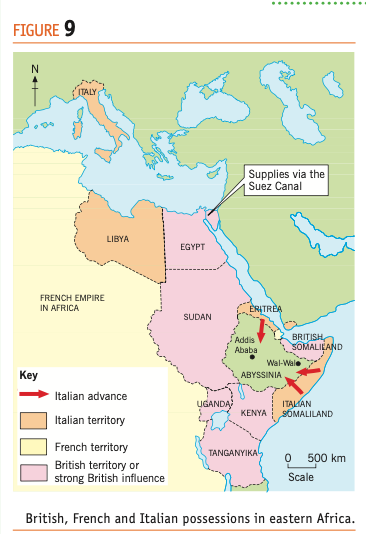
League’s doorstep. Italy was a European power. It
even had a border with France. Abyssinia bordered on
the Anglo-Egyptian territory of Sudan and the British
colonies of Uganda, Kenya and British Somaliland. Unlike
events in Manchuria, the League could not claim that
this problem was in an inaccessible part of the world.
Some argued that Manchuria had been a special case. Would
the League do any better in this Abyssinian crisis?
LON 1930’S - Abyssinian crisis - Background
The origins of this crisis lay back in the previous century.
In 1896 Italian troops had tried to invade Abyssinia but
had been defeated by a poorly equipped army of tribesmen
in the Battle of Adowa. Mussolini wanted revenge for this
humiliating defeat. He also had his eye on the fertile land
and mineral wealth of Abyssinia. However, most importantly,
he wanted glory and conquest. His style of leadership
needed military victories and he had often talked of
restoring the glory of the Roman Empire.
In December 1934 there was a dispute between Italian and Abyssinian
soldiers at the Wal-Wal oasis – 80 km inside Abyssinia. Mussolini took this
as his cue and claimed this was actually Italian territory. He demanded an
apology and began preparing the Italian army for an invasion of Abyssinia.
The Abyssinian emperor Haile Selassie appealed to the League for help.
LON 1930’S - Abyssinian crisis - Phase 1: the League plays for time
From January 1935 to October 1935, Mussolini was supposedly negotiating
with the League to settle the dispute. However, at the same time he was
shipping his vast army to Africa and whipping up war fever among the
Italian people.
To start with, the British and the French failed to take the situation
seriously. They played for time. They were desperate to keep good relations
with Mussolini, who seemed to be their strongest ally against Hitler. They
signed an agreement with him early in 1935 known as the Stresa Pact, which
was a formal statement against German rearmament and a commitment to
stand united against Germany. At the meeting to discuss this, they did not
even raise the question of Abyssinia. Some historians suggest that Mussolini
believed that Britain and France had promised to turn a blind eye to his
exploits in Abyssinia in return for his joining them in the Stresa Pact.
However, as the year wore on, there was a public outcry against Italy’s
behaviour. A ballot was taken by the League of Nations Union in Britain in
1934–35. It showed that a majority of British people supported the use ofmilitary force to defend Abyssinia if necessary. Facing an autumn election at
home, British politicians now began to ‘get tough’. At an assembly of the
League, the British foreign minister, Hoare, made a grand speech about the
value of collective security, to the delight of the League’s members and all
the smaller nations. There was much talking and negotiating. However, the
League never actually did anything to discourage Mussolini.
On 4 September, after eight months’ deliberation, a committee reported
to the League that neither side could be held responsible for the Wal-Wal
incident. The League put forward a plan that would give Mussolini some of
Abyssinia. Mussolini rejected it.
LON 1930’S - Abyssinian crisis - Phase 2: sanctions or not?
In October 1935 Mussolini’s army was ready. He launched a full-scale invasion
of Abyssinia. Despite brave resistance, the Abyssinians were no match for the
modern Italian army equipped with tanks, aeroplanes and poison gas.
This was a clear-cut case of a large, powerful state attacking a smaller
one. The League was designed for just such disputes and, unlike in the
Manchurian crisis, it was ideally placed to act.
There was no doubting the seriousness of the
issue either.
The Covenant (see page 30) made it clear
that sanctions must be introduced against
the aggressor. A committee was immediately
set up to agree what sanctions to impose.
Sanctions would only work if they were
imposed quickly and decisively. Each week a
decision was delayed would allow Mussolini to
build up his stockpile of raw materials.
The League banned arms sales to Italy; banned
loans to Italy; banned imports from Italy. It
also banned the export to Italy of rubber, tin
and metals. However, the League delayed a
decision for two months over whether to ban
oil exports to Italy. It feared the Americans
would not support the sanctions. It also feared
that its members’ economic interests would be
further damaged. In Britain, the Cabinet was
informed that 30,000 British coal miners were
about to lose their jobs because of the ban on
coal exports to Italy.
More important still, the Suez Canal, which
was owned by Britain and France, was not
closed to Mussolini’s supply ships. The
canal was the Italians’ main supply route to
Abyssinia and closing it could have ended the
Abyssinian campaign very quickly. Both Britain
and France were afraid that closing the canal
could have resulted in war with Italy. This
failure was fatal for Abyssinia.
LON 1930’S - Abyssinian crisis - The Hoare-Laval pact
Equally damaging to the League was the secret dealing between the British
and the French that was going on behind the scenes. In December 1935, while
sanctions discussions were still taking place, the British and French foreign
ministers, Hoare and Laval, were hatching a plan. This aimed to give Mussolini
two-thirds of Abyssinia in return for his calling off his invasion! Laval even
proposed to put the plan to Mussolini before they showed it to either the League
of Nations or Haile Selassie. Laval told the British that if they did not agree to
the plan, then the French would no longer support sanctions against Italy.
However, details of the plan were leaked to the French press. It proved
quite disastrous for the League. Haile Selassie demanded an immediate
League debate about it. In both Britain and France it was seen as a blatant
act of treachery against the League. Hoare and Laval were both sacked. But
the real damage was to the sanctions discussions. They lost all momentum.
LON 1930’S - Abyssinian crisis - No oil sanctions
The question about whether to ban oil sales was further delayed. In February
1936 the committee concluded that if they did stop oil sales to Italy, the
Italians’ supplies would be exhausted in two months, even if the Americans
kept on selling oil to them. But by then it was all too late. Mussolini had
already taken over large parts of Abyssinia. And the Americans were even
more disgusted with the ditherings of the French and the British than they
had been before and so blocked a move to support the League’s sanctions.
American oil producers actually stepped up their exports to Italy.
LON 1930’S - Abyssinian crisis -The outcomes
On 7 March 1936 the fatal blow was delivered. Hitler, timing
his move to perfection, marched his troops into the Rhineland,
an act prohibited by the Treaty of Versailles (see page 12).
If there had been any hope of getting the French to support
sanctions against Italy, it was now dead. The French were
desperate to gain the support of Italy and were now prepared
to pay the price of giving Abyssinia to Mussolini.
Italy continued to defy the League’s orders and by May
1936 had taken the capital of Abyssinia, Addis Ababa.
On 2 May, Haile Selassie was forced into exile. On 9 May,
Mussolini formally annexed the entire country.
The League watched helplessly. Collective security had
been shown up as an empty promise. The League of Nations
had failed. If the British and French had hoped that their
handling of the Abyssinian crisis would help strengthen
their position against Hitler, they were soon proved very
wrong. In November 1936 Mussolini and Hitler signed an
agreement of their own called the Rome–Berlin Axis.
Hitler - background summary - Collapse of international peace
Between 1918 and 1933 Adolf Hitler rose from being an obscure and
demoralised member of the defeated German army to become the all-
powerful Führer, DICTATOR of Germany, with almost unlimited power and
an overwhelming ambition to make Germany great once again. His is an
astonishing story which you can read about in detail in Chapter 9. Here you
will be concentrating on just one intriguing and controversial question:
how far was Hitler’s foreign policy to blame for the outbreak of war?
Collapse of international peace - Hitlers plans
Hitler was never secretive about his plans for Germany. As early as 1925
he had laid out in his book MEIN KAMPF what he would do if the Nazis ever
achieved power in Germany.
Abolish the Treaty of Versailles!
Like many Germans, Hitler believed that the TREATY OF VERSAILLES was unjust.
He hated the Treaty and called the German leaders who had signed it ‘The
NOVEMBER CRIMINALS’. The Treaty was a constant reminder to Germans of their
defeat in the First World War and their humiliation by the Allies. Hitler
promised that if he became leader of Germany he would reverse it (see
Source 1).
By the time he came to power in Germany, some of the terms had already
been changed. For example, Germany had stopped making REPARATIONS
payments altogether. However, most points were still in place. The table on
page 57 shows the terms of the Treaty that most angered Hitler.
Expand German territory!
The Treaty of Versailles had taken away territory from Germany. Hitler
wanted to get that territory back. He wanted Germany to unite with
Austria. He wanted German minorities in other countries such as
Czechoslovakia to rejoin Germany. But he also wanted to carve out an
empire in eastern Europe to give extra LEBENSRAUM or ‘living space’ for
Germans (see Source 2).
Defeat communism!
A German empire carved out of the SOVIET UNION would also help Hitler in
one of his other objectives – the defeat of COMMUNISM or BOLSHEVISM. Hitler
was anticommunist. He believed that Bolsheviks had helped to bring about
the defeat of Germany in the First World War. He also believed that the
Bolsheviks wanted to take over Germany (see Source 3).
Collapse of international peace - Rearmament
Hitler came to power in Germany in 1933. One of his first steps was to
increase Germany’s armed forces. Thousands of unemployed workers were
drafted into the army. This helped him to reduce unemployment, which was
one of the biggest problems he faced in Germany. But it also helped him to
deliver on his promise to make Germany strong again and to challenge the
terms of the Treaty of Versailles.
Hitler knew that German people supported rearmament. But he also knew it
would cause alarm in other countries. He handled it cleverly. Rearmament
began in secret at first. He made a great public display of his desire not to
rearm Germany – that he was only doing it because other countries refused
to disarm (see page 46). He then followed Japan’s example and withdrew
from the League of Nations.
In 1935 Hitler openly staged a massive military rally celebrating the
German armed forces and he even reintroduced conscription to the army.
He was breaking the terms of the Treaty of Versailles, but he guessed
correctly that he would get away with rearmament. Many other countries
were using rearmament as a way to fight unemployment. The collapse of
the League of Nations Disarmament Conference in 1934 (see pages 48–49)
had shown that other nations were not prepared to disarm.
Rearmament was a very popular move in Germany. It boosted Nazi support.
Hitler also knew that Britain had some sympathy with Germany on this
issue. Britain believed that the limits put on Germany’s armed forces by the
Treaty of Versailles were too tight. The permitted forces were not enough
to defend Germany from attack. Britain also thought that a strong Germany
would be a good buffer against communism.
Britain had already helped to dismantle the Treaty by signing the Anglo-
German Naval Agreement with Hitler in 1935, allowing Germany to increase
its navy to up to 35 per cent of the size of the British navy. The French
were angry with Britain about this, but there was little they could do.
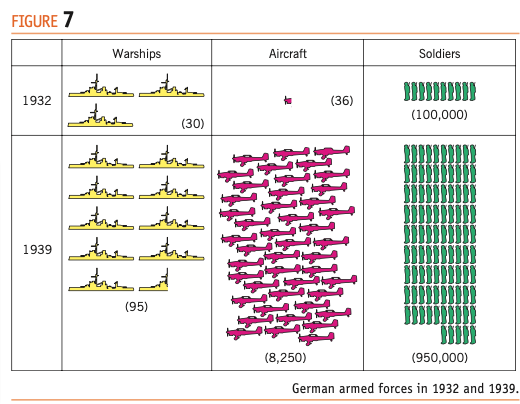
Through the rest of the 1930s Hitler ploughed more and more spending into
armaments (see Figures 6 and 7).
Collapse of international peace - The Saar plebescite
The SAAR region of Germany had been run by the League of Nations since
1919 (see page 34).
In 1935 the League of Nations held the promised plebiscite for people to vote
on whether their region should return to German rule. Hitler was initially wary
as many of his opponents had fled to the Saar. The League, however, was
determined that the vote should take place and Hitler bowed to this pressure.
So it seemed that the League was being firm and decisive with Hitler. The
vote was an overwhelming success for Hitler. His PROPAGANDA minister Joseph
Goebbels mounted a massive campaign to persuade the people of the Saar to
vote for the Reich. Around 90 per cent of the population voted to return to
German rule. This was entirely legal and within the terms of the Treaty. It was
also a real morale booster for Hitler. After the vote Hitler declared that he had
‘no!further territorial demands to make of France’.
Collapse of international peace - Remilitirization of the Rhineland
In March 1936, Hitler took his first really big risk by moving troops into the
Rhineland area of Germany. The Rhineland was the large area either side
of the River Rhine that formed Germany’s western border with France and
Belgium.
The demilitarisation of the Rhineland was one of the terms of the Treaty of
Versailles. It was designed to protect France from invasion from Germany.
It had also been accepted by Germany in the Locarno Treaties of 1925.
Hitler was taking a huge gamble with REMILITARISATION. If he had been forced
to withdraw, he would have faced humiliation and would have lost the
support of the German army (many of the generals were unsure about him,
anyway). Hitler knew the risks, but he had chosen the time and place well.
■ France and the USSR had just signed a treaty to protect each
other against attack from Germany (see Source 11). Hitler used the
agreement to claim that Germany was under threat. He argued that
in the face of such a threat he should be allowed to place troops on
his own frontier.
■ Hitler knew that many people in Britain felt that he had a right to
station his troops in the Rhineland and he was fairly confident that
Britain would not intervene. His gamble was over France. Would France
let him get away with it?
Hitler ordered 20,000 troops into the Rhineland and his generals had
orders to retreat if there was any resistance from the French. Despite the
rearmament programme, Germany’s army was no match for the French army.
It lacked essential equipment and air support. In the end, however, Hitler’s
luck held.
The attention of the League of Nations was on the Abyssinian crisis which
was happening at exactly the same time (see pages 51–52). The League
condemned Hitler’s action but had no power to do anything else. Even the
French, who were most directly threatened by the move, were divided over
what to do. They were about to hold an election and none of the French
leaders was prepared to take responsibility for plunging France into a war.
Of course, they did not know how weak the German army was. In the end,
France refused to act without British support and so Hitler’s big gamble
paid off. Maybe next time he would risk more!
The collapse of international peace - The spanish civil war
In 1936 a CIVIL WAR broke out in Spain between supporters
of the Republican Government (Republicans) and RIGHT-
WING rebels (Nationalists) under General Franco. The war
quickly gained an international dimension.
STALIN
’S USSR supported the Republican Government (in
the form of weapons, aircraft and pilots). Thousands
of volunteers from around 50 countries joined
International Brigades to support the Republicans.
Hitler and Mussolini then declared their support for
General Franco as a man who shared their world view.
Britain and France refused to intervene directly,
although France did provide some weapons for the
Republicans. Germany and Italy also agreed not to
intervene but then blatantly did so. Mussolini sent
thousands of Italian troops (officially they were
‘volunteers’). Germany sent aircraft and pilots who
took part in most of the major campaigns of the war
including bombing raids on civilian populations (see
Source 16). Hitler viewed the Spanish Civil War as a
good opportunity to try out his new Luftwaffe (air
force) and develop the Blitzkrieg tactics the German
military would use in future conflicts.
The conflict had important consequences for peace.
It strengthened the bonds between Mussolini and
Hitler. It encouraged Hitler to believe that Britain
and France would not intervene against him if he
took further actions against the Treaty of Versailles.
Although Britain did not intervene, Hitler’s actions
alarmed Chamberlain and he ordered massive increases
in spending on Britain’s armed forces, especially the
Royal Air Force. At the same time, the USSR became
increasingly suspicious of Britain and France because of
their reluctance to get involved in opposing fascism.
The collapse of international peace
Militarism and the Axis
Meanwhile, in the east Japan was under the control of
hardline nationalist commanders such as General Tojo.
They also had the support of business leaders in Japan.
They wanted to extend Japan’s empire across Asia so it
could compete with other world powers, particularly the
USA. In 1937 the Japanese took their next big step with
the invasion of China. Some historians regard this as the
first campaign of the Second World War.
Hitler and Mussolini saw that they had much in common
with the military DICTATORSHIP in Japan. In 1936, Germany and
Japan signed an ANTI-COMINTERN PACT, to oppose communism.
Comintern was the USSR’s organisation for spreading
communism to other countries. In 1937, Italy also signed
it. This was called the Rome–Berlin Axis alliance.
There was very little Britain or France could do about
the Axis, but it was another worrying development,
especially as Britain did not have the resources to fight
Japan in the Far East and Germany in Europe.
The collapse of international peace - Anschluss 1938
With the successes of 1936 and 1937 to boost him, Hitler turned his
attention to his homeland of Austria. Hitler believed that the two states
belonged together as one German nation. Many in Austria supported the
idea of union with Germany. Hitler had tried to take over Austria in 1934,
but on that occasion Mussolini had stopped him. But in 1938 the situation
was different. Hitler and Mussolini were now allies.
There was a strong Nazi Party in Austria. Hitler encouraged them to stir
up trouble for the Government and hold demonstrations demanding union
with Germany. Hitler then told the Austrian Chancellor Schuschnigg that
only ANSCHLUSS (political union) could sort out these problems. Schuschnigg
appealed to Britain and France but it failed to provide any support so
Schuschnigg felt he had no option but to call a plebiscite (a referendum)
to see what the Austrian people wanted. Hitler was not prepared to risk
this – he might lose! He simply sent his troops into Austria in March 1938,
supposedly to guarantee a trouble-free plebiscite. Under the watchful eye
of the Nazi troops, 99.75 per cent voted for Anschluss.
Anschluss was completed without any military confrontation with France
and Britain. Chamberlain felt that Austrians and Germans had a right to be
united and that the Treaty of Versailles was wrong to separate them.
Once again, Hitler’s risky but decisive action had reaped a rich reward –
Austria’s soldiers, weapons and its rich deposits of gold and iron ore were
added to Germany’s increasingly strong army and industry. Hitler was
breaking yet another condition of the Treaty of Versailles, but it seemed
clear to him that Britain and France were not prepared to go to war to
defend it. However, Britain and France were not naïve either. Chamberlain
increased Britain’s rearmament spending further still and made plans for
compulsory military service and the preparation of air-raid defences.
The collapse of international peace - Appeasement : for and against
If Britain and France were not prepared to defend the Treaty of Versailles,
would they let Hitler have more of his demands? The short answer is yes,
and Britain’s policy at this time is known as APPEASEMENT. Neville Chamberlain
is the man most associated with this policy (see Profile on page 67)
although he did not become prime minister until 1937. Many other British
people (probably the majority), including many politicians, were also in
favour of this policy. However, there were some at the time who were very
critical. Here are the main arguments for and against.
Trusting Hitler
After each new move he made
Hitler said this was all he
wanted. Yet he often went back
on those promises. Appeasement
was based on the mistaken idea
that Hitler was trustworthy
*Fear of communism
Hitler was not the only concern of
Britain and its allies. He was not
even their main worry. They were
more concerned about the spread
of communism and particularly
the dangers to world peace posed
by Stalin, the new leader in the
USSR. Many saw Hitler as the
buffer to the threat of spreading
communism——————————————————————————————————————————————————————--
*Memories of the Great War
Both British and French leaders,
and much of their population,
vividly remembered the horrific
experiences of the First World
War. They wished to avoid
another war at almost any cost.
*German arms
Germany was rearming publicly
and quickly year by year. Hitler
claimed he was trying to catch
up with other countries, but
others could see that Germany
was better armed than Britain or
France.
*British arms
The British Government believed
that the armed forces were not
ready for war against Hitler.
Britain only began rearming in
1935 and INTELLIGENCE suggested
the British were some way behind
the Germans.
*The USA
American support had been
vital to Britain’s success in the
First World War. Britain could
not be sure it could face up to
Germany without the guarantee
of American help. But since
1919 the USA
had followed
a policy of
ISOLATIONISM.
American
leaders were
determined
not to be
dragged into
another European war
*The British empire
For Britain to fight a war against
Germany it needed to be sure it
had the support of the countries
in its empire or Commonwealth.
It was not a guaranteed certainty
that they would all support a war.
There was also the prospect of
Japan threatening British
interests in Asia, particularly
Singapore and even India.
*The Treaty of Versailles
Many felt that the Treaty of
Versailles was unfair to Germany.
Some of Hitler’s demands were
not unreasonable. They assumed
that once these wrongs were
put right then Germany would
become a peaceful nation again.
*The Soviet Union
Hitler made no secret of his plans
to expand eastwards. He had
openly talked of taking land in
Russia. Appeasement sent the
message to Stalin and the USSR
that Britain and France would
not stand in Hitler’s way if he
invaded Russia.
*Hitler’s allies
Hitler had already observed how
his allies, particularly the right-
wing dictatorships in Japan and
Italy, had got away with acts of
aggression.
*Economic problems
Britain and France had large
debts (many still left over from
fighting the First World War) and
huge unemployment as a result
of the Depression. They could not
afford a war.
The collapse of international peace - Czech Fears
Unlike the leaders of Britain and
France, Edvard Beneš, the leader
of Czechoslovakia, was horrified
by the Anschluss. He realised
that Czechoslovakia would be the
next country on Hitler’s list for
take-over. It seemed that Britain
and France were not prepared to
stand up to Hitler. Beneš sought
guarantees from the British and
French that they would honour
their commitment to defend
Czechoslovakia if Hitler invaded.
The French were bound by a
treaty and reluctantly said they
would. The British felt bound
to support the French. However,
Chamberlain asked Hitler whether
he had designs on Czechoslovakia
and was reassured by Hitler’s
promise (Source 21)
The collapse of international peace -Czechoslovakia - Hitlers threats
Despite what he said to Chamberlain, Hitler did have designs on
Czechoslovakia. This new state, created by the Treaty of Versailles, included
a large number of Germans – former subjects of Austria–Hungary’s empire
– in the Sudetenland area. Konrad Henlein, the leader of the Nazis in the
Sudetenland, demanded that the area should be part of Germany. In May
1938, Hitler made it clear that he intended to fight Czechoslovakia if
necessary. Historians disagree as to whether Hitler really meant what he
said. There is considerable evidence that the German army was not at all
ready for war. Even so, the news put Europe on full war alert.
The collapse of international peace - Czechoslovakia - Preparation for War
Despite what he said to Chamberlain, Hitler did have designs on
Czechoslovakia. This new state, created by the Treaty of Versailles, included
a large number of Germans – former subjects of Austria–Hungary’s empire
– in the Sudetenland area. Konrad Henlein, the leader of the Nazis in the
Sudetenland, demanded that the area should be part of Germany. In May
1938, Hitler made it clear that he intended to fight Czechoslovakia if
necessary. Historians disagree as to whether Hitler really meant what he
said. There is considerable evidence that the German army was not at all
ready for war. Even so, the news put Europe on full war alert.
The collapse of international peace - Czech - crisis talks
In September the problem reached crisis point. In a last-ditch effort to
avert war, Chamberlain flew to meet Hitler on 15 September. The meeting
appeared to go well. Hitler moderated his demands, saying he was only
interested in parts of the Sudetenland – and then only if a plebiscite
showed that the Sudeten Germans wanted to join Germany. Chamberlain
thought this was reasonable. He felt it was yet another of the terms of
the Treaty of Versailles that needed to be addressed. Chamberlain seemed
convinced that, if Hitler got what he wanted, he would at last be satisfied.
On 19 September the French and the British put to the Czechs their plans
to give Hitler the parts of the Sudetenland that he wanted. However, three
days later at a second meeting, Hitler increased his demands. He said he
‘regretted’ that the previously arranged terms were not enough. He wanted
all the Sudetenland.
To justify his demands, he claimed that the Czech Government was
mistreating the Germans in the Sudetenland and that he intended to
‘rescue’ them by 1 October. Chamberlain told Hitler that his demands were
unreasonable. The British navy was MOBILISED. War seemed imminent.
The collapse of international peace - czech - The Munich agreement
With Mussolini’s help, a final meeting was held in Munich on 29 September 1938.
While Europe held its breath, the leaders of Britain, Germany, France and
Italy decided on the fate of Czechoslovakia.
On 29 September they decided to give Hitler what he wanted. They
announced that Czechoslovakia was to lose the Sudetenland. They did not
consult the Czechs, nor did they consult the USSR. This is known as the
MUNICH AGREEMENT. The following morning Chamberlain and Hitler published a
joint declaration, which Chamberlain said would bring ‘peace for our time’.
The collapse of international peace - Consequences of the Munich Agreement
Hitler had gambled that the British would not risk war. The prize of the
Sudetenland had been given to him without a shot being fired. On 1
October German troops marched into the Sudetenland. At the same time,
Hungary and Poland helped themselves to Czech territory where Hungarians
and Poles were living.
The Czechs had been betrayed. Beneš resigned and the country descended
into chaos. But the rest of Europe breathed a sigh of relief. Chamberlain
received a hero’s welcome back in Britain, when he returned with the ‘piece
of paper’ – the Agreement – signed by Hitler (see photo in the Profile,
page 67).
Triumph or sell-out?
What do you think of the Munich Agreement? Was it a good move or a
poor one? Most people in Britain were relieved that it had averted war,
but many were soon openly questioning the whole policy of Appeasement.
Opinion polls in September 1938 show that the British people did not
think Appeasement would stop Hitler. It simply delayed a war, rather than
preventing it. And while he hoped for peace Chamberlain continued to
increase arms spending in preparation for war.
Czechoslovakia, 1939: the end of
Appeasement:
Although the British people welcomed the Munich Agreement, they did
not trust Hitler. In an opinion poll in October 1938, 93 per cent said they
did not believe him when he said he had no more territorial ambitions in
Europe. In March 1939 they were proved right. On 15 March, German troops
took over the rest of the country. ——- There was no resistance from the Czechs. Nor did Britain and France do
anything about the situation. However, it was now clear that Hitler could
not be trusted. For Chamberlain it was a step too far. Unlike the Sudeten
Germans, the Czechs were not separated from their homeland by the Treaty
of Versailles. This was an invasion. If Hitler continued unchecked, his next
target was likely to be Poland and his annexation of Czechoslovakia would
allow him to invade Poland from two fronts.
Britain and France told Hitler that if he invaded Poland they would declare
war on Germany. The policy of Appeasement was ended. However, after
years of Appeasement, Hitler did not actually believe that Britain and
France would risk war by resisting him.
The collapse of international peace - Stalins fears
Stalin had been very worried about the German threat to the Soviet Union
ever since Hitler came to power in 1933. Even so, Stalin could not reach any
kind of lasting agreement with Britain and France in the 1930s. In 1934 he
had made the USSR a member of the League of Nations, hoping the League
would guarantee his security against the threat from Germany. However,
all he saw at the League was its lack of action over Abyssinia and the
Spanish Civil War. Politicians in Britain and France had not resisted German
rearmament in the 1930s. Indeed, some in Britain seemed even to welcome
a stronger Germany as a force to fight communism, which they saw as a
bigger threat to British interests than Hitler.
Stalin’s fears and suspicions grew in the mid-1930s.
■ He signed a treaty with France in 1935 that said that France would help
the USSR if Germany invaded the Soviet Union. But Stalin was not sure
he could trust the French to stick to it, particularly when they failed
even to stop Hitler moving his troops into the Rhineland, which was
right on their own border.
■ The Munich Agreement in 1938 increased Stalin’s concerns. He was not
consulted about it. Stalin concluded from the agreement that France
and Britain were powerless to stop Hitler or, even worse, that they were
happy for Hitler to take over eastern Europe and then the USSR.
The collapse of international peace - Stalins negotations
Despite his misgivings, Stalin was still prepared to
talk with Britain and France about an alliance against
Hitler. The three countries met in March 1939, but
Chamberlain was suspicious of the USSR and was
reluctant to commit Britain. From Stalin’s point of
view, France and Britain then made things worse by
giving Poland a guarantee that they would defend it
if it was invaded. Chamberlain meant the guarantee as
a warning to Hitler. Stalin saw it as support for one of
the USSR’s potential enemies.
Negotiations between Britain, France and the USSR
continued through the spring and summer of 1939.
However, Stalin also received visits from the Nazi
foreign minister Ribbentrop. They discussed a very
different deal, a NAZI–SOVIET PACT.
The collapse of international peace - Stalins decision
In August, Stalin made his decision. On 23 August
1939, Hitler and Stalin, the two arch enemies,
signed the Nazi–Soviet Pact and announced the
terms to the world. They agreed not to attack one
another. Privately, they also agreed to divide Poland
between!them.
The collapse of international peace - Why did Stalin sign the Pact?
It was clear what Hitler gained from the Pact. He regarded it as his greatest
achievement. It gave him half of Poland and ensured he would not face a
war on two fronts if he invaded Poland. He had promised the Russians they
could have the rest of Poland as well as the Baltic states, but he never
intended to allow Stalin to keep these territories.
It is also clear what Stalin gained from it. It gave him some territory that
had once been part of Russia, but that was not the main point. The real
benefit was time! Stalin did not expect Hitler to keep his word. He knew
he was Hitler’s number one target. But he did not trust Britain and France
either. He did not think they were strong enough or reliable enough as
allies against Hitler. He expected to have to fight Hitler alone at some
point. So what he most needed was time to build up his forces to protect
the USSR from the attack he knew would come.
The collapse of international peace - Consequences - Nazi-soviet pact
The Pact cleared the way for Hitler to invade Poland. On 1 September 1939
the Germany army invaded Poland from the west, where they met little
resistance. Britain and France demanded he withdraw from Poland or they
would declare war. After the experience of the past three years Hitler was
certain Britain and France would not actually do anything about this. If
he was planning ahead at all, then in his mind the next move would surely
be an attack against his temporary ally, the USSR. However, Hitler was in
for a surprise. Britain and France kept their pledge. On 3 September they
declared war on Germany.