APUSH Unit 4.2 - The Market Economy and American Identity
 Studied by 0 people
 Call Kai
 Learn
Learn Practice Test
 Spaced Repetition
 Match
Match Flashcards
 Knowt Play
1/46

There's no tags or description
Looks like no tags are added yet.
Name | Mastery | Learn | Test | Matching | Spaced | Call with Kai |
|---|
No analytics yet
Send a link to your students to track their progress
47 Terms
Second Great Awakening
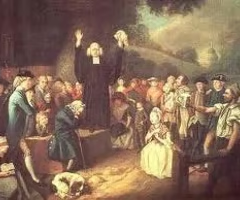
Religious movement that began in the early decades of the 19th century. Reaction against the rationalism of the Enlightenment. In the northern states it touched off social reform.
Burned-Over District
Popular name for Western New York, a region particularly swept up in the religious fervor of the Second Great Awakening.
market revolution
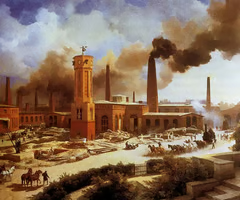
Starting in the early 19th century, produced vast economic growth, mass produced goods.
Elizabeth Cady Stanton
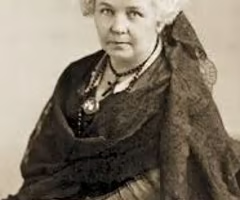
A women's rights reformer. She was not allowed to speak at an antislavery convention, and in response organized the Seneca Falls Convention in 1848
cotton gin
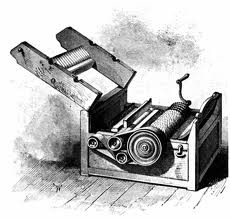
This machine was invented by Eli Whitney in 1793. It removed seeds from plant fibers. It expanded the institution of slavery
Eli Whitney; interchangeable parts
mass production employing interchangeable parts; Whitney first put it into practice, who was known for his cotton gin; wanted to be able to produce great numbers of muskets quickly; made it possible for owners of damaged objects to send away to a factory for the needed part, confident that the new one would precisely substitute for the old

William Llyod Garrison
Advocated the immediate emancipation of slaves without compensation to their owners. He was also the writer of the “Liberator”.
Frederick Douglass
(1817-1895) American abolitionist and writer, he escaped slavery and became a leading African American spokesman and writer. He published his biography, The Narrative of the Life of Frederick Douglass, and founded the abolitionist newspaper, the North Star.
Lucretia Mott
Early feminist who advocated for women's rights and against slavery. Co-organizer of the Seneca Falls Convention in 1848.
Dorthea Dix
Tireless reformer, who worked mightily to improve the treatment of the mentally ill. Appointed superintendant of women nurses for the Union forces.
Cult of Domesticity
Idealization of women and the home: true womanhood was based on piety, purity, submissiveness and domesticity.
Sectionalism: Industrial Northeast
Largely urban population that worked in factories; favored tariffs, manufacture, bankers. Laborers: immigrants, young girls in factories Initially centered on the textile industry, by the 1830s it was producing many different products
Sectionalism
Different parts of the country developing unique and separate economies and cultures (as the North, South and West). This can lead to conflict.
Sectionalism: Agricultural Northwest
Connected to the east by new transportation systems. Agricultural economy grew by expanding the area of settlement and adopting new agricultural techniques: reduced labor needs, farmers cultivated new varieties of seeds, imported better breeds of animals, improved tools and machines. Dependent on the Eastern consumers and manufacturers.
Sectionalism: The South
Largely agricultural, mostly cotton from 1830-1850.
Sectionalism: The West
Largely trapping and hunting, citizens lived a secluded life away from others.
Lowell Factory System
The system that recruited young farm women to work in the textile mills. They were housed in company dormitories near the mills.
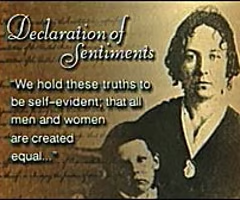
Seneca Falls Convention
In 1848 women's rights movement wrote a "Declaration of Sentiments", which declared all men and women equal and listed grievances. Essentially copied Declaration of Independence.
Transcendentalists
Followers of a belief which that knowledge transcends instead of coming by reason. They questioned organized religion and economic practices that took away an individual's self worth. They stressed self-reliance, self- culture, self-discipline and promoted an array of humanitarian reforms.
Henry David Thoreau
American transcendentalist who questioned a government that supported slavery. He started the movement of civil-disobedience (On Civil Disobedience) when he refused to pay the toll-tax to support him Mexican War. He lived in a cabin on Walden Pond for two years and authored Walden.
Ralph Waldo Emerson
Author of Self-Reliance. American transcendentalist who was against slavery and stressed self-reliance, optimism, self-improvement, self-confidence, and freedom.
Margaret Fuller
Social reformer, leader in women's movement and a transcendentalist. Edited "The Dial" which was the publication of the transcendentalists. It appealed to people who wanted "perfect freedom" "progress in philosophy and theology and hope that the future will not always be as the past".
Horace Mann
Secretary of the Massachusetts Board of Education; "Father of the public school system"; a prominent proponent of public school reform, & set the standard for public schools throughout the nation; lengthened academic year; pro training & higher salaries to teachers
Rev. Charles Finney
One of the most important leaders of the Second Great Awakening. He was against alcohol and supported women's involvement including preaching.
Temperance Movement
A social movement against the consumption of alcoholic beverages.
Joseph Smith
Founded Mormonism in New York in 1830 with the guidance of an angel. 1843, Smith's announcement that God sanctioned polygamy split the Mormons and let to an uprising against Mormons in 1844; translated the Book of Mormon. He was murdered by an angry mob who was persecuting him for his beliefs.
Transportation Revolution
Term referring to a series of nineteenth-century transportation innovations—turnpikes, steamboats, canals, and railroads—that linked local and regional markets, creating a national economy.
Communal Experiments
Shakers, New Harmony, Brook Farm, Oneida Community
Steel plow and mechanical reaper
inventions that encouraged farmers to build larger farms in the West
cottage industry
Manufacturing based in homes rather than in a factory, commonly found before the Industrial Revolution.
Factory System
This new system gradually replaced localized cottage industry. It decreased the need for skilled labor and increased productivity.
Erie Canal (1825)
New York state canal that linked Lake Erie to the Hudson River. It dramatically lowered shipping costs, fueling an economic boom in upstate New York and increasing the profitability of farming in the Old Northwest.
Asylum Movement
reformers proposed setting up new public institutions such as state-supported prisons, mental hospitals, and poorhouses; hope was that the inmates of these institutions would be cured of their antisocial behavior by being treated to a disciplined pattern of life in some rural setting
Abolition
The movement to make slavery and the slave trade illegal.
Angelina Grimke
Daughter of a South Carolina slaveholder that were antislavery. Controversial because they spoke to audiences of both men and women at a time when it was thought indelicate to address male audiences. Womens' rights advocates as well.
Neal Dow
Father of Prohibition; he made a law in Maine that would disallow lethal alcohol to be sold.
Sylvester Graham
American clergyman whose advocacy of health regimen emphasizing temperance and vegetarianism found lasting expression in graham cracker
Maria Stewart
The first black woman to lecture on women's rights and slavery in public in the early 1830s in Boston. Encountered vocal opposition and violence. Garrison published some of her lecture's in The Liberator.
Edger Allen Poe
American writer/poet, wrote "The Raven" and "The Fall of the House of Usher", father of mystery and modern detective stories, relied heavily on emotion.
Washington Irving
American writer remembered for the stories "Rip Van Winkle" and "The Legend of Sleepy Hollow"
Herman Melville
American writer whose experiences at sea provided the factual basis of Moby-Dick (1851), considered among the greatest American novels
Nathaniel Hawthorne
Originally a transcendentalist; later rejected them and became a leading anti-transcendentalist. He was a descendant of Puritan settlers. The Scarlet Letter shows the hypocrisy and insensitivity of New England puritans by showing their cruelty to a woman who has committed adultery and is forced to wear a scarlet "A".
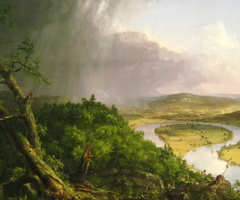
The Hudson School
School of art that emphasized the beauty of American landscapes, the magnitude of nature, and man's insignificant place in the natural world
genre painting
a style of painting depicting scenes from ordinary life, especially domestic situations.
The County Election
1852 painting by George Caleb Bingham. Example of genre painting
The Declaration of Independence, John Trumbull
Famous painting that depicts an idealized version of the signing of the Declaration. Illustrates the increasing nationalism and the desire to tell American stories in the new nation.
Noah Webster's dictionary
helped to standardize the American language
 Note
Note  Flashcards (32)