Physics- Forces and Pressure

0.0(0)
Studied by 0 people
call kaiCall Kai
learnLearn
examPractice Test
spaced repetitionSpaced Repetition
heart puzzleMatch
flashcardsFlashcards
GameKnowt Play
Card Sorting

1/22

encourage image

There's no tags or description

Looks like no tags are added yet.

Last updated 4:24 AM on 3/23/26
Name
Mastery
Learn
Test
Matching
Spaced
Call with Kai

No analytics yet

Send a link to your students to track their progress

23 Terms

1
New cards

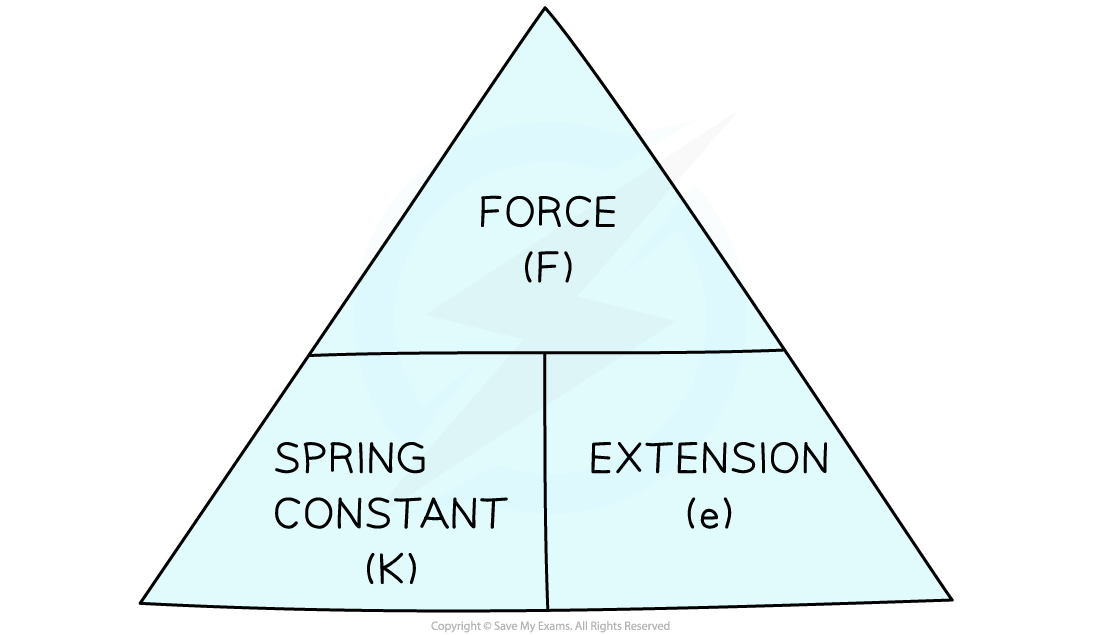
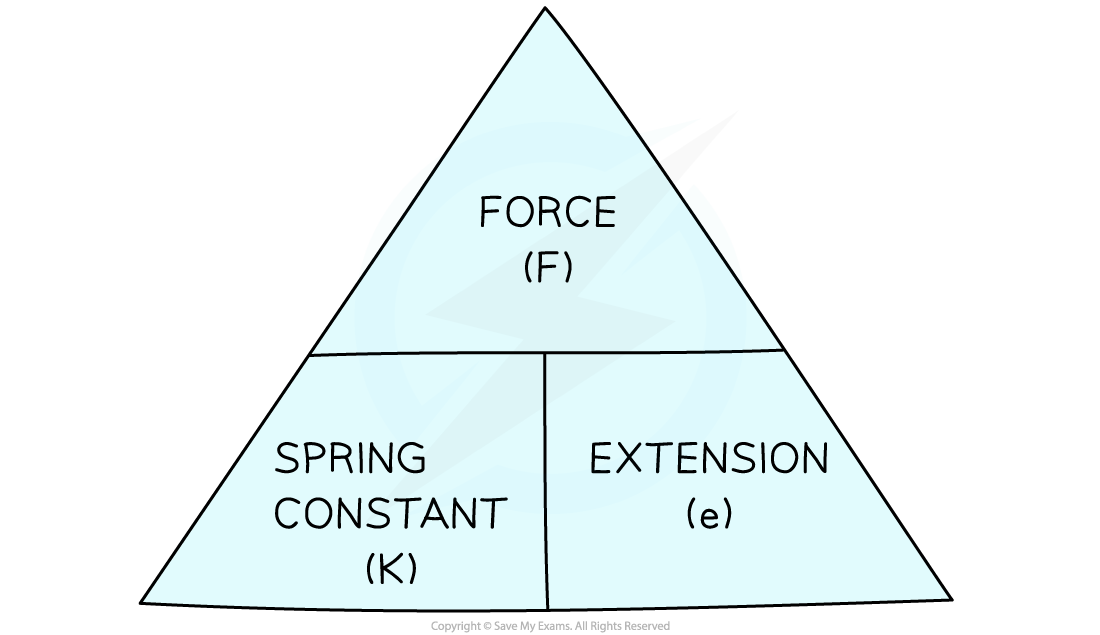
Hooke’s Law

Formula: Force = Spring constant x Extension

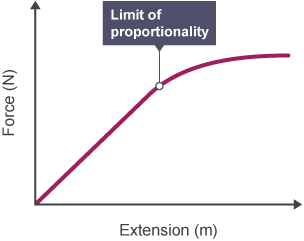
The extension of a spring is directly proportional to the force/ load applied to it, provided the limit of proportionality is not exceeded

  • Beyond the extension the spring remains permanently stretched
<p><strong>Formula: Force = Spring constant x Extension</strong></p><p></p><p><strong>The extension of a spring is directly proportional to the force/ load applied to it, provided the limit of proportionality is not exceeded</strong></p><ul><li><p>Beyond the extension the spring remains permanently stretched</p></li></ul><p></p>
2
New cards

Extension

Extension= Length of spring (with load) - original length of spring (without load)

3
New cards

Elastic Material

An elastic material is one that will return to it’s original shape when the applied force is removed

4
New cards

Plastic/Inelastic

A plastic or inelastic material is on that stays deformed when the applied force is removed

5
New cards

Load-extension Graph

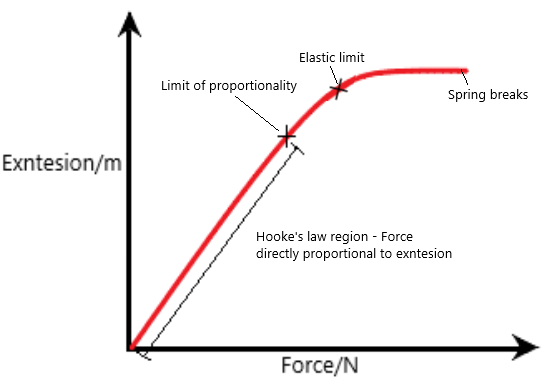
A load–extension graph for an elastic solid, such as a metal wire or spring, displays a linear (straight-line) relationship up to the proportionality limit, demonstrating Hooke’s Law. The graph (load on y-axis, extension on x-axis) has a gradient equal to the spring constant (stiffness).
<p><span><span>A load–extension graph for an </span><strong><span>elastic solid, </span></strong><span>such as a </span><strong><span>metal wire or spring</span></strong><span>, displays a </span><strong><span>linear (straight-line</span></strong><span>) relationship up to the proportionality limit, demonstrating Hooke’s Law. The graph (load on y-axis, extension on x-axis) has a gradient equal to the spring constant (stiffness).</span></span></p>
6
New cards

Too large force on objects

If too large a force is applied the material will lose its elasticity and be permanently deformed

7
New cards

Moment

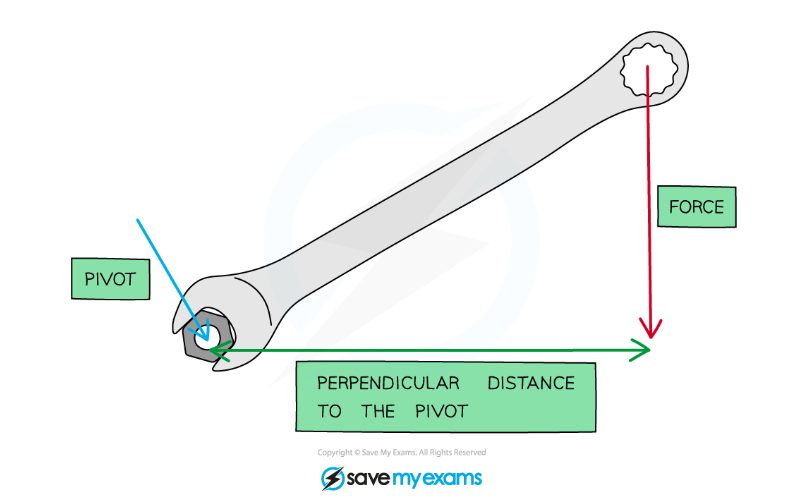
Moment of a force is a measure of its turning effect of a single force

  • Forces can cause the rotation of an object about a fixed pivot

  • This rotation can be clockwise or anticlockwise

e.g. : cap on drink bottle, A see-saw
<p>Moment of a force is a measure of its turning effect of a single force</p><ul><li><p>Forces can cause the <strong>rotation</strong> of an object about a fixed <strong>pivot</strong></p></li><li><p>This rotation can be <strong>clockwise&nbsp;</strong>or&nbsp;<strong>anticlockwise</strong></p></li></ul><p>e.g. : cap on drink bottle, A see-saw</p>
8
New cards

Moment Formula

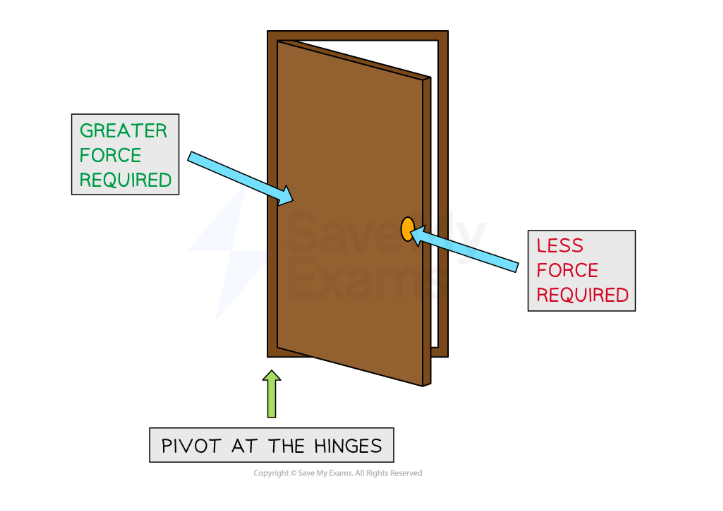
  • Formula: Moment = force × perpendicular distance from the pivot

Units for Moments; Newton metre/(Nm)

Increasing the distance at which a force is applied from a pivot decreases the force required

  • If you try to push open a door right next to the hinge, it is very difficult, as it requires a lot of force

  • If you push the door open at the side furthest from the hinge, then it is much easier, as less force is required
<ul><li><p><strong>Formula: Moment = force × perpendicular distance from the pivot</strong></p></li></ul><p></p><p>Units for Moments; <strong>Newton metre/(Nm)</strong></p><p></p><p><strong>Increasing</strong> the <strong>distance</strong> at which a force is applied from a pivot <strong>decreases</strong> the <strong>force</strong> required</p><ul><li><p>If you try to push open a door right next to the hinge, it is very difficult, as it requires a lot of force</p></li><li><p>If you push the door open at the side furthest from the hinge, then it is much easier, as less force is required</p></li></ul><p></p>
9
New cards

Equilibrium: Is balance

  • The forces on the object must be balanced/ the same

    • There must be no resultant force or resultant moment its in equilibrium

When a body is in equilibrium the sum of clockwise moments = Sum of anticlockwise moments about a pivot

  • Resultant moment = 0

10
New cards

Example set up of equipment to demonstrate equilibrium

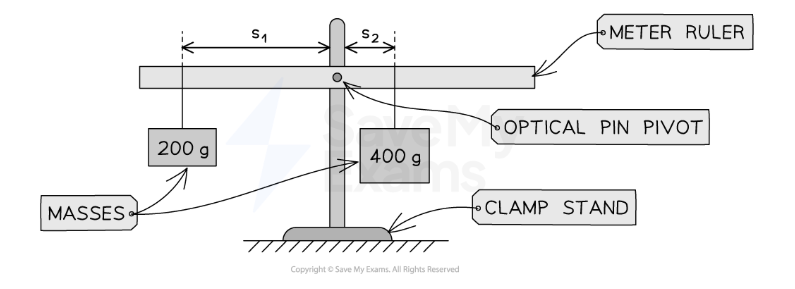
The ruler acts as the beam with the pin as the pivot. Unequal masses are added at different distances until the beam is balanced and equilibrium is reached

Method

  1. Hang unequal loads on either side of the pivot/fulcrum; one while one person hangs the loads

  2. Adjust the distances of mass 1, , and mass 2, , until the beam is balanced 

  3. Adjust further to ensure the beam is perfectly horizontal with no resultant moment

  4. Record the distance from the pivot of masses  and 

  5. Repeat the process for different sized load
<p><strong><em>The ruler acts as the beam with the pin as the pivot. Unequal masses are added at different distances until the beam is balanced and equilibrium is reached</em></strong></p><p>Method</p><ol><li><p>Hang unequal loads on either side of the pivot/fulcrum; one while one person hangs the loads</p></li><li><p>Adjust the distances of mass 1,&nbsp;, and mass 2,&nbsp;, until the beam is balanced&nbsp;</p></li><li><p>Adjust further to ensure the beam is perfectly horizontal with no resultant moment</p></li><li><p>Record the distance from the pivot of masses&nbsp; and&nbsp;</p></li><li><p>Repeat the process for different sized load</p></li></ol><p></p>
11
New cards

Centre of Mass

The weight of an object acts as a single downward force from a point called the centre of mass or centre of gravity

12
New cards

Determining the centre of gravity of an irregularly shaped plane lamina

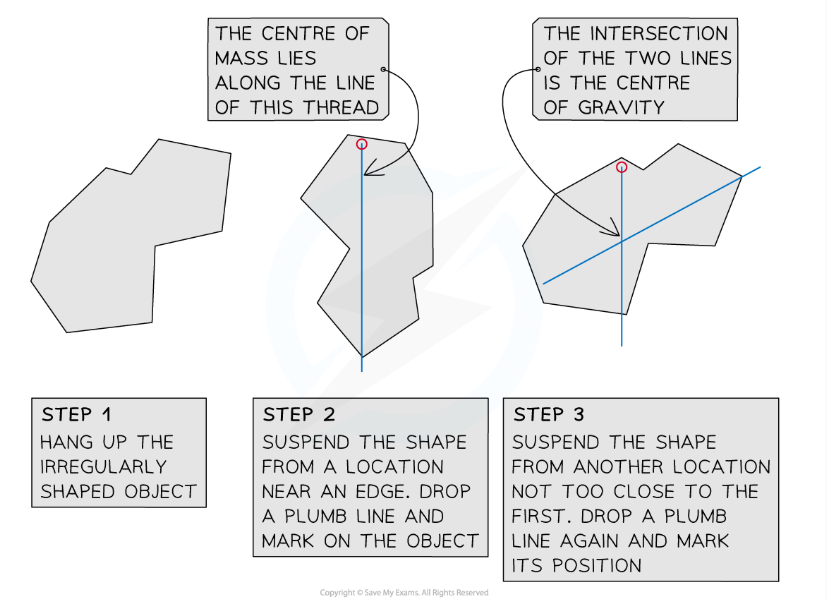
For irregularly shaped objects, the centre of gravity can be found using the suspension method

  1. Punch 3 holes near the outer edges of the shape in different locations

  2. Create a loop of thread and hang the shape from the clamp

  3. Use a plumb line (a weighted thread) aligned with the hanging thread to show the line of action of the weight force

  4. Use a ruler and pencil to mark the line of action of the weight force onto the plane lamina

  5. Repeat the process until 3 lines have been drawn

  6. The point at which the lines intersect is the position of the centre of gravity 


Analysis of results

  • Each shape is an irregularly shaped object

  • When an object is suspended from a point, it will always settle with its centre of gravity directly below the point of suspension
<p><strong><em>For irregularly shaped objects, the centre of gravity can be found using the suspension method</em></strong></p><ol><li><p>Punch 3 holes near the outer edges of the shape in different locations</p></li><li><p>Create a loop of thread and hang the shape from the clamp</p></li><li><p>Use a plumb line (a weighted thread) aligned with the hanging thread to show the line of action of the weight force</p></li><li><p>Use a ruler and pencil to mark the line of action of the weight force onto the plane lamina</p></li><li><p>Repeat the process until 3 lines have been drawn</p></li><li><p>The point at which the lines intersect is the position of the centre of gravity&nbsp;</p></li></ol><p><strong>&nbsp;</strong></p><p>Analysis of results</p><ul><li><p>Each shape is an irregularly shaped object</p></li><li><p><strong>When an object is suspended from a point, it will always settle with its centre of gravity directly below the point of suspension</strong></p></li></ul><p></p>
13
New cards

Position of the centre of gravity on the stability of simple objects

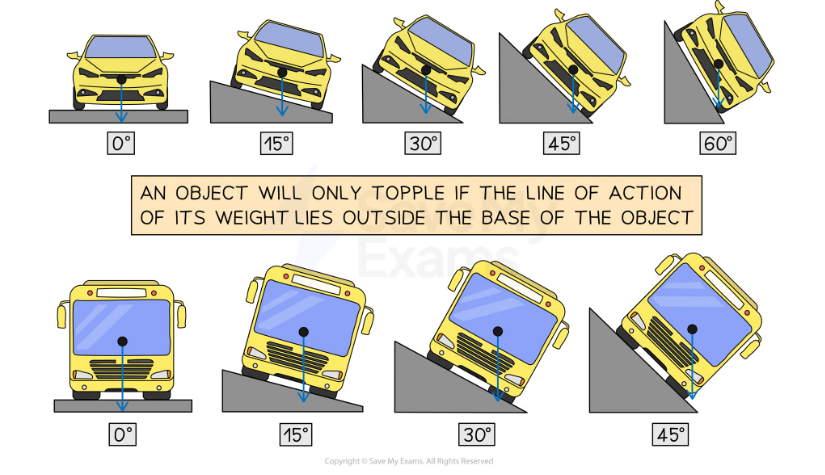
An object is most stable with a low Centre of gravity and a wide base, as a lower Centre of gravity requires a larger tilt angle for the vertical weight line to fall outside the base. Higher, narrower objects are less stable.
<p><strong><mark data-color="rgba(0, 0, 0, 0)" style="background-color: rgba(0, 0, 0, 0); color: inherit;">An object is most stable with a low Centre of gravity and a wide base, as a lower Centre of gravity requires a larger tilt angle for the vertical weight line to fall outside the base</mark></strong><span>. Higher, narrower objects are less stable.</span></p>
14
New cards

Pressure

pressure is force per unit area;

  • P=F/A

15
New cards

pressure varies with force and area in the context of everyday

examples

e.g.: Snowshoes: Snowshoes have a large surface area, which spreads a person's weight over a wider area, lowering the pressure on the snow and preventing sinking.

16
New cards

Extension

Extension in the spring is directly proportional to the applied force causing the extension. ie applied force is double the extension on spring is doubled
<p>Extension in the spring is directly proportional to the applied force causing the extension. ie applied force is double the extension on spring is doubled</p><p></p>
17
New cards

Spring Constant (k)

The spring constant (k) is a measure of the stiffness ( how difficult it is to stretch it of the spring)

  • Stifffer springs will have larger spring constans (k value

  • Units- N/m or N/cm or N/mm

<p>The spring constant (k) is a measure of the stiffness ( how difficult it is to stretch it of the spring)</p><ul><li><p>Stifffer springs will have larger spring constans (k value</p></li><li><p>Units- N/m or N/cm or N/mm</p></li></ul><p></p>
18
New cards

Describe, qualitatively, how the pressure beneath the surface of a liquid changes with ensity of the liquid

Effect of Density

  • Liquid pressure is greater in liquids with higher density.

  • A denser liquid has more mass per unit volume.

  • Therefore it exerts greater weight and produces greater pressure at the same depth. Describe how the pressure beneath the surface of a liquid changes with depth and density of the liquid

19
New cards

Describe, qualitatively, how the pressure beneath the surface of a liquid changes with depth of a liquid

Effect of Depth

  • Liquid pressure increases with depth.

  • The deeper you go below the surface, the greater the pressure.

  • This is because there is more liquid above, so the weight of the liquid increases

20
New cards

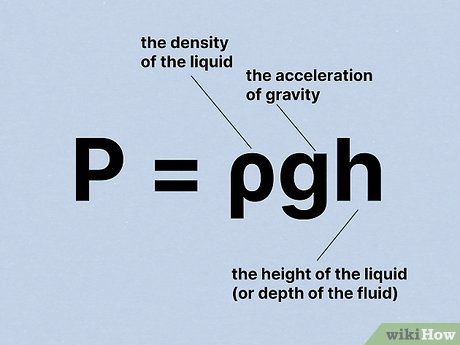
Equation of Liquid Pressure

The Equation for Liquid Pressure: P=ρgh

  • P = change in pressure (Pa) e.g. : N/m²

  • ρ\rho = density of liquid (kg/m³)

  • g = gravitational field strength (N/kg)

  • h = depth (m)

Unit of pressure: Pa (N/m²)

🧠 What This Means

Pressure:

  • Increases with depth

  • Increases with density

  • Increases with gravitational field strength
<p>The Equation for Liquid Pressure: <strong>P=ρgh <br></strong></p><p></p><ul><li><p><strong>P</strong> = change in pressure (Pa) e.g. : <strong>N/m²</strong></p></li><li><p><strong>ρ\rho</strong> = density of liquid (kg/m³)</p></li><li><p><strong>g </strong>= gravitational field strength (N/kg)</p></li><li><p><strong>h </strong>= depth (m)</p></li></ul><p></p><p>Unit of pressure: <strong>Pa (N/m²)</strong></p><p><span data-name="brain" data-type="emoji">🧠</span> What This Means</p><p>Pressure:</p><ul><li><p>Increases with <strong>depth</strong></p></li><li><p>Increases with <strong>density</strong></p></li><li><p>Increases with <strong>gravitational field strength</strong></p></li></ul><p></p>
21
New cards

Pascal

Pascal = N/m²

22
New cards

Pressure in Liquids

Pressure in a liquid acts equally in all directions

23
New cards

Forces effect on size and shape of a body

Forces can change the size and shape of a body

Explore top flashcards

flashcards
2B Vocab
68
Updated 180d ago
0.0(0)
flashcards
Immune and Epidemiology
35
Updated 1067d ago
0.0(0)
flashcards
APUSh 5.5-5.8 terms
22
Updated 496d ago
0.0(0)
flashcards
S2 Law and Society Final
212
Updated 1035d ago
0.0(0)
flashcards
Spanska v40
20
Updated 901d ago
0.0(0)
flashcards
2B Vocab
68
Updated 180d ago
0.0(0)
flashcards
Immune and Epidemiology
35
Updated 1067d ago
0.0(0)
flashcards
APUSh 5.5-5.8 terms
22
Updated 496d ago
0.0(0)
flashcards
S2 Law and Society Final
212
Updated 1035d ago
0.0(0)
flashcards
Spanska v40
20
Updated 901d ago
0.0(0)