College Physics II Test 3
 Call Kai
 Learn
Learn Practice Test
 Spaced Repetition
 Match
Match Flashcards
 Knowt Play
1/24

There's no tags or description
Looks like no tags are added yet.
Name | Mastery | Learn | Test | Matching | Spaced | Call with Kai |
|---|
No analytics yet
Send a link to your students to track their progress
25 Terms
A hydrogen nucleus, which has a charge e, is situated to the left of a carbon nucleus, which has a charge 6e. Which statement is true?
The electrical force experienced by the hydrogen nucleus is to the left, and the magnitude is equal to the force exerted on the carbon nucleus.
A plastic rod is charged up by rubbing a wool cloth, and brought to an initially neutral metallic sphere. It is allowed to touch the sphere for a few seconds, and then is separated from the sphere by a small distance. After the rod is separated, the rod ? .
is repelled by the sphere
Two identical small charged spheres are a certain distance apart, and each initially experiences an electrostatic force of magnitude F due to the other. With time, charge gradually diminishes on both spheres. When each of the spheres has lost half its initial charge, the magnitude of the electrostatic force will be ? .
1/4 F

The figure above shows two unequal charges +q and -Q, of opposite sign. Charge Q has greater magnitude than charge q. Point X is midway between the charges. IN what section of the line will there be a point where the resultant electric field is zero?
VW
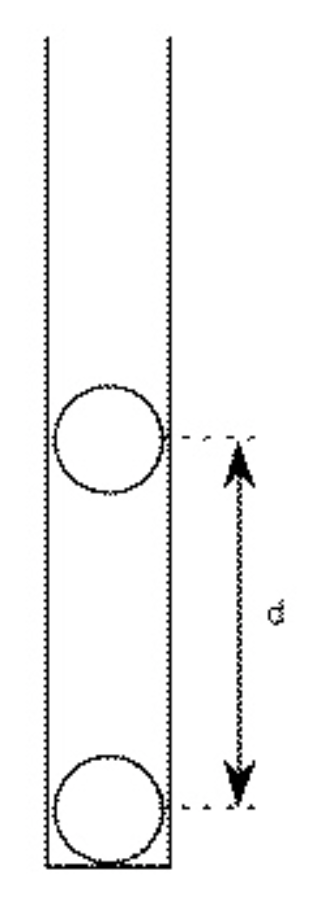
One charged plastic ball is vertically above another in a test tube as shown in the figure above. The balls are in equilibrium a distance d apart. If the charge on each ball is doubled, the distance between the balls in the test tube would become ? .
2d
A metal sphere is insulated electrically and is given a charge. If 50 electrons are added to the sphere in giving a charge, how many Coulombs are added to the sphere?
e = 1.6 \times 10^{-19}
-8.0 \times 10^{-18} \ C
Suppose a van de Graaff generator builds a negative static charge, and a grounded conductor is placed near enough to it so that a 7.0 \mu Cof negative charge arcs to the conductor. Calculate the number of electrons that are transferred.
e = 1.6 \times 10^{-19}
N=Q/e
4.38 \times 10^{13}
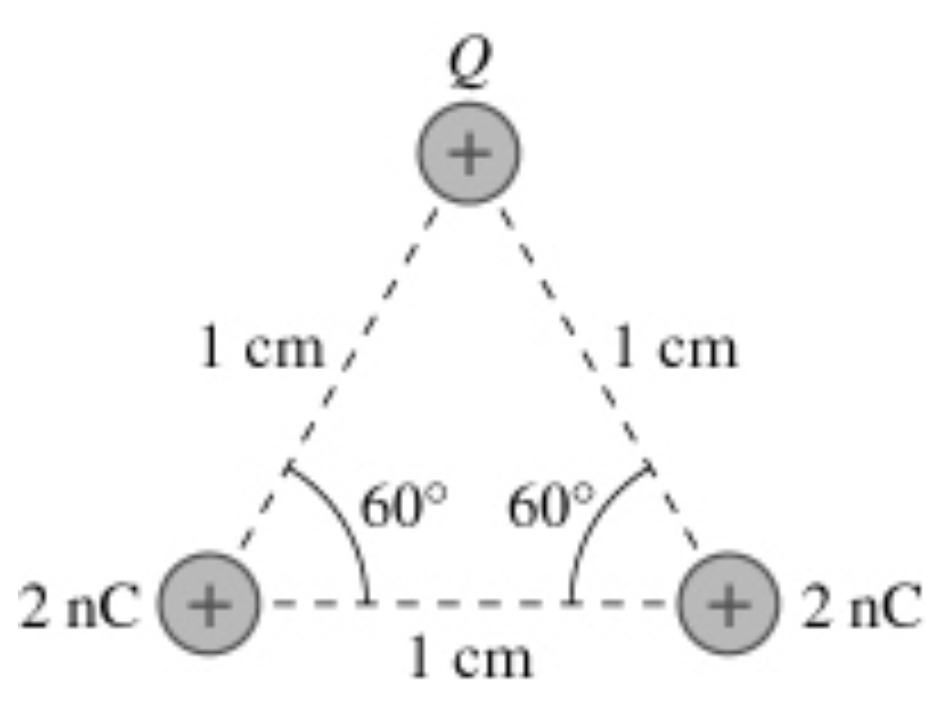
In the figure above, Q = 6.7 nC and all other quantities are exact. What is the magnitude of the electrical force (in N) on the charge Q?
F=k qQ/r² F_y=Fcos30
0.0021
Three charges of magnitude 3.0 \times 10^{-4} C each are located at x = 1.0 m, y = 0.0 m, at x = 0.0 m, y = 0.0 m, and at x = -1.0 m, y = 0.0 m. The one in the middle is negative, while the other two are positive. What is the net Coulombic force (in N) exerted by them on a negative 3.0 \times 10^{-5}C charge located at x = 0.0 m, y = 2.0 m? (The value of k is 9 \times 10^9 ).
8.7
The electric field 2.8 cm from a small object points toward the object with a strength of 180,000 N/C. What is the object's charge?
U=k|Q|/r^{2}\rightarrow|Q|=Ur^{2}/k
-16 nC
A small glass bead has been charged to 1.9 nC. What is the strength of the electric field 2.0 cm from the center of the bead?
E=kQ/r²
4.3 \times 10^4 \ N/C
Two electrons are passing 20.0 mm apart. What is the electric repulsive force that they exert on each other? (The value of k is 9 \times 10^9).
F=k {e²/r²}
5.8 \times 10^{-25} \ N
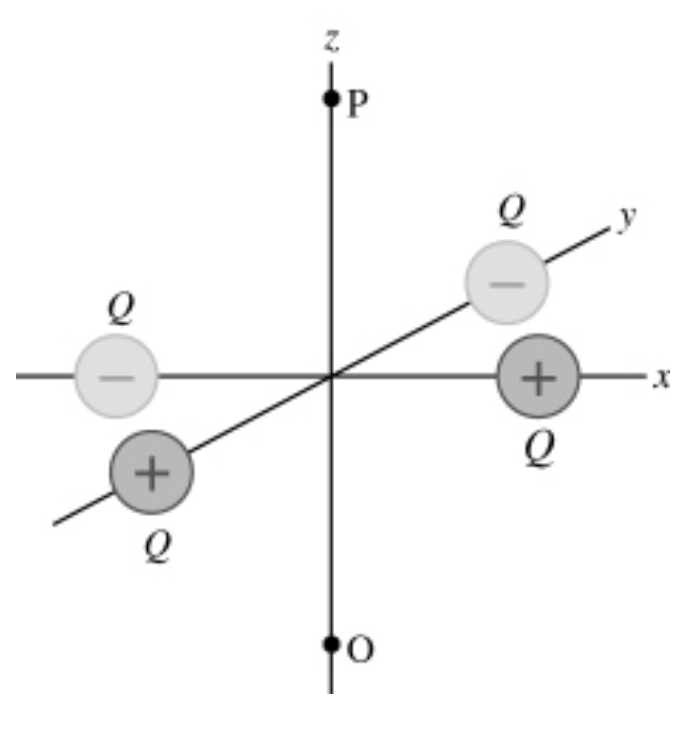
Four charged particles (two having a charge +Q and two having a charge -Q) are distributed on the xy-plane, as shown in the figure above. The charges are equidistant from the origin. The voltage is zero at infinity. The voltage at location P, which is on the z axis, is ? .
zero
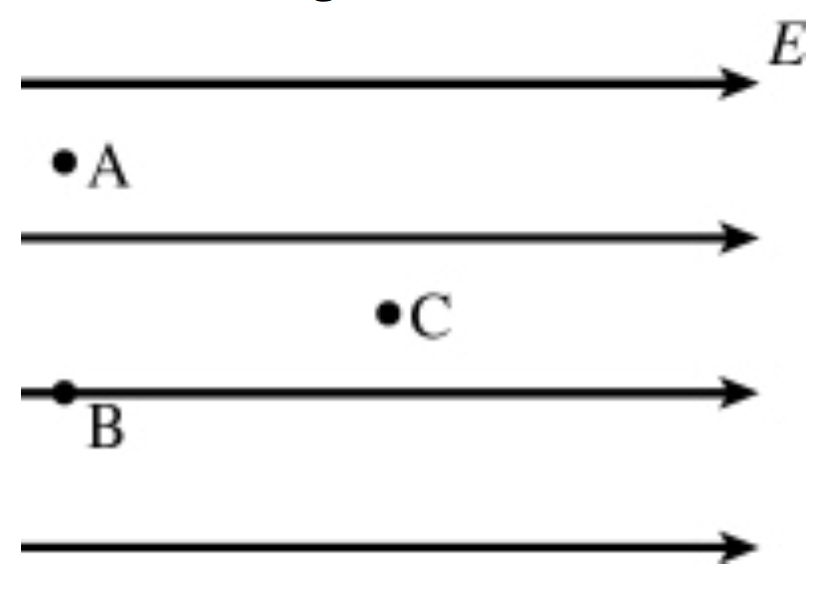
Suppose a region of space has a uniform electric field, directed toward the right, as shown in the figure above. Which statement is true?
The voltage at points A and B are equal, and the voltage at point C is lower than the voltage at point A.
The capacitance of a capacitor depends on ? .
none of these
Two conductors are joined by a long copper wire. Thus ? .
each conductor must be at the same potential
If the voltage at a point in space is zero, then the electric field must be ? .
impossible to determine based on the information given
A hydrogen atom consists of a proton and an electron. If the orbital radius of the electron increases, the potential energy of the electron ? .
increases
Each plate of a parallel-plate air capacitor has an area of 0.0010 m2, and the separation of the plates is 0.050 mm. An electric field of 7.4 x 10⁶ V/m is present between the plates. The capacitance of the capacitor, in pF, is closest to ? .
C=\epsilon _0 A/d
\epsilon _0 =8.85 \times 10^{-12}
180
A 300.0 pF capacitor consists of two circular plates of radius 0.30 mm. How far apart are the plates in micrometers? (The value of \epsilon_0 is 8.85 x 10⁻¹² C2/N•m2.)
C=\epsilon _0 A/d \Rightarrow d=\epsilon_0A/C
0.0083
The square plates of a 3,000 pF capacitor measure 40 mm by 40 mm and are separated by a dielectric which is 0.29 mm thick. The voltage rating of the capacitor is 800 V. The dielectric constant of the dielectric is closest to ? .
C= k\epsilon _0 A/d \Rightarrow k=Cd/\epsilon_0A
61
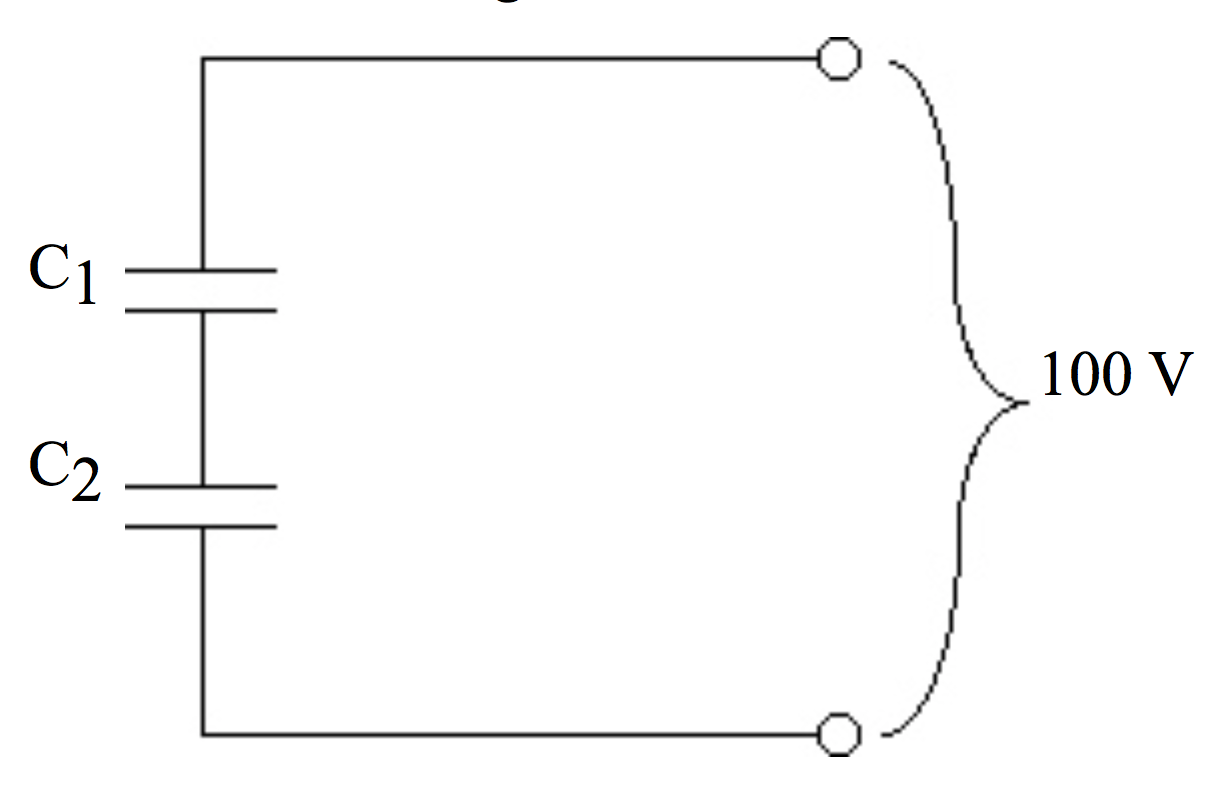
A potential difference of 100.0 V is applied across two capacitors in series, as shown in the figure above. If C1 is a 6.0 μF capacitor and has a voltage drop of 75 V across it, what is the capacitance of C2 (in μF)?
Q=C_1V_1=C_2V_2 \Rightarrow C_2 = Q/V_2
18
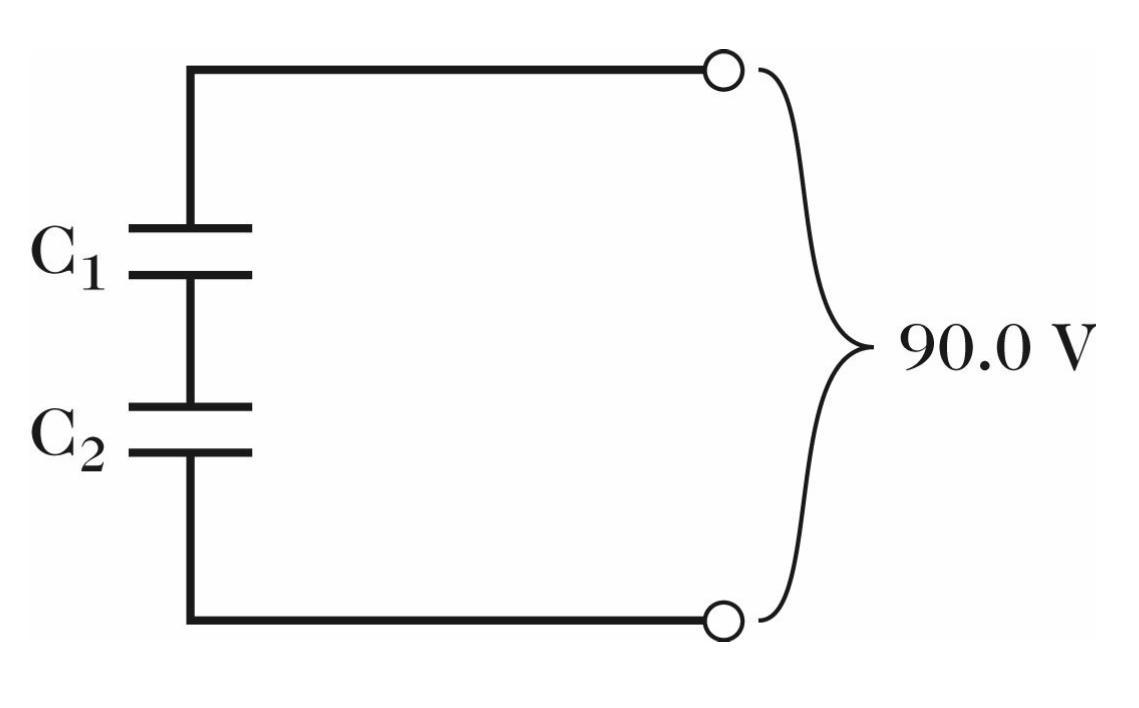
Two capacitors, one a 4.0 μF capacitor, C1, and the other a 7.0 μF capacitor, C2, are connected in series. If a 90.0 V voltage source is applied to the capacitors, as shown in the figure above, find the voltage drop (in V) across the 4.0 μF capacitor.
V_1=V_{total} * C_2/C_1+C_2
57
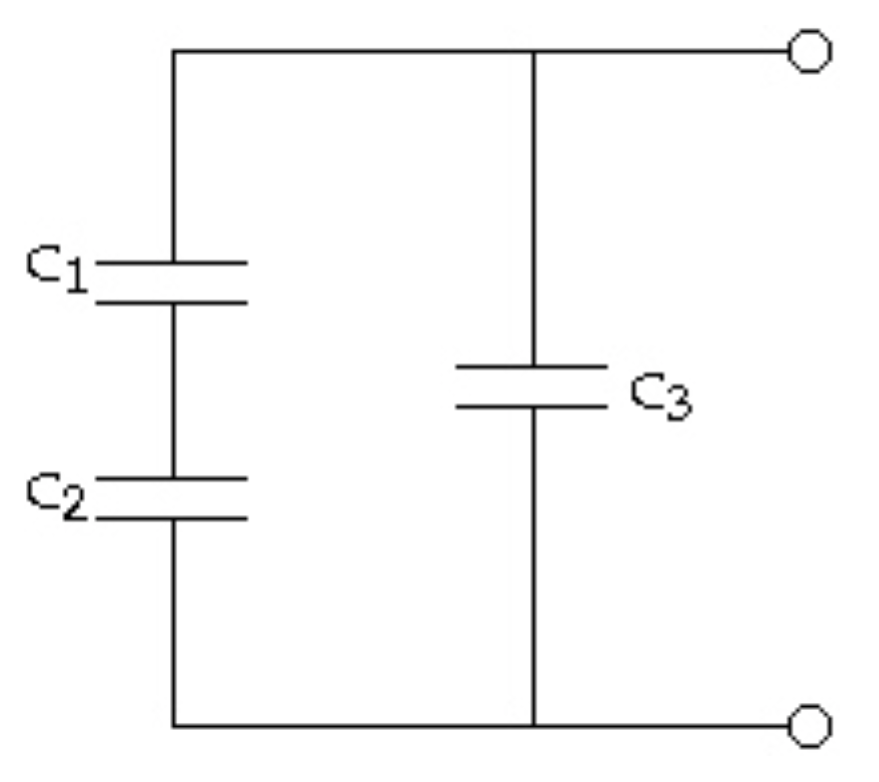
Three capacitors of equal capacitance are arranged as shown in the figure above. The voltage drop across C1 is 10.0 V. What is the voltage drop (in V) across C3?
V_{series}=V_1+V_2
20
A 5.0 μF, and a 14 μF, and a 21 μF capacitor are connected in parallel. How much capacitance would a single capacitor (in μF) need to have to replace the three capacitors.
C_{eq}=C_1+C_2+C_3
40
Explore top notes

