6. Active and intelligent packaging
 Call Kai
 Learn
Learn Practice Test
 Spaced Repetition
 Match
Match Flashcards
 Knowt Play
1/35

There's no tags or description
Looks like no tags are added yet.
Name | Mastery | Learn | Test | Matching | Spaced | Call with Kai |
|---|
No analytics yet
Send a link to your students to track their progress
36 Terms
How does packaging help prevent food waste?
Packaging is only a minor contribution to total GHG emission
Food loss should be prevented
Which packaging can help reduce it
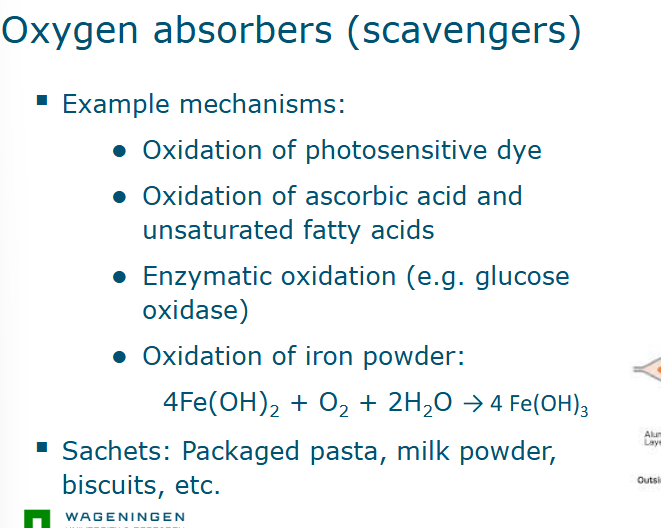
Oxygen absorber
Packaging that actively affects the internal environment of the product
Objective: increase shelf life
Oxygen is absorbed by packet
Definition and principle of active packaging
Active when the packaging actively change the condition of the packed food to extend shelf-life or improve safety or sensory properties, while maintaining quality of packaged food
The active components may be part of the packaging material or could be inserted or attached to the inside of the packaging
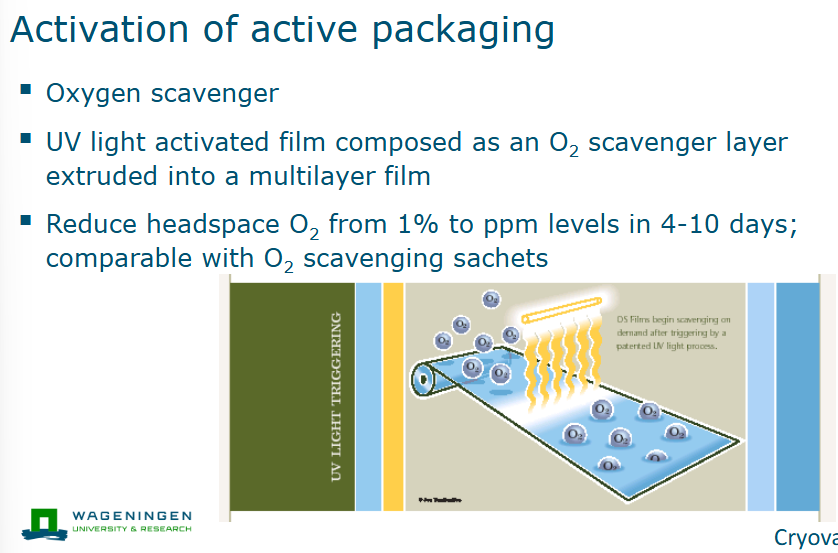
Active film
When active components are incorporated into the film
However these may degrade overtime when packaging is not yet used
Therefore this packaging can be activated using for example UV light.
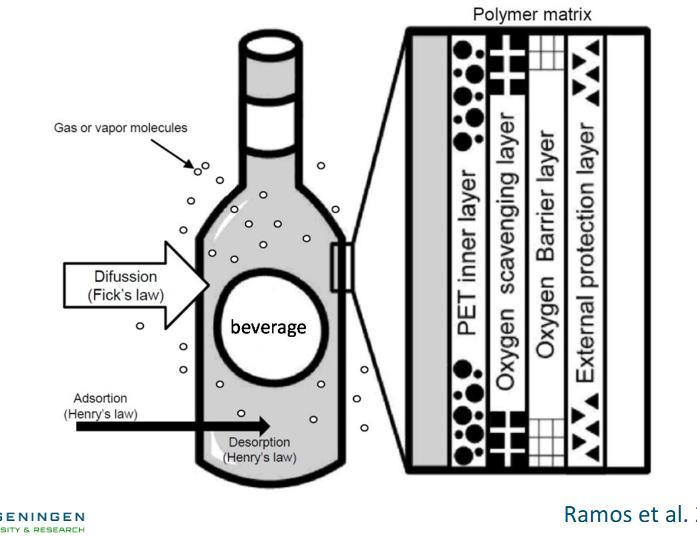
Passive protection
The scavenger layer is strategically put in between other layers so it only catches the oxygen passing through the packaging
Advantages of oxygen absorbers
Prevent oxidation: rancidity, change of colours, loss of nutrients
Prevent growth of aerobic microbes
Reduce or eliminate the need for preservatives and antioxidants
Slow don metabolism
Alternative for MAP and vacuum
Combination of MAP and vacuum packaging
MAP or vacuum packaging may not facilitate complete oxygen removal → residual O2 may be removed using oxygen scavenging technology
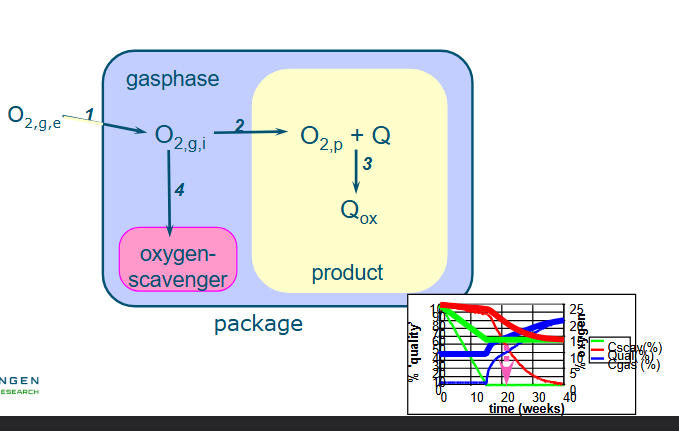
Modelling active packaging design
can help optimize packaging
Carbon dioxide emitters and scavengers
CO2 to inhibit microbial growth
Removal of O2 and dissolution of CO2 in the product creates a partial vacuum → collapse of flexible packaging
Dual action CO2 generators/O2 scavengers
Safety risks of CO2 in packaging
E.g. C. botulinum type B
Mechanisms: ferrous carbonate or a mixture of ascorbic acid and sodium bicarbonate
Moisture absorber
Used to absorb drip from meat, poultry and fish (or for vegetables that condense)
This then prevents microbes from growing in the moisture and it looks more attractive to consumers
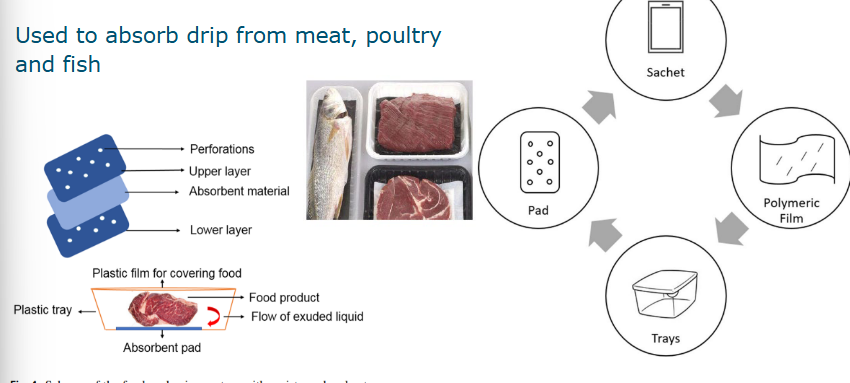
Advantages of moisture absorber
Enhanced product appearance and freshness: shelf life
Removes and retains spoilage bacteria
Reduces costly rewraps and product downgrades
Reduces product and packaging waste
Which factors of the food, the package and the environment do you need to consider when selecting a type of moisture absorber
Food:
Sensitivity
Size
Weight
Initial aw
Shelf life
Package:
WVTR
Environment:
T
RH
Antimicrobial packaging
Antimicrobial agents (e.g. organic acids or bacteriocins’ or metals or metal oxides) may be incorporated in or on (coating) package materials
Extends shelf life: especially for fresh foods
Forms of antimicrobial packaging
Additions of sachets/pads containing volatiles
Incorporation of volatile and non-volatiles directly into polymers
Coating or adsorbing antimicrobials onto polymer surface
Immobilization of antimicrobials to polymers by ion or covalent linkages
Use of polymers that are inherently antimicrobial
Direct vs indirect contact
if only part of the food comes in contact with the food, then it might be good to allow the volatiles to diffuse into the packaging atmosphere.
These are known as release antimicrobials
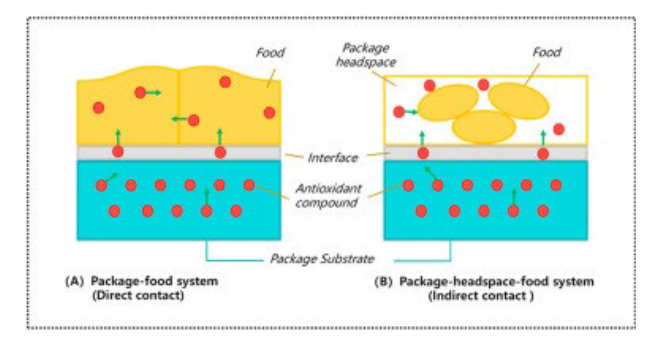
Release antimicrobials
Synthetic antimicrobials
Natural antimicrobials: e.g. essential oils
Naturally in situ formed antimicrobials
e.g. mustard seeds must be broken and combined with water to get antimicrobial effect.
Allows for controlled release
Effect of AITC on fat
More fat = reduction in antimicrobial effect of AITC
Controlled formation and release of AITC (antimicrobial compound in musterd)
Activate Myrosinase:
Hydrolysis of sinigrin glucosinolate
Formation of AITC
Release AITC:
Diffusion
Partitioning
Control by:
Particle size
Water content
Oil content
Advantages of active packaging
Extension of shelf life
Enables longer transport, batch production
Less expensive packaging material
packaging for limited shelf life products may require enhancement of only one property for a fixed period
Simpler processing
Additional microbiological “hurdles” can allow MAP to be achieved without use of expensive equipment
Difficult to handle products
oxygen can be removed form tightly packed products such as cheeses that are subject to mold growth
Prevents use of antimicrobials in foods: clean label
Perceived quality
Perceived quality = analyses product quality from the viewpoint of the consumer
Quality of food changes
Variation in intrinsic quality attributes
Variation in initial quality
Variable conditions
Why is intelligent packaging necessary?
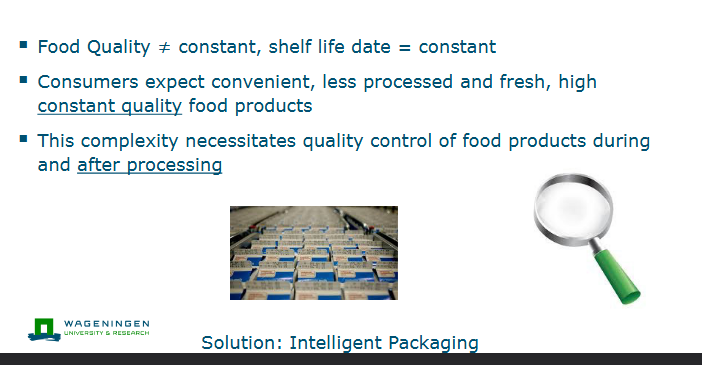
What is intelligent packaging?
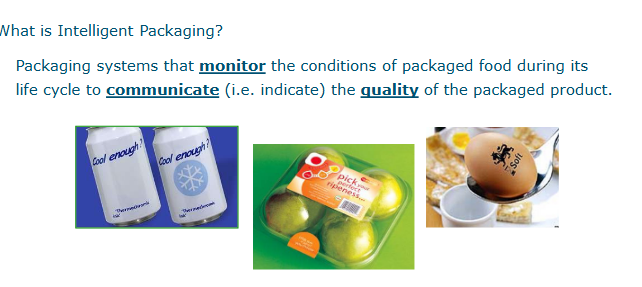
Smart freshness indicator
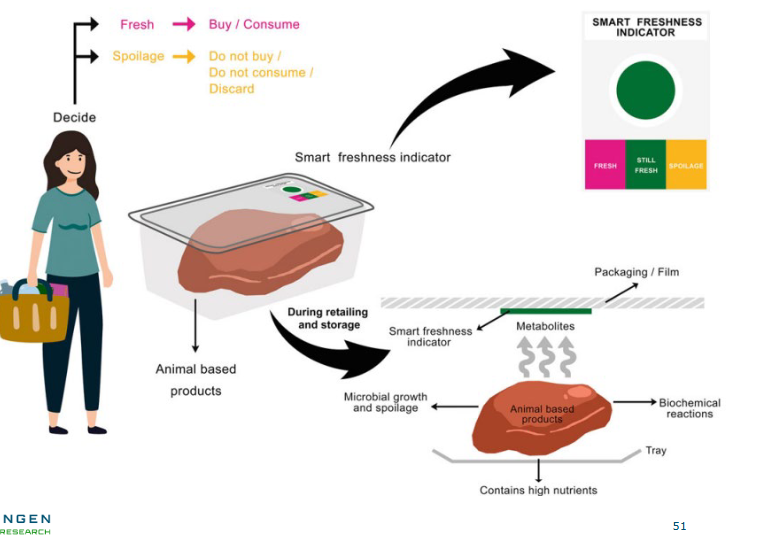
What are the two types of intelligent packaging?
Packaging systems with sensor for measuring:
Quality attributes (indicator compound for quality, like volatiles)
Advantage: direct quality indicator
Disadvantage: specific sensors for each product group
External conditions (T, humidity, pressure, integrity)
Advantage: sensor has broad application
Disadvantage: indirect quality indicator
Application of IP
Expensive, highly perishable foods
rapid quality deterioration
variable initial quality
High wastage
What intelligent packaging could be used for milk?
Can be indirect, by measuring temperature with a sensor we can predict quality of food
Quality sensor would be too expensive as milk is pretty cheap
TTI
Time temperature indicator
Provide visual indications of the cumulative effects of the temperature history and are used as freshness indicators for estimating remaining shelf life
See picture: on day four there was an increase in temp to it can be assumed that that decreased the quality
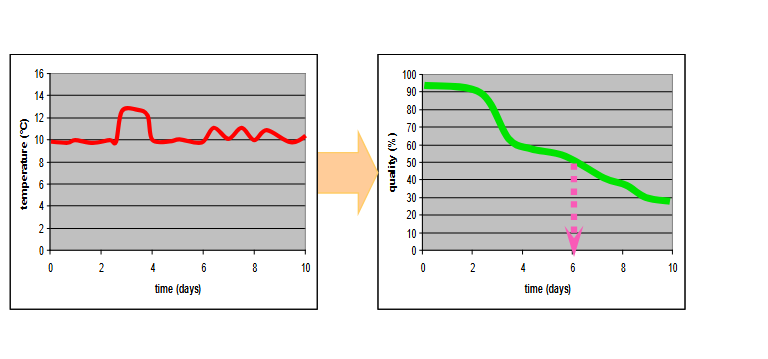
Formula TTI
Temperature sensitivity should have similar sensitivity to temperature as the product.
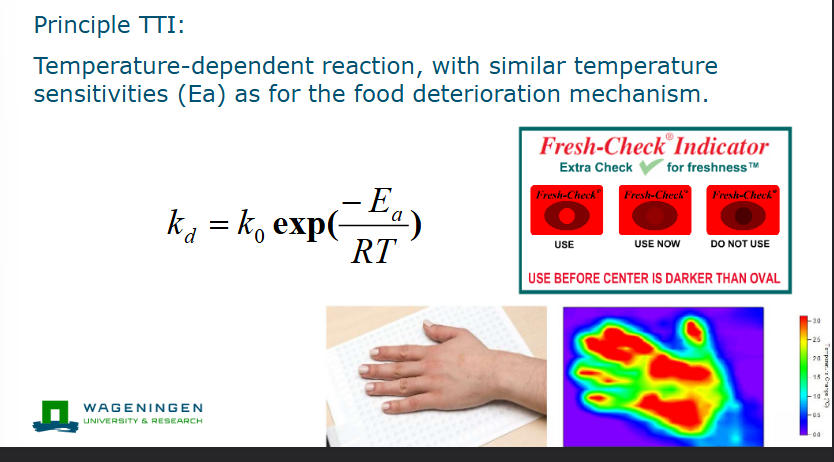
Mechanisms of TTI
Polymerization that occurs upon increase in temperature
Enzymatic reaction: drop in pH from enzymatic lipid hydrolysis
Lipolytic enzymes and pH indicator dye
Lipid substrate
Close to reactions in fatty foods
Diffusion reactions: diffusion is dependent on temperature, dependent on Ficks first law
Fresh fish quality sensor
Initial quality: unknown and highly variable
Development of freshness sensor
Important quality attribute of fresh fish:
Smell that indicates freshness
TMA levels correlate with sensory evaluation of freshness
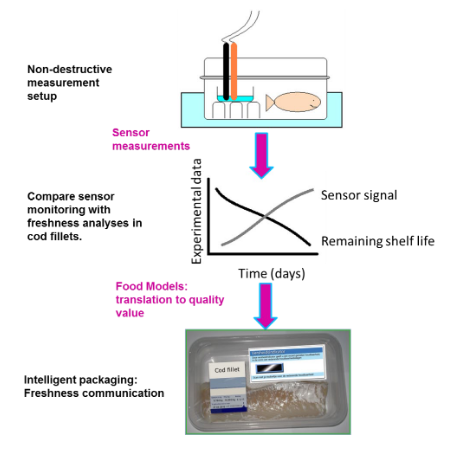
Development of non-destructive method
Non-destructive method monitors changes in the freshness status
Electrodes in aqueous sensor phase
Volatile compounds dissolve in aqueous phase
In the picture you can see that the results correlate with the freshness of the fish
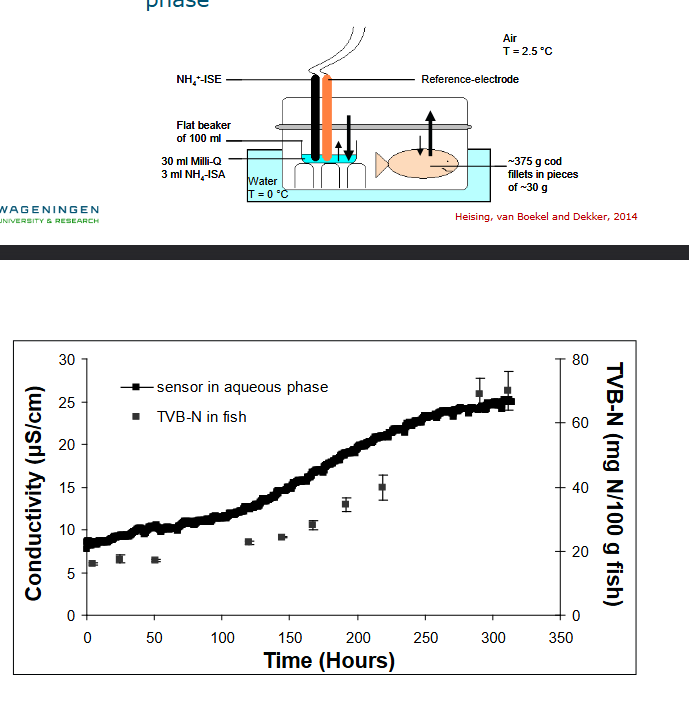
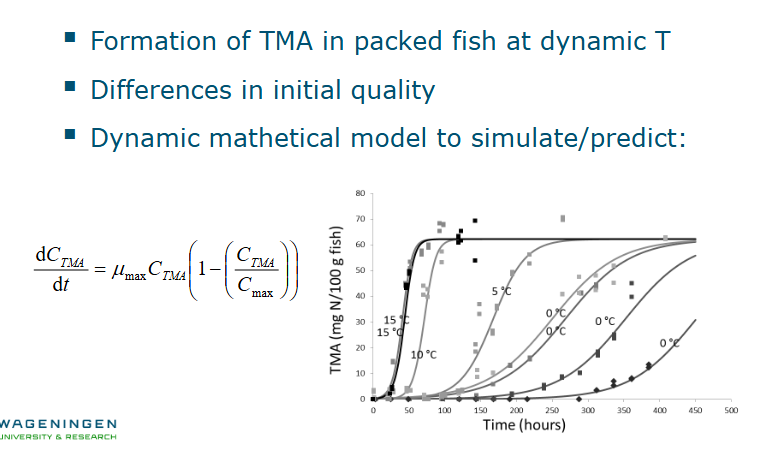
Modelling TMA formation
The graph also shows the differences in quality per fish
Approach development: intelligent packaging
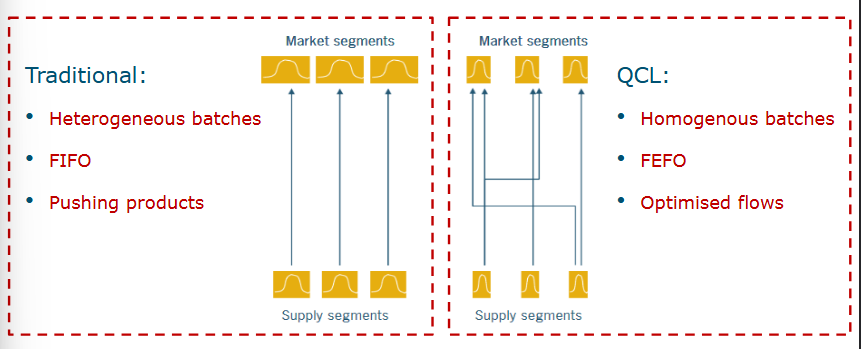
Quality-controlled logistics
Instead of first in first out, FIFO can be determined depending on simply quality if using sensor
Dynamic pricing based on DED
Currently, only discount on last selling day
Dynamic pricing
Based on dynamic expiration date
Consumers can choose for products with longer/shorter remaining shelf life
Explore top notes

