5.3: Neuronal communication
 Call Kai
 Learn
Learn Practice Test
 Spaced Repetition
 Match
Match Flashcards
 Knowt Play
1/95

There's no tags or description
Looks like no tags are added yet.
Name | Mastery | Learn | Test | Matching | Spaced | Call with Kai |
|---|
No analytics yet
Send a link to your students to track their progress
96 Terms
What is a sensory receptor?
A specialised cell or structure that detects a specific stimulus and converts it into an action potential (electrical signal)
What are sensory receptors?
transducers
What are transducers?
a cell that converts one form of energy into another - in this case to an electrical impulse
Do sensory receptors respond to all stimuli?
No, each sensory receptor is specific to one type of stimulus
What are Pacinian corpuscles?
a pressure sensor that detects changes in pressure on the skin
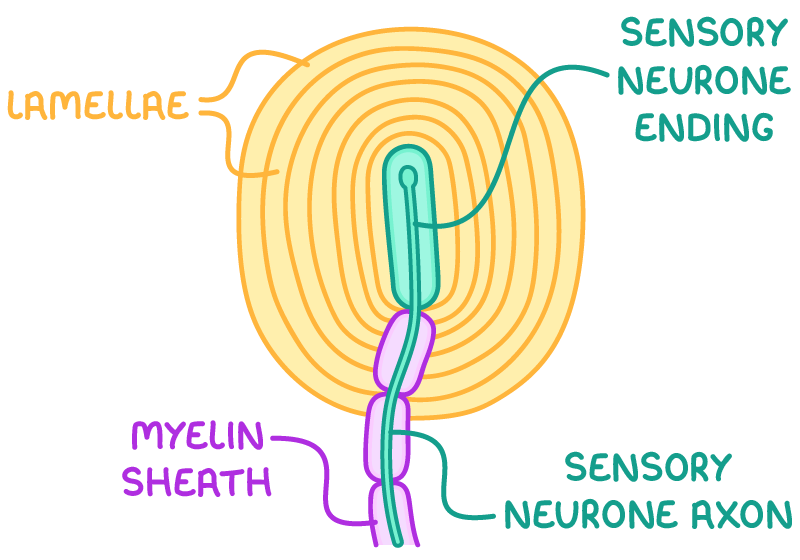
What happens when pressure is applied to a Pacinian corpuscle?
Pressure is applied to the skin
Rings of connective tissue (lamellae) deform
This stretches the sensory neurone membrane
Stretch-mediated sodium channels open
Na⁺ ions diffuse in
A generator potential is produced
If the generator potential reaches threshold:
An action potential is triggered
Action potential travels along the sensory neurone
What are the key differences between a generator potential and an action potential?
Generator potential | Action potential |
|---|---|
Local change | Travels |
Graded (size varies - depends on stimulus strength) | All-or-nothing: once threshold is reached, always the same size |
Depends on stimulus strength | Same size every time |
Can summate | Cannot summate |
How does stimulus strength affect generator potential?
Stronger stimulus produces a larger generator potential
How does stimulus strength affect action potentials?
Stronger stimulus increases the frequency of action potentials, not their size
What do the sodium potassium pumps in the membrane do?
actively pump sodium ions out of the cell and potassium ions into the cell. 3 sodium ions are pumped out for every 2 potassium ions pumped into the cell
What is the purpose of the sodium potassium pumps doing this?
when the channel proteins are all closed, they work to create a concentration gradient. The conc of sodium ions outside the cell increases, while the conc of potassium ions inside the cell increases. The membrane is more permeable to potassium ions, so some of these leak out of the cell. The membrane is less permeable to sodium ions, so few of these are able to leak into the cell
What is the result of these ionic movements?
a potential gradient across the cell membrane. The cell is negatively charged inside compared with outside. This negative potential is enhanced by the presence of negatively charged anions inside the cell
Define polarised
when the cell membrane is more negatively charged inside compared with the outside
How is a nerve impulse created?
by altering the permeability of the nerve cell membrane to sodium ions. This is achieved by opening sodium ion channels. This means that sodium ions can move down conc gradient into the cell. The movement of ions creates a potential difference (charge) across the membrane. The inside of the cell becomes less negative than the outside than usual (depolarisation)
Define depolarisation
where the inside of a cell membrane becomes less negatively charged compared with the outside
What happens if a small stimulus is detected compared to a larger stimulus?
if a small one is detected, only a few sodium channels will open.
What are the 3 types of neurons?
sensory, relay and motor
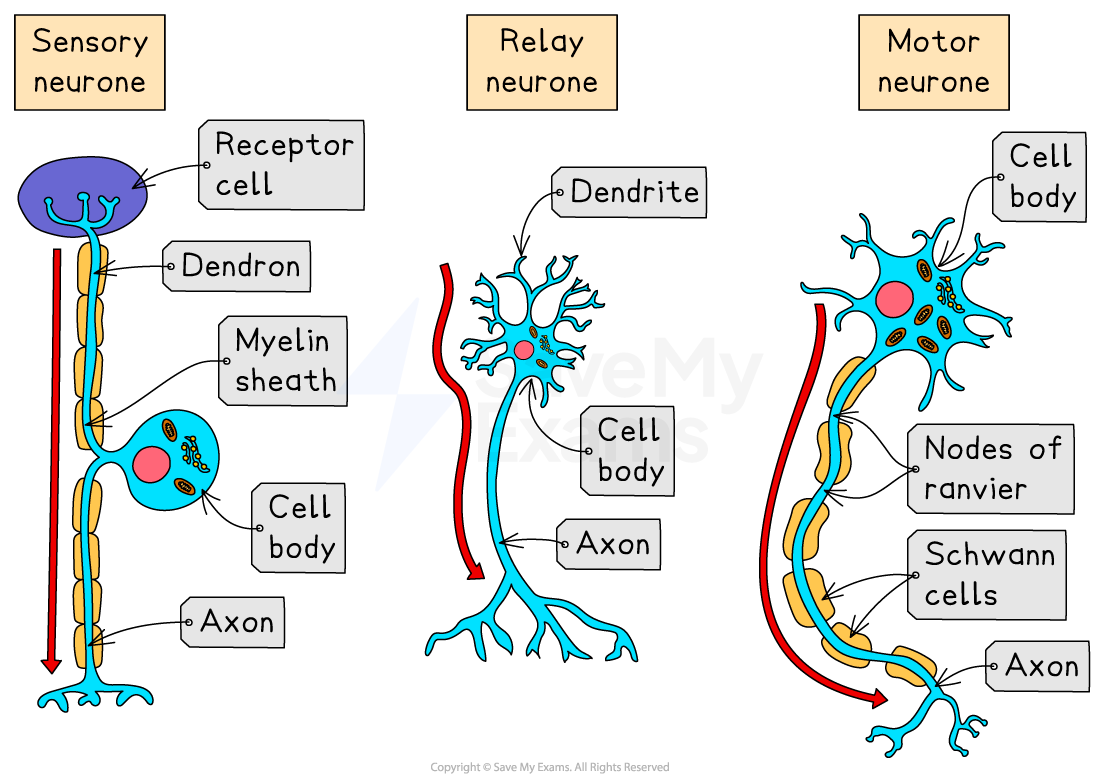
What is the sensory neuron?
they carry the action potential from a sensory receptor to the CNS
What is the structure of sensory neurons?
One long dendron (from receptor to cell body)
Cell body partway along the neurone
Short axon (from cell body to CNS)
Many dendrites at the receptor end and they are short, they don’t connect to the cell body
myelin sheath and nodes of Ranvier present
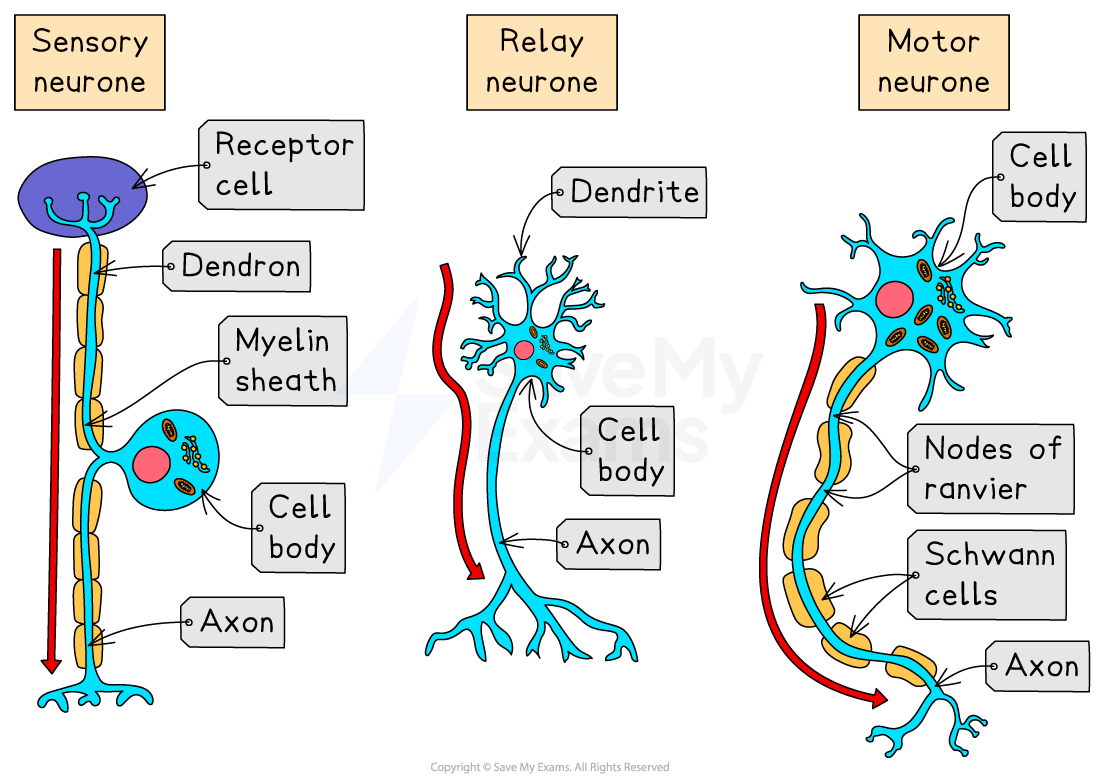
What is the relay neuron?
they connect sensory and motor neurons
What is the structure of relay neurons?
short axon
short dendrites - many of them
found in the CNS
no myelin sheath
no dendron
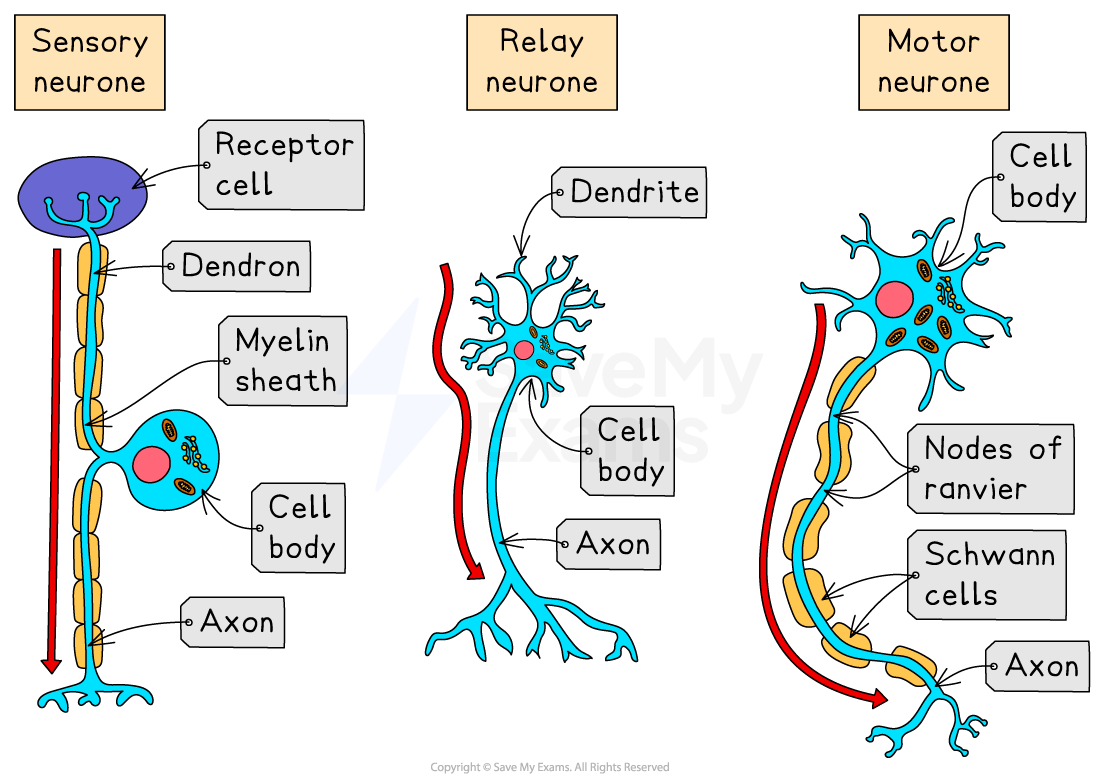
What is the motor neuron?
they carry an action potential from the CNS to an effector such as a muscle or gland
What is the structure of the motor neuron?
no dendrons
cell body at the end of the neuron and int he CNS
long axon and short dendrites (many)
dendrites are directly connected to the cell body
What is myelin?
A fatty insulating layer surrounding the axon of some neurones
Which cells form the myelin sheath?
Schwann cells
What is the function of myelin?
To increase the speed of nerve impulse transmission
What are the gaps in the myelin sheath called?
Nodes of Ranvier
Why do myelinated neurones transmit impulses faster?
Myelin acts as an insulator and prevents loss of ions
What type of conduction occurs in myelinated neurones?
Saltatory conduction
What does saltatory conduction mean?
The action potential jumps from node to node
Compare conduction in myelinated and non-myelinated neurones.
Myelinated neurones use saltatory conduction and are faster; non-myelinated neurones conduct continuously and are slower
What are the advantages of myelination?
can transmit action potential much more quickly
carry action potentials over long distances
What is the resting potential?
electrical potential difference across the membrane of a neurone when it is not transmitting an impulse, typically about –60 mV
What are the main factors that create the resting potential?
Sodium–potassium pump (Na⁺/K⁺ pump)
Potassium ion diffusion (leak channels)
Membrane permeability differences
What does the sodium–potassium pump do?
It actively transports:
3 Na⁺ ions out of the neurone
2 K⁺ ions into the neurone
→ using ATP
How does the Na⁺/K⁺ pump contribute to resting potential?
Makes the inside of the neurone more negative
Why does K⁺ diffuse (leak) out of the neurone?
High concentration inside (due to pump)
Membrane is more permeable to K⁺ than Na⁺
What happens to the membrane at resting potential?
it is polarised
What is a generator potential?
graded depolarisation in a sensory receptor produced in response to a stimulus
What happens to ion channels when a stimulus is applied?
few sodium ion channels open in the receptor membrane allowing Na+ into the cell and produce a small depolarisation (generator potential)
What must happen for an action potential to be triggered?
The generator potential must reach the threshold level
What is an action potential?
a rapid, temporary reversal of membrane potential that travels along a neurone
What must happen before an action potential is triggered?
The membrane must be depolarised to threshold (≈ –50 mV)
What happens at threshold?
Voltage-gated Na⁺ channels open causing sodium ions to diffuse into the cell making it less negative (membrane depolarises : -50mV)
What is positive feedback in an action potential?
Initial Na⁺ entry causes further depolarisation
This opens more Na⁺ channels
→ even more Na⁺ enters
What is the peak of an action potential?
Around +40 mV, when the inside becomes positively charged compared to outside
What happens to Na⁺ and K⁺ channels at the peak?
they close and voltage-gated K⁺ channels open
What happens during repolarisation?
Voltage-gated K⁺ channels open
K⁺ diffuses out of the neurone
Membrane becomes negative again
What causes hyperpolarisation?
K⁺ channels close slowly
Too much K⁺ leaves
Membrane becomes more negative than resting potential
What is the refractory period?
A period where the neurone cannot (or is less likely to) generate another action potential
What happens during the refractory period?
Various ion pumps(sodium/potassium) and channels work together to restore the membrane back to the resting potential
Why is the refractory period important?
Ensures one-way transmission of impulses
Prevents overlap of signals
allows cell to recover after an action potential
What does an action potential graph look like?
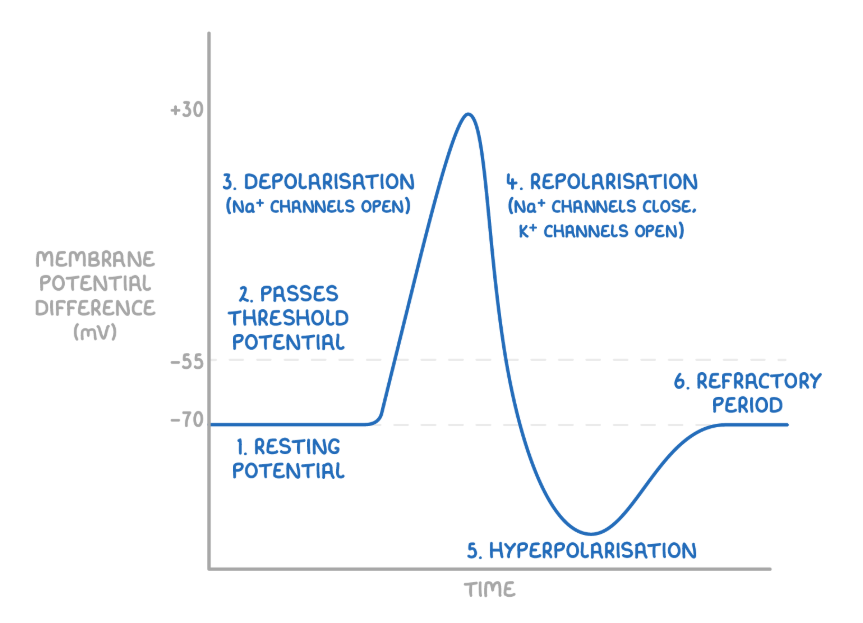
What is the all-or-nothing principle?
An action potential is only generated if the threshold is reached, and when it is, it is always the same size regardless of stimulus strength.
Does a stronger stimulus produce a bigger action potential?
❌ No — action potentials are always the same size
✔ Stronger stimulus → higher frequency of action potentials
How is a higher frequency made?
higher intensity stimulus - more sodium channels are open - more generator potentials - more frequent action potentials entering CNS
What are local currents?
the movement of ions that spread depolarisation to adjacent regions of a neurone, helping spread an action potential
How do local currents spread depolarisation?
Na⁺ enters the neurone during depolarisation
Positive ions flows sideways inside the axon (down conc gradient)
Moves to adjacent resting regions
Causes them to depolarise
What happens in the next section of membrane?
Depolarisation reaches threshold
Voltage-gated Na⁺ channels open
A new action potential is generated
Why does the action potential only move in one direction?
because the previous region is in the refractory period:
Na⁺ channels are inactivated
Cannot be depolarised again immediately
What are the 3 factors affecting the speed of transmission of an action potential?
myelination
axon diameter
temperature
How does myelination affect the speed of transmission?
myelin sheath allows for saltatory conduction
faster
How does axon diameter affect the speed of transmission?
A larger axon diameter means there is less resistance to ion flow, so the wave of depolarisation travels faster along the axon.
How does temperature affect the speed of transmission?
Higher temperatures accelerate the diffusion of ions, leading to faster depolarisation and faster impulse transmission.
However, temperatures above 40°C can cause proteins to denature, which results in slower impulse transmission due to membrane damage.
What is saltatory conduction?
the transmission of an action potential along a myelinated neurone where the impulse ‘jumps’ from node to node
Where are action potentials generated in a myelinated neurone?
Only at the nodes of Ranvier (membrane is only depolarised here)
Why don’t action potentials occur in myelinated regions?
Myelin acts as an electrical insulator
Prevents ion movement across the membrane
How do local currents behave in saltatory conduction?
Local currents travel under the myelin sheath - creates a longer localised circuit
Rapidly carry depolarisation to the next node
What are the advantages of saltatory conduction?
much faster transmission
more energy-efficient
maintains signal strength over long distances
What is the synaptic cleft?
a small gap between 2 neurones
What is a cholinergic synapse?
a synapse that uses acetylcholine as its neurotransmitter
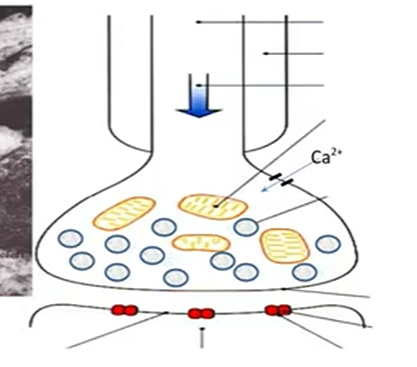
Label this synapse diagram
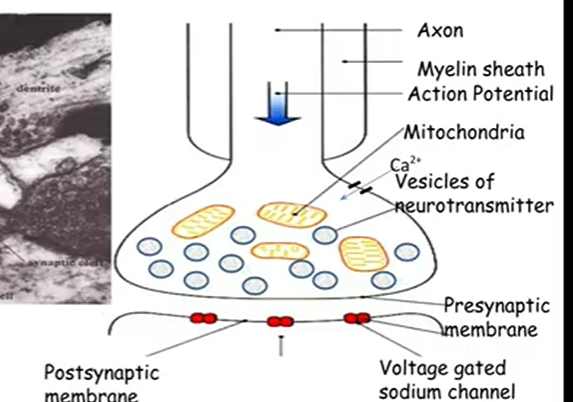
What are the specialised features of the pre-synaptic bulb?
many mitochondria
larger amount of SER - packages neurotransmitter into vesicles
lots of vesicles containing acetylcholine
voltage-gated calcium ion channels in the membrane
What happens when an action potential arrives at the synaptic bulb?
it causes the voltage gated Ca²⁺ channels to open which causes calcium ions to diffuse into the presynaptic bulb
What is the role of Ca²⁺ in synaptic transmission?
Ca²⁺ causes synaptic vesicles to move to and fuse with the presynaptic membrane
How is acetylcholine released?
By exocytosis
What happens at the postsynaptic membrane?
acetylcholine diffuses across the synaptic cleft and binds to complementary receptor sites (change shape) on the sodium ion channels
What happens when neurotransmitter binds to receptors?
This opens sodium ion channels in the postsynaptic membrane, leading to the depolarisation of the postsynaptic membrane. If this depolarisation reaches a threshold level, an action potential is triggered in the postsynaptic neurone
What enzyme breaks down acetylcholine?
Acetylcholinesterase
Why must acetylcholine be broken down?
To stop continuous stimulation - if it is left in the synaptic cleft, it will continue to open sodium ion channels and cause action potentials (sodium channels close)
What is the product of the hydrolysing of acetylcholine?
choline and acetate
What happens to the choline and acetate?
recycled - enter the synaptic bulb and are recombined to form acetylcholine using ATP from respiration in the mitochondria. stored in vesicles for future use
What does EPSP stand for?
Excitatory Postsynaptic Potential
What is an EPSP?
A small depolarisation of the postsynaptic membrane that makes it more likely to reach threshold and fire an action potential
What is summation?
occurs when the effects of several excitatory post-synaptic potentials are added together (until it reaches threshold)
What does IPSP stand for?
Inhibitory Postsynaptic Potential
What is an IPSP?
A hyperpolarisation of the postsynaptic membrane that makes it less likely to reach threshold and generate an action potential ; neurotransmitters may bind to post-synaptic membrane and close ion channels
What happens if EPSPs outweigh IPSPs?
Membrane depolarises to threshold
Action potential generated
What happens if IPSPs outweigh EPSPs?
Membrane becomes more negative
No action potential
What are the two types of summation?
Temporal summation
Spatial summation
What is temporal summation?
Multiple impulses from the same synapse arriving close together in time - filters out ‘background’ of low level stimuli
How does temporal summation increase firing?
Repeated firing by a presynaptic neurone leads to continuous neurotransmitter release.
An increased amount of neurotransmitter makes it more likely to trigger postsynaptic firing.
What is spatial summation?
Impulses arriving from multiple synapses at the same time (converge on a single postsynaptic neurone or effector cell)
How does spatial summation increase firing?
The combined input of neurotransmitters can trigger postsynaptic firing
How many IPSPs are needed to prevent an action potential?
1
What happens when a synapse runs out of vesicles containing the neurotransmitter?
it is said to be fatigued - the nervous system no longer responds to the stimulus as we have become habituated to it

