Strategies for Series Testing Master Sheet
 Call Kai
 Learn
Learn Practice Test
 Spaced Repetition
 Match
Match Flashcards
 Knowt Play
1/24

There's no tags or description
Looks like no tags are added yet.
Name | Mastery | Learn | Test | Matching | Spaced | Call with Kai |
|---|
No analytics yet
Send a link to your students to track their progress
25 Terms
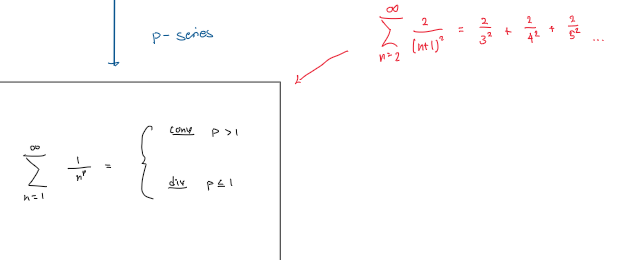
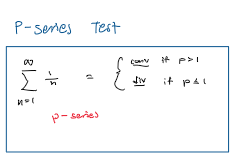
What is the p-series test?
What is the geometric series test?
Characteristics
each term multiplied by same consent ( r )
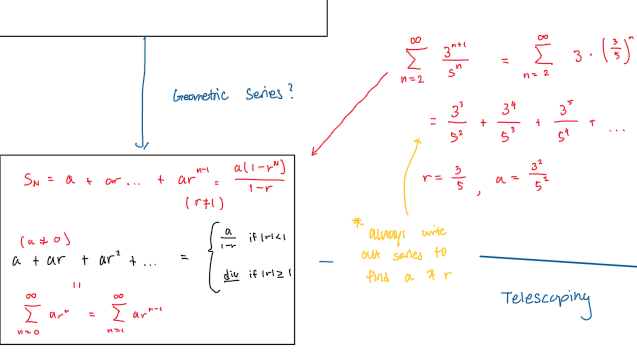
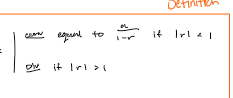
For a geometric series test, how can tell if something is convergent or divergent
a / ( 1 - r ) —> if abs ( r ) < 1
divergent —> if abs ( r ) >= 1
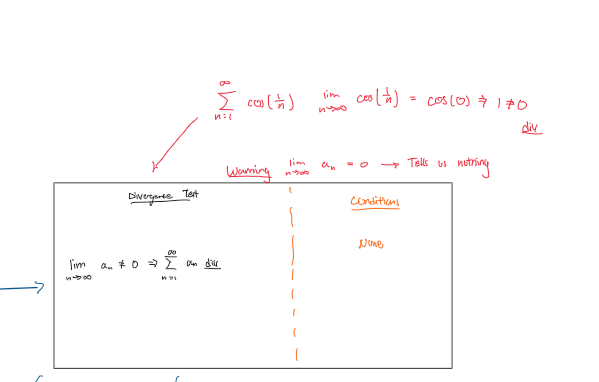
What is the divergence test?
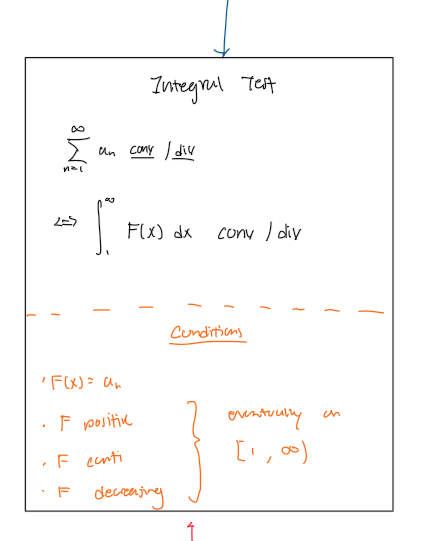
When should you know to use the intergral test
Can a(n) be modelled by a function we can intergrate
What is the integral test
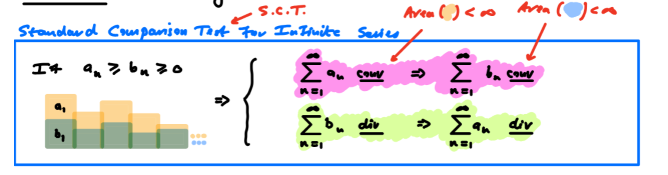
What should you know to use the Standard Comparison Test
does it resemble p-series/geo series
Can the a(n) be bounded easily
What should you know to use the Limit Comparison Test
does it resemble p-series/geo series
Is it hard to bound a(n) appropriately
What is the Limit Comparison Test
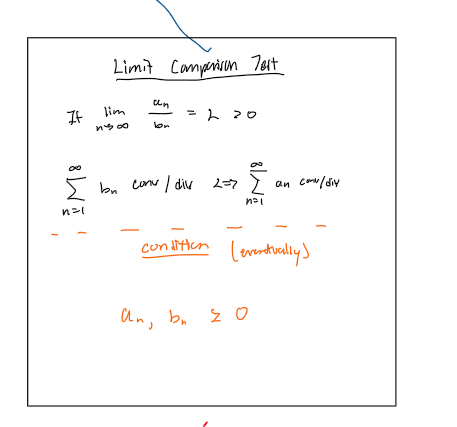
What is the Standard Comparison Test
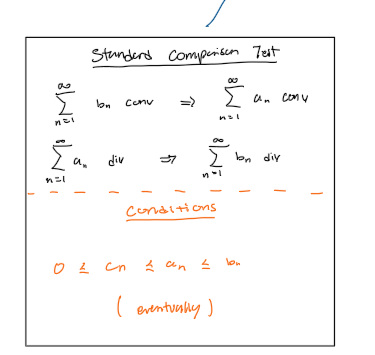
What are the situations you would use the root v.s. the ratio test
Root: expression raised to the nth power
Ratio: expression has factorials or products
What is the root & ratio test formulas?
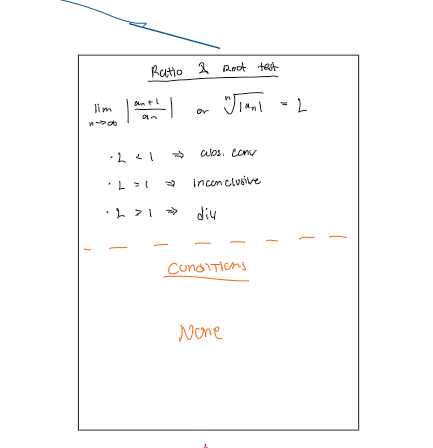
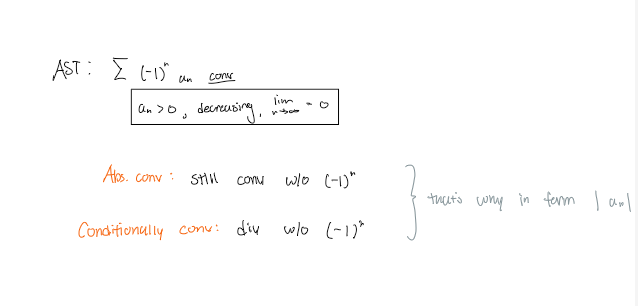
What’s the formula for Alternating Series Test?
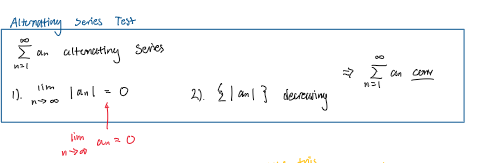
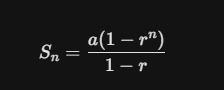
What is the Finite Sum Formula for geometric series
For geometric series, what are the conditions for convergent and divergent
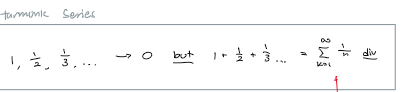
What is the most basic harmonic series that you should always remember?
How does changing the start point of a Series affect whether it’s convergent or divergent?
It doesn’t
What are the conditions for Integral Test?
Integral test used when limit —> goes to 0 (usually test this when checking for divergence test
Conditions
Func positive
Func decreasing in [1, infinity] → anything within interval is fine
Func continuous
What is the p-series test
How does the standard comparison test look like
What is abs convergent v.s. conditional convergent
abs ( an ) —> conv
abs ( an ) —> div
What should you always keep in mind when dealing with factorials
If it’s (n+1)! => last sequence always (n-1) * n * (n+1)
IT ISN’T LIKE THE IMAGE

What does the lim (1 + 1/n) ^ n equal to
equal to e
How to solve for bn in limit comparison test
analyze an (original function) —> bn is the dominant behavior for a large n

