Decision Making and Judgment
 Call Kai
 Learn
Learn Practice Test
 Spaced Repetition
 Match
Match Flashcards
 Knowt Play
1/15

There's no tags or description
Looks like no tags are added yet.
Name | Mastery | Learn | Test | Matching | Spaced | Call with Kai |
|---|
No analytics yet
Send a link to your students to track their progress
16 Terms
Define Probability
Measurement of the degree of uncertainty
The chance that an event will happen
0 = complete uncertainty that the event will not happen
1 = complete certainty that the event will happen
Heuristics and biases approach by Kahneman & Tversky
People don’t use formal probability rules (E.g ratios, percentages) when making judgments.
Instead, they rely on heuristics (mental shortcuts) to simplify complex decisions.
These shortcuts are efficient and useful, but can lead to systematic errors (biases).
Define Heuristics vs Bias
Heuristics: shortcuts or rules of thumb that make judgments easier esp for complex tasks
Bias: A systematic error
Key point: Judgement and decision making often involves ———
Judgment and decision making often involves estimating probabilities, and these judgments frequently rely on heuristics— mental shortcuts that can produce systematic biases.
Availability heuristics + study on letter R
people judge how likely or how common something is based on how easily they can think of examples of it.
E,g If you keep seeing news stories about plane crashes, you may think plane crashes are very common.
Design:
They asked whether the letter R appears more often:
in the first position of words, or
in the third position
Most people say first position. b/c it is easier to think of words w/ R in the first position than the third position
Availability heuristics: Ross and Sicoly study on married couples
Study design:
Married couples were asked how much responsibility each person had for chores.
Results:
Both people often said they were more responsible for most tasks. —> b/c its easier to remember what you did vs you dont always see or remember your partners actions
so your own effort comes to mind more easily
Representativeness heuristic
probabilities are estimated by evaluating the extent to which they are representative of
the associated category or process that generated them“How much does this match my idea of that category?”
people judge probability based on how much something resembles the typical example of a category.
Can lead to systematic errors and violation of laws of probability
Example:
A person is described as:
quiet
shy
loves reading
detail-oriented
People often guess they are a librarian instead of a salesperson because they match the stereotype of a librarian.
But that does not mean librarian is actually more likely.
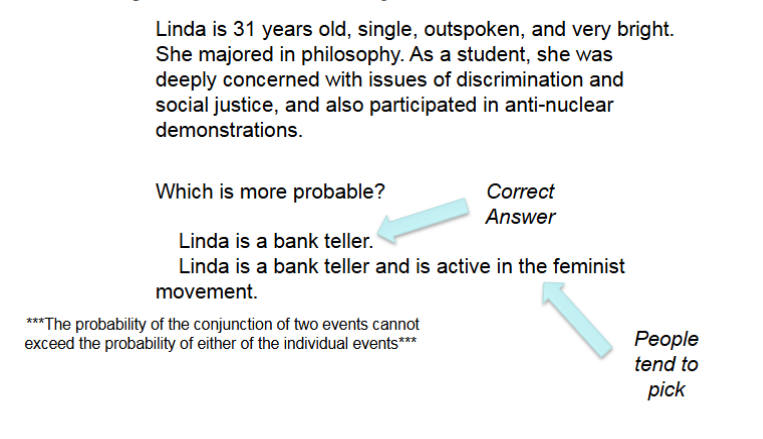
Conjunction fallacy
the mistake of thinking that two events happening together is more likely than just one of those events alone.
P(A and B) can’t be greater than P(A)
Anchoring and adjustment heuristic
when making estimates individuals start from an initial value and adjust to determine the answer. Individuals estimates will be biased by the starting point —> this means their answer is often influenced by that starting number so they will provide a number near that
Metacognition
Our thinking about our own thinking
the ability to monitor and control our own cognitions
confidence judgment = Calibration curve
a type of metacognitive judgment/ thinking
your confidence affects how you control your thinking. Therefore, being metacognitively accurate/ correct is important in regulating your cognition —> confidence matches how often you are actually correct is important (80% confident = 80% correct)
too confident = dont check choices
underconfident = doubt your decisions too much
Calibration curve
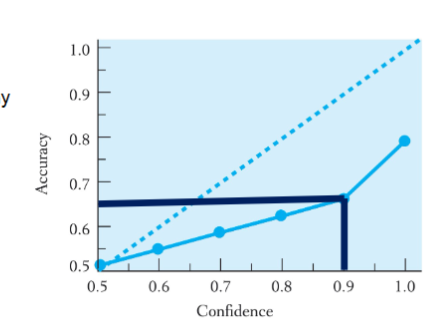
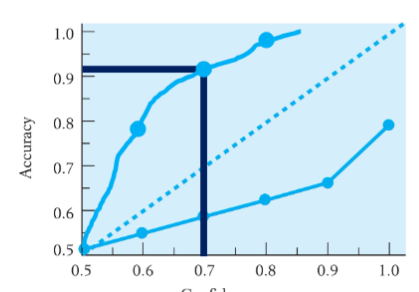
Calibration curve: help you evaluate the confidence accuracy
Linear line = perfect calibration where your confidence perfectly lines p with accuracy
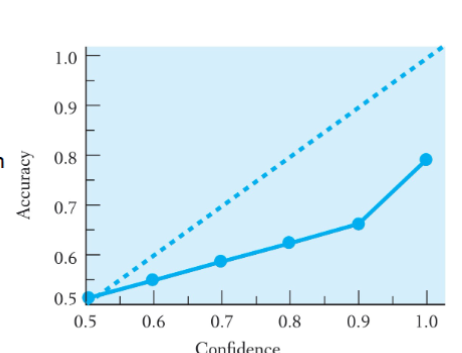
Overconfident calibration curve
Line is under the perfect dotted line (confidence = accuracy)
underconfident calibration curve
Line is above the dotted perfect line
Judgment of learning (JOL)
Predictions of future recall —> your guess about how likely you are to remember something later.
JOLs are inferential, not direct readings of memory strength —> you are not directly measuring your memory. Instead, you are making an estimate based on cues.
E.g when studying you might use these cues “this felt easy to study” “I just saw it” to predict how likely you are to remember something in the future
Not all cues are valid
Warm sensation of mastery
Massed studying (cramming studying) gives you a warm sensation of mastery where you feel confidence bc the material is still fresh but this feeling is misleading + Creates a false sense of mastery
Key point: Even when those judgments …
Even when those judgments are about our own cognitions, judgment and decision making often involves estimating probabilities, and these judgments frequently rely on heuristics— mental shortcuts that can produce systematic biases

