5.2 Hypothalamus-anterior pituitary axis
 Call Kai
 Learn
Learn Practice Test
 Spaced Repetition
 Match
Match Flashcards
 Knowt Play
1/36

Earn XP
Description and Tags
Hypothalamus-anterior pituitary axis
Name | Mastery | Learn | Test | Matching | Spaced | Call with Kai |
|---|
No analytics yet
Send a link to your students to track their progress
37 Terms
Hypothalamus-anterior pituitary axis
Hypothalamic hormones control the secretion of anterior pituitary hormones → Anterior pituitary hormones control the secretion of hormones from the peripheral endocrine organs
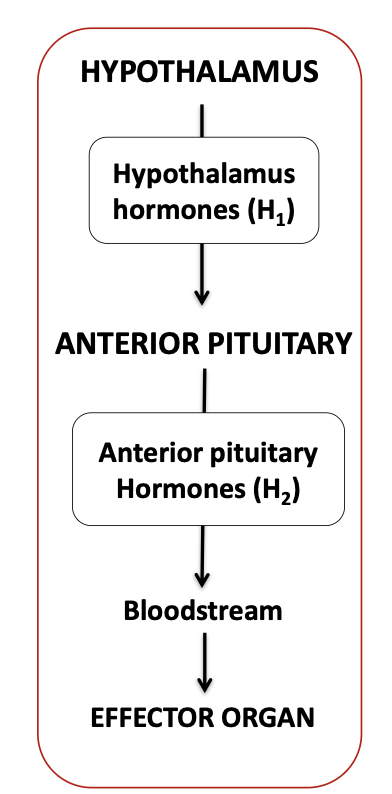
Describe the (Growth hormone) GH axis including stimulation, inhibition, targets, and effects
Hypothalamus:
GHRH (Growth Hormone-Releasing Hormone) → stimulates GH
Somatostatin (SS) → inhibits GH
Anterior pituitary:
GH (Growth hormone / somatotropin)
Target organs:
Muscles
Adipose tissue
Liver
Effects:
Growth of muscles & bones
Stimulates IGF-1 production
Describe the CRH–ACTH pathway & its effects.
Hypothalamus:
CRH (Corticotropin-Releasing Hormone)
Anterior pituitary:
ACTH (Adrenocorticotropic hormone / corticotropin)
Target organ:
Adrenal gland (cortex)
Effect:
Secretion of glucocorticoids (cortisol)
Describe the TRH–TSH–thyroid hormone axis.
Hypothalamus:
TRH (Thyrotropin-Releasing Hormone)
Anterior pituitary:
TSH (Thyroid-Stimulating Hormone / thyrotropin)
Target organ:
Thyroid gland
Effect:
Release of:
T3 (triiodothyronine)
T4 (thyroxine)
Describe prolactin regulation & function.
Hypothalamus:
Dopamine (DA) = prolactin-inhibiting hormone → inhibits PRL
PRH (prolactin-releasing hormone) → hypothetical / not clearly identified
Anterior pituitary:
Prolactin (PRL)
Target organ:
Mammary glands
Effects:
Milk production
Breast development
→ Prolactin is mainly under inhibitory control (dopamine)
Describe the GnRH–LH/FSH axis including functions.
Hypothalamus:
GnRH (Gonadotropin-Releasing Hormone)
Anterior pituitary:
LH (Luteinizing hormone)
FSH (Follicle-stimulating hormone)
Target organ:
Gonads (ovaries/testes)
Effects:
Regulation of reproductive cycle
Secretion of steroid hormones:
Estrogen
Progesterone
Testosterone
Somatostatin inhibits
growth hormone
Dopamine inhibits
prolactin
What are the target organs for each pituitary hormone?
GH → Muscle, adipose tissue, liver
ACTH → Adrenal gland
TSH → Thyroid gland
Prolactin → Mammary glands
LH/FSH → Gonads
Hypothalamic hormones
Dopamine
TRH
CRH
Somatostatin
GHRH
GnRH
Anterior pituitary hormones
Prolactin
TSH
ACTH
GH
FSH
LH
Endocrine targets & the hormones they secrete
Thyroid gland = Thyroid hormones
Adrenal cortex = Cortisol
Liver = Insulin like growth factors
Endocrine cells of the gonads = Androgens, estrogens, progesteron
Nonendocrine targets
Breast
Many tissues
Germ cells of the gonads
thyroid gland
synthesizes & stores its hormones
thyroid gland produces
Calcitonin
Thyroid hormones (T3/T4)
Thyroid hormones are essential in
development & metabolism regulation
thyroid gland contain
iodine (I)
&
hydrophobic
Present in plasma in thyroid gland → two forms
T3 → (Triiodothyronine)
T4 → (Tretraiodotironine/ thyroxine)
T4 in plasma is
abundant than T3 → but T3 is more active
The majority of T4 hormone is
transformed to T3 inside the target cells
Most cells have receptors for thyroid hormones, so
T3 & T4 have effects throughout the body
T3 and T4 create a negative feedback loop with the
hypothalamus & pituitary
Actions of thyroid hormones:
Regulate basal metabolic rate & thermogenesis
They regulate the processes of growth & development
Regulate basal metabolic rate & thermogenesis
Increase the amount of energy consumed in a resting state, as well as the amount of heat produced by cells.
Thyroid hormones Stimulates
Catabolism of carbohydrates and lipids
Hepatic glucose synthesis
Protein turnover
Heart rate & ventilation rate
Activity of Na+/K+ pump
Oxygen consumption in mitochondria
Heat production
They regulate the processes of growth & development is fundamental for
The functioning of the central nervous system
Fundamental for the functioning of the central nervous system
Embryonic development
Adult CNS
Adult CNS
Impaired T3 & T4 concentrations affect attention, memory, learning capacity, sleep/arousal cycles, & hunger sensations (hypo/hyper thyroidism).
Embryonic development
Reduced T3/T4 levels during pregnancy result in reduced cortex & cerebellum formation → Severe cognitive deficits.
Previously called cretinism, now CIDS.
Hypothyroidism
Reduced T3,T4 secretion → Reduced negative feedback loop → Commonly accompanied by increased TRH and TSH levels.
Hypothyroidism causes
Auto-immune attack (Hashimoto disease)
Deficiency of iodine
Injury to the thyroid
Hypothyroidism is due to
low iodine
symptoms of Hypothyroidism
Fatigue, slow cognitive processes & depression
Reduced appetite but weight gain, low BMR
Irregular or heavy periods
Bradychardia
Being sensitive to cold
Goiter (excessive thyroid growth)
Hyperthyroidism
Excessive T3 & T4 production
Negative feedback to TRH & TSH.
Hyperthyroidism causes
Graves disease: Immunoglobulins like TSH (TSI) in blood → Constant thyroid stimulation
Thyroiditis: gland inflammation
Excessive iodine consumption
Tumor in the pituitary (TSH is increased)
Symptoms of Hyperthyroidism
Increased heart rate
Irritability, nervousness, mood swings
Increased appetite but weight loss
Excessive sweating
Insomnia
Goiter (excesive thyroid growth) & exophthalmos
Hyperthyroidism is due to
Graves disease

