1 - Introduction
 Studied by 0 people
 Call Kai
 Learn
Learn Practice Test
 Spaced Repetition
 Match
Match Flashcards
 Knowt Play
1/22

There's no tags or description
Looks like no tags are added yet.
Name | Mastery | Learn | Test | Matching | Spaced | Call with Kai |
|---|
No analytics yet
Send a link to your students to track their progress
23 Terms
What is an Artifact?
A document or other item created during a portfolio, program, or project to help manage it and provide information to the project team, stakeholders, and management.
What is a Benefit?
A gain or asset realized by the organization and other stakeholders as the result of outcomes delivered.
What is an Outcome?
An end result or consequence of a process or project. Outcomes encompass the long-term effects, changes or value generated by the project's deliverables, which can be either positive or negative. Positive outcomes, often termed “benefits", may include enhancements inperformance, efficiency or customer satisfaction. Conversely, negative outcomes, known as “disbenifits", may involve unintended adverse effects or costs. Evaluating outcomes is essential to determine how effectively a project has achieved its intended objectives and to understand its overall impact.
What is an Output?
A product, result, or service generated by a process. May be an input to a successor process.
What is a Portfolio?
A collection of programs, projects, and operations managed as a group to maximize overall value delivery and achieve strategic objectives, meet mandatory obligations, or generate income streams. Related activities may include subsidiary portfolios (subportfolios) and operations.
What is a Product?
An Artifact that is produced, is quantifiable, and can be either an end item itself or a component item. “Product” is an overarching term that includes tangible (physical goods) and intangible (digital goods and services) items.
What is a program?
A group of related projects and program activities managed in a coordinated manner to obtain benefits not available from managing them individually. These interrelated activities can serve program components to enable the program to deliver the highest value and may include subsidiary programs.
What is a project?
A temporary initiative in a unique context undertaken to create value. The temporary nature of a project indicates a beginning and an end to the project work or a phase of the project work. A project’s unique context can be driven by its distinct goals, environmental conditions, approaches, stakeholders, or other dimensions. Projects can be stand-alone efforts or part of a portfolio or program.
What is Project Management?
The application of knowledge, skills, tools, and techniques to project activities to meet or exceed the intended value. Meeting or exceeding value in project management does not mean to endorse or accept gold plating or scope creep, but to emphasize a value-driven decision-making process, helping to ensure that the final project outcome satisfies the project stakeholders’ needs.
What is a Project Management Office (PMO)?
Organizational entities, typically established as departments or teams, primarily tasked with centralizing activities related to the management of portfolios, programs, and/or projects. The nature of these activities can vary according to the unique needs of each organization.
What is a Project Management Team?
The members of the project team who are directly involved in project management activities.
What is a Project Manager?
The person assigned by the performing organization to lead the team that is responsible for achieving the project objectives. Project managers perform a variety of functions such as facilitating the project team’s work to achieve the intended outcomes and managing the processes to bring about those outcomes in order to enable value delivery.
What is Project success?
The consensus view across intended beneficiaries, other stakeholders and project participants that a project was perceived to have delivered value that was worth the effort and expense.
What is a Project Team?
A set of individuals performing the work of the project to achieve its objectives.
What is Value?
The excess of financial and non-financial benefits over investment that is gained from achieving the goals from a portfolio, program or project. Different stakeholders perceive value in different ways, which can be explained quantitavely or qualitatively. Thus, organizations may focus on business value as determined by performance metrics or finances, such as return on investment (ROI). Customers may interpret value as the convenience offered by a given product or service. Governments and nongovernmental organizations (NGOs) may prioritize the value of societal impact on groups of people and their communities and environments.
What is a Value Delivery System?
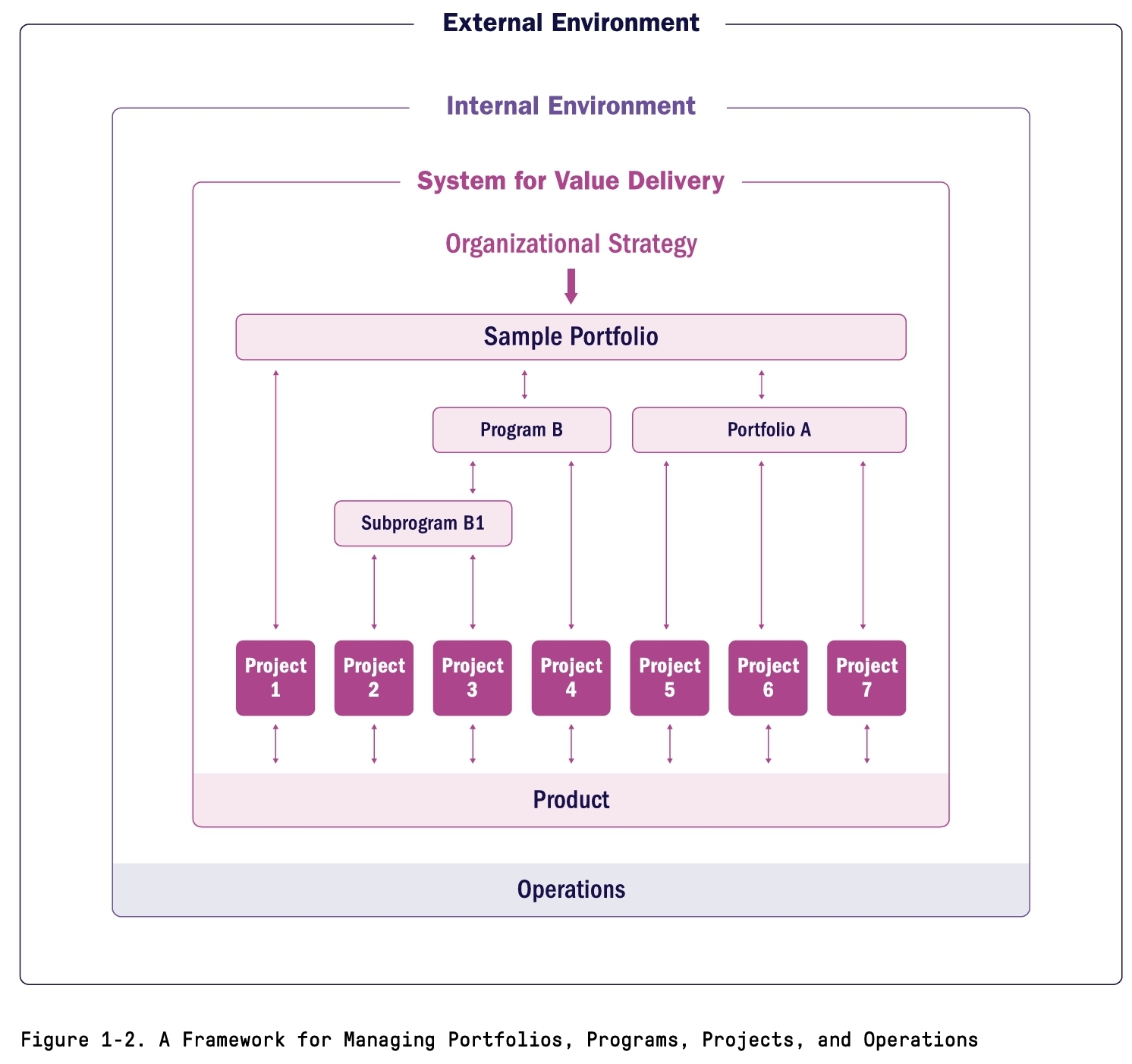
A collection of strategic business activities aimed at building, sustaining, and/or advancing an organization. Portfolios, programs, projects, products, and operations can all be part of an organization’s system for value delivery. This system enables organizations to align their work with their strategic objectives and achieve desired outcomes.
What characterizes a Project?
Temporary. Projects are initiated to create value by producing tangible and/or intangible deliverables such as products, services, or other results. Unlike ongoing operations, projects are temporary and have a defined beginning and end. Although projects are temporary, their deliverables often persist beyond the project’s conclusion. Usually, a project ends when one or more of the following conditions are met:
The project’s objectives have been achieved,
A governing body, the project sponsor, or the project team has determined that the objectives will not or cannot be met,
Resources (Funding, human or physical), are exhausted or no longer available,
Due to changes in strategy, priorities, or the external environment, the need for the project no longer exists,
The project is terminated for other reasons such as legal, regulatory, or compliance issues
Unique context. A unique context in projects refers to the conditions and environments that distinguish one project from another, even if they have otherwise similar characteristics. This uniqueness arises from factors such as differences in goals, scope, duration, location, technology, quality, costs, risks, resources, and stakeholders involved the project. Even if two projects aim for the same value or objectives, each project differs due to the context in which it is carried out. These differences require tailored management approaches to meet the specific needs and challenges of each project. As a result, the unique context of each project requires customized strategies for success.
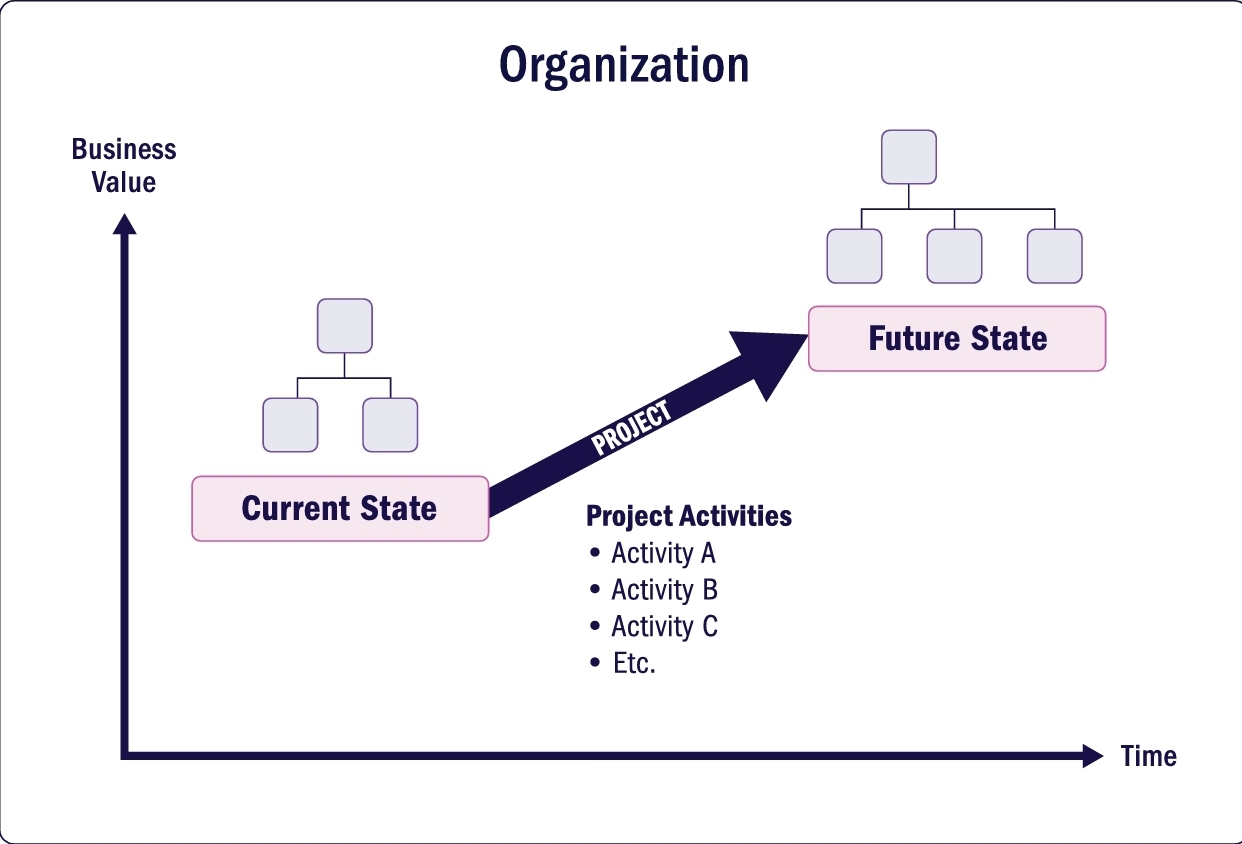
Value creation through organizational change. Projects, in pursuit of value, drive change in organizations. From a business perspective, a prjects’s purpose is to move an organization from one state to another to achieve a specific objective. Before the project begins, an organization is in its current state. The desired result of the change driven by the project is described as the future state. For some projects, this shift may involve creating a transition state where several steps are taken in a structured manner to achieve the future state. The successful completion of a project results in the organization moving to the future state and achieving value for the organization, as defined by key stakeholders.
In which ways can an organization’s unique context influence the governance of portfolios, programs and projects?
Enforcing legal, regulatory and compliance requirements,
Defining ethical social and environmental responsibilities,
Specifying operational, legal, financial and risk policies,
Promoting the alignment of portfolios, programs, and projects with strategic objectives at different hierarchical levels
Ensuring that initiatives contribute to the organizational mission and vision,
Facilitating decision-making that maximizes delivered value connected to the system for value delivery.
Which factors lead to the initiation of a project?
Meeting regulatory, legal or social requirements,
Satisfying stakeholder requests or needs,
Implementing or changing business or technological objectives,
Creating, improving or fixing products, processes, organizations or services
What is the focus of operations management?
Efficient, effective production of products and/or services
Helps ensure that business operations are conducted efficiently and effectively by utilizing optimal resources to meet customer demands asks deliver value.
As such, operations management is concerned with managing processes that transform inputs (e.g., materials, components, energy, and labor) into outputs (e.g., products, goods, services, and/or other results). Operations management is distinct from formal project management as outlined in this standard.
At which points projects can intersect with operations during a periodic life cycle?
When developing new products or services, upgrading offerings, or expanding outputs,
While improving product or service divergent operations or their development process,
At the end of the product life cycle
At each closeout phase or iteration.
What distinguishes projects, programs, a portfolio and operations?
Projects are often managed as stand-alone initiatives but they can also be part of larger portfolios or programs.
When projects are grouped together into a program, they are managed in a coordinated manner to obtain benefits not available from managing them individually. Programs drive significant organizational change, they are not merely late projects. Programs aim to achieve organizational change and improvement by connecting resources and aligning projects strategically to creates synergies. This integration maximizes generated value, enhance efficiency and drivers value that individual projects cannot achieve on their own.
Some organizations use a portfolio to manage multiple programs and projects that are underway at any given time. A portfolio is a collection of programs, projects, and operations managed as a group to maximize overall value delivery and achieve strategic objectives, meet mandatory obligations, or generate income streams. Portfolio management involves selecting, prioritizing, managing, and optimizing an organization’s programs and projects in line with its strategic goals, obligations (legal or otherwise), or business objectives. This holistic view helps ensure that resources are allocated efficiently and that the portfolio delivers maximum value.
Portfolios, programs, projects, and operations often engage with the same stakeholders and may compete for the same resources. Portfolio, program, and project managers should work together with operations leaders to maintain a balanced approach to resource allocation and stakeholder engagement. Overlap and competition for resources can otherwise threaten the organization’s strategic objectives.
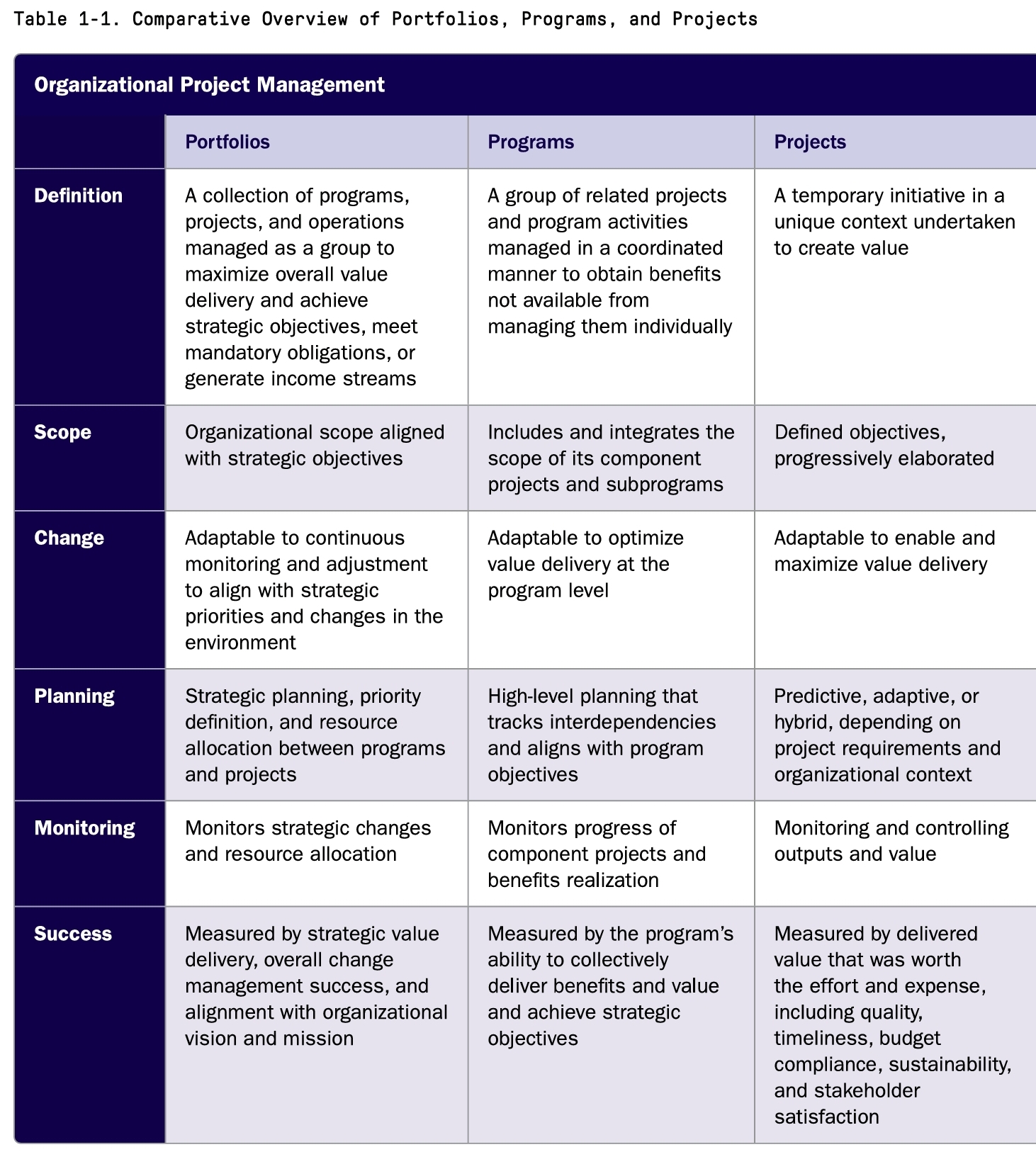
Organizational project management
Comparative overview of portfolios, programs and purports from an organizational perspective.
Key differences and similarities in definition, scope, change, planning, monitoring and success criteria.
 Note
Note  Flashcards (36)