The cardiovascular system
 Call Kai
 Learn
Learn Practice Test
 Spaced Repetition
 Match
Match Flashcards
 Knowt Play
1/21

There's no tags or description
Looks like no tags are added yet.
Name | Mastery | Learn | Test | Matching | Spaced | Call with Kai |
|---|
No analytics yet
Send a link to your students to track their progress
22 Terms
What is the Pulmonary pathway of blood
De-oxygenated blood to the lungs, Oxygenated blood to the heart
What is the systemic pathway of blood
Oxygenated blood to the body, De-oxygenated to the heart
Describe the pathway of blood
Deoxygenated blood enters the Right Atrium
Right Atrium contracts forcing open the Tricuspid valve, sending deoxygenated blood into the RV
Right Ventricle contracts forcing open semi-lunar valve sending de-oxygenated blood to the lungs (carried by the pulmonary artery)
Oxygenated blood is carried back to the heart by the pulmonary vein
Oxygenated blood enters the left atrium
Left atrium contracts forcing the bicuspid valve to open, sending oxygenated blood to the left ventricle
Left ventricle contracts forcing open the semilunar valve which sends oxygenated blood through the aorta as it is carried to the body
What are the components of the Cardiac conduction system
Sinoatrial node (SA node)
Atrioventricular node (AV node)
HIS bundle
Purkinje fibres
What is the function of the Sinoatrial node/ SA node
a small mass of cardiac muscle found in the wall of the right atrium that generates the heartbeat
What is the function of the Atrioventricular node (AV node)
this node relays the impulse between the upper and lower sections of the heart (delays impulse to allow the full contraction of the atrium and the filling of the ventricles) delay of 0.1secs to allow contraction to finish
What is the function of the bundle of HIS
a collection of heart muscle cells that transmit electrical impulses from the AV node via the bundle branches to the ventricles
What is the function of the Purkinje fibres
muscle fibres that conduct impulses in the walls of ventricles
What does myogenic mean
the capacity of the heart to generate its own impulses
What does systole mean
when the heart contracts
blood is expelled from the chambers of the heart
What does diastole mean
the phase of the cardiac cycle where the heart muscle relaxes allowing the chambers to fill with blood
Describe the process of the cardiac conduction system
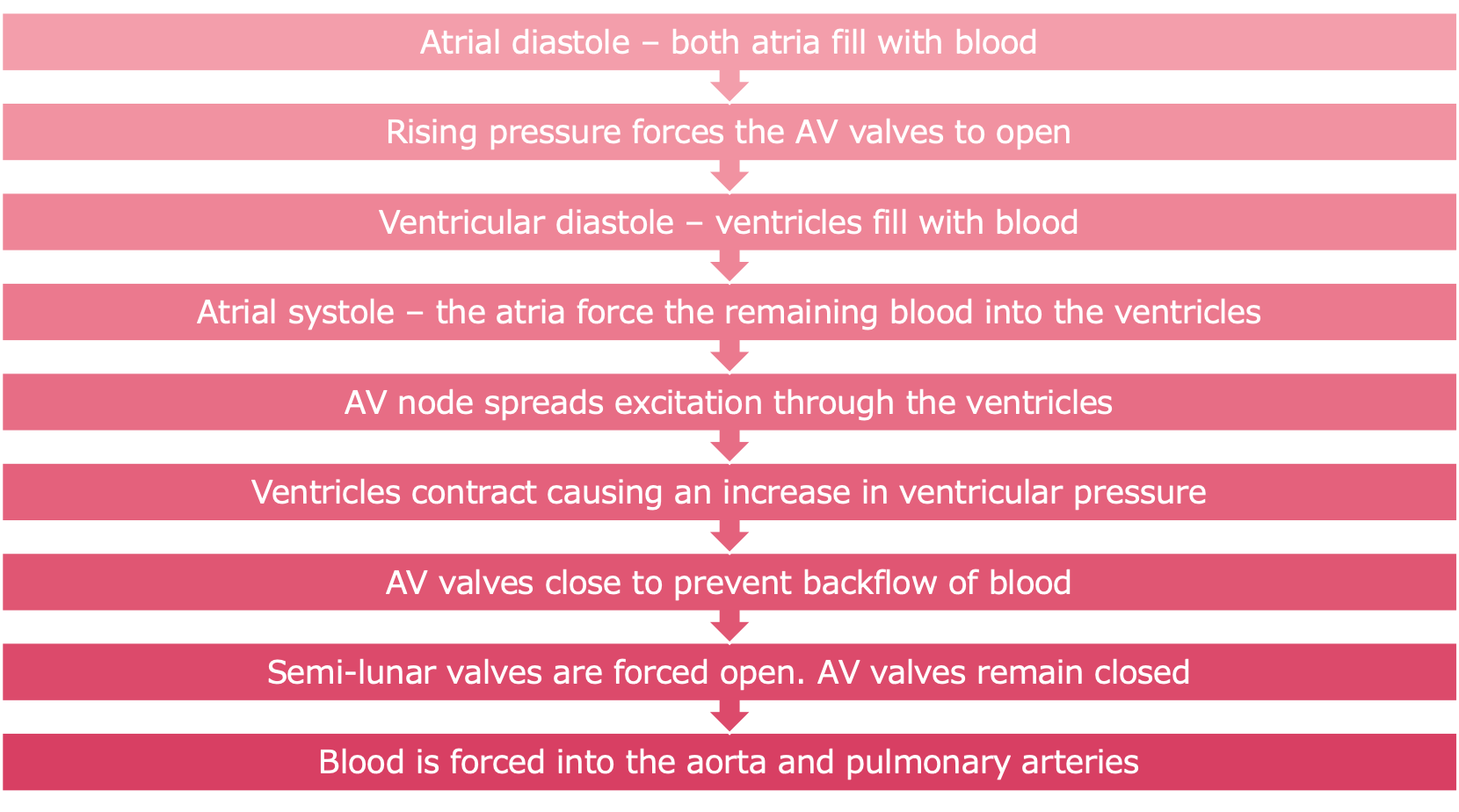
Describe what happens at each stage of the cardiac cycle
Stage of cardiac cycle | Description | Action of valves |
Atrial Diastole | Atrium relaxes Fills with blood | AV valves close SL valves open |
Ventricular Diastole | Ventricle relaxes Fills with blood | AV valves open Semi lunar valves close |
Atrial Systole | Atrium contracts Blood is forced out | AV valves open SL valves close |
Ventricular Systole | Ventricle contracts Blood is forced out
| Semi lunar valves forced open AV valves closed |
What does the sympathetic nervous system do
stimulates the heart to beat faster
What does the parasympathetic nervous system do
returns the heart to it’s resting level
PARACHUTES SLOW THINGS DOWN
What is the MEDULLA OBLONGATA
located in the brain is the cardiac control centre
what are the 3 main mechanisms of the medulla oblongata
chemoreceptors
baroreceptors
Proprioceptors
What is the function of chemoreceptors
Found in the carotid arteries and the aortic arc
they Sense chemical changes => Detect the increase in C02 when exercising
The increase in conc. will effect the stimulation of the sympathetic nervous system which means the heart will beat faster
What is the function of baroreceptors
they Contain nerve endings which respond to the stretching of the arterial wall caused by changes in blood pressure
If a change occurs signals are sent to the medulla
Increase in pressure = increase in stretch of baroreceptor sensors = decrease in HR
Decrease in pressure = decrease in stretch = increase HR
When exercise starts the set point increases to prevent the reduction of HR and a negative impact on performance (less oxygen delivered)
What is the function of proprioceptors
they are Sensory nerve endings located in the muscles, tendons and joints - provide info on movement and body position
they Detect increase in muscle movement
They trigger impulses to the medulla => sends impulse through the CNS to the SA Node to increase HR
When the PNS stimulates the SA Node, HR decreases
In short what does each mechanism do
Chemoreceptors | DETECT: Increase in CO2 | RESPONSE: Increase in HR |
Baroreceptors | DETECT: Increase in BP | RESPONSE: Decrease in HR |
Proprioceptors | DETECT: Increase in muscle movement | RESPONSE: Increase in HR |
What is the hormonal control mechanism
it effects HR
Adrenaline - the stress hormone
Released by the sympathetic nerves and cardiac nerve during exercise
Stimulates the SA Node resulting in an increase in speed and force of con traction
this Increases cardiac output
Which results in more blood being pumped to the working muscle

