ap world midterm study guide
 Call Kai
 Learn
Learn Practice Test
 Spaced Repetition
 Match
Match Flashcards
 Knowt Play
1/39

There's no tags or description
Looks like no tags are added yet.
Name | Mastery | Learn | Test | Matching | Spaced | Call with Kai |
|---|
No analytics yet
Send a link to your students to track their progress
40 Terms
“My main conclusion was that societies developed differently on different continents because of differences in continental environments not in human biology. Advanced technology, centralized political organization, and other features of complex societies could emerge only in dense sedentary populations capable of accumulating food surpluses—populations that depended for their food on the rise of agriculture that began around 8,500 B.C. But the domesticable wild plant and animal species essential for that rise of agriculture was distributed very unevenly over small areas of the globe, which thus became the earliest homelands thereby gained a head start developing guns, germs, and steel. The languages and genes of those homeland inhabitants, as well as their livestock, crops, technologies, and writing systems, became dominant in the ancient and modern world.” Source: Jared Diamond, Guns, Germs, and Steel: The Fate of Human Societies.”
Jared Diamond’s argument would best explain…
The differences between historical developments in the Americas and Eurasia prior to the Columbian exchange.
“My main conclusion was that societies developed differently on different continents because of differences in continental environments not in human biology. Advanced technology, centralized political organization, and other features of complex societies could emerge only in dense sedentary populations capable of accumulating food surpluses—populations that depended for their food on the rise of agriculture that began around 8,500 B.C. But the domesticable wild plant and animal species essential for that rise of agriculture was distributed very unevenly over small areas of the globe, which thus became the earliest homelands thereby gained a head start developing guns, germs, and steel. The languages and genes of those homeland inhabitants, as well as their livestock, crops, technologies, and writing systems, became dominant in the ancient and modern world.” Source: Jared Diamond, Guns, Germs, and Steel: The Fate of Human Societies.”
Which type of evidence did Diamond most likely utilize?
Genetic evolution showing the evolution of plants and animals.
“My main conclusion was that societies developed differently on different continents because of differences in continental environments not in human biology. Advanced technology, centralized political organization, and other features of complex societies could emerge only in dense sedentary populations capable of accumulating food surpluses—populations that depended for their food on the rise of agriculture that began around 8,500 B.C. But the domesticable wild plant and animal species essential for that rise of agriculture was distributed very unevenly over small areas of the globe, which thus became the earliest homelands thereby gained a head start developing guns, germs, and steel. The languages and genes of those homeland inhabitants, as well as their livestock, crops, technologies, and writing systems, became dominant in the ancient and modern world.” Source: Jared Diamond, Guns, Germs, and Steel: The Fate of Human Societies.”
Diamond’s most likely purpose for writing this passage was to…
Explain how guns, germs, and steel changed human development.
“Thus the Lord made Himself known to the people of Israel in Egypt; and yet He allowed them the use of the sacrifices which they were wont to offer to the Devil, in his own worship; so as to command them in his sacrifice to kill beasts, to the end that, changing their hearts, they might lay aside one part of the sacrifice, while they retained another; that while they offered the same beasts they were wont to offer, they should offer them to God, and not to idols; and thus they would no large by the same sacrifices.” Source: Pope Gregory, giving advice to the bishop of England, 601 CE
The pope’s strategy to convert the people of England is based on that assumption that…
Local customs will acquire a Christian meaning.
“Thus the Lord made Himself known to the people of Israel in Egypt; and yet He allowed them the use of the sacrifices which they were wont to offer to the Devil, in his own worship; so as to command them in his sacrifice to kill beasts, to the end that, changing their hearts, they might lay aside one part of the sacrifice, while they retained another; that while they offered the same beasts they were wont to offer, they should offer them to God, and not to idols; and thus they would no large by the same sacrifices.” Source: Pope Gregory, giving advice to the bishop of England, 601 CE
Based on the pope’s attitude towards the local customs of the people in England, which of the following would he most likely support?
Festival honoring local ancient gods as Christian holy days.
“Thus the Lord made Himself known to the people of Israel in Egypt; and yet He allowed them the use of the sacrifices which they were wont to offer to the Devil, in his own worship; so as to command them in his sacrifice to kill beasts, to the end that, changing their hearts, they might lay aside one part of the sacrifice, while they retained another; that while they offered the same beasts they were wont to offer, they should offer them to God, and not to idols; and thus they would no large by the same sacrifices.” Source: Pope Gregory, giving advice to the bishop of England, 601 CE
Which of the following characterizes the pope’s attitude towards the practices of local people?
Accommodating.
“It is their nature to plunder whatever other people possess.” Source: 14th century Arab historian Ibn Khaldun, discussing nomadic societies.
Which of the following evidence would COUNTER the view of pastoral societies expressed by Ibn Khaldun?
Mongols offered merchants 10% above their asking price.
“It is their nature to plunder whatever other people possess.” Source: 14th century Arab historian Ibn Khaldun, discussing nomadic societies.
Which of the following best accounts for the ability of pastoral nomads to conquer many agrarian societies between 1000 CE and 1450 CE?
Nomads dominated trade routes.
“When Moctezuma had finished, Dona Maria translated his address into Spanish so that the Captain could understand it. Cortes replied in his strange and savage tongue, ‘Tell Moctezuma that we are his friends. There is nothing to fear.’” Source: Anonymous. Aztec illustrated histories translated from Nahuatl language.
Which of the following best describes the Anonymous author’s likely purpose in writing this account?
The role of Dona Maria.
“When Moctezuma had finished, Dona Maria translated his address into Spanish so that the Captain could understand it. Cortes replied in his strange and savage tongue, ‘Tell Moctezuma that we are his friends. There is nothing to fear.’” Source: Anonymous. Aztec illustrated histories translated from Nahuatl language.
Which of the following events was the most likely immediate cause of the events described in the passage?
Cortes negotiating for military support.
“When Moctezuma had finished, Dona Maria translated his address into Spanish so that the Captain could understand it. Cortes replied in his strange and savage tongue, ‘Tell Moctezuma that we are his friends. There is nothing to fear.’” Source: Anonymous. Aztec illustrated histories translated from Nahuatl language.
Which of the following was an immediate consequence of the events described in the passage?
The eventual collapse.
Chinese Population 600-1200 CE
Year Population
600 45 million
800 50 million
1000 60 million
1127 100 million
1200 115 million
Which of the following best explains the changes in China’s population shown in the table above?
Agricultural output increased population.
Which of the following was most responsible for the initial spread of Islam to West Africa?
Merchants on the trans-Saharan trade route.
As Islam spread between 1200 and 1600, it affected gender relations in which of the following ways?
Existing local customs of marriage blended with Islam’s customs.
Which of the following provides the best evidence of the extent of the migrations of Bantu peoples?
Language similarities.
Which of the following best supports the conclusion that Japan borrowed extensively from Tang and Song China?
Societal relations based on Confucian principles.
Which of the following describes an important distinction between the core beliefs of Confucianism and Daoism as developed in the period 600 BCE to 600 CE?
Daoism is human connection to nature. Confucianism focused on social aspects.
Which of the following best supports the assertion that the trade routes of the period between 600 CE created a network of exchange that connected major Afro-Eurasian civilizations?
Looking at archeological evidence.
In the period 600 CE - 1450 CE, Africa’s Swahili coast was a major part of which trading system?
Indian Ocean Trade Network.
“[N]o teaching is more harmful that Buddhism. In breaking the laws of the country and injuring the people, none can surpass Buddhism…Now there are at present so many monks and nuns that to count them is impossible. They all depend on farming for their food, and upon silk-worms for their clothing! The public monasteries and temples, as well as private chapels and shrines, are innumerable; all of them are so gigantic and imposing that they vie with the Imperial Palace in splendor!” Source: Edict of the Chinese emperor Tang Wuzong, 845 CE.
The opinions expressed in the passage above is the most consistent with which of the following policies in the late Tang period?
Closure of monasteries.
“We can no longer be content with writing only the history of victorious elites, or with detailing the subjugation of dominated ethnic groups…We thus need to uncover the history of ‘the people without a history.’” Source: Eric Wold, anthropologist, 1982
Research on which of the following subjects would be the best example of the approach described in the excerpt above?
The lives of the Amerindians involved in the Trans-Atlantic fur trade.
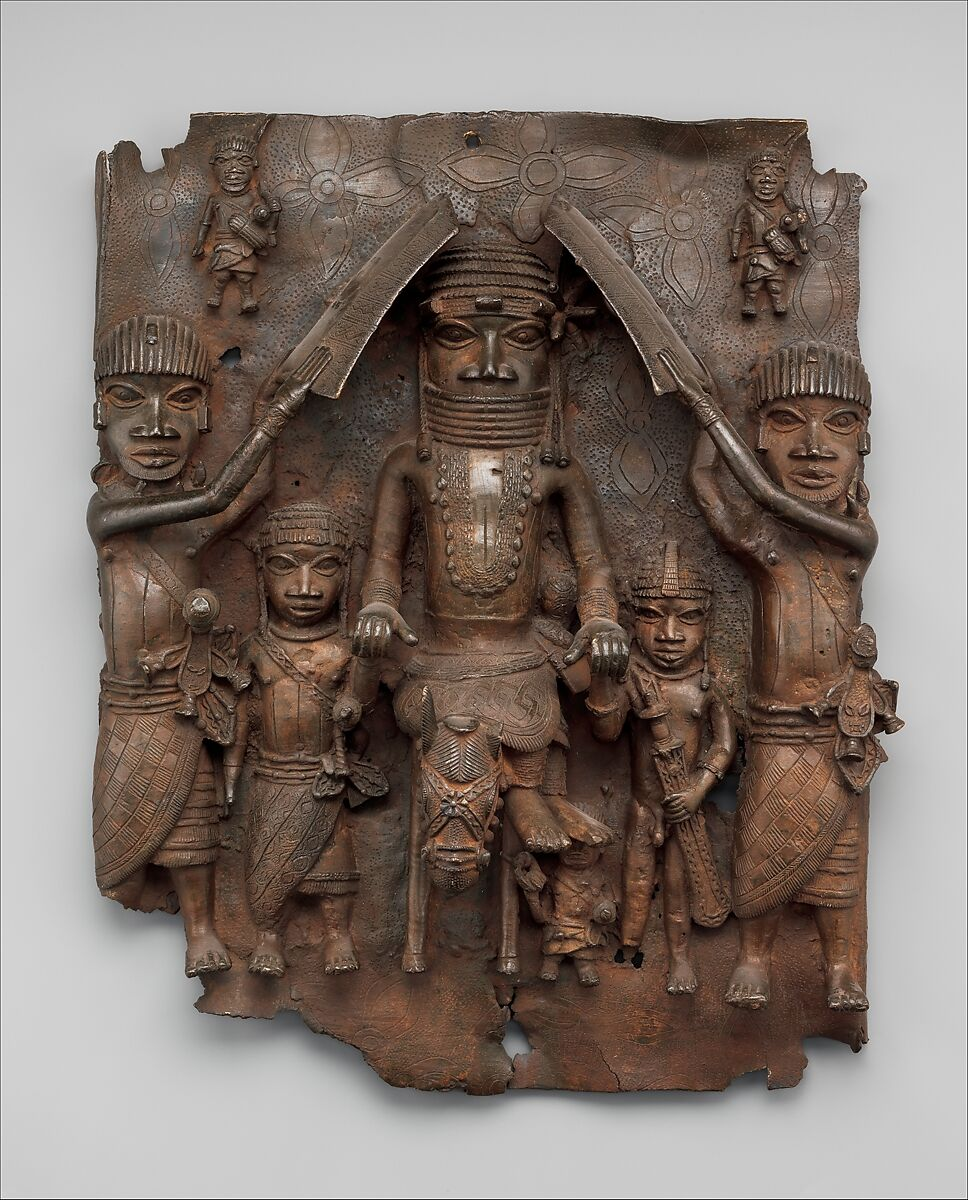
“In this brass plague, the seated figure in the middle is the king of the Benin Kingdom in West Africa. Kneeling beside him are two attendants. The two smaller figures in the back represent Portuguese traders. The date of its creation is uncertain, but it is no earlier that the 15th century.”
Which interpretation of this piece of art is most consistent with the context of the period?
West Africans split their loyalty between their king and the Portuguese
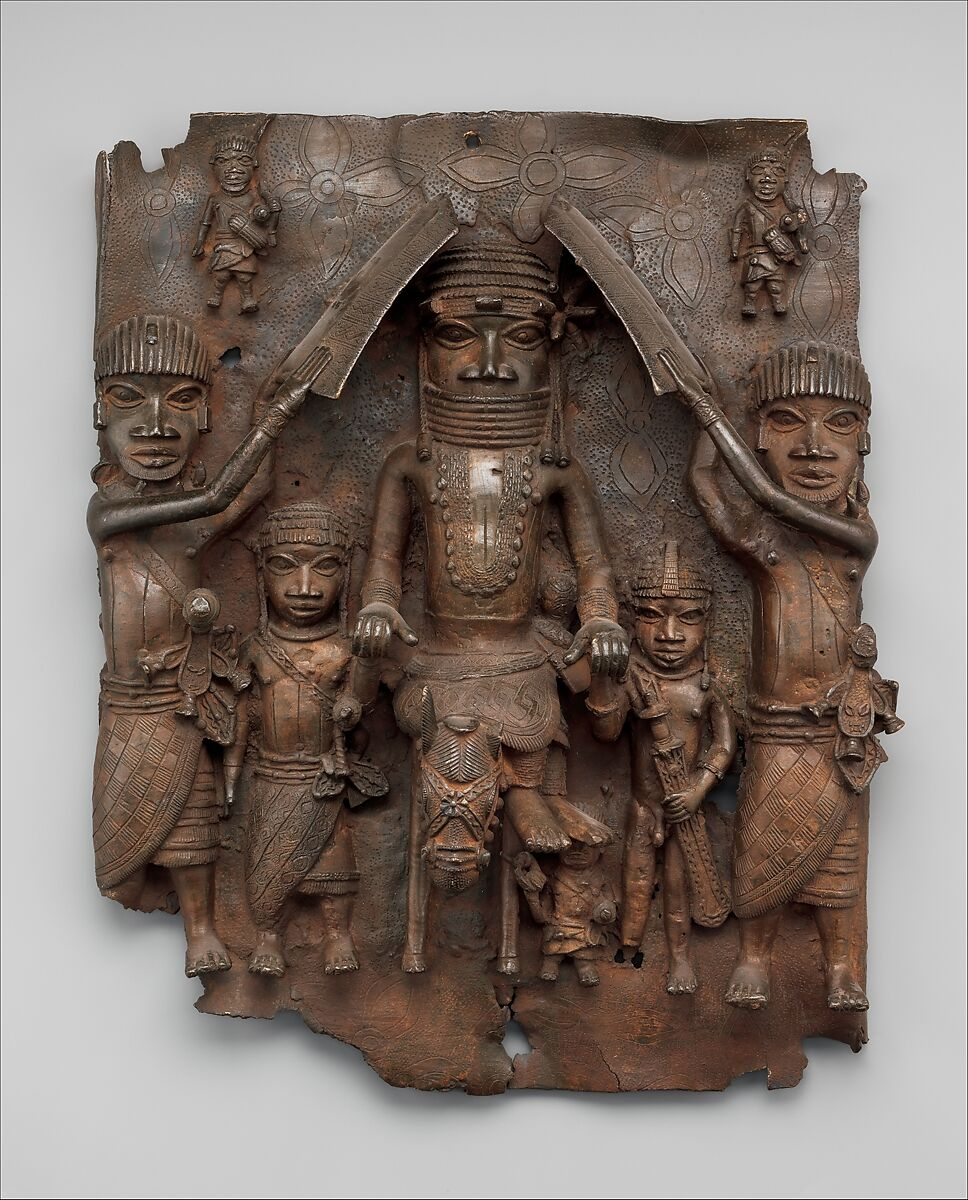
“In this brass plague, the seated figure in the middle is the king of the Benin Kingdom in West Africa. Kneeling beside him are two attendants. The two smaller figures in the back represent Portuguese traders. The date of its creation is uncertain, but it is no earlier that the 15th century.”
The plague provides evidence for a historian studying…
The effects of slave trading on African kings and queens.
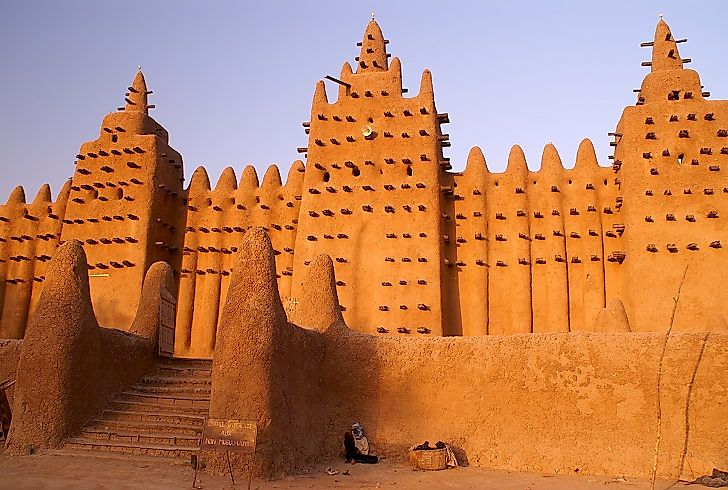
The photograph above of a mosque (first erected in the fourteenth century) in what modern-day West African country of Mali best exemplifies which of the following historical processes?
Spread of religion along trade routes.
“Inside the city…there are many abbeys and churches of Idolaters…Both men and women clothe themselves in silk, so bast is the supply of the material….The crowd of people…is so vast that no would believe it possible [feed them all]…All the squares are rammed with traders who have brought in stores…by land or water…And [the are] free from jealousy or suspicion of the conduct of their women. These they treat with the greatest respect…” Source: Marco Polo in The Book of Sir Marco Polo the Venetian Concerning the Kingdoms of the East.
“The garments of the town’s inhabitants of made of fine Egyptian fabrics…[T]heir women show no bashfulness before women and do not veil themselves though they are [faithful] in attending the prayers…A traveler in this country carries no provisions, [not] food or seasonings, neither gold nor silver. When he comes to. village the women bring out millet, milk, chickens, plump lotus fruit and…pounded haricot beans.” Source: Ibn Battuta, Travels in Asia and Africa.
Which of the following is the most likely reason for similarities in Marco Polo and Ibn Battuta’s accounts of their travels in the 13th and 14th centuries?
The places both involved long distance trade.
“Inside the city…there are many abbeys and churches of Idolaters…Both men and women clothe themselves in silk, so bast is the supply of the material….The crowd of people…is so vast that no would believe it possible [feed them all]…All the squares are rammed with traders who have brought in stores…by land or water…And [the are] free from jealousy or suspicion of the conduct of their women. These they treat with the greatest respect…” Source: Marco Polo in The Book of Sir Marco Polo the Venetian Concerning the Kingdoms of the East.
“The garments of the town’s inhabitants of made of fine Egyptian fabrics…[T]heir women show no bashfulness before women and do not veil themselves though they are [faithful] in attending the prayers…A traveler in this country carries no provisions, [not] food or seasonings, neither gold nor silver. When he comes to. village the women bring out millet, milk, chickens, plump lotus fruit and…pounded haricot beans.” Source: Ibn Battuta, Travels in Asia and Africa.
Which of these accurately describes the political status of China in Marco Polo’s time?
China was under the control of Mongol rulers.
“Inside the city…there are many abbeys and churches of Idolaters…Both men and women clothe themselves in silk, so bast is the supply of the material….The crowd of people…is so vast that no would believe it possible [feed them all]…All the squares are rammed with traders who have brought in stores…by land or water…And [the are] free from jealousy or suspicion of the conduct of their women. These they treat with the greatest respect…” Source: Marco Polo in The Book of Sir Marco Polo the Venetian Concerning the Kingdoms of the East.
“The garments of the town’s inhabitants of made of fine Egyptian fabrics…[T]heir women show no bashfulness before women and do not veil themselves though they are [faithful] in attending the prayers…A traveler in this country carries no provisions, [not] food or seasonings, neither gold nor silver. When he comes to. village the women bring out millet, milk, chickens, plump lotus fruit and…pounded haricot beans.” Source: Ibn Battuta, Travels in Asia and Africa.
Which of these best accounts for the observation made by these travelers about the status of women in China and West Africa in this era?
Women generally followed long cultural norms.
The non-technological factor that MOST facilitated long-facilitated trade in the Indian Ocean basin was…
The seasonal monsoon winds.
Which of the following would enable a historian to argue that the Mississippian culture was characterized by a high degree of social organization?
It erected large mounds for cultural purposes.
Which of the following best explains how many similarities between Buddhist and Hindu spiritual tenets?
Both have routes in traditional Vadism.
Which of the following explains why the spread of Champa rice revoluntionized agriculture throughout East and Southeast Asia?
Its drought resistant properties allowed for two harvestings per year, increasing the food production.
In what ways were the histories of the Bantu and the Polynesians similar?
Their migrations dispersed a single cultural group over vast differences.
Which of the following caused Mali’s rise as a regional power during the 1300’s?
Its status as one of Afro-Eurasia’s main sources of gold.
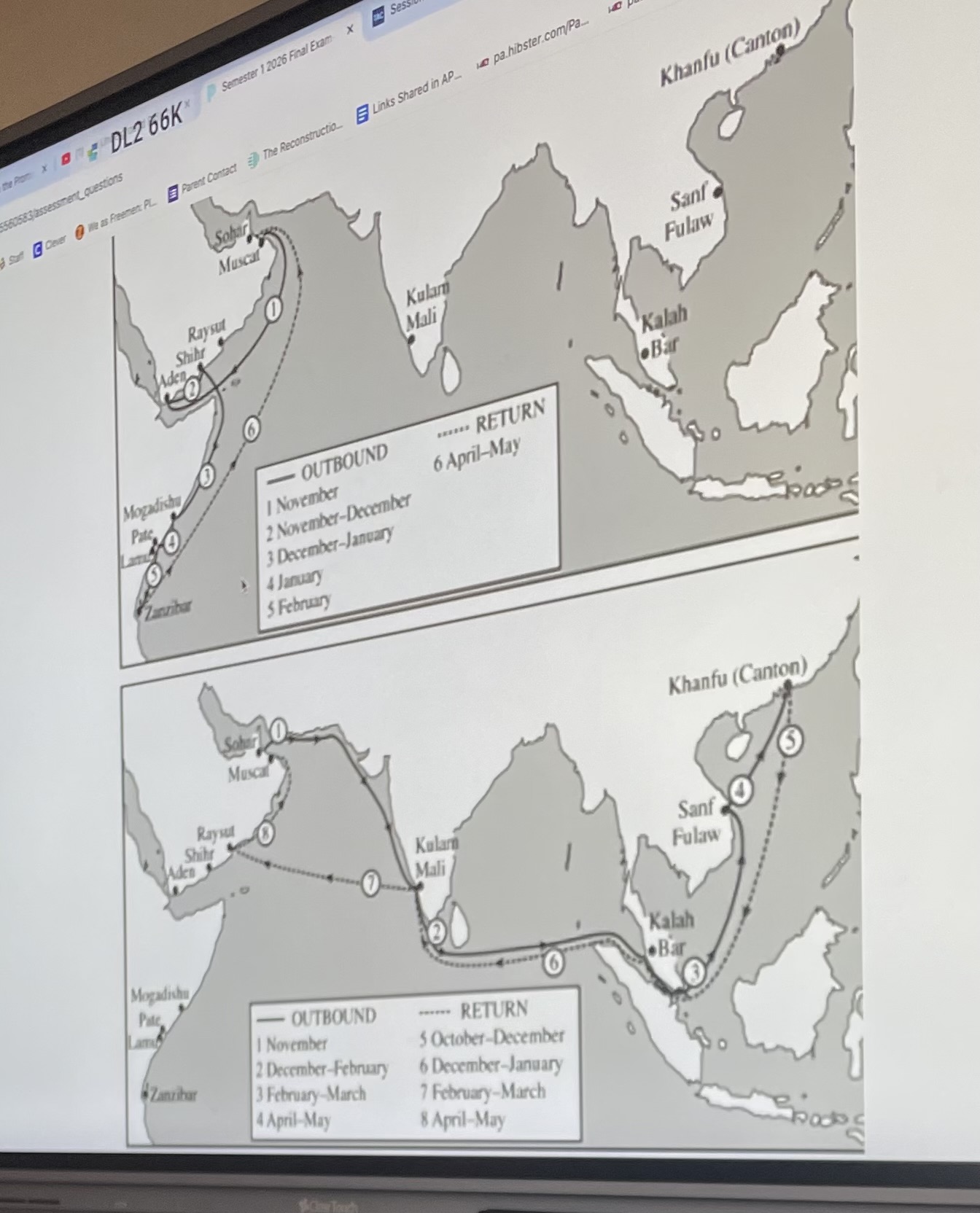
TYPICAL SAILING ROUTES AND SCHEDULES OF MERCHANTS TRAVELING TO EAST AFRICA AND FROM MUSCAT, CIRCA 1400 CE
The particular routes and timings of the voyages depicted on the maps best reflect which of the following characteristics of Omani merchants?
Their advanced knowledge of Indian Ocean winds.
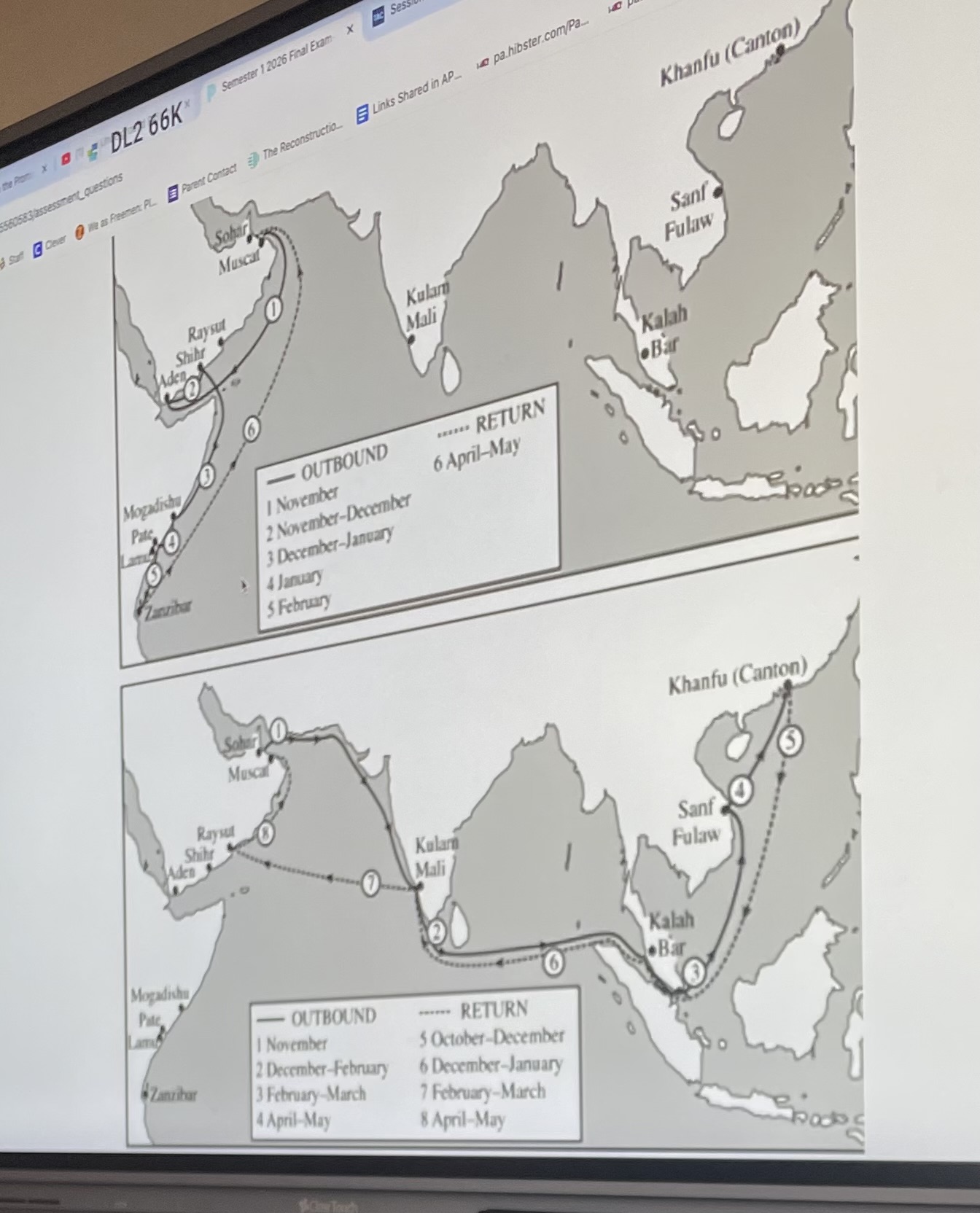
TYPICAL SAILING ROUTES AND SCHEDULES OF MERCHANTS TRAVELING TO EAST AFRICA AND FROM MUSCAT, CIRCA 1400 CE
Based on the maps and your knowledge of world history, which of the following best describes the effect of the spread of Islam on Indian Ocean trade?
It led to the growth of commerce on already existing trade routes.
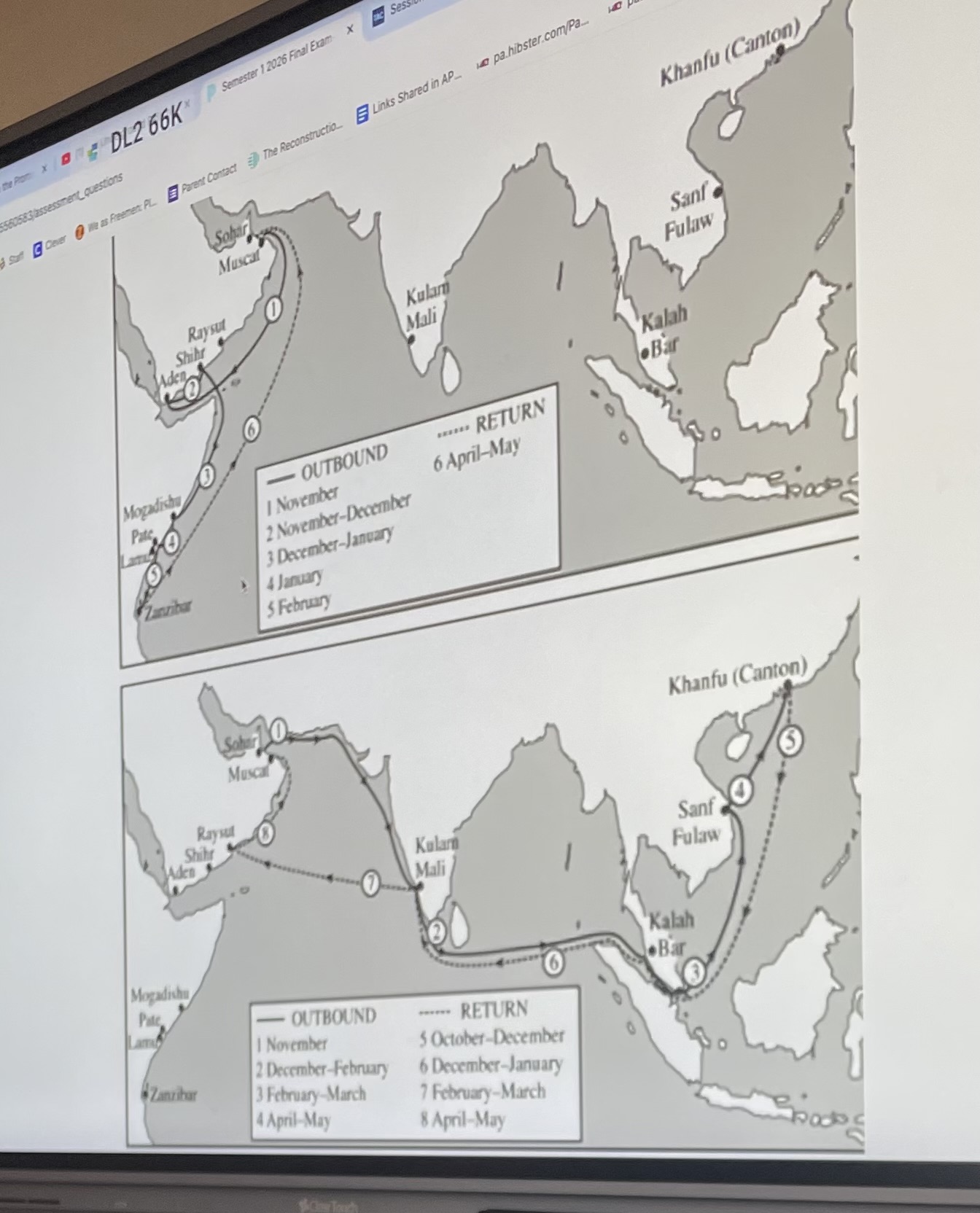
TYPICAL SAILING ROUTES AND SCHEDULES OF MERCHANTS TRAVELING TO EAST AFRICA AND FROM MUSCAT, CIRCA 1400 CE
Which of the following factors contributed the most to Omani traders’ ability to undertake the voyages depicted on the maps?
Navigation and maritime inventions
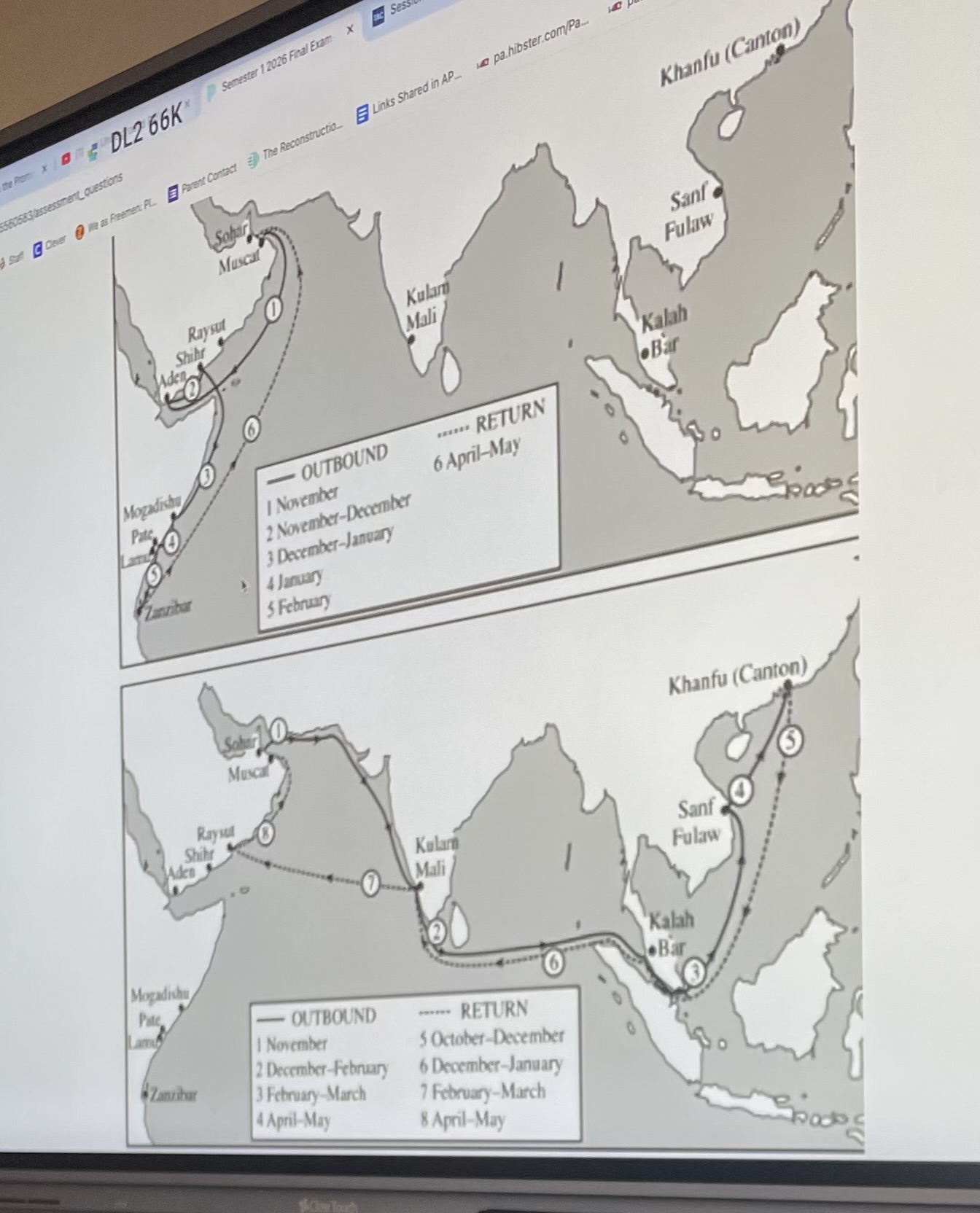
TYPICAL SAILING ROUTES AND SCHEDULES OF MERCHANTS TRAVELING TO EAST AFRICA AND FROM MUSCAT, CIRCA 1400 CE
Based on the maps and your knowledge of world hisotry, which of the following could be best inferred about the South and East Asian trading cities on the map?
They had merchant communtiies.
“Having on one occasion asked my father the reason why he had forbidden anyone to prevent or interfere with the building of [Hindu temples], his reply was…’With all the human race, I am at peace…Neither is it to be forgotten, that the class of whom we are speaking…Are usefully engaged, either in the pursuits of science of that arts, or of improvements for the benefit of mankind, and have in numerous instances arrived in the highest distinctions in the state, there being, indeed, to be found i this city of men of every description, and of every religion on the face of the earth.’” Source: Jahangir, Mughal emperor, early 17th century, recalling a conversation with his father, Akbar the Great.
Which of the following represents a substantial difference in the governing policies of the Mughal emperors of South Asia and the Christian rulers in Western Europe in the 17th century?
Mughal emperors practiced religious tolerance. Christian rulers imposed Christianity.
“Having on one occasion asked my father the reason why he had forbidden anyone to prevent or interfere with the building of [Hindu temples], his reply was…’With all the human race, I am at peace…Neither is it to be forgotten, that the class of whom we are speaking…Are usefully engaged, either in the pursuits of science of that arts, or of improvements for the benefit of mankind, and have in numerous instances arrived in the highest distinctions in the state, there being, indeed, to be found i this city of men of every description, and of every religion on the face of the earth.’” Source: Jahangir, Mughal emperor, early 17th century, recalling a conversation with his father, Akbar the Great.
One likely goal of Jahangir’s statement was to…
Sustained Hinduism loyalty to a Muslim state.
“Having on one occasion asked my father the reason why he had forbidden anyone to prevent or interfere with the building of [Hindu temples], his reply was…’With all the human race, I am at peace…Neither is it to be forgotten, that the class of whom we are speaking…Are usefully engaged, either in the pursuits of science of that arts, or of improvements for the benefit of mankind, and have in numerous instances arrived in the highest distinctions in the state, there being, indeed, to be found i this city of men of every description, and of every religion on the face of the earth.’” Source: Jahangir, Mughal emperor, early 17th century, recalling a conversation with his father, Akbar the Great.
Which feature of the Mughal empire represented a change from most South Asian states that had preceded it?
The Mughals united the majority of South Asia under one rule.

