4. Animal Kingdom
 Call Kai
 Learn
Learn Practice Test
 Spaced Repetition
 Match
Match Flashcards
 Knowt Play
1/301

302 Terms
What is a cellular level of organisation in animals?
The cells of the animal are arranged in loose cell aggregates. Some division of labour occurs among cells.
What is a tissue level of organisation in animals?
The arrangement of cells is more complex. Here the cells performing the same function are arranged into tissues.
What is an organ level of organisation in animals?
Tissues are grouped together to form organs, each specialised for a particular function.
What is an organ-system level of organisation in animals?
Organs have associated to form functional systems, each system concerned with a specific physiological function.
Which animal phylum has cellular level of organisation?
Porifera
Which animal phyla have tissue level of organisation?
Coelenterata and Ctenophora
Which animal phyla have organ level of organisation?
Platyhelminthes
Which animal phyla have organ-system level of organisation?
Everything including and after Aschelminthes
What are the three types of digestive systems?
cell-aggregated
blind-sac (incomplete digestive system)
tube-in-tube (complete digestive system)
What is the difference between blind-sac and tube-in-tube digestive systems?
blind-sac digestive systems means there is only 1 opening for intaking food and excreting undigested material
tube-in-tube digestive systems means there are two openings, one for food intake (mouth) and one for excretion (anus)
Which animal phylum shows cell-aggregated digestive system?
Porifera
Which animal phyla show blind-sac (incomplete) digestive system?
Coelenterata
Ctenophora
Platyhelminthes
Which animal phyla show tube-in-tube (complete) digestive system?
Everything including and after Aschelminthes.
What are the three germ layers?
Endoderm
Ectoderm
Mesoderm
What are the two types of circulatory systems?
closed circulatory system
open circulatory system
Describe an open circulatory system
Blood is pumped out of the heart and the cells and tissues are directly bathed in it
Describe a closed circulatory system
Blood is circulated through a series of vessels of varying diameters (arteries, veins and capillaries).
Which animal phylum has organisms that are asymmetrical?
Porifera
Which animal phyla have organisms that exhibit radial symmetry? What is an exception?
Coelenterata, Ctenophora have radial symmetry
Adult Echidnoderms have radial symmetry but larval echidnoderms do not have radial symmetry
Which animal phyla have organisms that exhibit bilateral symmetry? What is an exception?
The phyla that have bilateral symmetry are
Platyhelminthes
Aschelminthes
Annelida
Arthropoda
Mollusca
Hemi-chordata
Chordata
The exception is that larval stages of Echidnoderms also exhibit bilateral symmetry while adult echidnoderms exhibit radial symmetry
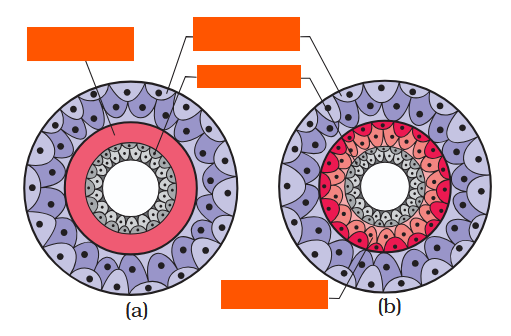
(a) is diploblastic germinal layers
(b) is triploblastic germinal layers
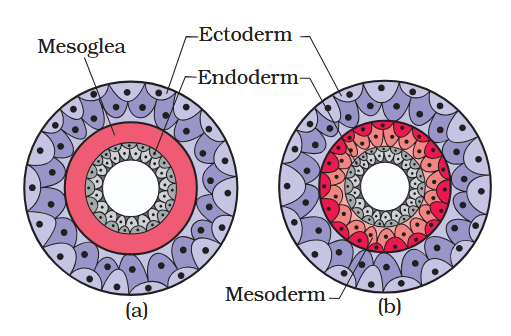
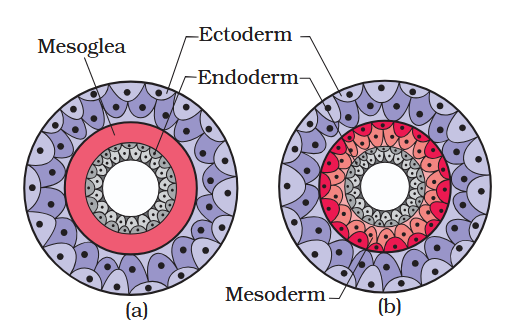
What sort of germinal layers is (a)?
What sort of germinal layers is (b)?
(a) is diploblastic germinal layers
(b) is triploblastic germinal layers
What is a mesoglea?
It is an undifferentiated mass found in diploblastic germ layers between the endoderm and ectoderm.
What are diploblastic animals?
Animals in which the cells are arranged in two embryonic layers, an external ectoderm and an internal endoderm, are called diploblastic animals. An undifferentiated layer, mesoglea, is present in between the ectoderm and the endoderm.
What are triploblastic animals?
Those animals in which the developing embryo has a third germinal layer, mesoderm, in between the ectoderm and endoderm, are called triploblastic animals.
What is a coelem?
It is the presence of a cavity/space between the body wall and the elementary canal (lined on both sides by a mesoderm) in an organism.
What is a pseudo-coelem?
In some animals, the body cavity is not lined by mesoderm, instead, the mesoderm is present as scattered pouches in between the ectoderm and endoderm. Such a body cavity is called pseudocoelom.
In which animal phyla is the coelem absent?
porifera
coelenterata
ctenophora
platyhelminthes
In which animal phylum is a pseudo-coelem present?
Aschelminthes
In which animal phyla is a coelem present?
Annelida
Arthropoda
Mollusca
Echidnodermata
Hemi-chordata
Chordata
What is metamerism?
In some animals, the body is externally and internally divided into segments with a serial repetition of at least some organs. Also known as segmentation.
What is a notochord?
Notochord is a mesodermally derived rod-like structure formed on the dorsal side during embryonic development in some animals.
What is the distinctive feature of phylum Porifera?
Body with pores and canals in walls
What is the distinctive feature of phylum Coelenterata?
Cnidoblasts present.
What is the distinctive feature of phylum Ctenophora?
Comb plates for locomotion.
What is the distinctive feature of phylum Platyhelminthes?
Flat body, suckers.
What is the distinctive feature of phylum Aschelminthes?
Often worm-shaped, elongated.
What is the distinctive feature of phylum Annelida?
Body segmentation like rings.
What is the distinctive feature of phylum Arthropoda?
Exoskeleton of cuticle, jointed appendages.
What is the distinctive feature of phylum Mollusca?
External skeleton of shell usually present.
What is the distinctive feature of phylum Echidnodermata?
Water vascular system, radial symmetry.
What is the distinctive feature of Hemi-chordata?
Worm-like with proboscis, collar and trunk.
What is the distinctive feature of phylum Chordata?
Notochord, dorsal hollow nerve cord, gill slits with limbs or fins.
In which animal phyla is segmentation present? There are three
Annelida
Arthropoda
Chordata
In which animal phylum is a circulatory system present but a respiratory system absent?
Annelida
In which animal phyla is a circulatory system absent?
Porifera all the way to Aschelminthes
In which animal phyla is a circulatory system present?
Annelida all the way to Chordata
In which animal phyla is a respiratory system absent?
Porifera all the way to Annelida
In which animal phyla is a respiratory system present?
Arthropoda all the way to Chordata
Members of phylum Porifera are commonly known as ______.
Sponges
What is the habitat of animals from phylum Porifera?
mostly marine
Sponges do not have a digestive system, but they have 2 openings. What is the significance of this?
They are part of the water-transport or canal system
What are ostia?
Minute pores present in the body walls of sponges, through which water enters into the central cavity.
What is an osculum?
The hole through which water exits the central cavity of sponges.
What is a spongocoel?
The central cavity of sponges
What is the significance of the water-transport or canal system in poriferans?
This pathway of water transport is helpful in food gathering, respiratory exchange and removal of waste.
What are choanocytes?
They are the collar cells that line the spongocoel and canals in poriferans.
How does digestion occur in poriferans?
Digestion is intra-cellular.
What are spicules?
Little spikes that make up the skeleton in poriferans, for support.
What are spongin fibres?
FIbres that give poriferans their shape and provide support to their structure.
How do sexes present in poriferans?
Poriferans are hermaphrodite, i.e., eggs and sperms are produced by the same individual.
How do sponges reproduce asexually?
Sponges reproduce asexually by fragmentation.
How do sponges reproduce sexually?
Sponges reproduce sexually by formation of gametes.
In poriferans, is fertilization internal or external?
internal
In poriferans, is development direct or indirect?
indirect
What are the 3 examples of phylum Porifera?
Sycon (Scypha)
Spongilla (Fresh water sponge)
Euspongia (Bath sponge)
Why is phylum Coelenterata also called Cnidaria?
Because of the presence of cnidoblasts, or cnidocytes.
What is the habitat of animals in phylum Coelenterata?
aquatic, mostly marine
Are animals in Coelenterata diploblastic or triploblastic?
diploblastic
What is a hypostome?
The thing on which coelenterates have their mouths (their one single opening)
Which are the three animal phyla that are diploblastic?
Porifera
Coelenterata
Ctenophora
Which are the animal phyla that are triploblastic?
everything after the first three phyla
What are cnidoblasts or cnidocytes?
They are little sacs which contain stinging capsules (or nematocysts).
What is the function of nematocysts in Coelentarata?
They are lasso-like structures which lash out in case of danger, capturing prey, or anchorage.
Where are cnidoblasts/cnidocytes present on animals in phylum Coelenterata?
on their tentacles and body
How does digestion occur in Coelenterata?
Digestion is both intracellular and extracellular.
Some of the cnidarians, e.g., corals have a _______ composed of calcium carbonate.
Some of the cnidarians, e.g., corals have a skeleton composed of calcium carbonate.
Some of the cnidarians, e.g., corals have a skeleton composed of _______________.
Some of the cnidarians, e.g., corals have a skeleton composed of calcium carbonate.
Cnidarians exhibit two basic body forms called ______ and _______.
Cnidarians exhibit two basic body forms called polyp and medusa.
Cnidarians exhibit two basic body forms called polyp and medusa. What is the structure and motility of a polyp?
A polyp has a sessile and cylindrical form.
Cnidarians exhibit two basic body forms called polyp and medusa. What is the structure and motility of a medusa?
A medusa is umbrella-shaped and free-swimming.
Obelia is a peculiar cnidarian. What is its peculiarity?
Those cnidarians which exist in both forms exhibit alternation of generation (Metagenesis), i.e., polyps produce medusae asexually and medusae form the polyps sexually (e.g., Obelia).
What is a chief example of a cnidarian with a polyp form?
Adamsia
What is a chief example of a cnidarian with a medusa form?
Aurelia
What are the 5 examples of animals in phylum Coelenterata?
Physalia (Portuguese man-of-war)
Adamsia (Sea anemone)
Pennatula (Sea pen)
Gorgonia (Sea-fan)
Meandrina (Brain coral)
What are animals from phylum Ctenophora called commonly?
Sea walnuts
Comb jellies
Which animal phyla have exclusively marine animals? There are 3 such phyla. (ish?)
Ctenophora
Echidnodermata
Protochordates
What is the habitat of animals in phylum Ctenophora?
exclusively marine
In animals in phylum Ctenophora, the body bears eight external rows of ______ ______ _____, which help in locomotion
In animals in phylum Ctenophora, the body bears eight external rows of ciliated comb plates, which help in locomotion
How does digestion occur in animals in phylum Ctenophora?
Digestion is both intracellular and extracellular.
______________ (the property of a living organism to emit light) is well-marked in ctenophores.
Bioluminescence (the property of a living organism to emit light) is well-marked in ctenophores.
How are sexes presented in animals in phylum Ctenophora?
They are hermaphrodite
How does reproduction occur in animals in phylum Ctenophora?
Reproduction takes place only by sexual means.
In animals in phylum Ctenophora, is fertilisation external or internal?
external
In animals in phylum Ctenophora, is development direct or indirect?
indirect
What are the two examples of animals in phylum Ctenophora?
Pleurobrachia
Ctenoplana
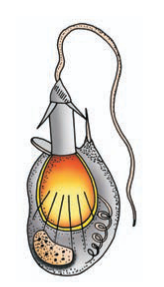
What is this structure
Cnidoblast
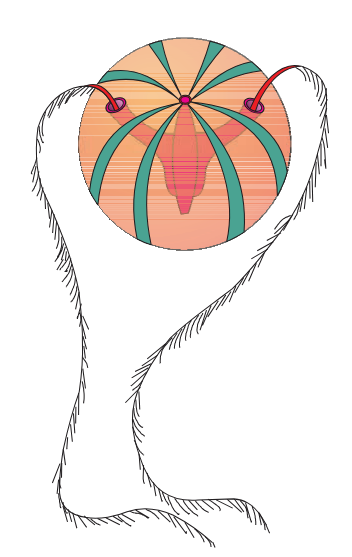
What is this organism
Pleurobrachia
What is the common name of animals from phylum Platyhelminthes?
flat-worms
Why are animals from phylum Platyhelminthes called flatworms?
Because they have dorso-ventrally flattened body.