(1A) - Distribution Concepts and Protein Binding
 Call Kai
 Learn
Learn Practice Test
 Spaced Repetition
 Match
Match Flashcards
 Knowt Play
1/51

There's no tags or description
Looks like no tags are added yet.
Name | Mastery | Learn | Test | Matching | Spaced | Call with Kai |
|---|
No analytics yet
Send a link to your students to track their progress
52 Terms
1-compartment model
Drug distributes:
Instantaneously
Uniformly
Complete
Real body ≠
uniform → distribution is complex
Volume of Distribution (Vd)
Defined as:
“Apparent space drug distributes into”
Volume of Distribution (Vd)
IMPORTANT:
NOT a real physical space
Just a mathematical value
Even if Vd ≈ body fluid → does NOT mean
drug only goes there
Example:
Lipophilic drug → prefers fat
Hydrophilic drug → stays in plasma
DISTRIBUTION STARTS WITH…
BLOOD
Blood Components:
Plasma proteins
Red blood cells
Extravascular Tissues:
Proteins
Fat
Bone
States of Drug in blood
Free drug
Bound drug
Only FREE drug can:
Be absorbed
Distribute
Be metabolized
Be excreted
Produce pharmacologic effect
Free drug =
ACTIVE drug
BOUND DRUG
Attached to proteins/macromolecules
Cannot:
Cross membranes
Be metabolized
Be excreted
Produce effect
BOUND DRUG
think…
inactive storage
Protein Binding
Drug + macromolecule interaction
Types of Binding - overview
Reversible (MOST COMMON)
Irreversible
Reversible (MOST COMMON)
Weak (H-bond, Van der Waals)
Drug can bind/unbind
Irreversible
Covalent bonding
Permanent
🚨 Example:
Acetaminophen toxicity → liver damage
Reactive metabolite binds liver proteins → damage
Factors Affecting Binding
1. Drug Factors
Molecular weight
Lipophilicity
Drug concentration
2. Protein Factors
Amount of protein
Type/structure
3. Drug–Protein Affinity
Strength of binding
4. Drug Interactions
Compete for same binding site
Can increase free drug → toxicity
5. Patient Conditions
Liver disease ↓ proteins
Uremia alters binding
High drug + low protein →
Low drug + high protein →
High drug + low protein → MORE free drug
Low drug + high protein → MORE bound drug
MAJOR PROTEINS - overview
1. ALBUMIN
2. α1-ACID GLYCOPROTEIN
3. LIPOPROTEINS (LDL, HDL)
4. ERYTHROCYTES (RBCs)
OTHER
IV TUBING / IV SET BINDING
TPN (TOTAL PARENTERAL NUTRITION) INTERACTIONS
ALBUMIN
Most abundant protein
Produced by liver
Long half-life (~2–3 weeks) (t½: ~17–18 days)
Normal: 35–50 g/L
ALBUMIN
function
Maintains osmotic pressure in the blood
Transports poorly soluble substances
ALBUMIN
Binds:
Acidic drugs
Hydrophobic drugs
ALBUMIN
Key Features:
Multiple binding sites
Can bind strongly
ALBUMIN
CLINICAL PEARL
Liver disease → ↓ albumin → ↑ free drug
α1-ACID GLYCOPROTEIN
Lower concentration (0.4–1.0 g/L)
Produced in liver
α1-ACID GLYCOPROTEIN
Binds:
Basic drugs
α1-ACID GLYCOPROTEIN
Key Features:
Low capacity (few sites)
High affinity
LIPOPROTEINS (LDL, HDL)
Transport lipids
LIPOPROTEINS (LDL, HDL)
Binding Mechanism
Drug dissolves in lipophilic core
LIPOPROTEINS (LDL, HDL)
Binds:
Highly lipophilic drugs
LIPOPROTEINS (LDL, HDL)
function
transport corticosteroids
ERYTHROCYTES (RBCs)
Usually minimal binding
💡 Examples:
Cyclosporine (~50%)
Phenytoin (~25%)
KEY CLINICAL IDEA
Pharmacokinetics (ADME) depends on FREE drug
Total drug ≠
active drug
→ Only free drug matters
High protein binding ≠
stronger drug
→ Actually less active (less free drug)
STEP-BY-STEP FLOW
Drug enters blood
Drug ⇄ binds to protein
Only free drug moves
Free drug:
Distributes
Gets metabolized
Gets excreted
Causes effect
IV TUBING / IV SET BINDING
Key idea:
Some drugs bind to:
IV tubing
Plastic/plasticizers
IV TUBING / IV SET BINDING (VERY TESTABLE CONCEPT)
a. Result:
b. solution
a. Drug never reaches patient
b. Prime IV line
Run albumin or other solution first
Coat tubing → prevent drug loss
TPN (TOTAL PARENTERAL NUTRITION) INTERACTIONS
Contains:
Lipids
Amino acids
Carbs
TPN (TOTAL PARENTERAL NUTRITION) INTERACTIONS
Key concept:
Lipophilic drugs bind to lipids in TPN
TPN (TOTAL PARENTERAL NUTRITION) INTERACTIONS
Causes:
Drug binding / loss
Compatibility issues
DRUG “PROMISCUITY”
Drugs bind to many unexpected things
Not just proteins
Basic drugs →
Acidic drugs →
Basic drugs (Hydrobromide drug) → AAG
Acidic drugs → Albumin
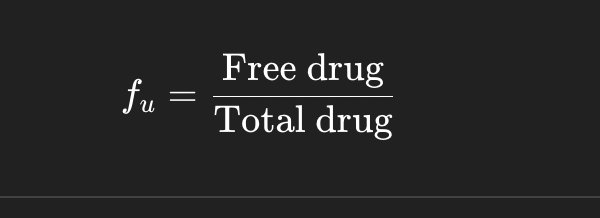
FREE FRACTION (fᵤ)
Fraction of drug that is free (unbound)
FREE FRACTION (fᵤ)
equation (ON FORMULA SHEET)
Bound fraction: equation
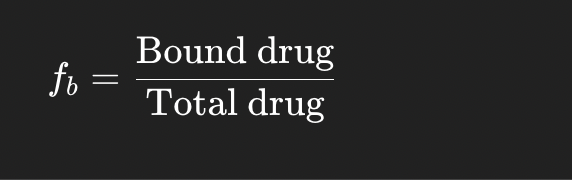
fu and fb relation

Equation to CONVERTING BETWEEN FREE & TOTAL CONCENTRATION

Equation to CONVERTING BETWEEN BOUND & TOTAL CONCENTRATION
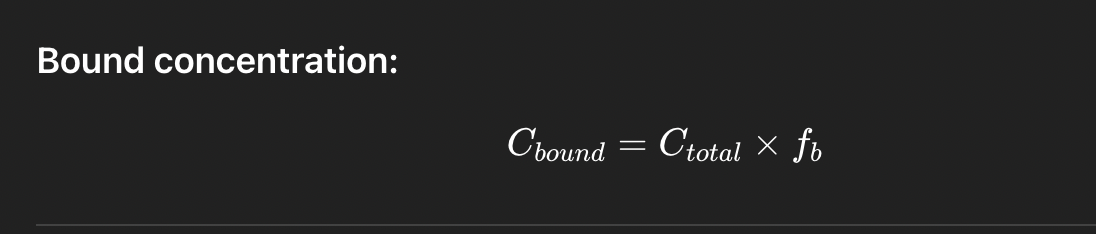
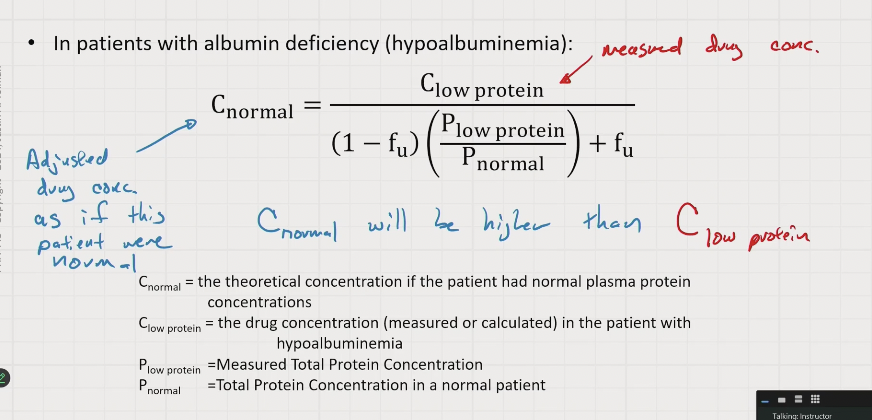
What is this equation about? Equation be give in exam!
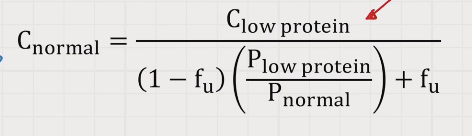
(this math problem in HW)
it used when correcting for altered plasma protien
PHENYTOIN (SPECIAL CASE)
it’s similar to previous flashcard but with phenytoin
~95–98% protein bound
Very sensitive to albumin changes
this equation NOT on the exam
Explore top notes

