8) Groundwater flow equations
 Studied by 0 people
 Call Kai
 Learn
Learn Practice Test
 Spaced Repetition
 Match
Match Flashcards
 Knowt Play
1/15

There's no tags or description
Looks like no tags are added yet.
Name | Mastery | Learn | Test | Matching | Spaced | Call with Kai |
|---|
No analytics yet
Send a link to your students to track their progress
16 Terms
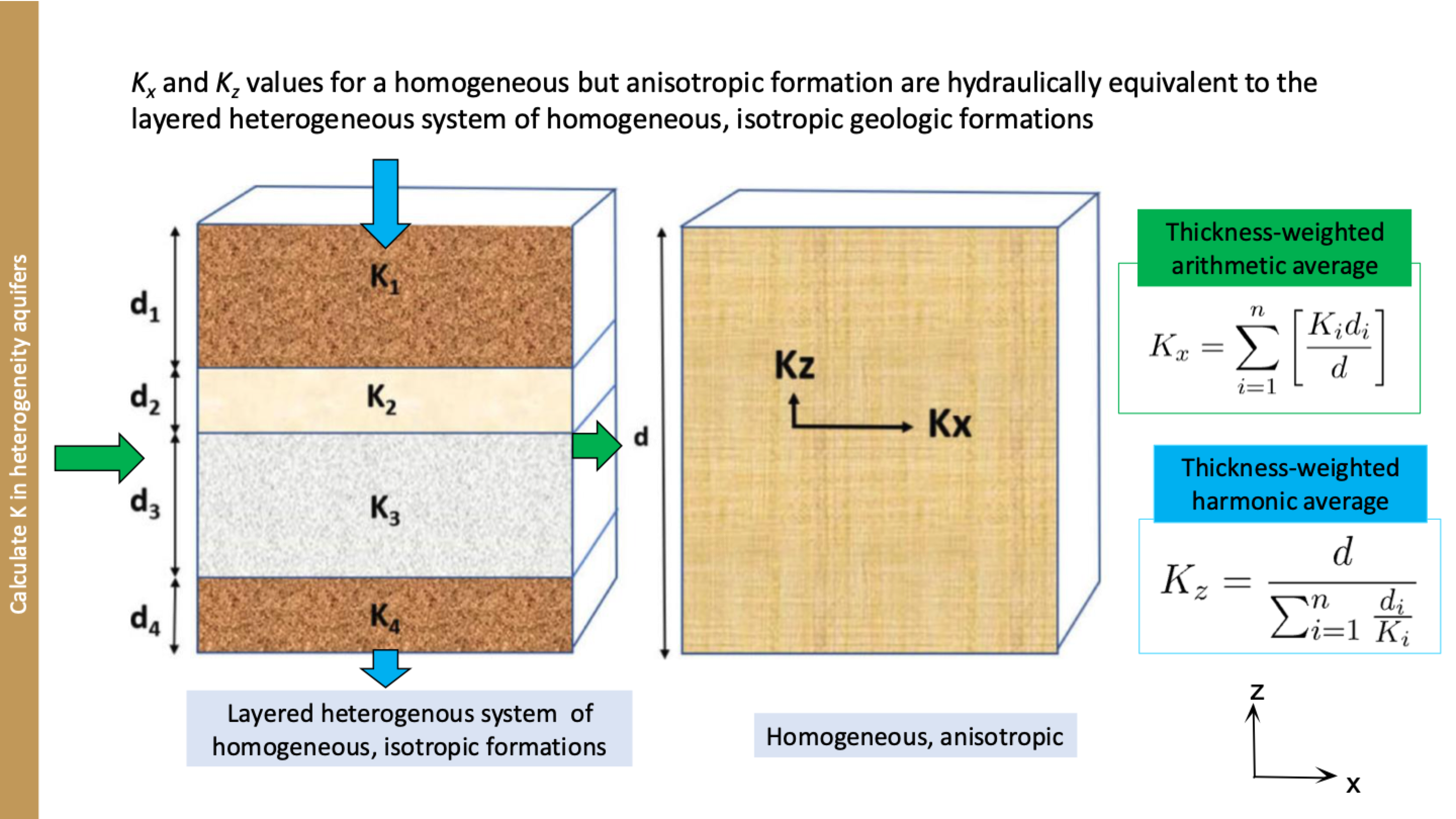
explain this
layered system, 3 thicknesses with 3 K values
difference in hydraulic head across the units is the same and the same distance travelled
total Q = Q1+Q2+Q3 = K
Q = -KA∆h/∆L = area in this case its thickness
total Q = -K1b1∆h/∆L + -K2b2∆h/∆L + -K3b3∆h/∆L
hydraulic gradient out because it’s the same for each part
Q = -∆h/∆L * sum of Kibi
steady state vs transient conditions
steady state: mass of water in REV is constant, inflow=outflow
heads, gradients, flow rates do not vary with time
transient conditions: mass of water in REV varies with time, inflow does not equal outflow, heads, gradients, flow rates vary with time
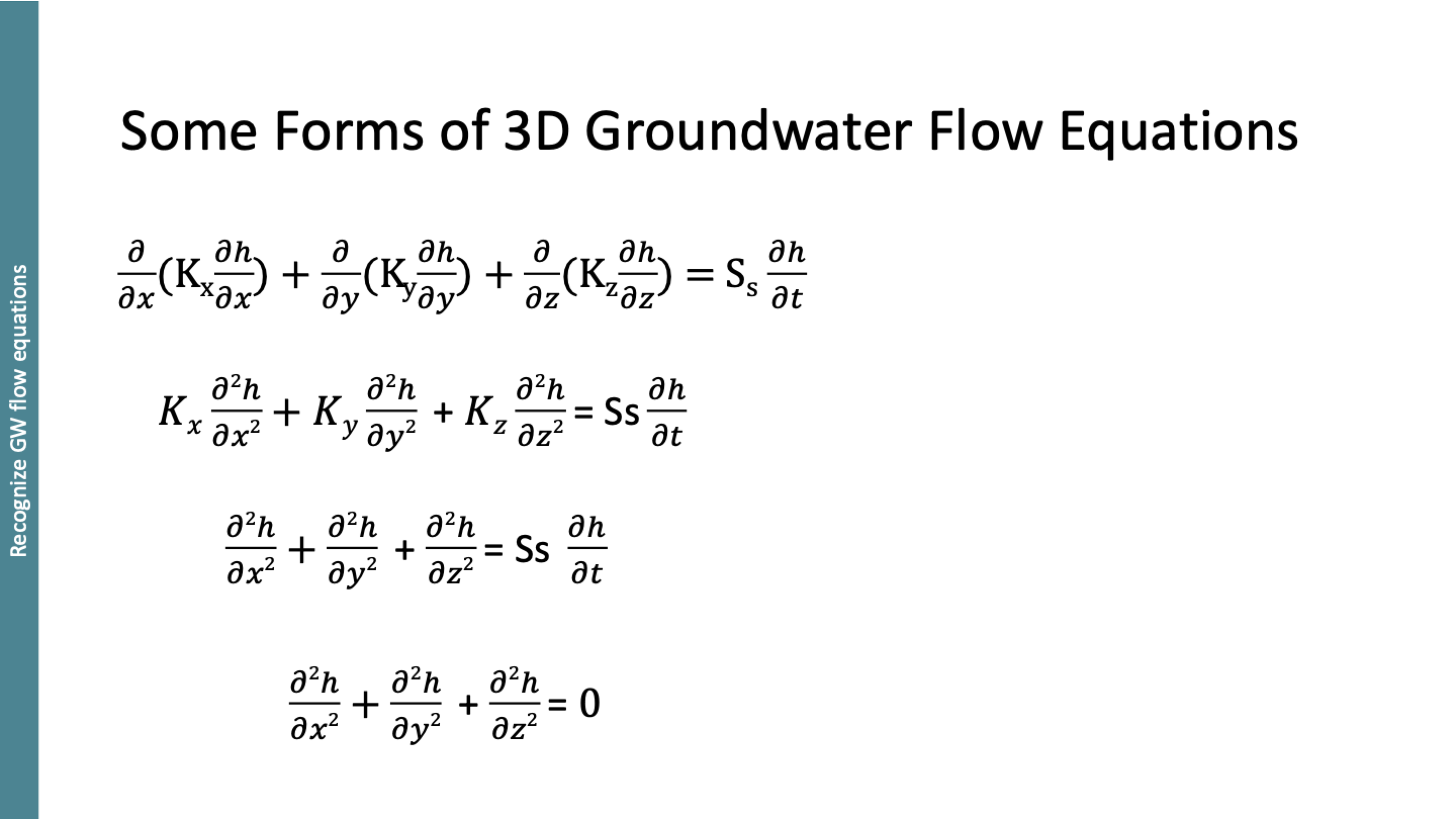
which are these examples
first: anisotropic, heterogeneous
spatial gradient, K is allowed to vary in space
second: anisotropic, homogeneous
k does not vary in space (outside of derivative), but diff K for each direction
third: isotropic, homogeneous
K is not in equation
forth: steady state
darcy’s law describes what?
mass fluxes
how do we get change in mass flux across REV with 1D flow
rate of change of density and specific discharge as you move across x distance
increasing in slope means head is falling, water coming out of storage
increase in flow = more water = less head
specific yield in a groundwater equation means?
unconfined aquifer
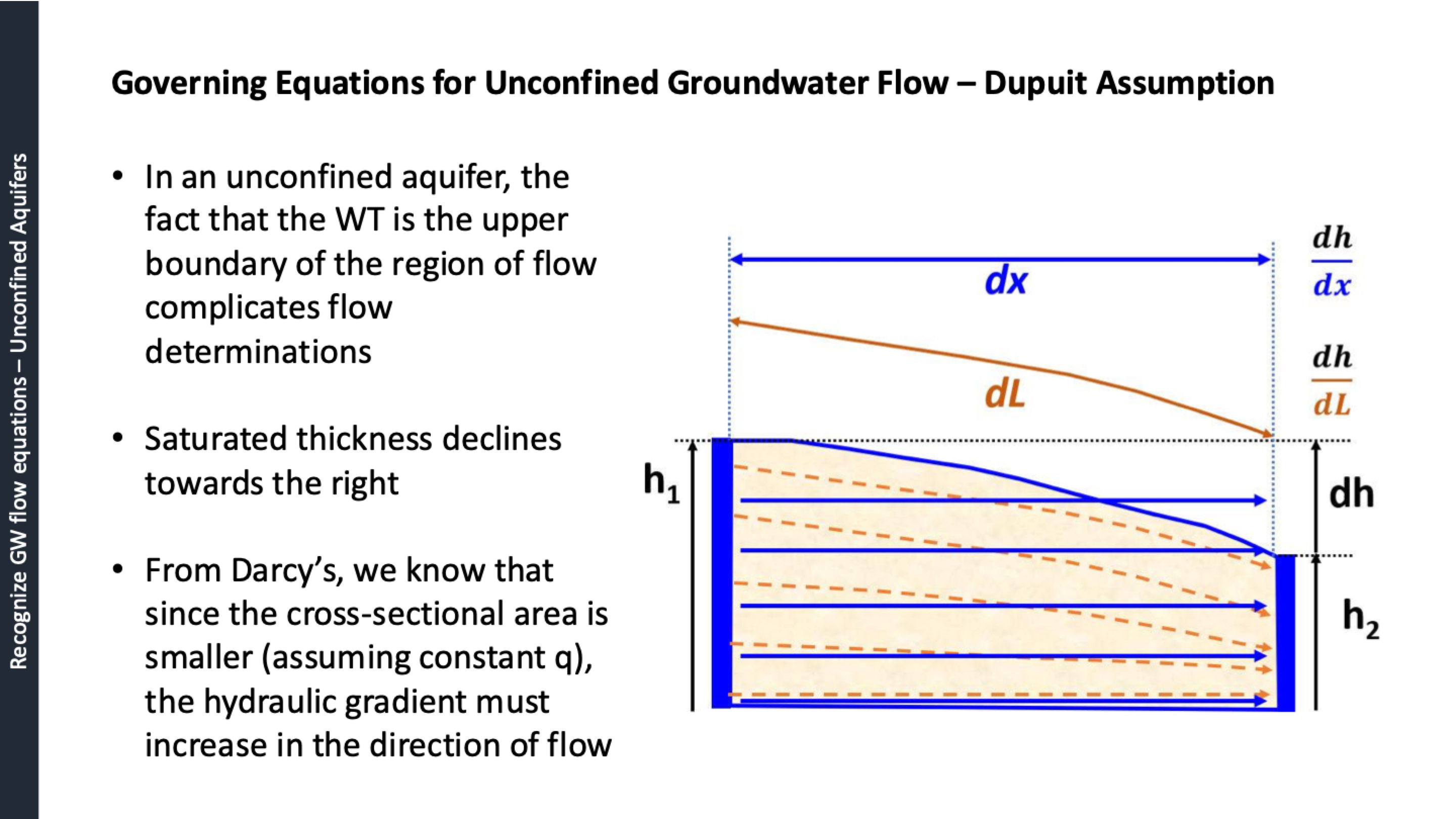
explain this, what assumption is it?
cross-sectional area is smaller to the right, so hydraulic gradient must increase considering constant flow
dupuit assumption: change in head probably won’t be significant, so ignore that it curves and just get area instead of doing dL, get dx
assume steady state
what is the procedure to solving a problem
identify boundaries
choose appropriate form of flow equation
specify initial conditions (steady state flow equations have no time in them, so we don’t need to specify initial conditions)
specify boundary conditions (Specified head boundary, or specified flux boundary)
specify material properties
solve the equation
details on specified head boundary
dirichlet
head is known at the boundary of the flow region
boundary forms an equipotential, adjacent equipotentials must be parallel to this boundary
model calculates flow rates at the location where head is specified
details on specified flux boundary
neumann
no flow or constant flow
no flow: perpendicular to equipotentials
constant flow: recharge or leakage applied to boundary
model calculates the head at the location where the flux is specified
how will the boundary look with recharge vs no recharge at the water table (WT)
no recharge, WT is a flow line, perfectly perpendicular
recharge: WT is not a flow line, equips are at an angle to WT
details on no flow boundary configurations
divide between the regions
no flow on the edge too, not the exit of the orange flow, the fact that it’s the boundary means its no flow
there is recharge and no flow so it’s specified flux boundary
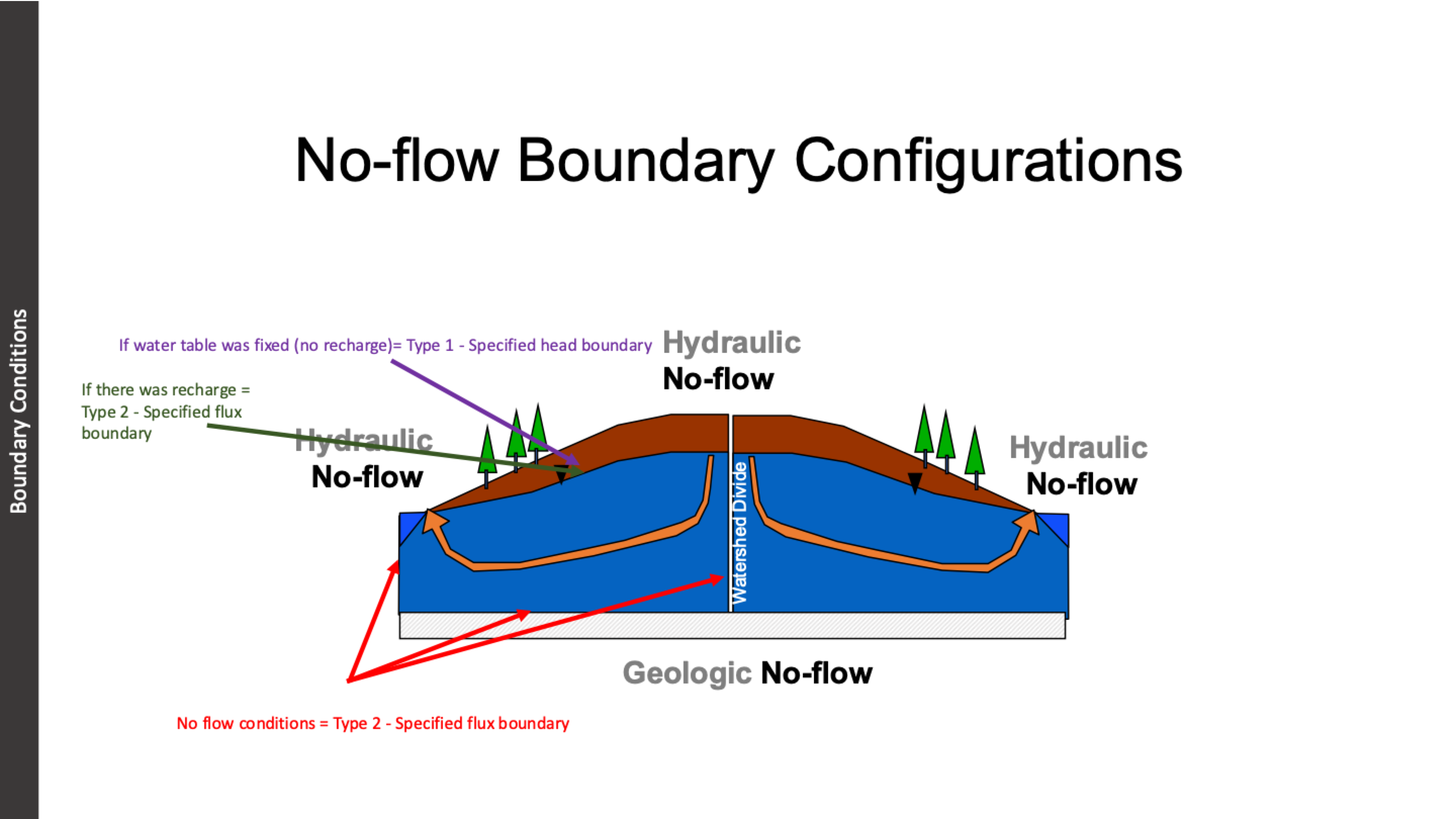
if there is no recharge and we know the height of the water table, what kind of boundary is that? why?
specific head
we know head at water table
examples of physical boundaries
no flow boundary at low K rock
constant head boundary at lake
water table with recharge AND without recharge
faults (can restrict or enhance K)
any major disruption in hydrogeologic unit disrupts boundaries as well
seawater-freshwater interface (limits flow, forces fresh unconfined GW to discharge along the coast)
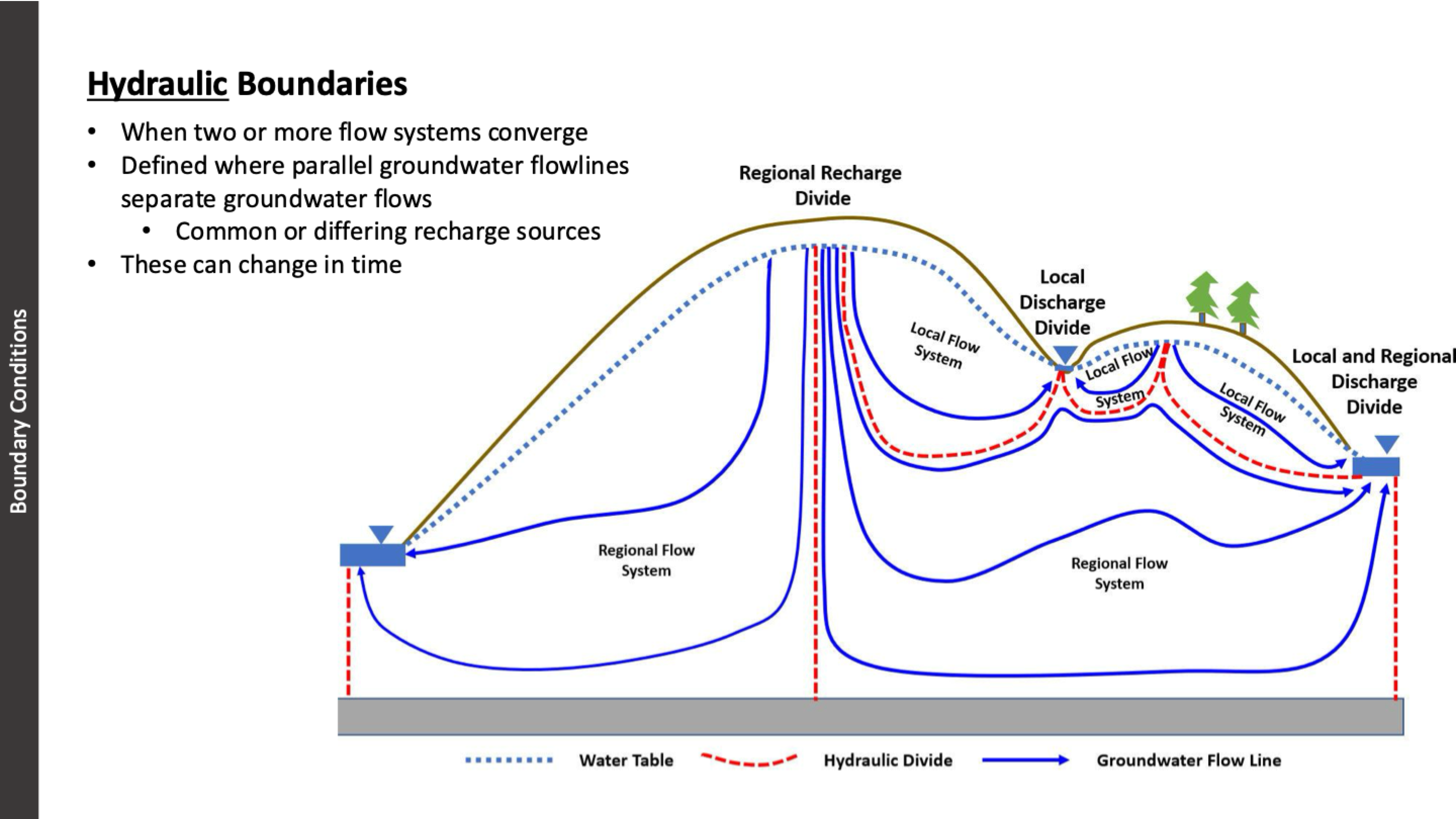
examples of hydraulic boundaries
when two or more flow systems converge
parallel groundwater flowlines separate groundwater flows
common or differing recharge sources
what are methods of solution for GW flow equations
analytical: give exact solutions to the eqtns
restricted to simple systems with regular geometry (homogeneous, isotropic, 1D, 2D)
graphical: flow nets for steady state, 2D problems
numerical: computers give approximate solutions to more complex problems by breaking the domain into small regions
 Note
Note  Flashcards (73)