3. Accounting and Finance
 Studied by 0 people
 Call Kai
 Learn
Learn Practice Test
 Spaced Repetition
 Match
Match Flashcards
 Knowt Play
1/161

There's no tags or description
Looks like no tags are added yet.
Name | Mastery | Learn | Test | Matching | Spaced | Call with Kai |
|---|
No analytics yet
Send a link to your students to track their progress
162 Terms
the balance sheet, the income statement, and the statement of cash flows
The most (BLANK) assets are at the top of the balance sheet with the least at the bottom
Shows in detail how much of the firm's earnings has been retained in the business rather than paid out as dividends and how much money has been raised by issuing new shares or spent by repurchasing stock
statement of shareholders' equity
The difference between current assets and current liabilities
net current assets or net working capital
net current assets or net working capital
Shareholders' equity is equal to which is equal to
Suppose that Target borrows $500 million by issuing new long-term bonds. It places $100 million of the proceeds in the bank and uses $400 million to buy new machinery. What items of the balance sheet would change? Would shareholders’ equity change?
Cash and equivalents would increase by $100 million. Property, plant, and equipment would increase by $400 million. Long-term debt would increase by $500 million. Shareholders' equity would not change.
All items in the balance sheet are expressed as a percentage of total assets
common-size balance sheet
retained earnings is not a pile of (BLANK) that a company has built up form its past operations
cash
U.S. procedures for preparing financial statements
generally accepted accounting principles (GAAP)
net worth of the firm according to the balance sheet
book value
GAAP states that assets must be shown in the balance sheet at their
historical cost adjusted for depreciation
based on the past cost of the asset, not its current market price or value to the firm
book value
In the case of cash the difference between book value and market value is
zero
Usually the market value of fixed assets is much (BLANK) than the book value
higher
In the case of liabilities, the accountant simply records the amount of money that you have (BLANK) to pay
promised
For short-term liabilities the recorded value is generally (BLANK) to the market value of the promise
close
If interest rates rise after you have issued the debt, lenders may (BLANK) prepared to pay (BLANK) as your total debt
not be, as much
If interest rates fall after you have issued the debt, lenders may (BLANK) prepared to pay (BLANK) your total debt
be, more than
Market values of assets and liabilities do not generally (BLANK) their book values
equal
Market values measure (BLANK) values of assets and liabilities
current
The difference between book value and market value is likely to be greatest for
shareholders’ equity
Shareholders are concerned with the (BLANK) value of their shares
market
Balance sheet showing market rather than book values of assets, liabilities, and stockholders’ equity.
market-value balance sheet
market value of assets - market value of liabilities =
market value of the shareholders’ equity claim
stock price =
market value of shareholders’ equity/number of outstanding shares
It has invested $10 billion in building its new auto plant. To finance the investment, Jupiter borrowed $4 billion and raised the remaining funds by selling new shares of stock in the firm. There are currently 100 million shares of stock outstanding. Make the book-value balance sheet (in billions) if these are the Jupiter’s only assets.
Assets:
Auto plant 10
Liabilities and shareholders’ equity:
Debt 4
Shareholders’ equity 6
Investors are placing a market value on Jupiter’s equity of $7.5 billion ($75 per share times 100 million shares). We assume that the debt outstanding is worth $4 billion. Make the market-value balance sheet (in billions) if these are the Jupiter’s only assets.
Assets:
Auto plant 11.5
Liabilities:
Debt 4
Shareholders’ equity 7.5
the market value of the assets must be equal to the market value of the (BLANK) plus the market value of the
liabilities, shareholders’ equity
Thus, in contrast to the balance sheet shown in the company’s books, the market-value balance sheet is (BLANK). It depends on the profits that investors (BLANK) the assets to provide
forward-looking, expect
Financial statement that shows the revenues, expenses, and net income of a firm over a period of time
income statement
Earnings before interest and taxes (EBIT) =
total revenues - costs - depreciation
All items on the income statement are expressed as a percentage of revenues
common-size income statement
Cash payments are dividend into two groups which are (BLANK) which include wages and (BLANK) which include the purchase of new machinery
current expenditures, capital expenditures
Current expenditures are (BLANK) from current profits
deducted
when calculating profits, the accountant does not deduct the (BLANK) on new equipment that year, even though cash is paid out. However, the accountant does deduct (BLANK) on assets previously purchased, even though no cash is currently paid out.
expenditure, depreciation
matches revenues with expenses so that goods paid for are treated as an investment and when the goods are taken out of inventory they are reduced from inventory
accrual accounting
In the United States, firms may maintain two sets of accounts, one for (BLANK) and one for (BLANKS)
reporting, taxes
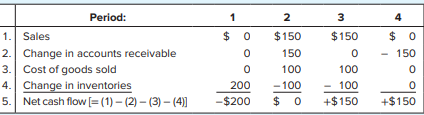
Cash outflow =
cost of goods sold + change in inventories
Cash inflow =
sales shown in the income statement - change in uncollected bills
cash outflow in each period =
is equal to the cost of goods sold that is shown in
the income statement + change in inventories
Consider a firm that spends $200 to produce goods in period 1. In period 2, it
sells half of those goods for $150, but it doesn’t collect payment until one period
later. In period 3, it sells the other half of the goods for $150, and it collects
payment on these sales in period 4. Calculate the profits and the cash flows for
this firm in periods 1 to 4.
y
Financial statement that shows the firm’s cash receipts and cash payments over a period of time
statement of cash flows
cash generated from ormal business activities
cash flow from operations
cash that has been invested in plant and equipment or in the acquisition of new
businesses.
cash flows from investments
cash flows such as the sale of new debt or stock
cash flows from financing activities
The three sections of the statement of cash flows are
1. Cash provided by operations
2. Cash flows from investments
3. Cash provided for (used by) financing activities
Any additions to current assets (other than cash itself) need to be (BLANK) from (BLANK) because these absorb cash but do not show up in the income statement
subtracted, net income
Any additions to current liabilities need to be (BLANK) to (BLANK) because these release cash
added, net income
interest is usually included in statement of cash flows in the
cash flow from operations
When there are discrepancies between statements to understand movements in cash, you will want to focus on the company’s
statement of cash flows
Would the following activities increase or decrease the firm’s cash balance?
a. Inventories are increased.
b. The firm reduces its accounts payable.
c. The firm issues additional common stock.
d. The firm buys new equipment
a. decrease
b. decrease
c. increase
d. decrease
Cash flow available for distribution to investors after firm pays for new investments or additions to working capital
free cash flow (FCF)
Free cash flow =
interest payments to debt investors + shareholders’ operating cash flow - capital expenditures
Security analysts forecast
earnings per share
U.S. accounting rules, GAAP, are spelled out by the
Financial Accounting Standards Board (FASB)
Companies that investors worry about the fact that seem particularly prone to inflate their earnings by playing fast and loose with accounting practice are referred to as having
low quality earnings
Some examples of ambiguities in accounting rules that have been used by companies to conceal unflattering information:
1. Revenue recognition
2. Cookie-jar reserves
3. Off-balance sheet assets and liabilities
When you tell your cusomters that the price of your product may rise in the new year and suggest that they place an extra order. This increases this year’s sales at the expense of next year’s sales. This practice is known as
channel stuffing
Many companies have been thought to use channel stuffing to overstate their
earnings, but very blatant instances are liable to attract the
SEC
refer to an accounting practice where companies create artificial reserves during profitable periods to offset potential losses or smooth out earnings in less profitable periods
Cookie-jar reserves
When Enron created and placed paper firms—so-called special-purpose entities (SPEs)—in the middle of its transactions to exclude liabilities from its financial statements.
off-balance sheet assets and liabilities
The International Financial Reporting Standards (IFRS), are set by the London-based
International Accounting Standards Board (IASB)
For some years, the SEC has worked to bring U.S. accounting standards more in line with
international rules
IFRS tend to be “(BLANK),” By contrast, in the United States, GAAP are accompanied by thousands of pages of prescriptive regulatory guidance and interpretations from auditors and accounting groups.
principles-based
In response to these scandals, Congress passed the (BLANK), widely known as SOX.
Sarbanes-Oxley Act
SOX created the (BLANK) to oversee the auditing of public companies; it banned accounting firms from offering (BLANK) to companies whose accounts they audit; it prohibited any individual from heading a firm’s (BLANK) for more than (BLANK) years; and it required that the board’s audit committee consist of directors who are (BLANK). Sarbanes–Oxley also required that (BLANK) certify that the financial statements present a fair view of the firm’s financial position and demonstrate that the firm has adequate controls and procedures for financial reporting.
PCAOB, other services, audit, five, independent of the company’s management, management
Managers and investors worry that the costs of SOX and the burden of meeting detailed, inflexible regulations are pushing some corporations to return from public to
private ownership
Some blame SOX and onerous regulation in the United States for the fact that an increasing number of foreign companies have chosen to list their shares (BLANK) rather than New York
overseas
The United States follows a (BLANK) approach, with detailed rules governing virtually every circumstance that possibly can be anticipated. In contrast, the European Union takes a (BLANK) approach to accounting.
rules-based, principles-based
Europe and the United States have been engaged for years in attempts to (BLANK) their systems, and many in the United States have lobbied for the greater simplicity that principles-based accounting standards might offer. These efforts in recent years have effectively (BLANK)
coordinate, stalled
passed in December 2017, reduced the corporate tax rate
The U.S. Tax Cuts and Jobs Act
When firms calculate taxable income, they are allowed to deduct (BLANK). These (BLANK) include an allowance for (BLANK)
expenses, expenses, depreciation
The company is also allowed to deduct (BLANK) paid to debtholders when calculating its taxable income, but (BLANK) paid to shareholders are not deductible
interest, dividends
Dividends are paid out of
after-tax income
Interest payments (BLANK) corporate taxes
reduce
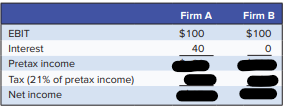
Calculate
Pretax income: $60, $100
Tax: $12.6, $21
Net income: $47.4, $79
The bad news about taxes is that each extra dollar of (BLANK) increases taxable income by $1 and results in 21 cents of extra taxes. The good news is that each extra dollar of (BLANK) reduces taxable income by $1 and therefore reduces taxes by 21 cents
revenue, expense
Most states also impose
corporate taxes
Companies are not obliged to show 100% depreciation in their income statement. Instead they usually write off a (BLANK) of the investment over its forecast life
constant proportion
If the company assumes a slower rate of depreciation in its income statement, the tax charge shown in the income statement will be (BLANK) in the (BLANK) years of an asset’s life than the actual tax payment. This difference is recorded in the balance sheet as a (BLANK) for (BLANK).
higher, early, liability, deferred tax
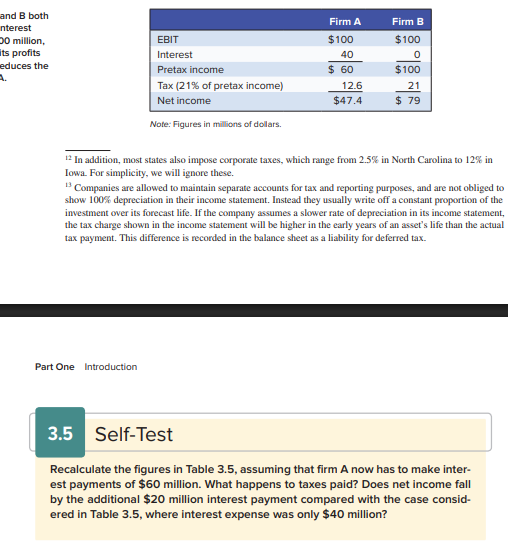
Taxes owed by firm A fall from $12.6 million (when debt was $40 million) to $8.4 million. The reduction in taxes is 21% of the extra $20 million of interest expense. Net income does not fall by the full $20 million of extra interest expense. It instead falls by interest expense less the reduction in taxes, or $20 million − $4.2 million = $15.8 million.
 Note
Note  Flashcards (127)