Operative One -- Dental Composite Material-Mechanical Properties: Vidal
 Call Kai
 Learn
Learn Practice Test
 Spaced Repetition
 Match
Match Flashcards
 Knowt Play
1/39

There's no tags or description
Looks like no tags are added yet.
Name | Mastery | Learn | Test | Matching | Spaced | Call with Kai |
|---|
No analytics yet
Send a link to your students to track their progress
40 Terms
Force is generated through
one body acting on another
Force will result in
translation or deformation: it depends on whether the body is constrained and rigid or deformable
3 characteristics of force
Point of application
Magnitude
Direction of application
Force is measured in units of
Newtons (N)
Occlusal forces:
Different teeth, restored (dentures) vs intact, gender, age, ect
When designing restorations and selecting materials consider
location, opposing dentition, and force-generating capacity of the patient
When force acts on a constrained body
the force is resisted by the body
Stress is the
internal reaction of a material to an external load/force
Both the applied force and the stress are distributed over
an area of the body
Stress = force/area
Resistance is dependent on
the surface area which the load was delivered
The area is more important than the
force
Unit of stress is
Pascal (Pa)
megapascal is often used in dentistry (MPa)
In dentistry: Occlusal forces applied over small areas (cusp tips) can produce
very high stresses
Explain why premature contacts are damaging
Small area supporting large occlusal forces
To reduce local stresses
1. Multiple simultaneous contacts
2. Occlusal forces distributed over larger surface areas
Strain is
deformation a body undergoes when a stress acts upon it
Strain is measured as a
net change in length of a material following the application of a load
Deformation depends on
the type of stress
Strain is often reported as
a percentage
Stain is an important consideration in
ortho wires
implant screws
Impression materials
Types of stress
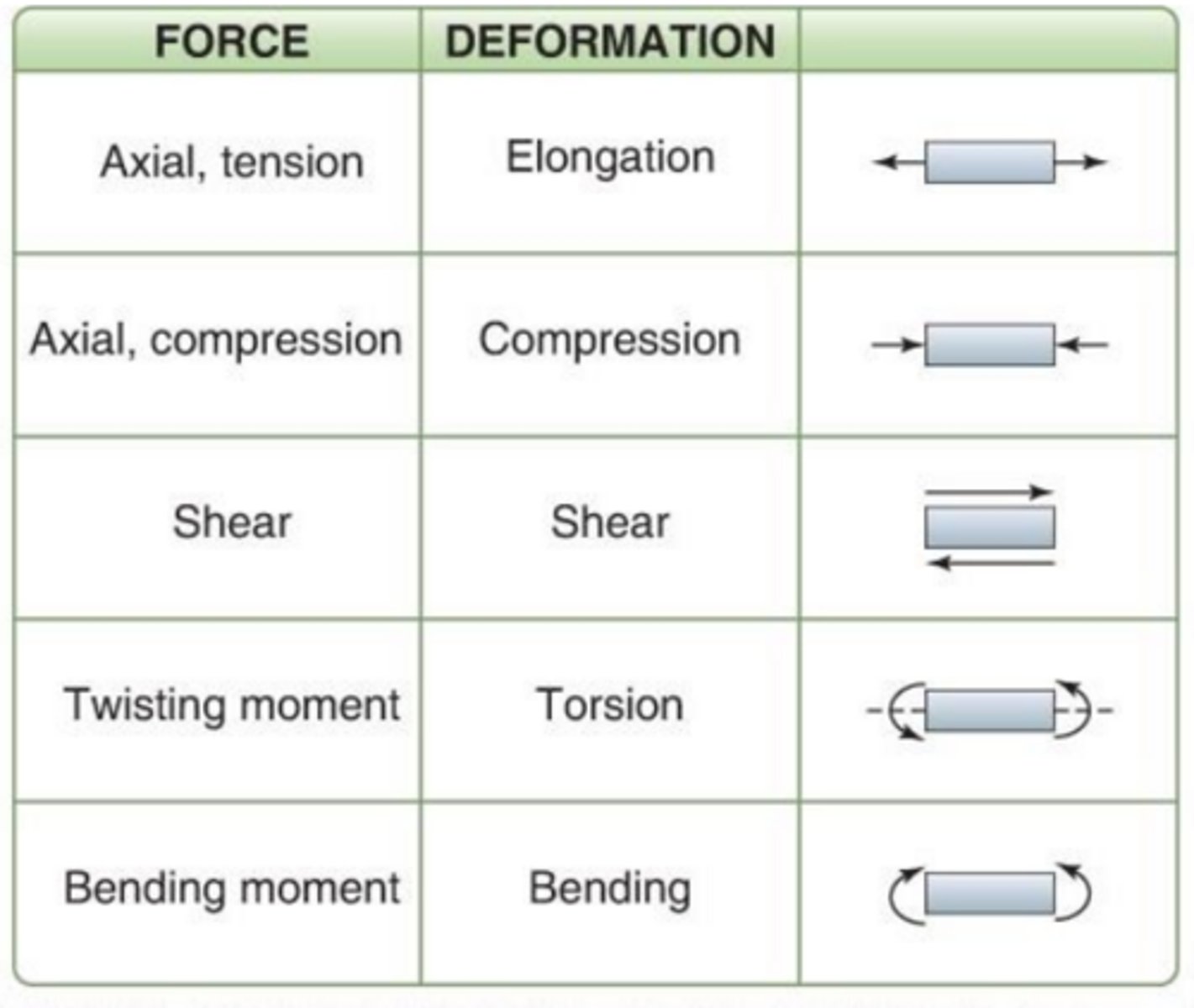
Several forces can combine to develop
complex stresses in a structure
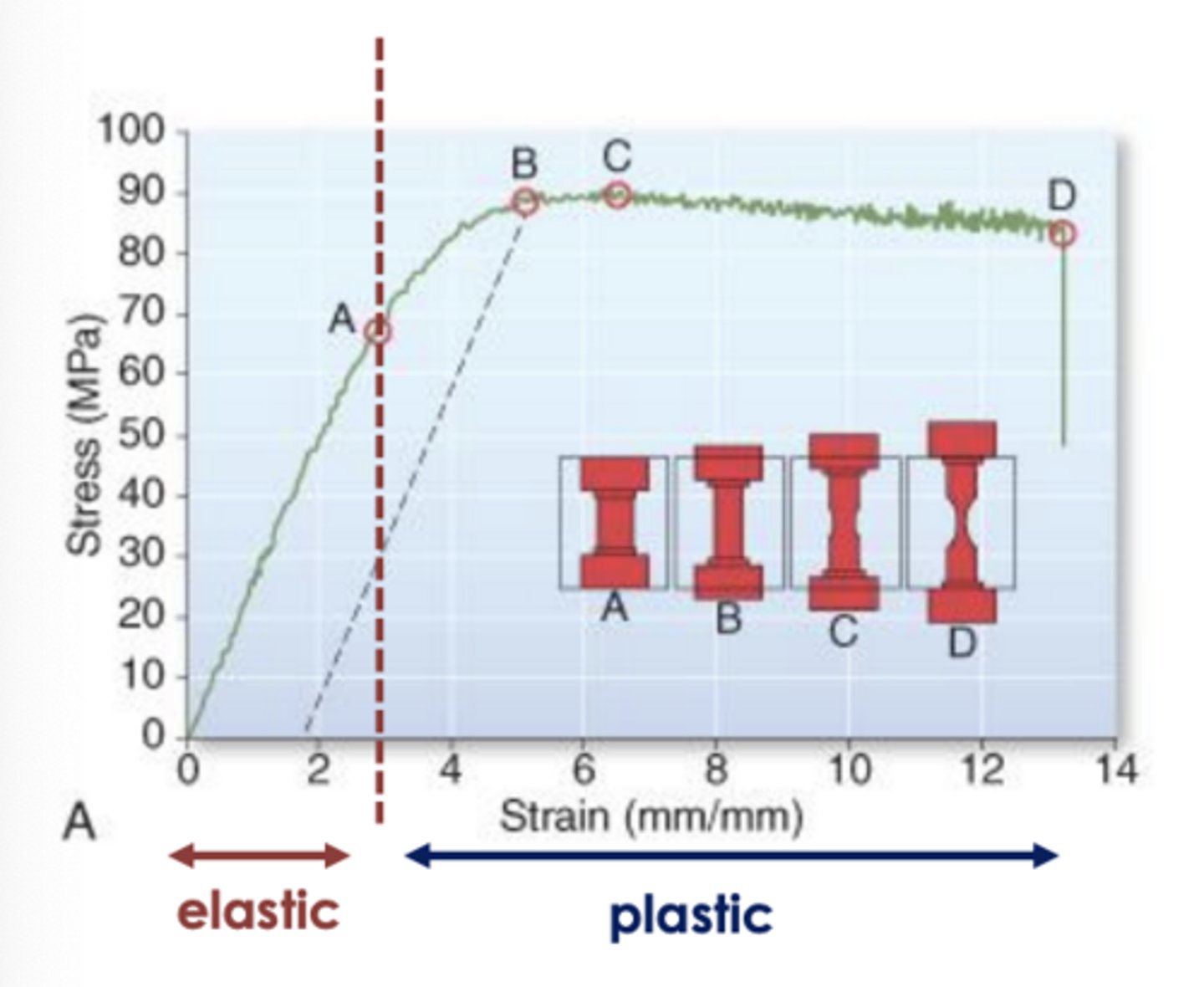
Stress-Strain curve
0-A = stress is linearly proportional to the strain (elastic deformation)
A = Proportional limit, beyond this point deformation is permanent (plastic deformation)
B = yield strength - point at which a small defined amount of permanent strain has occurred
C = Ultimate (tensile) strength
D = Fracture strength
Modulus of elasticity
Ability to sustain deformation without permanent change in size or shape
Toughness
resistance of a material to fracture
Fracture toughness
ability to plastically deform without fracture, calculated as the area under the elastic and plastic portions of the stress strain curve
Material's ability to resist to the propagation of a crack
Brittle materials tend to have
low toughness, little deformation (plastic) before failure
Higher fracture toughness indicates
lower rate of bulk fracture, marginal degradation and surface wear
Wear
Loss of material resulting from removal and relocation of materials through the contact of two or more materials
Resin composite wear results from a combination of
chemical damage to the surface of the material and mechanical breakdown
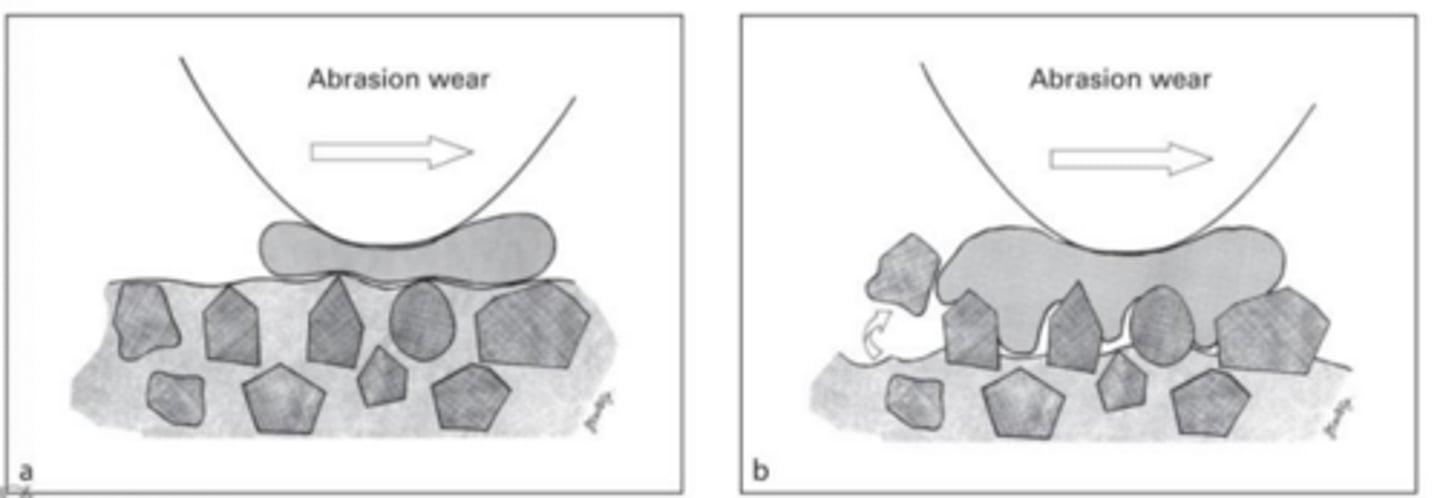
Abrasive action of particles during mastication (IMAGE)
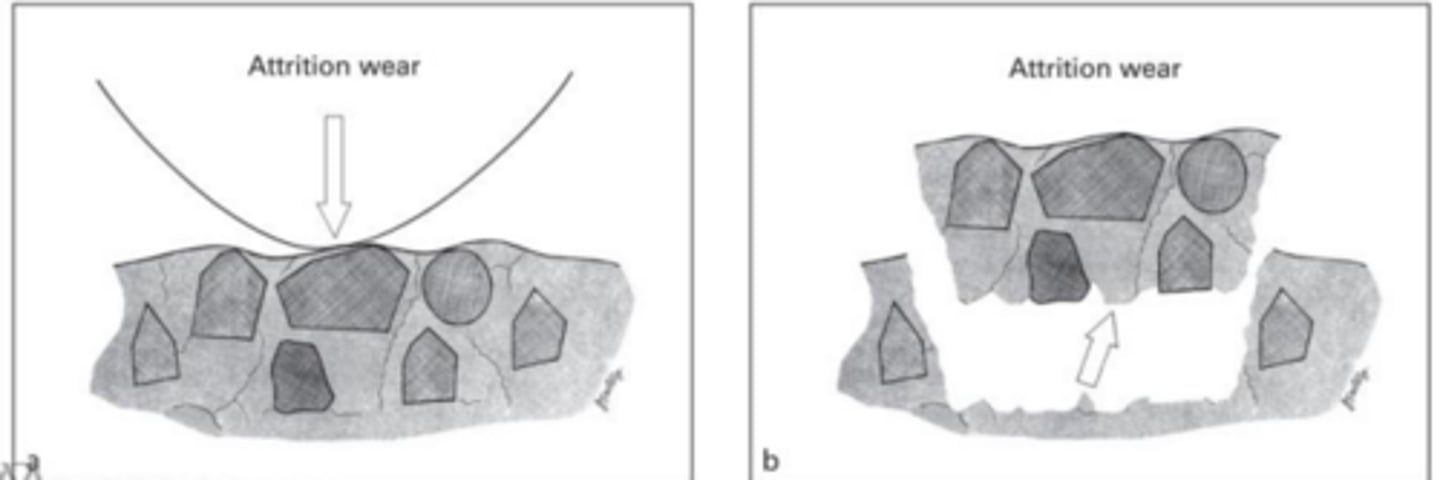
Attrition is related to
loss of material as result of direct contact with opposing tooth surfacs
Physical properties
Working and setting times
Polymerization shinkage/stess
radiopacity
Water sorption and solubility
Color stability
Thermal properties
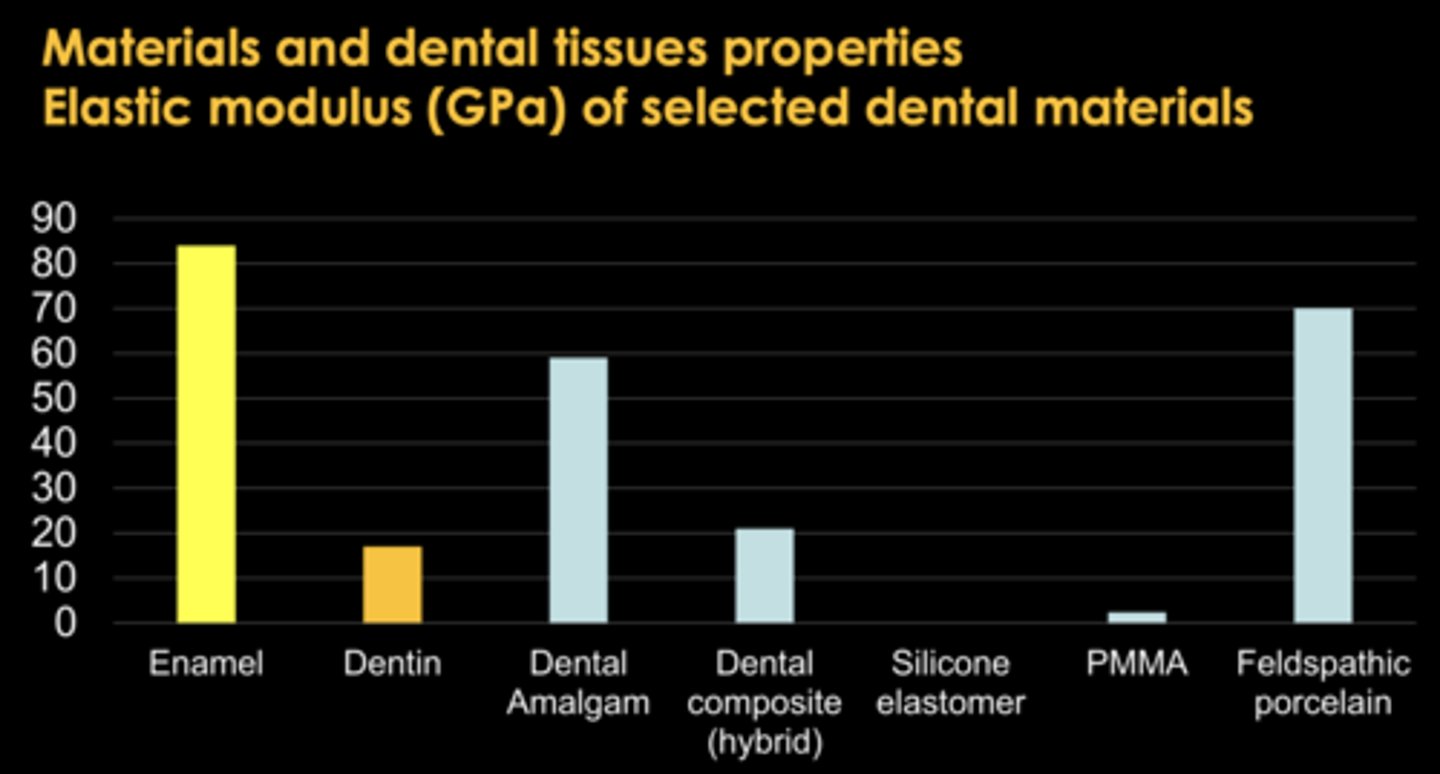
Material and dental tissues properties Elastic modulus (GPa) of selected dental materials
IMAGE
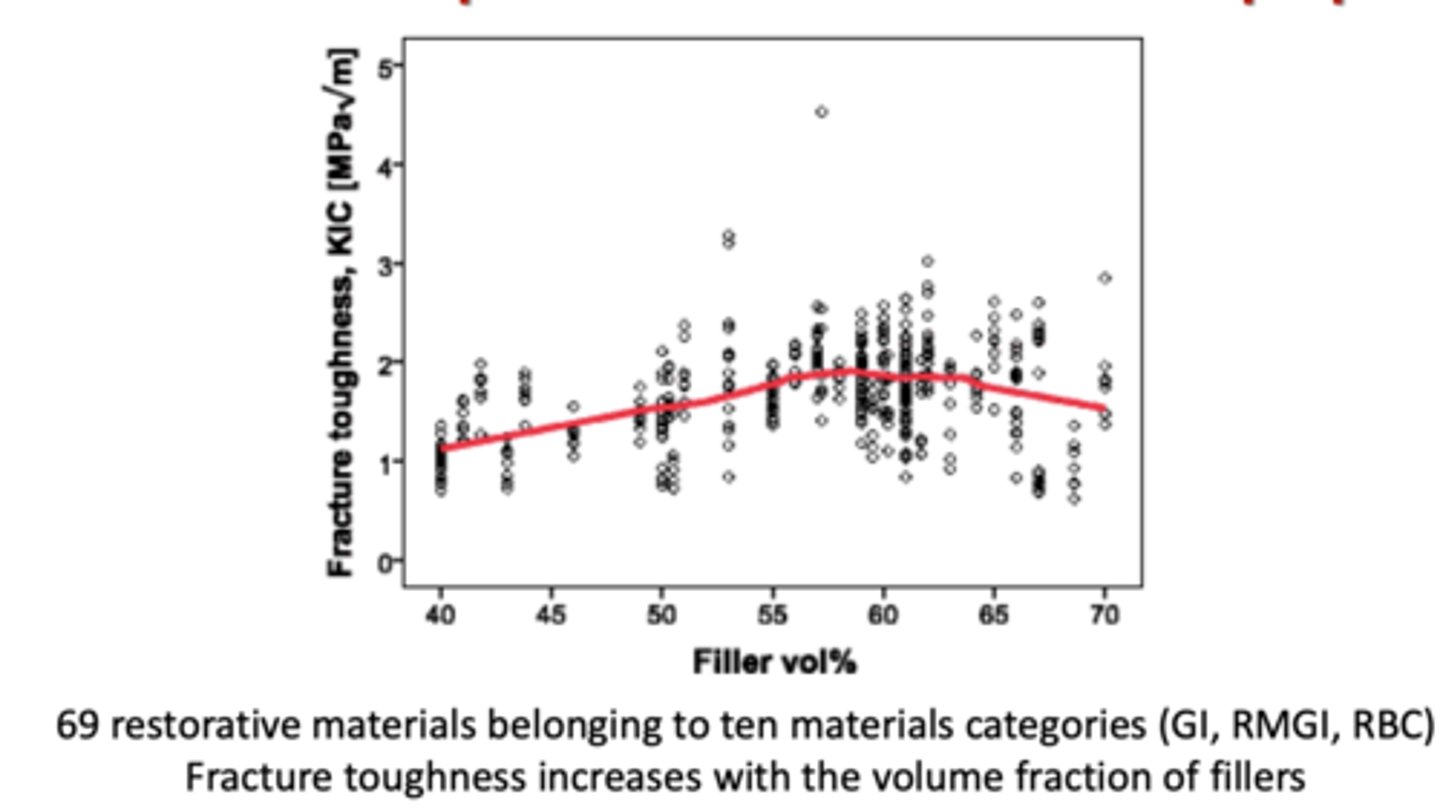
How does RBC composition affect its mechanical properties (IMAGE)
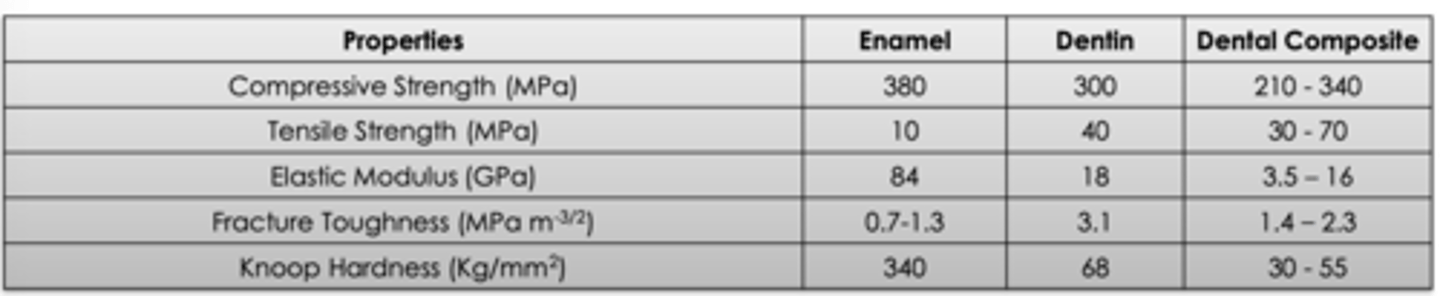
Mechanical properties of restorative materials and dental hard tissues (IMAGE)
Polymerization shrinkage and stress:
De-bonding - Marginal gaps (microleakage)
Cusp deflection (post-op sensitivity) or fracture
Recurrent caries
Incomplete polymerization:
Presence of residual monomers (low degree of conversion)
Poor mechanical properties
Release of monomers and other components that can reach the pulp and cause pulp inflammation
SUMMARY: Optimizing material performance
Understanding the mechanical properties of dental composites helps in selecting materials that can withstand occlusal forces, reducing the risk of fractures and ensuring long-term durability in restorative dentistry
SUMMARY: Enhancing Clinical Outcomes
Knowledge of properties such as flexural strength, wear resistance and polymerization shrinkage allows clinicians to tailor composite selection and placement techniques, improving the success of restorations and patient satisfaction
Explore top notes

