Globalisation
 Call Kai
 Learn
Learn Practice Test
 Spaced Repetition
 Match
Match Flashcards
 Knowt Play
1/20

There's no tags or description
Looks like no tags are added yet.
Name | Mastery | Learn | Test | Matching | Spaced | Call with Kai |
|---|
No analytics yet
Send a link to your students to track their progress
21 Terms
What is Globalisation?
The growing interdependence of the world’s economies, cultures and populations, brought about by cross-border trade in goods and services, technology , as well as flows of investment, people and information
What is a Global Market
A market which involves buying and selling goods and services in all (or virtually all) countries around theworld. It can also refer to the number of people, in various countries, who might want to buy a business’s goods/services.
If a business operates in a global market it means that its products and operations have extensive reach across the globe. This process shows no sign of slowing down and 0many businesses and consumers are behaving as if there is just one ‘market’ (global market)
What is a Developing Market
Also known an emerging economy/market refers to a country with a growing economy and a growing consumption population.These markets are expected to continue to develop at a relatively fast pace, especially because the growing population means more people entering labour force.
They are characterised by substantial investment in productive capacity, which moves them away from traditional economies, such as agriculture and the export of raw materials.
Developing markets have a high potential for future growth
e.g: China,India and Brazil
What factors have contributed to Globalisation
Deregulation of markets
Political Changes
Removal of barriers to trade
Lowering of transportation costs
Improved communication systems
Factors Contributing to Globalisation: Communication Technologies
Use of internet, e-commerce and and mobile technology had made it quicker and easier to communicate
Advances in tech have revolutionised communications, making it clear to communicate globally and lowering cost of communication e.g teleconference, Skype, Zoom, MS Teams v Face to face meetings.
Factors Contributing to Globalisation:Liberalisation of Trade
The World Trade Organisation (WTO) has assisted in the reduction/removal of trade barriers and there has been a greater proliferation of trade agreements across the world.
This has lead to reduced tariffs and protectionism. Whilst some protectionist measures remain in place, a large number of countries with significant global economic influence have lowered protectionist measures.
Increased freedom of good and services increased export opportunities and therefore has a significant effect on economic welfare. This has led to a greater dependency on trade as a proportion of GDP.
Factors Contributing to Globalisation: Cost of Transportation
This has made the movement of good an serviced across the globe more efficient
Improved transportation services such as shipping and airlines have made this possible
Improved infrastructure e.g (roads and internet has also made globalisation earlier)
Factors contributing to Globalization: Consumer Tastes
Demand for a wider range of good and services partly as a result of more multicultural society and also greater exposure to world travel
Positive effects of Globalization on the Business
Further growth can be achieved – larger target market which increases sales and market share and can lead to enhanced brand image, reputation and increased competitiveness
Market economies can occur - Selling to many countries increases the scale of production, average costs fall making them more competitive.
Reduced seasonality – UK summer period is short but swimwear etc can be sold to countries that experience summer in Oct-Feb e.g. Australia
Greater spread of risk - The impact of the decline stage of the business cycle/economy in one market can be lessened by continued trade in other markets.
Easier access to materials, technologies and expertise
New markets bring new sales opportunities - By selling in new markets, sales can increase quickly, this is especially important when the market is saturated.
Opportunities of partnerships with overseas businesses – Which can improve the service they offer to customers.
Businesses can reduce costs and increase profits -By producing in low-cost countries.
Negative effects of Globalization on the Business
UK businesses have increased competition
Exchange rates will impact sales
UK labour costs higher
Risk of becoming unethical /potential damage to brand
Language and cultural differences
Diseconomies of scale
Intellectual property Risk of dilution or taking eye off core business
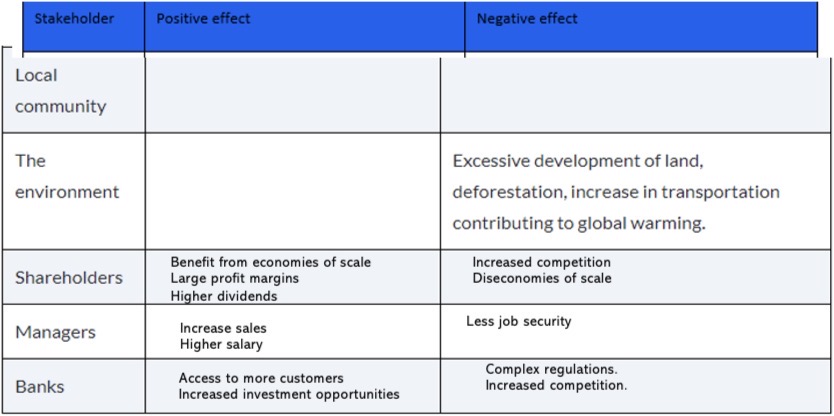
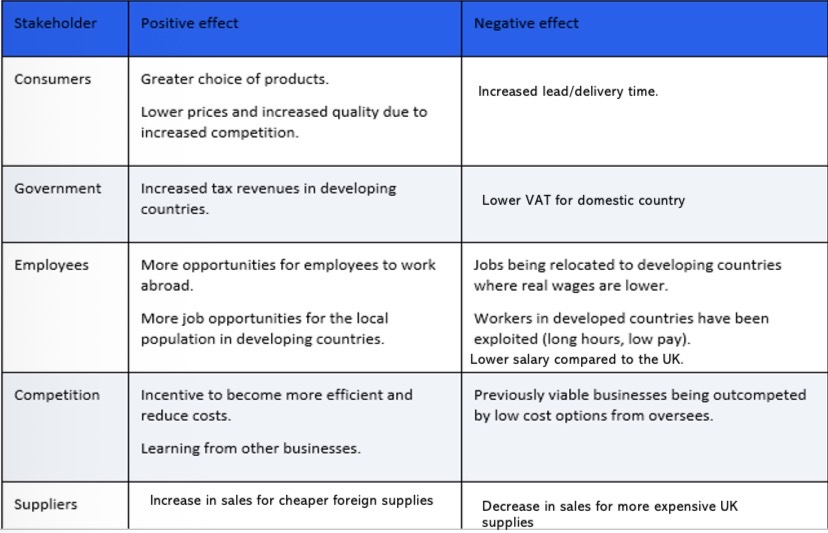
Positive and negative effects of globalisation on different stakeholder groups
What is Glocalisation
Businesses that engage in a global market strategy do not differentiate elements of their marketing mix to meet the needs of local customers. This contrasts with businesses that do adapt their business in order to reflect the needs of the local customers.
A global localisation approach, or ‘glocalisation’, is one that considers local tastes, customs and traditions. By considering the preferences of consumers in different markets across the world, businesses have enhanced their success.
Mc Donald’s Glocalisation
Maintaining and promoting the global brand name is still vitally important in this approach. McDonald's menu, of course, keeps its core elements everywhere in the world but there are local variations.
For example:
Japan - Chicken Katsu Burger, a breaded chicken sandwich flavoured with soy sauce and ginger.
Germany - ‘McCurrywurst’, a hot sausage with tangy curry tomato sauce.
China - McWings
McArabie – Grilled Kofta Royal Arabian Flavour
India – McCurry pan, Crispy Chinese, Pizza McPuff, Paneer Salsa wrap
Fast Food Chain Glocalisation
Most global fast food chains have adopted such a strategy.
Their branded logos are instantly recognisable on high streets all over the world; however, their menus will vary considerably, depending the local tastes and preferences of their customers. Such a market-oriented approach enhances sales turnover.
Global businesses today must be constantly aware of changing consumer tastes; failure to invest in market research in foreign markets will result in a lack of competitiveness.
Global Growth Strategies
1) Glocalisation
2) Global Branding
3) External growth- Merging with or, acquiring a business in another country
4) Identifying target markets
Global Branding
Businesses that have established a strong brand identity in their domestic market are sometimes able to introduce their product or service into other countries based on the recognition of their brand in other parts the world.
McDonald’s have used this strategy to introduce their products to virtually every country across the globe. The brand identity is so strong that selling highly lucrative franchise agreements, as well as setting up their own directly managed restaurants, has resulted in unrivalled success in the fast food sector.
Global Branding Continued
Even when established as a global brand, businesses must continue to build their brand identity.
Even businesses as well-established globally as McDonald's cannot become complacent. It is an ongoing process and they must continue to invest in advertising and develop promotional campaigns in order to reinforce their brands.
Increasingly businesses are using social media campaigns to promote their brands to a truly global audience. The impact of placing adverts in strategic places on sites such as Twitter and Google cannot be underestimated. Global brand managers have adjusted their marketing strategies to take full advantage of the opportunities presented by social media.
Global Growth Strategies—External Growth
Merging with or acquiring a business in another country is the most common strategy for achieving external growth.
A merger usually involves the purchase of an entire target business. Taking over a business in this way will give immediate access to the market within that country. The business can be rebranded with the parent company’s name (for example Santander taking over the Abbey Bank), or it can retain the original name (for example Walmart taking over ASDA supermarkets in the UK).
External Growth Continued
The difficult decision to make in this situation is how much of the parent company’s working practices should be adopted by the subsidiary. Walmart, the American supermarket giant, after taking over ASDA in the UK, introduced the idea of meeting and greeting customers in store. This was a reasonable success in the UK but the same strategy, when used in their German stores, failed badly.
This type of horizontal integration requires huge amounts of direct investment and attempting to grow in this manner requires extensive research prior to going ahead. If the domestic market is saturated, and growth has been set as an objective, then investing in foreign markets is one solution. It must be remembered, however, that the risks are high.
Identifying Target Markets
The final method a business can use to achieve global growth is by targeting specific markets
A new product launch in a new market is not often targeted at the mass market, it is more likely to be aimed at specific market segments.
Kia cars, when launched in the UK, focussed on a segment that did not care about brand status, but wanted low cost motoring. Kia targeted that low-cost segment by offering low prices, extended warranties and low-cost servicing.
A product that is used in one way in one market can have a different use in another market. For example, Marmite in the UK is predominantly used as a spread to put on bread: in India it is used as a flavouring additive in cooking.
Deciding on which segment to target can be very difficult. In depth market research is required to identify specific market needs.
This can be very expensive and is no guarantee of success. However, failure to carry out market research is likely to make a high-risk strategy even riskier.
Evaluation of Global Growth
Depends on:
Finance available
Actions of competitions
Aims of the business

