Theme 3D - Market Failure
 Studied by 0 people
 Call Kai
 Learn
Learn Practice Test
 Spaced Repetition
 Match
Match Flashcards
 Knowt Play
1/20

There's no tags or description
Looks like no tags are added yet.
Name | Mastery | Learn | Test | Matching | Spaced | Call with Kai |
|---|
No analytics yet
Send a link to your students to track their progress
21 Terms
Describe direct provision
Government supplies goods directly to consumers (so they become the producer)
Ensures certainty of producing good at the socially optimal quantity since government objective is the maximise society’s welfare
Describe free provision (for positive externality)
This can be done by either directly producing the masks themselves or outsourcing to private companies, and then distributing them to all Singaporeans at no cost at community centres
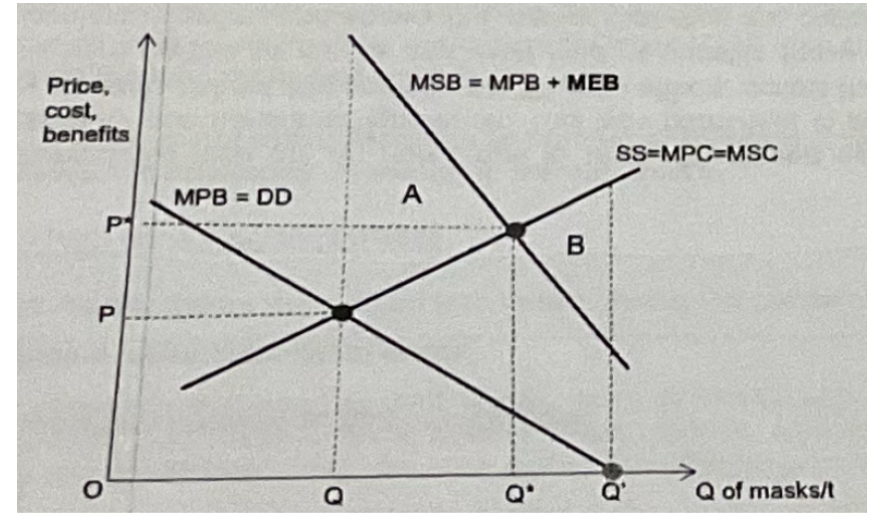
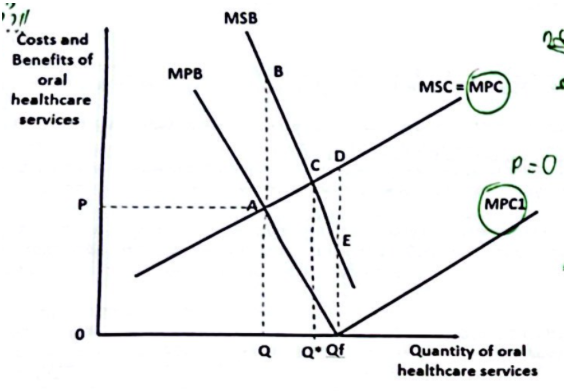
The socially optimal output level is at Q* where MSB = MSC and the market output level when masks are provided for free (P=0) will be at Q' where DD cuts P=0
As P falls from P to 0, quantity demanded for masks increases from Q to Q'
The original welfare loss is area A
With free provision, over-consumption may occur and the welfare loss when the masks are provided free is area B as MSC is greater than MSB for Q* to Q units of output
As long as Q’ is closer to socially optimal level of Q*, there will be improvement in society’s welfare
Assuming area A is larger than area B, free provision will improve allocative efficiency in the society
Explain extent of MEB
If MEB is not substantial, then free direct provision would lead to significant overproduction of renewable energy leading to increase in welfare loss. In this case…
P = 0 is demand curve
Draw graph for free provision
Describe free direct provision
As the government is not profit-oriented, it does not need to earn revenue to cover the cost of production
Direct provision of the goods and services can be financed through the taxes the government collects -> public goods can be free to consumers -> allocative efficiency achieved
The government would decide on the quantity of goods to reach society's optimal output -> produce to maximise society’s welfare
NO GRAPH
Describe impact of free direct provision
Government incur opportunity costs as government funds used for public goods could have been spent on other areas
Government lack the profit incentive to minimise cost -> productive inefficiency
Lack of perfect information may however result in the government under or overproducing the good
Describe direct provision of merit goods
Governments take over production of goods with significant positive externalities (Eg. Education and healthcare – normally produced by private sector)
Provide the good to consumers for free or at a very low price
Impact:
Governments lack incentive to minimise cost as their aim to meet the output level targets -> productive inefficiency
Compared to private firms which are profit-motivated and want to lower marginal cost
Describe joint provision
Private and public sectors produce a particular good or service together
Government provide funding and outsource production and maintenance of goods to private producers by awarding them contracts
Private producers have more efficient in minimizing costs as costs have direct effect on their profitability
This eliminates the productive inefficiency associated with direct provision
Eg. Private and public hospitals -> address the demerits of the government taking over production completely -> private sector creates competition for the government enterprise and improves productive efficiency
Describe emissions standards
Eg. Emissions standards on automobile and factories that emit polluting gases, restrictions on lead and benzene content in petrol
NOT quota (quota on emissions no diagram)
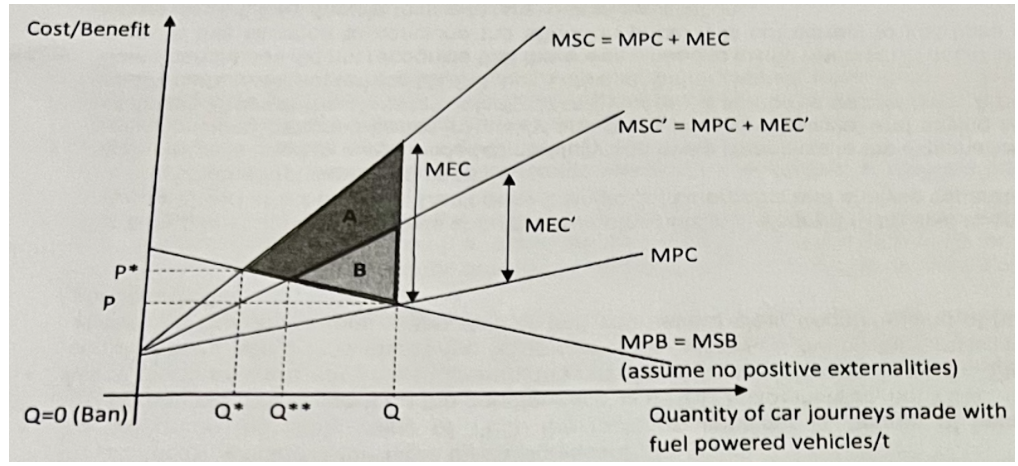
This will reduce MEC to MEC’ as less air pollutants means third parties are less likely to fall sick from breathing in air pollutants -> less healthcare costs
A smaller divergence between MSC and MPC will mean the new Q where DD=SS is closer to socially optimal level Q’
Welfare area reduced from A to B
Draw emission standards graph
Describe the other 2 laws
Laws that command the use of particular methods to reduce the negative externalities
Eg. Make compulsory the installation of catalytic converters to reduce pollution from vehicle exhaust
Limit sale / use of certain goods at certain times or at certain places
Eg. Restriction on alcohol availability based on retail sale hours
Eg. In Singapore, there are designated control zones for drinking of alcohol
Eg. In some countries, cars are only allowed on the streets on certain days to reduce congestion
Describe total ban
Bans are used when it is very difficult to use other policies to limit the amount of the externalities generated or when the damage caused is very severe
Whether this improves or worsens society’s welfare would depend on the magnitude of the MEC (higher MEC -> improvement in society’s welfare)
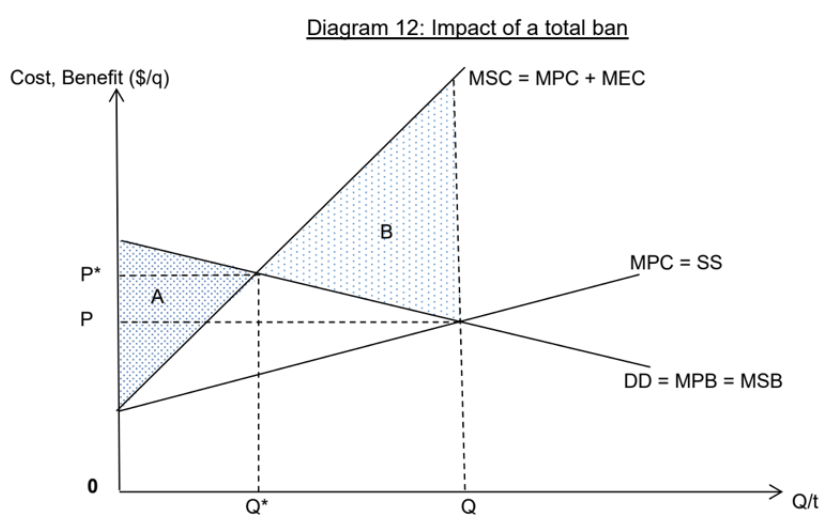
The socially optimal level of output is Q* where MSB = MSC
At output of Q*, the net total social benefit (societal welfare) = area A
Under the free market, the equilibrium output is Q where DD = SS
The negative externality causes a deadweight welfare loss to society of area B
If MEC was high such that the divergence between MPC and MSC was large, resulting in area B > area A (diagram), a total ban will improve society’s welfare, even though it does not cause output to be at the socially optimal level
Why is MEC high: Eg. Singapore is a small country with well-run public transport, hence MPB and MSB (convenience of driving) is not high. Since MEC causes profound air pollution problems, divergence between MPB and MSB is high causing MEC to be large.
If area A > area B, it will be better to leave the market alone and let it produce at Q
Describe graph of total ban
Describe quota
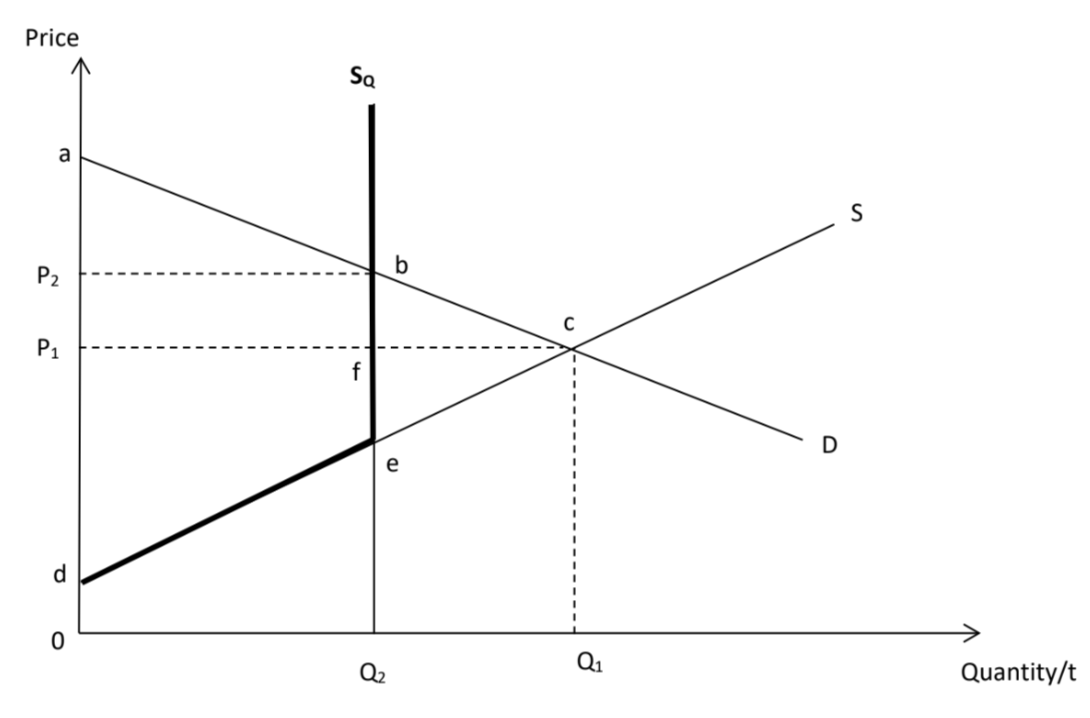
Limit the number of goods and services available for sale, usually in terms of restrictions to imports (to protect domestic producers) or exports (to ensure self-sufficiency)
Are legally established maximum quantities defined by the government.
To address positive externalities
Government issuing a fixed number of licenses to producers who will then have the right to sell the goods
Can impose laws to make consumption compulsory (Eg. Primary school) -> DD rises -> new quantity consumed rises to socially optimal level -> welfare loss eliminated
Describe law to tackle adverse selection
Laws that regulate the quality that producers have to meet or laws that force sellers to replace defective goods
Eg. In Singapore, the Consumers Association of Singapore (CASE) can use laws to prohibit fraudulent misrepresentations in the sale of defective consumer products or set minimum safety standards for consumer products
SG ‘Lemon law’ : forces sellers to replace or repair defective goods and allows buyers the right to a discount or refund if the repairs or replacements of the defective products are not possible or not provided within a reasonable time
They allow protection against goods that fail to meet standards of quality and performance.
Sellers are forced to be honest about product quality + legally obligated to repair, refund or replacement the ‘lemon’ cars that consumers unintentionally paid a higher price for -> buyers more willing to pay higher prices as there is greater assurance of product quality -> reducing the problem of adverse selection as buyers and sellers of good quality products can engage in mutually advantageous trade based on an agreeable price
Describe public education
Government provide information to educate consumers on the true marginal private benefits of consuming these goods -> reduce extent of information failure-> consumers aware of true MPB -> improve individual decision making -> willingness increase causing demand to increase
Governments carry out national campaigns to encourage health checks or discourage gambling -> showing statistics or highlighting the potential benefits/harms in the campaign messaging
GIVE EXAMPLES
They can place posters and advertisements in shopping malls or use social media to inform the public about the harm brought about by wearing fast fashion.
They can employ impactful visuals showing the cumulative effect of long-term, low-level exposure to chemicals and how it can erode their health over time, reducing their quality of life and potentially shortening their lifespan.
In many countries, cigarette packs are also labelled with health warning messages to inform smokers about the damage that smoking does to their body
Describe limitations of lemon law to correct adverse selection + eval
Consumer may be unaware of its existence -> consumers will still remain unwilling to pay prices high enough to incentivise gems to stay in the market
If the public is unaware and the government efforts to make them aware has an opportunity cost that is too high, the policy might fail to correct market failure
Unintended consequence: open to misuse where the consumers might buy an item just to use it for a short time before demanding a refund (exploit)
Evaluation: Strong Rule of Law
Mere passing of such a law is likely to cause producers to refrain from misleading consumers as they know that they might be found liable to conduct a refund or repair if they knowingly mis-sold a product.
Describe healthcare public education examples
Examples |
|
Give explanation for healthcare public education
Consumers aware of true MPB -> perceived MPB increase closer to true MPB -> increases the consumers’ willingness and DD increases -> In the event that such public campaigns are perfectly successful in closing the information gap…
Give healthcare public education evaluation
Measures may not be effective if households do not follow up with medical treatments and change their lifestyle after the service
SG characteristic: stressful working culture -> no time to exercise / find medical treatment
Aging population: investment into healthcare screenings should be placed on high priority -> government intervention likely to result in a more efficient outcome
Draw other free provision graph (100% subsidy)
MPC will fall and shift to MPC1 where it coincides with the MPB at P = 0
Where P = 0, output will increase from Q to Qf
New overconsumption
Assuming Qf closer to Q* than Q, new welfare loss less than original
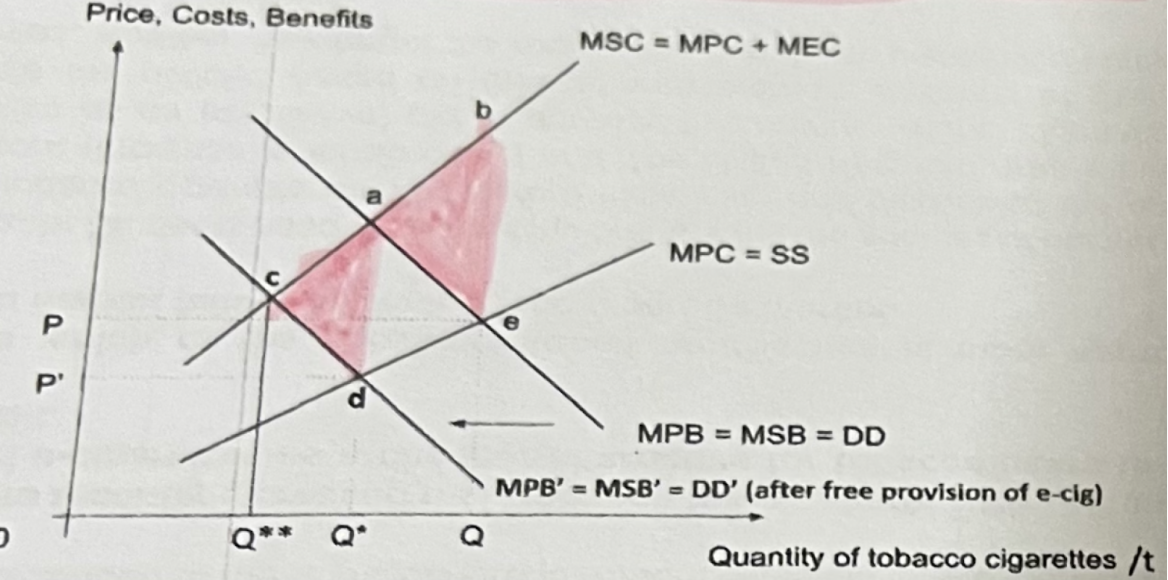
Free provision e-cigarettes address market failure of cigarettes) NOTE: negative externality (give graph and explanation)
Fall in price of e-cigarettes to 0 will cause smokers to switch over to consuming e-cigarettes instead as they are substitutes (XED > 0, from Table 1)
Cause demand for cigarettes to fall from DD to DD’ causing fall in consumption for tobacco
However, the new demand = MPB = MSC results in new socially optimal level of Q** where MSB’ = MSC
Hence, welfare loss is reduced from abe to adc, increasing allocative efficiency but not completely eliminating welfare loss
 Note
Note  Flashcards (28)