Nervous System Functions, Structures, and Key Concepts for Biology
 Call Kai
 Learn
Learn Practice Test
 Spaced Repetition
 Match
Match Flashcards
 Knowt Play
1/130

There's no tags or description
Looks like no tags are added yet.
Name | Mastery | Learn | Test | Matching | Spaced | Call with Kai |
|---|
No analytics yet
Send a link to your students to track their progress
131 Terms
What are the main functions of the nervous system?
Sensory input, integration, control of muscles and glands, mental activity, and homeostasis.
Sensory Input
sensory receptors respond to stimuli
Integration
brain and spinal cord process stimuli
Mental activity
brain
What are the two main divisions of the nervous system?
Central Nervous System (CNS) and Peripheral Nervous System (PNS).
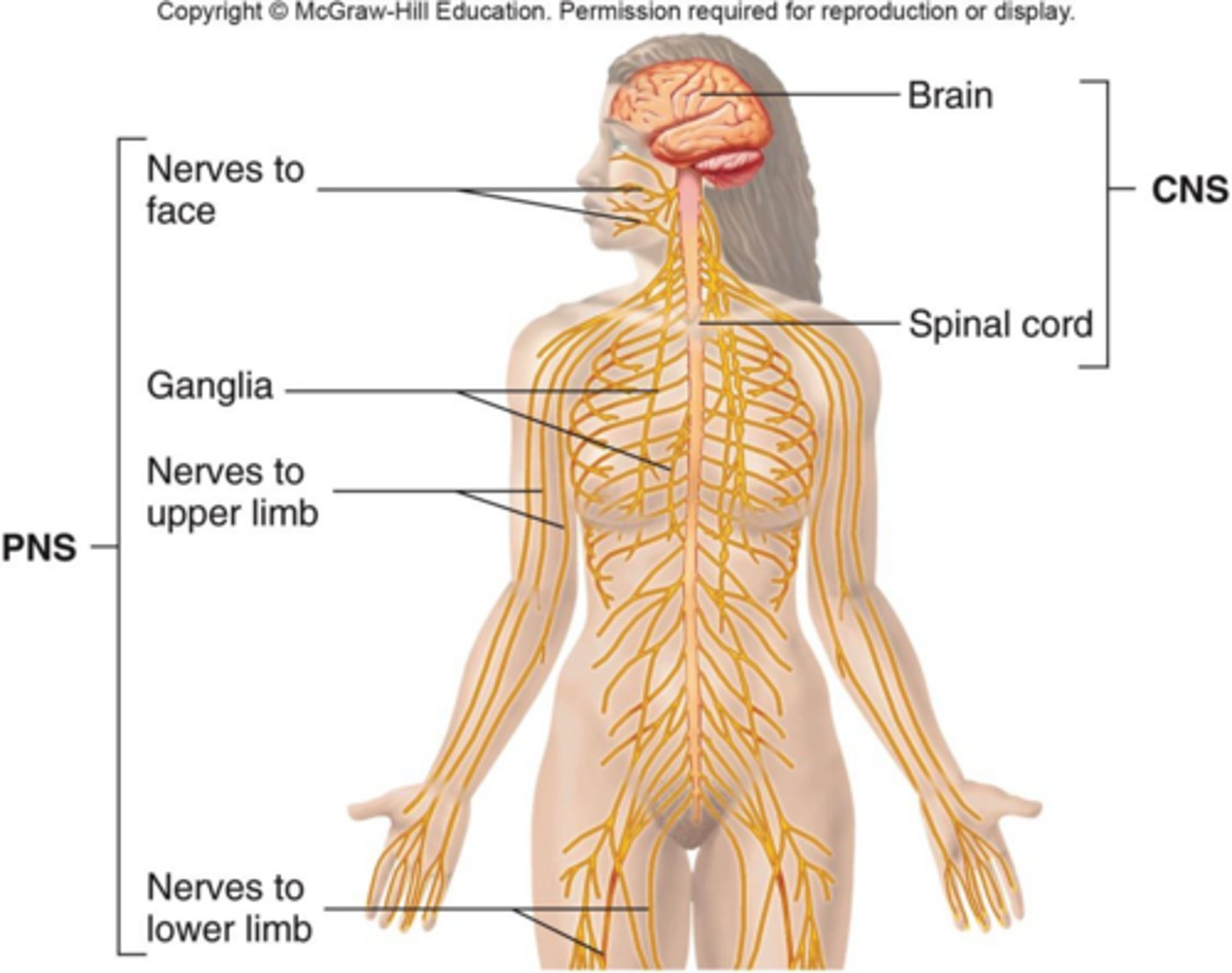
What does the Central Nervous System (CNS) consist of?
The brain and spinal cord.
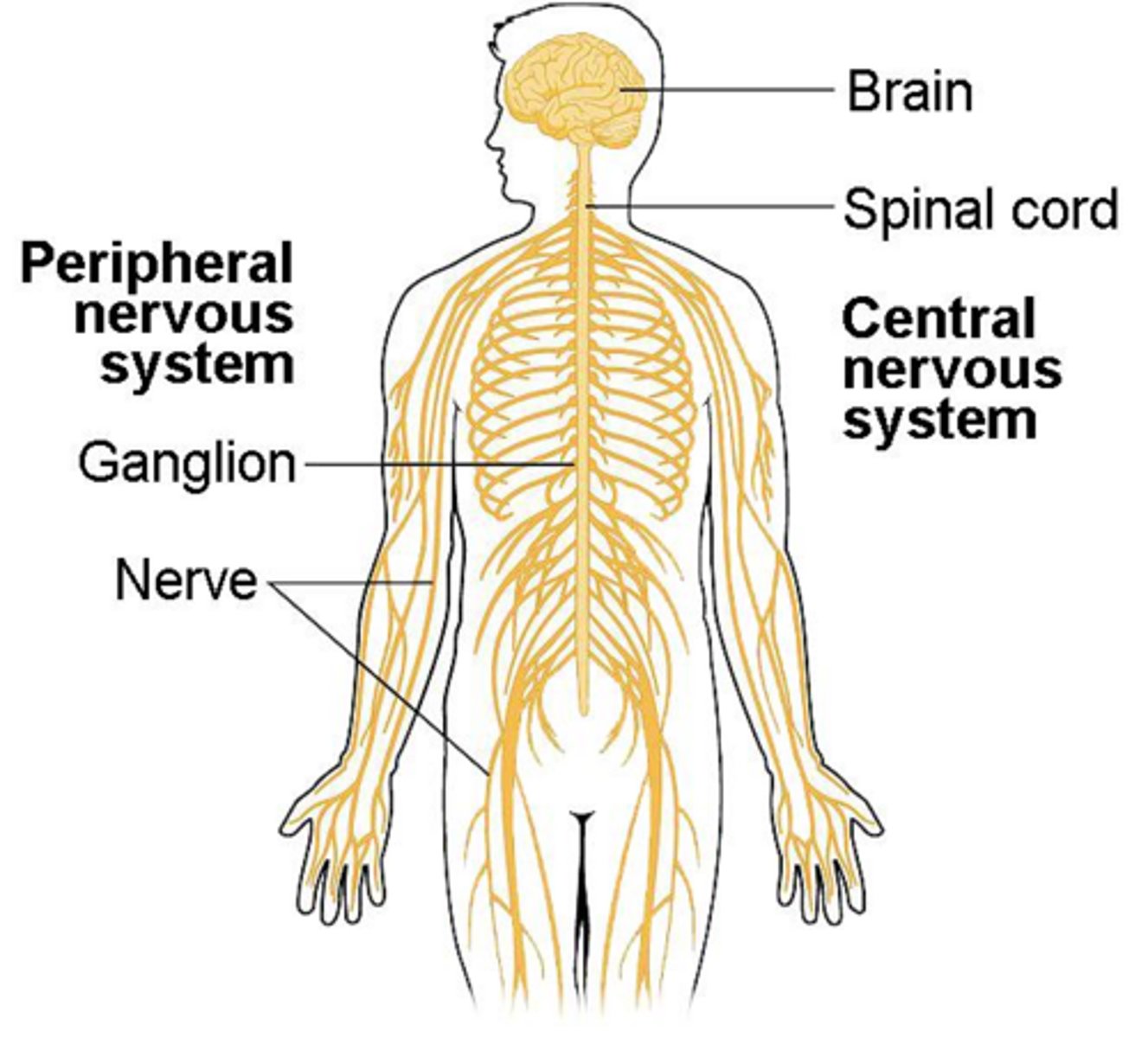
What does the peripheral nervous system (PNS) consist of?
all neurons outside CNS
What is the role of sensory receptors?
They respond to stimuli and provide sensory input.
What is the function of neurons?
To receive input, process it, and produce a response.
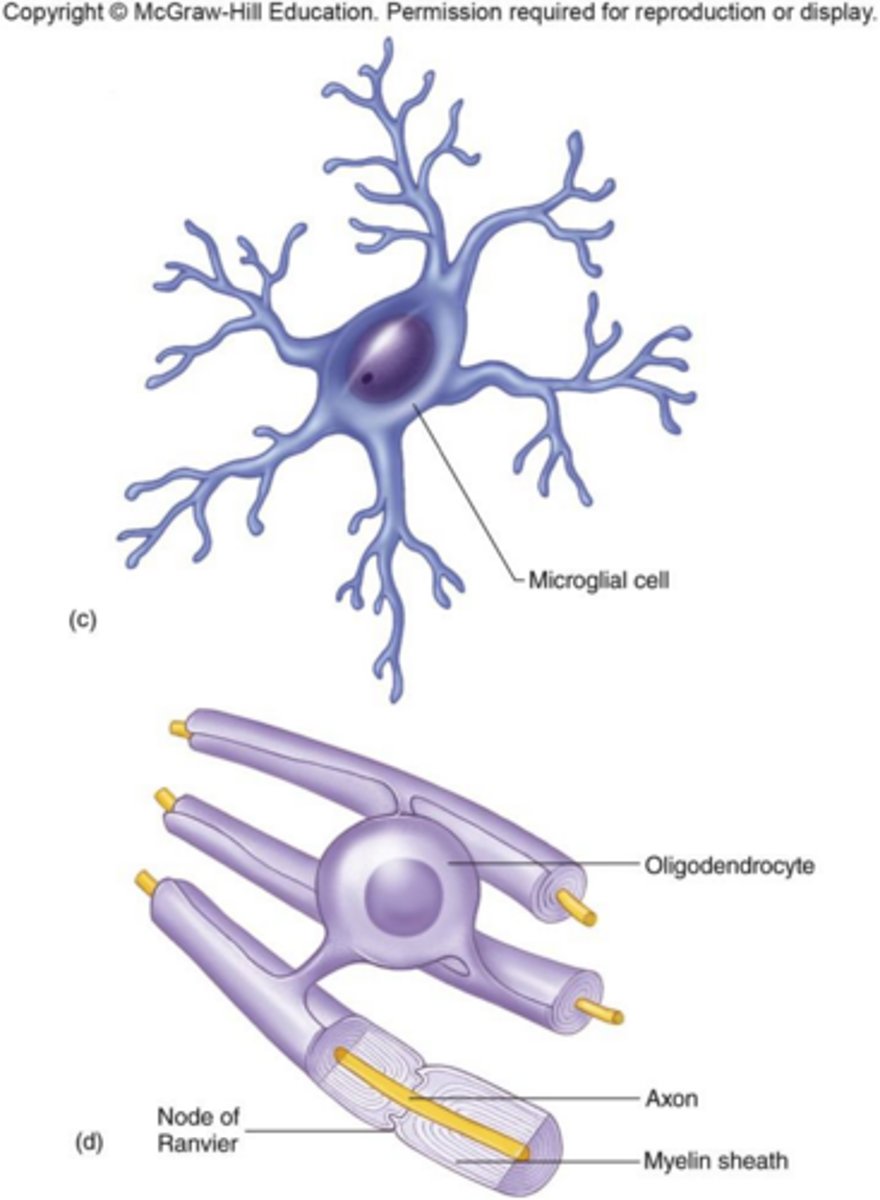
What is the myelin sheath?
A fatty, protective wrapping around axons that acts as an insulator.
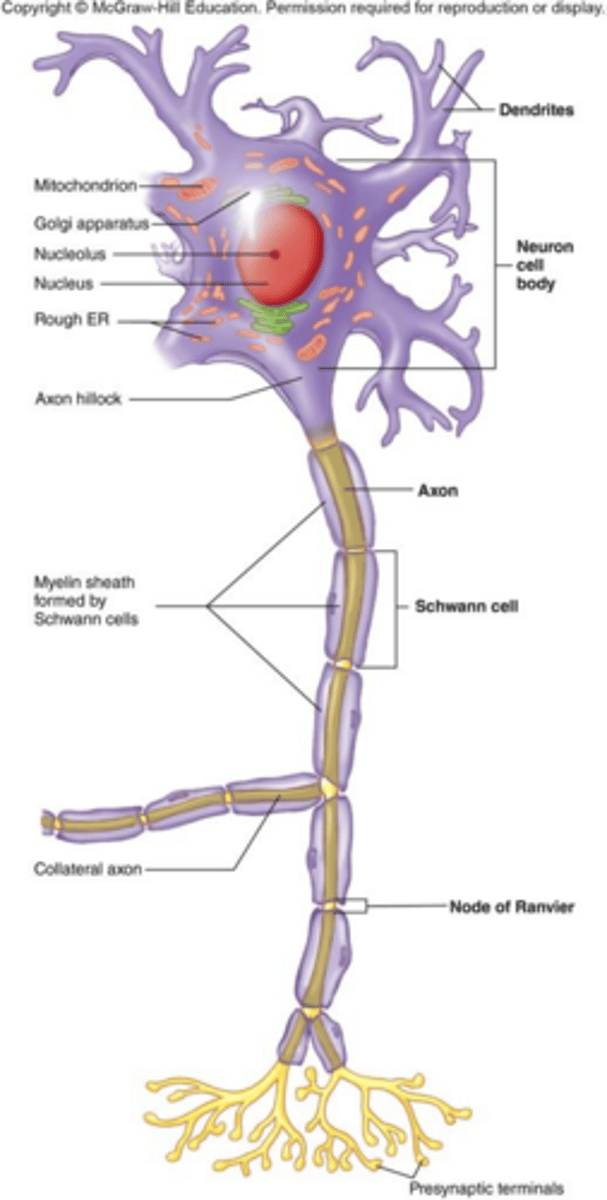
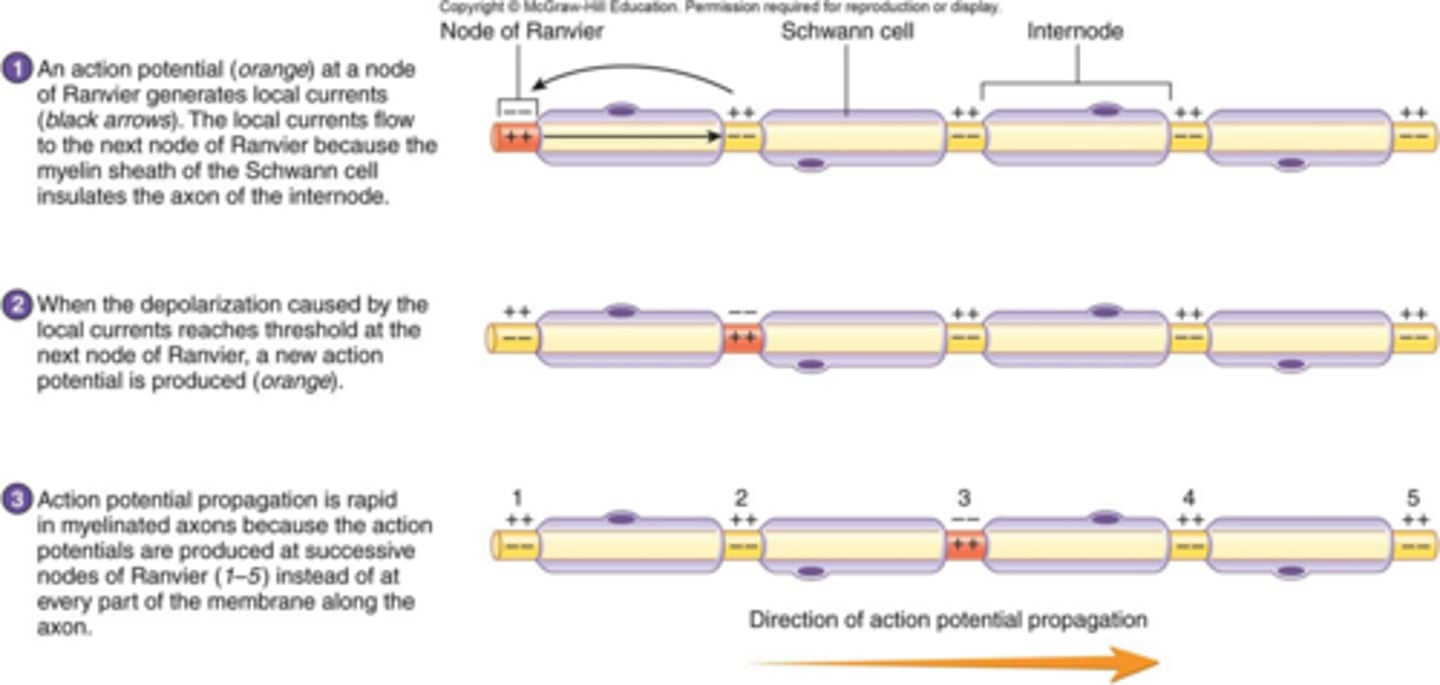
What are Nodes of Ranvier?
Gaps in the myelin sheath where action potentials develop.
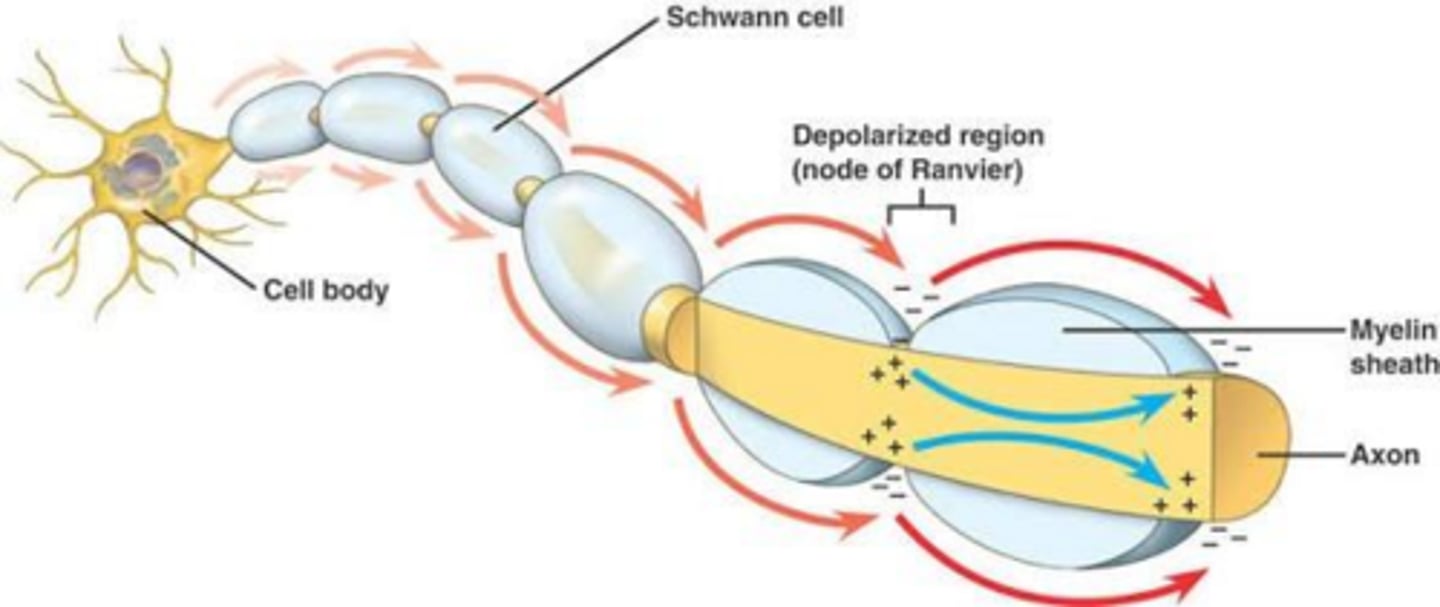
What is saltatory conduction?
The jumping of action potentials along myelinated axons, allowing faster conduction.
What disease affects the myelin sheath?
Multiple sclerosis.
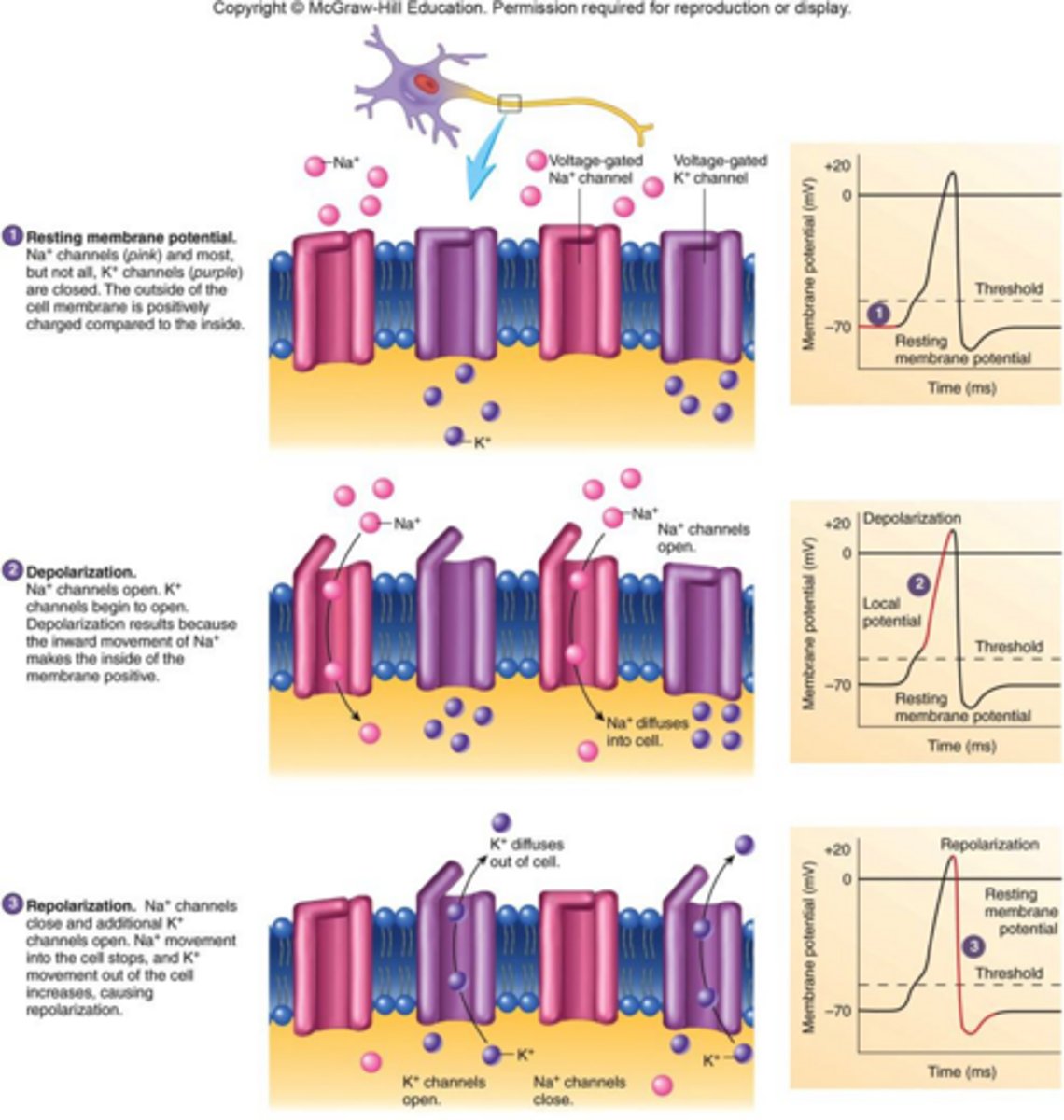
What is an action potential?
An electrical signal that causes depolarization and repolarization in neurons.
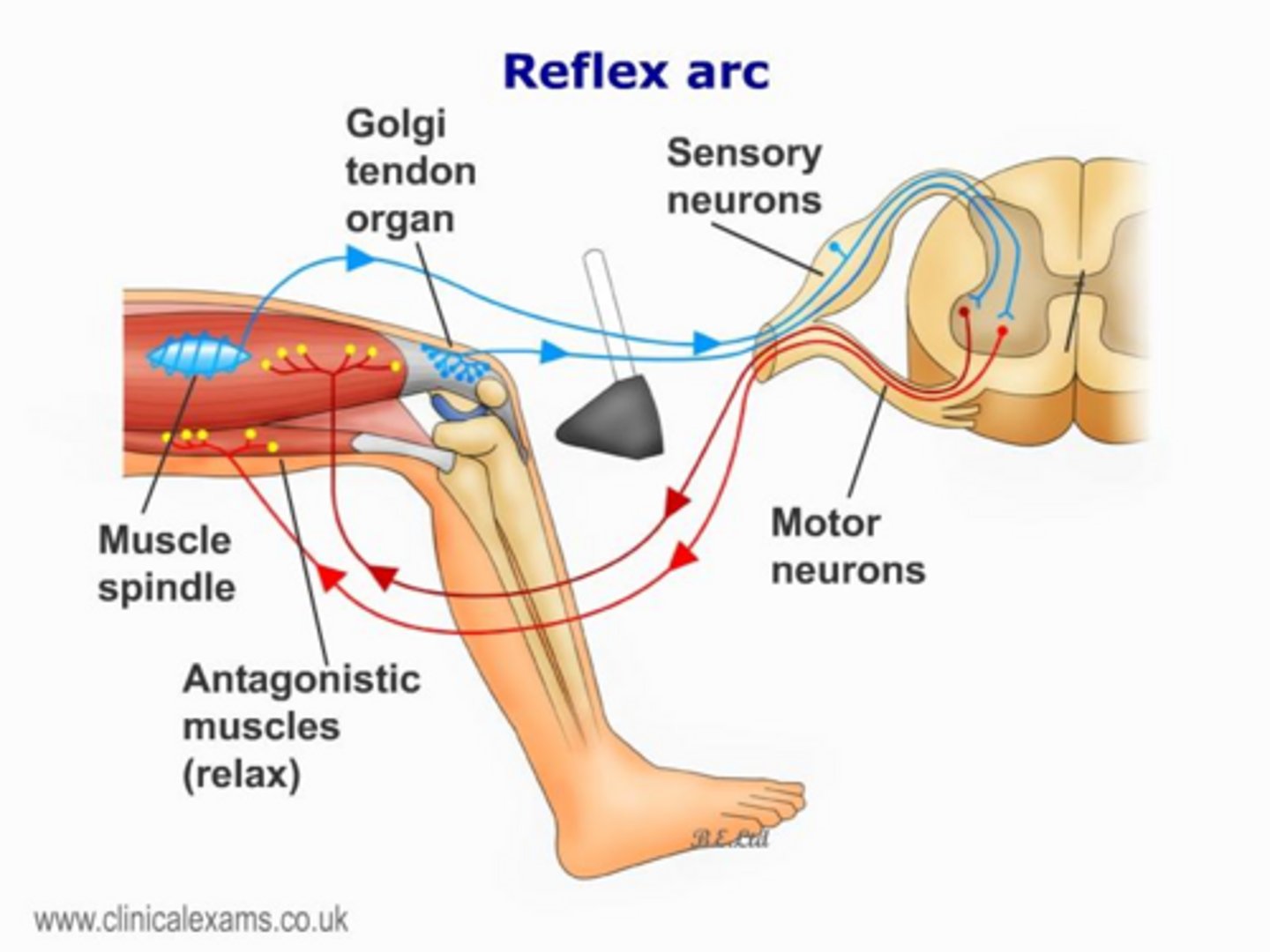
What are the components of a reflex arc?
Sensory receptors, sensory neurons, interneurons, motor neurons, and effectors.
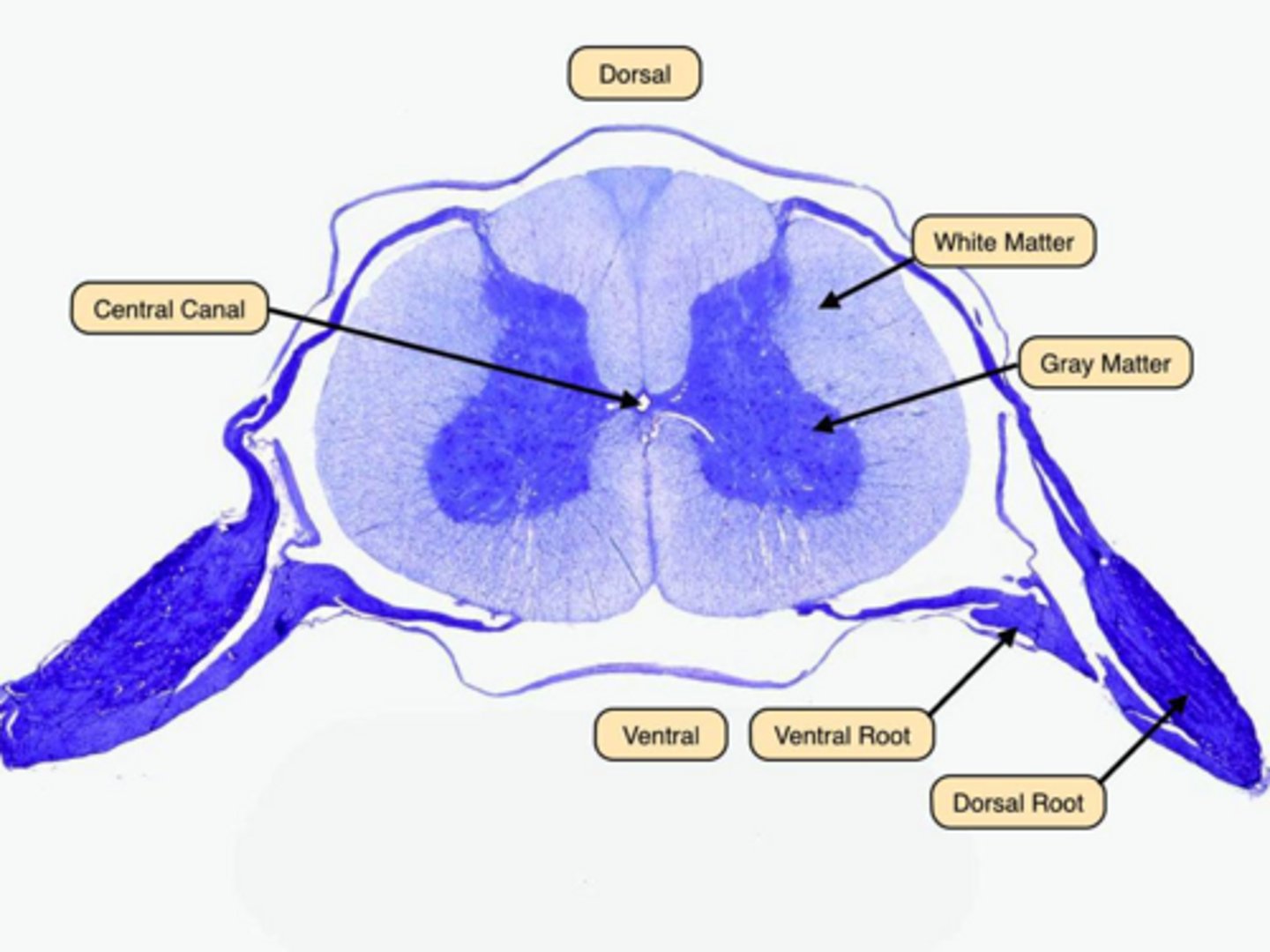
What is the difference between gray matter and white matter?
Gray matter contains cell bodies and dendrites, while white matter contains myelinated axons.
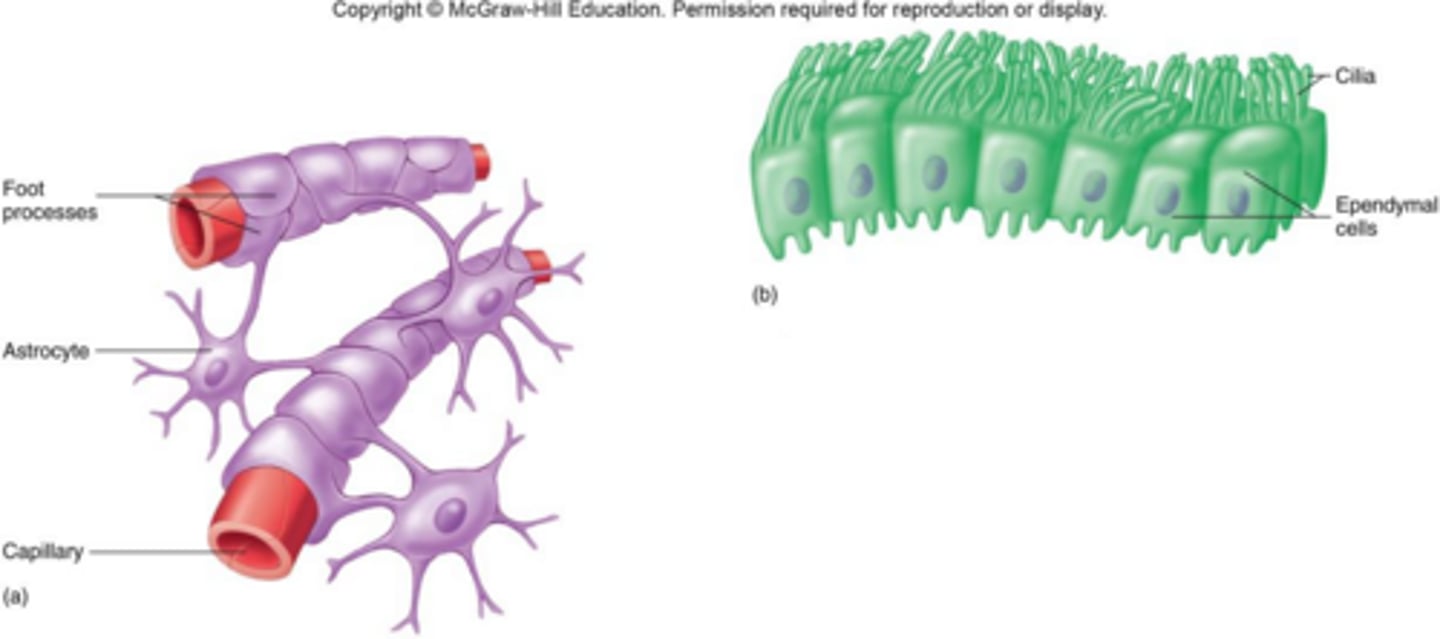
What is the role of astrocytes?
They are star-shaped neuroglia that form the blood-brain barrier.
What do oligodendrocytes do?
They produce the myelin sheath in the Central Nervous System.
What is the function of Schwann cells?
They produce the myelin sheath in the Peripheral Nervous System.
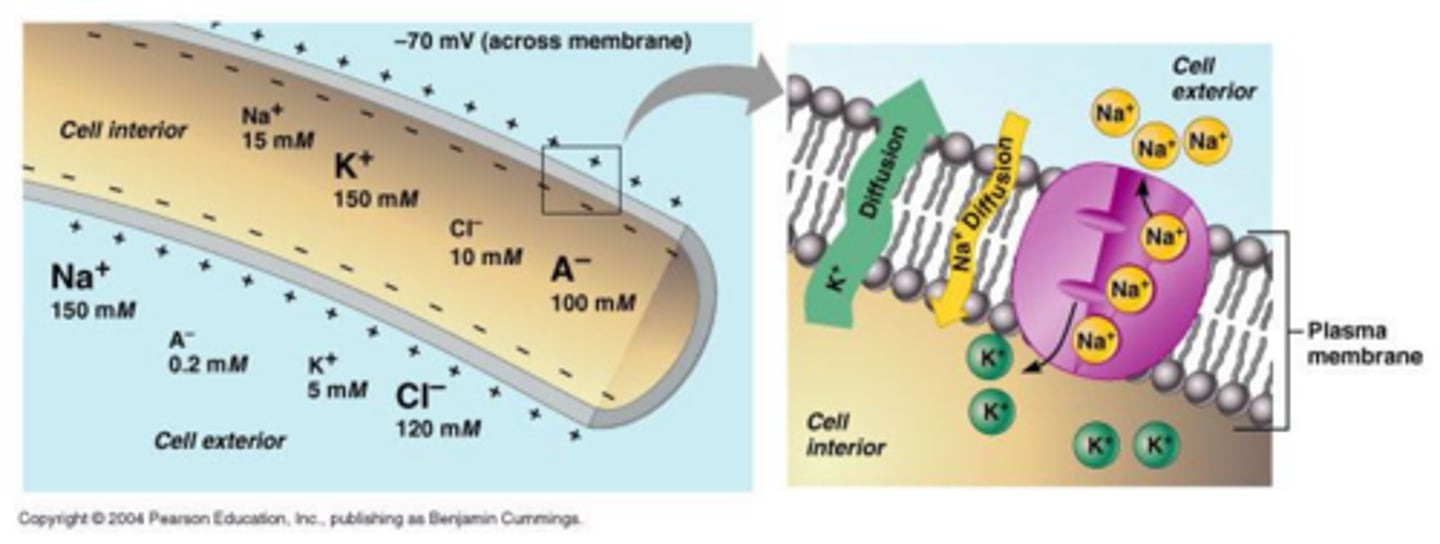
What is the resting membrane potential?
The electrical charge difference across the membrane when a neuron is not actively transmitting signals.
What happens during depolarization?
The inside of the membrane becomes more positive due to the influx of Na+ ions.
What is a synapse?
The junction where an axon connects to a muscle, gland, organ, or another neuron.
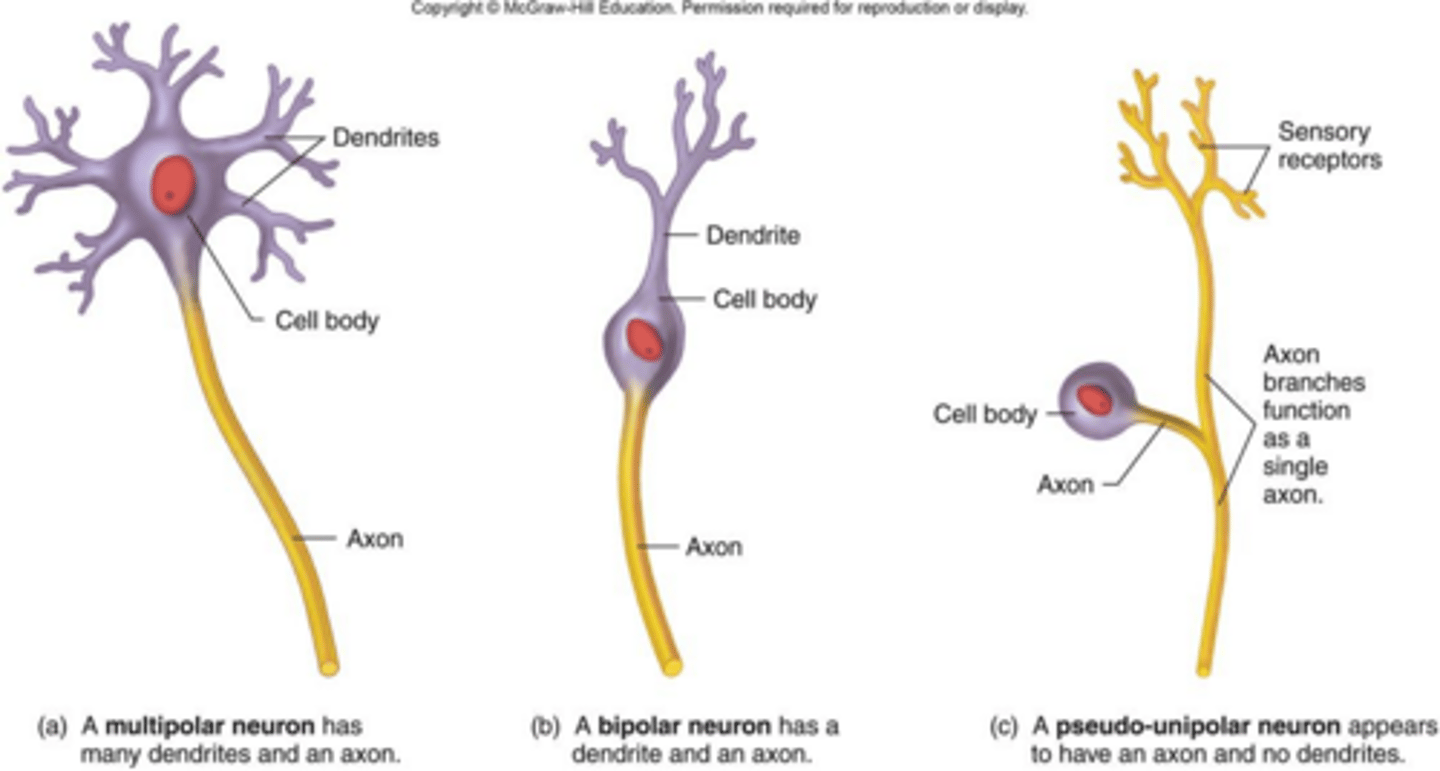
What are the three types of neurons?
Multipolar, bipolar, and pseudo-unipolar neurons.
What is the function of the sodium/potassium pump?
To restore the resting membrane potential by moving Na+ out and K+ into the cell.
What is the role of interneurons?
To process stimuli and connect sensory and motor neurons within the CNS.
What is a converging neuronal pathway?
A pathway where two or more neurons synapse with the same neuron.
What is a diverging neuronal pathway?
A pathway where one neuron's axon divides to synapse with multiple neurons.
What is the phrenic nerve responsible for?
Innervating the diaphragm.
What are the three major plexuses of spinal nerves?
Cervical Plexus, Brachial Plexus, and Lumbosacral Plexus.
What does the term 'reflex' refer to?
An involuntary response to a stimulus.
What is the function of ependymal cells?
To produce and circulate cerebrospinal fluid (CSF).
What is the cervical plexus?
A network of nerves formed by the anterior rami of the first four cervical nerves (C1-C4).
What is the brachial plexus?
A network of nerves formed by the anterior rami of the spinal nerves C5 to T1.
What is the lumbar plexus?
A network of nerves formed by the anterior rami of the lumbar spinal nerves L1 to L4.
What is the sacral plexus?
A network of nerves formed by the anterior rami of the sacral spinal nerves L4 to S4.
What is the coccygeal plexus?
A network of nerves formed by the anterior ramus of the last sacral nerve and the coccygeal nerve.
What is cerebrospinal fluid?
Fluid that bathes the brain and spinal cord, providing a protective cushion around the CNS.
What are the components of the brainstem?
Medulla oblongata, pons, and midbrain.
What is the function of the medulla oblongata?
Regulates heart rate, blood vessel diameter, breathing, swallowing, and other vital functions.
What is the function of the pons?
Acts as a bridge between the cerebrum and cerebellum and is involved in breathing and chewing.
What is the function of the midbrain?
Coordinates eye movement, pupil diameter, and turning the head toward noise.
What is the reticular formation?
A network of neurons in the brainstem that regulates cyclical motor functions and consciousness.
What are the components of the diencephalon?
Thalamus and hypothalamus.
What is the function of the thalamus?
Influences moods and detects pain; it is the largest portion of the diencephalon.
What is the function of the hypothalamus?
Controls the pituitary gland and regulates homeostasis, body temperature, thirst, and hunger.
What are the lobes of the cerebrum?
Frontal, parietal, occipital, and temporal lobes.
What is the primary function of the frontal lobe?
Controls voluntary motor functions, aggression, moods, and smell.
What is the primary function of the parietal lobe?
Evaluates sensory input such as touch, pain, pressure, temperature, and taste.
What is the primary function of the occipital lobe?
Responsible for vision.
What is the primary function of the temporal lobe?
Responsible for hearing, smell, and memory.
What is the function of the cerebellum?
Controls balance, muscle tone, and coordination of fine motor movement.
What are ascending tracts?
Pathways in the brain and spinal cord that transmit sensory information from the periphery to the brain.
What is the primary somatic sensory cortex?
The general sensory area located in the parietal lobe where sensations are perceived.
What is the primary motor cortex?
Located in the frontal lobe, it controls voluntary motor movement.
What are descending tracts?
Pathways that project from upper motor neurons in the cerebral cortex to lower motor neurons in the spinal cord.
What is the function of the basal nuclei?
Plan, organize, and coordinate motor movements and posture.
What is Wernicke's area?
Located in the parietal lobe, it is responsible for sensory speech where words are heard and comprehended.
What is Broca's area?
Located in the frontal lobe, it is responsible for motor speech where words are formulated.
What are the types of brain waves?
Alpha waves (awake, quiet), beta waves (intense mental activity), delta waves (deep sleep), and theta waves (in children).
What is the difference between short-term and long-term memory?
Short-term memory retains information for a few seconds to minutes, while long-term memory can last for minutes or permanently.
What are the three layers of meninges?
Dura mater (thickest), arachnoid mater (middle), and pia mater (innermost, surface of the brain).
What is meningitis?
An infection of the meninges, which can be bacterial or viral.
What are cranial nerves?
12 pairs of nerves that are primarily responsible for sensory and motor functions.
What are the divisions of the peripheral nervous system?
Afferent (sensory) and efferent (motor) divisions.
What is the autonomic nervous system?
Part of the efferent division that controls involuntary responses.
What is the sympathetic nervous system?
Activated during stress, part of the fight or flight response.
What is the parasympathetic nervous system?
Activated under normal conditions, involved in digestion and other homeostatic functions.
Why is the myelin sheath important?
It increases the speed of nerve signal transmission by allowing signals to jump between nodes (saltatory conduction).
Why are reflexes important?
They allow fast, automatic responses that protect the body from harm.
Why is the hypothalamus important?
It maintains homeostasis by regulating temperature, hunger, thirst, and hormones.
What are the steps of an action potential?
Resting state → Na⁺ enters (depolarization) → threshold reached → K⁺ exits (repolarization) → sodium-potassium pump resets.
What is the threshold in an action potential?
The minimum level of stimulation required to trigger an action potential.
What is the all-or-none law?
Once threshold is reached, the neuron fires completely or not at all.
What is the difference between the sympathetic and parasympathetic nervous systems?
Sympathetic: fight or flight (increases heart rate, breathing); Parasympathetic: rest and digest (conserves energy, aids digestion).
What is the difference between the CNS and PNS?
CNS: brain and spinal cord (control center); PNS: all nerves outside CNS (communication lines).
What is the difference between afferent and efferent neurons?
Afferent: carry signals TO CNS; Efferent: carry signals FROM CNS.
What is the difference between dorsal and ventral roots?
Dorsal: sensory input; Ventral: motor output.
What is an example of a reflex arc?
Touching a hot stove and quickly pulling your hand away.
What is an example of a sympathetic response?
Heart rate increases when running or scared.
What is an example of a parasympathetic response?
Digestion increases after eating.
What is the function of the occipital lobe?
Vision (occipital = optical).
What is the function of the frontal lobe?
Movement and decision-making (front = action).
What is the overall function of the nervous system?
Detects stimuli (sensory input), processes information (integration), produces a response (motor output), and maintains homeostasis.
What is a neurotransmitter?
A chemical messenger released at a synapse to transmit signals between neurons.
What happens at a synapse?
Neurotransmitters are released from one neuron and bind to receptors on another cell.
What is the sodium-potassium pump?
A membrane protein that restores resting potential by moving Na⁺ out and K⁺ into the cell.
Why is the myelin sheath important?
It increases the speed of nerve signal transmission by allowing signals to jump between nodes (saltatory conduction).
Why are reflexes important?
They allow fast, automatic responses that protect the body from harm.
Why is the hypothalamus important?
It maintains homeostasis by regulating temperature, hunger, thirst, and hormones.
What is the threshold in an action potential?
The minimum level of stimulation required to trigger an action potential.
What is the all-or-none law?
Once threshold is reached, the neuron fires completely or not at all.
What is the difference between the sympathetic and parasympathetic nervous systems?
Sympathetic: fight or flight (increases heart rate, breathing); Parasympathetic: rest and digest (conserves energy, aids digestion).
What is the difference between gray matter and white matter?
Gray matter: cell bodies and dendrites; White matter: myelinated axons.
What is the difference between CNS and PNS?
CNS: brain and spinal cord (control center); PNS: all nerves outside CNS (communication lines).
What is the difference between afferent and efferent neurons?
Afferent: carry signals TO CNS; Efferent: carry signals FROM CNS.
What is the difference between dorsal and ventral roots?
Dorsal: sensory input; Ventral: motor output.
What is an example of a reflex arc?
Touching a hot stove and quickly pulling your hand away.
What is an example of a sympathetic response?
Heart rate increases when running or scared.
What is an example of a parasympathetic response?
Digestion increases after eating.
What is the function of the occipital lobe?
Vision (occipital = optical).
Explore top notes

