Biology II- Chapter 18
 Studied by 0 people
 Call with Kai
 Learn
Learn Practice Test
 Spaced Repetition
 Match
Match Flashcards
 Knowt Play
1/19

Earn XP
Description and Tags
BIOL 1620- Evolution & the Origin of Species
Name | Mastery | Learn | Test | Matching | Spaced | Call with Kai |
|---|
No study sessions yet.
20 Terms
Evolution
Change in genetic composition of a population over time
Unit of ____ is called population
Charles Darwin
English naturalist and biologist- Believed all species shared a common ancestor, and famous for theory of evolution by natural selection (change over time due to traits that are needed to survive and reproduce)
Origin of Species; one of the most influential texts of this century created by him
Darwins “Term” for evolution
Descent with modification (he did not specifically use the word “evolution”)
Darwins Influence Origin (who influenced him?)
Aristotle, Linnaeus, Cuvier, and Lamarck
Aristotle
View species as unchanging. Organisms were placed in a “latter or scale” based on complexity
Old Testament
Linnaeus
Founder to Taxonomy; classifying organisms, into a hierarchical systems (Scala Naturae)
binomial naming species
ex) Apis mellifera or Homo sapiens
Genus species- Genus being capitalized and species being lowercase
did this to show pattern of creation, NOT for evolutionary kinship
George Cuvier
Paleontologist; observed that fossils in older strata are different from newer fossils or living animals
usually found in layers of strata; sedimentary rocks
Opposed evolution and attributed this to “repopulation after a catastrophe”… NOT true.
Lamarck
First person proposing a mechanism of how life changes.
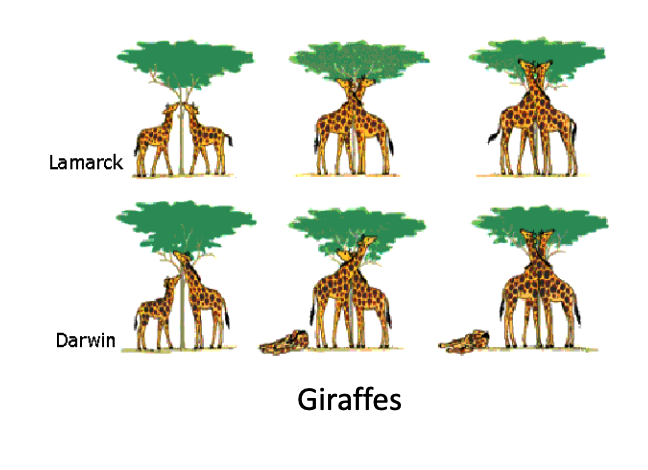
hypothesized that species evolve through use and disuse of body parts
used traits= larger/stronger, unused traits=smaller/weaker.
Organisms can pass modifications to next generations.
Darwin & Lamarck differences
ex) Lamarck believed that for giraffes, their necks grew over time to help them get their food, whereas Darwin believed that over time short necks died because they were unable to reach the trees and longer necks lived to reproduce those “favorable” traits onto the next generation.
Church
In order to study, they had to do it through the _____.
Voyage of the Beagle
A ship sent by British Navy to chart the coastline of South America- Darwin spent 5 years on the ____.
Found the Galápagos Islands and this was where Darwin concluded his findings
The Galápagos Islands
Led Darwin to conclude that the populations descended from a common ancestor, and he ultimately concluded that they had evolved and WERE evolving
many islands with different populations of “species” on each island.
populations were related but where different on each island.
Finches
Diverse bird species that had many unique adaptations.
Beaks and behavior were adapted to the specific foods on their home islands
Natural Selection
Process in which individuals inherited traits that help them survive and reproduce at higher traits
ex) Giraffes
Artificial Selection/ Breeding
Humans modified other species by selecting and breeding individuals with desired traits
result= organisms having little resemblance to ancestors
Darwin argued that a similar process as artificial selection can also occur in Nature (natural selection!)
Observation 1: Members of a population often vary greatly in their traits-
Observation 2: Traits are inherited from parents to offspring
Observation 3: All species are capable of producing more offspring that the environment can support
Observation 4: Owing to lack of food or other resources, many of these offspring do not survive
Inferences from these observations- 5 year journey
#1 Individuals who’s inherited traits give them higher probability of surviving and reproducing in a given environment tend to leave more offspring than other individuals (Focus on parents)
#2 This unequal ability of individuals to survive and reproduce will lead to the accumulation of favorable traits in the population over generations (Focus on the offspring)
Adaptation (Process)
Changes caused by natural selection leading to a greater fit between a population and its environment across generations
Adaptation (Trait)
An inherited trait that enhances an individuals survival and reproduction in a specific environment (=increased fitness)
Fitness
The relative contribution an individual makes to the gene pool of the next generation
 Note
Note  Flashcards (550)