Biology 5.1.1- Communication and Homeostasis
 Studied by 0 people
 Call Kai
 Learn
Learn Practice Test
 Spaced Repetition
 Match
Match Flashcards
 Knowt Play
1/6

There's no tags or description
Looks like no tags are added yet.
Name | Mastery | Learn | Test | Matching | Spaced | Call with Kai |
|---|
No analytics yet
Send a link to your students to track their progress
7 Terms
Why do multicellular organisms need communication systems?
To respond to changes in their internal and external environments (and keep the internal conditions within regular set limits through homeostasis)
To coordinate the activities of different organs and specialised cells
What are some internal and external factors that need to be responded to during homeostasis?
Internal:
pH
Water potential
Blood glucose concentration
Internal temperature
External:
Light
Sound
Temperature
Humidity
How does cell-cell signalling work on different levels?
Between adjacent cells:
Various chemicals can be produced by a cell, which diffuse towards the target cell and are recognised by receptors on the cell surface membrane (though some are small and non-polar enough to diffuse through) which trigger a response
Eg. Neurotransmitters transmit signals short distances across the synapses between nerve cells
Between distant cells:
The chemicals used are hormones, which are transported through the blood to reach the target cells
What are endotherms and ectotherms?
Endotherms
Animals that possess physiological mechanisms for the maintenance of internal body temperature
E.g. mammals and birds
Ectotherms
Animals that rely on behavioural mechanisms to maintain internal body temperature, for example by moving into or out of the sun, or huddling together for warmth
E.g. reptiles, amphibians and fish
Ectotherms that live in water, such as fish, don’t actually thermoregulate however as the temperature of water bodies are not very variable
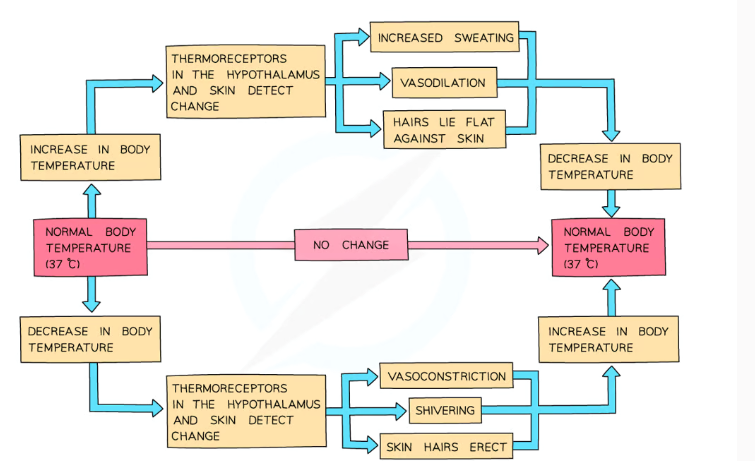
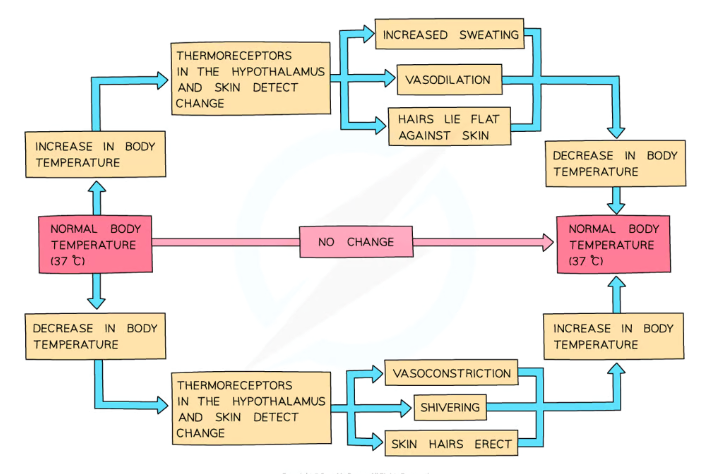
How do endotherms cool down by thermoregulation?
They detect external temperature changes using peripheral receptors (thermoreceptors found in the skin and mucous membranes)- these send impulses to the hypothalamus
There are also receptors in the hypothalamus monitoring the temperature of the blood
The hypothalamus initiates homeostatic responses, such as:
Vasodilation- the smooth muscle in arteriole walls near the skin relaxes, allowing more heat to be lost by radiation
Sweating- sweat evaporates off the skin, removing latent heat and cooling the body
Flattening skin hairs- the erector muscles in the skin relax, allowing air to circulate over the skin freely
How do endotherms heat up by thermoregulation?
They detect external temperature changes using peripheral receptors (thermoreceptors found in the skin and mucous membranes)- these send impulses to the hypothalamus
There are also receptors in the hypothalamus monitoring the temperature of the blood
The hypothalamus initiates homeostatic responses, such as:
Vasoconstriction- the smooth muscle in arteriole walls near the skin contracts, allowing less heat to be lost by radiation
Raising skin hairs- the erector muscles in the skin contract, forming an insulating layer of air
Shivering- the muscles rapidly contract and relax to release heat energy from respiration
How do ectotherms conduct thermoregulation?
To cool down, they:
Seek shade
Move into water
Dig burrows
To heat up, they:
Bask in the sun/on warm surfaces
Huddle together

