Exam 3 BIOS 110
 Call Kai
 Learn
Learn Practice Test
 Spaced Repetition
 Match
Match Flashcards
 Knowt Play
1/57

There's no tags or description
Looks like no tags are added yet.
Name | Mastery | Learn | Test | Matching | Spaced | Call with Kai |
|---|
No analytics yet
Send a link to your students to track their progress
58 Terms
8. When do plants perform the Calvin Cycle?
A) During the day, when the light-harvesting reactions are occurring
B. During the night
C. Plants peform the Calvin Cyle all day and all night, as long as there is CO2
A) During the day, when the light-harvesting reactions are occurring
9. Structurally, how does the Rubisco in a C3 plant differ from the Rubisco in a C4 plant?
A. The Rubisco in a C4 plant has less affinity for O2
B. The Rubisco in a C4 plant has more affinity for O2
C. There is no difference between the Rubisco in a C3 plant and a C4 plant
C There is no difference between the Rubisco in a C3 plant and a C4 plant
10. Where would you find the greatest concentration of C4 plants?
A. The tropical rain forests (hot, wet)
B. The Illinois prairies (warm, sometimes wet, sometimes dry)
C. The grasslands in west Nebraska & Kansas (hot, dry)
D. The temperate rainforests of Oregon (sometimes warm, sometimes cold, always wet) E. Northern Canada (cold, dry)
C. The grasslands in west Nebraska & Kansas (hot, dry)
11. What happens during photorespiration?
A. Oxygen reacts with glucose, breaking it down and consuming energy
B. Oxygen reacts with glucose, breaking it down and producing energy
C. Rubisco attaches an oxygen molecule to RuBP, oxidizing it
D. Rubisco attaches an oxygen molecule to RuBP, reducing it
E. None of the above
C. Rubisco attaches an oxygen molecule to RuBP, oxidizing it
Normal atmospheric conditions are 20% O2, 400 ppm CO2 (0.0400%). C3 plants grown under which of the following conditions will show the least amount of photorespiration?
A. 30% O2, 600 ppm CO2
B. 30% O2, 400 ppm CO2
C. 20% O2, 600 ppm CO2
D. 10% O2, 400 ppm CO2
E. 10% O2, 600 ppm CO2
E. 10% O2, 600 ppm CO2
You grow wheat (a C3 plant) and corn (a C4 plant) in a greenhouse and measure the photorespiration rate each. You then double the CO2 concentration while keeping all other environmental conditions the same. You then measure the photorespiration rate in the corn and the wheat. What will be your results?
A. Both the corn and the wheat will show great reduction in their photorespiration rates
B. Only the corn will show a great reduction in its photorespiration rate
C. Only the wheat will show a great reduction in its photorespiration rate
D. Neither the corn nor the wheat will show great reduction in their photorespiration rates
C. Only the wheat will show a great reduction in its photorespiration rate
Engleman was a researcher studying photosynthesis in the 1800s. One of his famous experiment is he shown white light through a prism, producing the classic visible light spectrum. He wanted to see what colors of light produced the most photosynthesis and which produced the least in algae. What were Engleman’s findings?
A. Only algae grown under blue light performed photosynthesis
B. Only algae grown under green light performed photosynthesis
C. Only algae grown under red light performed photosynthesis
D. Algae grown under red or blue light performed photosynthesis, those grown under green light did not
E. Algae grown under blue and green light performed photosynthesis, those grown under red light did not
D. Algae grown under red or blue light performed photosynthesis, those grown under green light did not
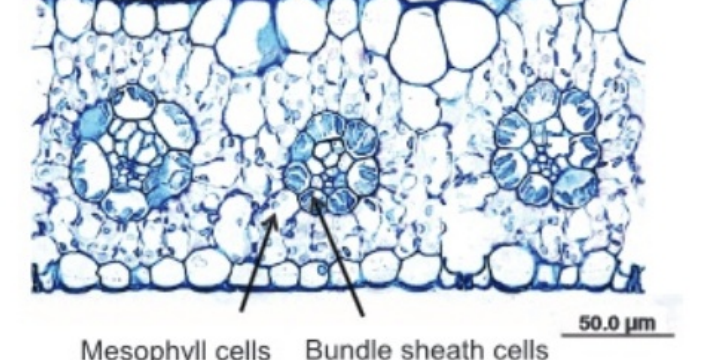
18. Based on the leaf cross section shown on the right, this plant is most likely a:
A. C3 plant B. C4 plant C. CAM plant
C4 Plant
In what type of cells does the Calvin cycle occur in C4 plants?
A. The mesophyll cells
B. The bundle sheath cells
C. The epidermis
D. A & B
E. A, B, & C
B. The bundle sheath cells
18O is a non-radioactive isotope of oxygen. You expose plants to water containing 18O (i.e H2 18O) and capture all of the gasses and byproducts of photosynthesis. Where will you see the most 18O?
A. ATP
B. Glucose
C. CO2 gas
D. O2 gas
E. H+
D. O2 gas
You physically puncture the thylakoid membranes. This puncturing does not damage any of the molecules bound to the thylakoid membrane (i.e. they still function normally), but now there are large holes connecting the thylakoid space and stroma. How will this affect the light-harvesting reactions?
A. There will be much less oxygen production, but ATP and NADPH production will be unaffected
B. There will be much less NADPH production, but ATP and oxygen production will be unaffected
C. There will be much less ATP production, but NADPH and oxygen production will be unaffected
D. There will be much less ATP and NADPH production, but oxygen production will be unaffected
E. There will be much less ATP, NADPH, and oxygen production
C. There will be much less ATP production, but NADPH and oxygen production will be unaffected
22. How many of the above processes have a net production of ATP?
You have two cultures of yeast, one growing under aerobic conditions and one growing in anaerobic conditions. Which of the below statement is true for these cultures
A. Neither yeast culture will produce CO2
B. Yeast in the aerobic culture will produce CO2, but the anaerobic yeast will not
C. Yeast in the anaerobic culture will produce CO2, but the aerobic yeast will not
D. Yeast in both cultures will produce CO2
D. Yeast in both cultures will produce CO2
Which of the following would best represent the progression of energy transformations that occur during aerobic cellular respiration?
A. chemical energy stored in food > potential energy stored in electrons > potential energy established by a proton (H+ ) gradient > chemical energy stored in ATP
B. chemical energy stored in food > potential energy stored in electrons > chemical energy stored in ATP > potential energy established by a proton (H+ ) gradient
C. chemical energy stored in food > chemical energy stored in ATP > chemical energy stored in NADH
D. chemical energy stored in food > chemical energy stored in ATP > potential energy established by a proton (H+ ) gradient
A.
What is the effect of a high concentration of ATP on the enzyme phosphofructokinase?
A. ATP is a substrate, so the activity of the enzyme will be increased
B. The enzyme will be allosterically inhibited in the presence of high concentrations of ATP
C. The enzyme will be allosterically enhanced in the presence of high concentrations of ATP
D. The enzyme will be permanently damaged by high concentrations of ATP
E. ATP concentration has no effect on phosphofructokinase
B. The enzyme will be allosterically inhibited in the presence of high concentrations of ATP
33. You mutate phosphofructokinase so that the allosteric site has a greater affinity for ATP. How will this affect enzyme activity?
A. This will increase the activity of phosphofructokinase
B. This will decrease the activity of phosphofructokinase
C. This will have no effect on the activity of phosphofructokinase
B. This will decrease the activity of phosphofructokinase
7. When sunlight strikes PSII, an electron absorbs the light and gets excited. This electron is then stolen by from PSII by phaeophyton. When this happens: A. Both PSII and phaeophyton become oxidized
B. PSII becomes oxidized while phaeophyton becomes reduced
C. PSII becomes reduced while phaeophyton becomes oxidized
D. Both PSII and phaeophyton become reduced
B. PSII becomes oxidized while phaeophyton becomes reduced
8. From which source does PSII replace its lost electron?
A. ATP B. NADPH C. O2 D. CO2 E. H2O
E. H2O
During Cyclic Photophosphorylation:
A. ATP, NADPH, and O2 are not produced
B. ATP is produced; neither NADPH nor O2 are produced
C. NADPH and O2 are produced; ATP is not produced
D. ATP, NADPH, and O2 are all produced
B. ATP is produced; neither NADPH nor O2 are produced
10. The reaction: ADP + phosphate –> ATP is catalyzed by the enzyme ATP synthase in thylakoid membranes. This reaction is powered by:
A. Movement of electrons between photosystem II and photosystem I.
B. Oxidation of water
C. The electrochemical gradient of H+ generated by the electron transport chain D. Oxidation of NADPH
E. Absorption of photons by chloroplast pigment
C. The electrochemical gradient of H+ generated by the electron transport chain
11. The Rubisco in a C4 plant has _________ affinity for oxygen than the Rubisco in a C3 plant A. more B. less C. the same
the same
In C4 plants, the first enzyme to fix carbon is PEP Carboxylase. PEP Carboxylase as _____ affinity for oxygen. A. great B. little C. no
no
Rice is a C3 plant while sugar cane is a C4 plant. You grow both plants in a growth chamber under ambient conditions (20% O2 , 400 ppm CO2 ) and measure the rates of photorespiration in both. You then reduce the atmospheric CO2 concentrations to 300 ppm. What changes in photorespiration would you see in both plants?
A. Both rice and sugar cane would show great increases in the rate of photorespiration
B. Rice would show a great increase in the rate of photorespiration, sugar cane would show little to no change
C. Sugar cane would show a great increase in the rate of photorespiration, rice would show little to no change
D. Both rice and sugar cane would show little to no change in the rate of photorespiration
B. Rice would show a great increase in the rate of photorespiration, sugar cane would show little to no change
14. Where is most of the Rubisco in a C4 plant?
A. In the epidermis
B. In the mesophyll cells
C. In the bundle sheath cells
D. In the vascular tissue
E. None of the above
C. In the bundle sheath cells
Plants produce oxygen gas as a byproduct of photosynthesis. From what molecule does the atoms comprising this oxygen gas originate?
A. Glucose B. CO2 C. H2O D. ATP E. NADPH
C H20
Paraquot is an herbicide which blocks PSI’s ability to donate electrons to Ferredoxin. What effects will Paraquot have on an exposed plant’s ability to perform cyclic and non-cyclic photophosphorylation?
A. The exposed plant could perform neither cyclic nor non-cyclic photophosphorylation
B. The exposed plant could perform cyclic photophosphorylation, but not non-cyclic photophosphorylation
C. The exposed plant could perform non-cyclic photophosphorylation, but not cyclic photophosphorylation
D. The exposed plant could perform both cyclic and non-cyclic photophosphorylation
A. The exposed plant could perform neither cyclic nor non-cyclic photophosphorylation
18. You sample plants in the below areas. Which are would show the greatest proportion of the plant communities to be C4 plants?
A. Washington rain forest (cool, moist)
B. Norther Canada (cold, dry)
C. Central Illinois (warm, seasonally dry)
D. Oklahoma City, Oklahoma (hot, dry)
E. Okefenokee Swamp, Florida (hot, moist)
D. Oklahoma City, Oklahoma (hot, dry)
Perforins are chemicals which punch holes in biological membranes, but do not affect the associated proteins. You inject perforins inside of a chloropast, and they punch large holes in the thylalkoid membranes, but do not affect the molecules in the electron transport chain. What effects would exposure to perforins have on the chloroplast’s ability to synthesize ATP and NADPH.?
A. The chloroplast would still be able to produce both ATP and NADPH
B. The chloroplast would be able to produce ATP but not NADPH
C. The chloroplast would be able to produce NADPH but not ATP
D. The chloroplast would not be able to produce ATP and NADPH
C. The chloroplast would be able to produce NADPH but not ATP
All living plant cells can get all the energy they need from photosynthesis. Therefore, they do not require O2 for aerobic respiration to produce energy
A. True
B. False
B
Plants use the glucose produced by photosynthesis for:
A. Cellular Respiration
B. Storage (starch)
C. Growth (cellulose)
D. B & C
E. A, B, & C
E
Dinitrophenol (DNP) and Guthion both reduce ATP synthesis in mitochondria exposed to these chemicals. DNP functions by damaging the ATP synthase, allowing H + to flow across the membrane while not producing ATP. The electron transport chain is unaffected. Guthion functions by damaging complex IV, preventing electron flow. ATP synthase is unaffected. You expose one aerobic culture of yeast to DNP, expose another aerobic culture of yeast to Guthion and then measure oxygen consumption of these two cultures. As a control, you have an aerobic culture exposed to neither chemical. What would you expect the relative oxygen consumption of these three cultures to be?
A. The control and the DNP-exposed samples will have high oxygen consumption, the Guthion-exposed sample will have minimal oxygen consumption
B. The control and the Guthion-exposed samples will have high oxygen consumption, the DNP-exposed sample will have minimal oxygen consumption
C. The control will have a high oxygen consumption, the Guthion-exposed and the DNPexposed samples will have minimal oxygen consumption
D. All of the samples will have a high oxygen consumption
A. The control and the DNP-exposed samples will have high oxygen consumption, the Guthion-exposed sample will have minimal oxygen consumption
Which of the above experimental conditions, DNP exposure and Guthion exposure, will show a decrease in NADH oxidation when compared to the control?
A. Neither will show a decrease in NADH oxidation
B. DNP-exposed mitochondria will show a decrease in NADH oxidation
C. Guthion-exposed mitochondria will show a decrease in NADH oxidation
D. Both DNP-exposed and Guthion-exposed mitochondria will show a decrease in NADH oxidation
C. Guthion-exposed mitochondria will show a decrease in NADH oxidation
25. What is the final electron acceptor in the mitochondrial electron transport chain?
A. ATP B. NADH C. CO2 D. O2 E. H2O
O2
How much of an ATP reserve does your body have at any given moment?
A. Seven seconds B. Seven minutes C. Seven hours D. Seven days
Seven Minutes
What is the biological function of fermentation?
A. To produce either ethanol or lactic acid, both of which are useful to the cell
B. To oxidize pyruvate, a deadly poison to the cell
C. To breakdown pyruvate and produce a few more ATPs
D. To oxidize NADH to form NAD+ E. None of the above
D. To oxidize NADH to form NAD+
What causes the bubbles in bread when it is baked??
A. The CO2 produced from oxidation of pyruvate
B. The CO2 produced from the citric acid cycle
C. The CO2 produced from fermentation
D. A & B
C. The CO2 produced from fermentation
29. You have a mixture of water and ethanol. You wish to concentrate the ethanol by distillation. The boiling point of ethanol is 78ºC and the boiling point of water is 100ºC. To what temperature should you set your heating plate to best distill the ethanol?
A. 70ºC B. 85ºC C. 100ºC D. 120ºC
B
Which of the below changes will decrease the rate of glycolysis? I. Increase the affinity of the phosphofructokinase active site to ATP II. Increase the affinity of the phosphofructokinase allosteric site to ATP III. Decrease the affinity of the phosphofructokinase active site to ATP IV. Decrease the affinity of the phosphofructokinase allosteric site to ATP
A. I only B. II only C. III only D. II & III E. I & IV
D
When the Citric Acid Cycle is complete, where is most of the energy from the initial glucose molecule?
A. ATP B. CO2 C. H2 O D. O2 E. NADH
NADH
You have several human muscle cells in culture. You place some of the cells in an aerobic environment and other cells in an anaerobic environment and measure CO2 outputs. Which of the below statements are true?
A. Both the aerobic an anaerobic muscle cultures will produce great amounts of CO2 .
B. The muscle cells under anaerobic conditions will produce great amounts of CO2 , but the muscle cells under aerobic conditions will produce little to no CO2
C. The muscle cells under aerobic conditions will produce great amounts of CO2 , but the muscle cells under anaerobic conditions will produce little to no CO2 .
D. Both the aerobic an anaerobic muscle cultures will produce little to no CO2 .
C
In Phosphofructokinase, the active site has a much higher affinity for ATP than the allosteric site does. Which answer best summarizes what the consequences of a mutated gene which produced phosphofructokinase with the allosteric site having a much higher affinity for ATP than the active site?
A. Glycolysis would be inhibited only at high ATP concentrations
B. Glycolysis would be inhibited even if ATP concentrations were low in the cell.
C. Glycolysis would occur faster at low ATP concentrations
D. Glycolysis would occur via a completely different metabolic pathwa
B. Glycolysis would be inhibited even if ATP concentrations were low in the cell.
22. How many of the above processes have a net production of ATP?
A. One B. Three C. Four D. Five E. Six
D
. How many of the above processes have a net consumption of ATP?
A. None B. One C. Two D. Three E. Four
B
Which of the above processes have a net production of CO2?
A. II & III B. I, II, III C. II, III, V D. II, III, VI E. II, III, V, VI
C
In which of the above processes does substrate-level phosphorylation occur?
A. I only B. II only C. III only D. I & II E. I & III
E
Which of the above processes oxidize NADH to NAD+?
A. V only B. VI only C. V & VI D. IV, V, VI E. I, II, III
D
In which of the above processes is there a net production of O2?
A. IV only B. VII only C. VIII only D. VII, VIII E. IV, VII, VIII
B
. In which of the above processes is there a generation of a H+ gradient?
A. IV only B. VII only C. VIII only D. VII, VIII E. IV, VII, VIII
E
What is the final electron acceptor in the mitochondrial electron chain?
A. H2O B. CO2 C. O2 D. ATP E. NAD+
C
What is the final electron acceptor in non-cyclic photophosphorylation?
NADPH
On the thylakoid membrane, there are areas which can peform both cyclic and non-cyclic photophosporylation . However, there are other areas which can only perform cyclic photophosporylation.
True
The atoms in the oxygen released into the air as a product of photosynthesis comes from which molecule?
H20
What is not a direct effect of plants absorbing sunlight?
ATP and NADPH are broken down into ADP and NADP+
The reaction: ADP + phosphate –> ATP is catalyzed by the enzyme ATP synthase in thylakoid membranes. This reaction is powered directly by:
The electrochemical gradient of H+ generated by the electron transport chain
Which of the following sequences correctly represents the flow of electrons during photosynthesis?
H2O →photosystem II → photosystem I → NADPH → Calvin Cycle
ou are doing an experiment on how the color of light will affect plant growth rate. The idea behind this experiment is that growth rate is proportional to photosynthetic rate, so plants that photosynthesize more will grow more. You have three groups of plants:
Plants grown under blue light
Plants grown under green light
Plants grown under red light
All other variables (light intensity, temperature, day length, etc.) are kept constant. Which group of plants will show the least growth?
Plants grown under green light
What is the primary function of the Calvin cycle?
To synthesize simple sugars from CO2
Plants use the glucose produced by photosynthesis for:
Cellular Respiration, Storage (starch), and Growth (cellulose)

