FINC425 Exam 2 Multiple Choice
 Call Kai
 Learn
Learn Practice Test
 Spaced Repetition
 Match
Match Flashcards
 Knowt Play
1/18

There's no tags or description
Looks like no tags are added yet.
Name | Mastery | Learn | Test | Matching | Spaced | Call with Kai |
|---|
No analytics yet
Send a link to your students to track their progress
19 Terms
Which of the following does not impact the percentage of a client’s complete portfolio that should be invested optimally in the portfolio of risky assets (with the rest going into the risk-free asset)?
Risk premium of the portfolio of risky assets
The client’s risk aversion
The variance of the portfolio of risky assets
All of the above
All of the above
The weight depends on the risk premium of the risky portfolio (E[rp] - rf), the clients risk aversion (A), and the variance of the risky portfolio (O2p)
![<p>All of the above</p><p></p><p>The weight depends on the risk premium of the risky portfolio (E[r<sub>p</sub>] - r<sub>f</sub>), the clients risk aversion (A), and the variance of the risky portfolio (O<sup>2</sup><sub>p</sub>)</p>](https://assets.knowt.com/user-attachments/b66bb70e-a87e-44d0-ae77-904558d7cec9.png)
If your client only wants to choose one of the two risky funds to combine with the risk-free asset to form her complete portfolio, which metric should you use to choose between the two funds?
Sharpe Ratio: the portfolio with the highest Sharpe ratio combined with the risk-free asset will give us the best combinations
An investor’s degree of risk aversion will determine her _______?
Optimal mix of the risk-free asset and risky portfolio: all investors have the same optimal risky portfolio (sharpe ratio). The risk-free rate does not differ across investors. THe capital market line does not depend on the investor’s risk aversion.
True or false? The minimum variance portfolio always invests 100% in the lowest risk asset
False: the minimum variance portfolio is the combination of assets that gives the lowest possible risk, not just the lowest-risk asset
In a portfolio diversified across a large number of assets, the portfolio’s variance will depend mainly on:
The covariances across assets: covariances impact portfolio risk in diversified portfolios
True or false: An individual asset can lie outside the efficient frontier
False
True or false: adding more assets to the consideration set can move the efficient frontier up and to the left (greater expected return for given level of risk)
True
True or false: A decrease in correlations across assets can move the efficient frontier up and to the left
True
True or false: The minimum variance portfolio is the portfolio composed of the risky assets that has the smallest standard deviation
True
What is the efficient frontier?
Set of weights in the assets that maximize expected return for each level of risk.
Risk that can be eliminated through diversification is called _____ risk
Firm-specific, unsystematic, idiosyncratic, etc.
In the single-index model, how do we estimate the stock’s beta?
Regress the stock’s excess return (Y) on the market’s excess return (X) and the coefficient on the market excess return is beta.
True or false? In a CAPM world, the market portfolio will have the highest attainable Sharpe ratio of any asset or portfolio.
True, the market portfolio is the optimal portfolio for all investors because it is the highest Sharpe ratio portfolio.
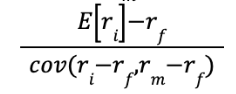
In a CAPM world, every security and portfolio (including the market portfolio) will have the same:
The risk investors care about is the covariance of asset returns with the market
In a CAPM world, the market portfolio is the portfolio:
With the capital allocation line tangent to the efficient frontier
With the highest sharpe ratio
that every investor wants to hold as their risky asset portfolio
The market portfolio is the highest Sharpe ratio portfolio
What is the Capital Market Line
The portfolio with the highest Sharpe ratio, tangent capital allocation line
The arbitrage pricing theory (APT) does not assume:
The market is in equilibrium, and everyone holds the market portfolio: the APT assumes that a factor model can describe security returns, there are sufficient securities to diversify away idiosyncratic risk and there is no arbitrage (CAPM assumes the market is in equilibrium)
True or false: if there is no arbitrage in financial markets, then the price of the same security should be equal across all exchanges in which it trades
True: investors will take advantage of any price discrepancies, until prices are identical across markets
Which of the following are uses for a mutli-factor model?
calculate a stock’s expected return
calculate a company’s cost of equity capital
evaluate a fund manager’s performance
all of the above
All of the above: all are things done with a mutli-factor model

