Psychic Energy - Chapter 13
 Call Kai
 Learn
Learn Practice Test
 Spaced Repetition
 Match
Match Flashcards
 Knowt Play
1/21

There's no tags or description
Looks like no tags are added yet.
Name | Mastery | Learn | Test | Matching | Spaced | Call with Kai |
|---|
No analytics yet
Send a link to your students to track their progress
22 Terms
Psychic energy
A source of energy within each person that WHAT the person to do one thing or another ( or not another)
Psychic energy
A source of energy within each person that MOTIVATES the person to do one thing or another ( or not another)
Psychic energy
Psychic energy operates according to the law of CONSERVATION OF ENERGY.
The amount of psychic energy an individual possesses remained CONSTANT throughout the person’s lifetime.
Psychic energy
Psychic energy operates according to the law of WHAT.
The amount of psychic energy an individual possesses remained WHAT throughout the person’s lifetime.
Psychic energy
The WHAT is a reservoir of psychic energy.
Psychic energy
The Id is a reservoir of psychic energy.
Psychic energy
Psychodynamic theory is a theory that describes how psychic energy is WHAT (analogous to energy transformation in physics)
Psychic energy
Psychodynamic theory is a theory that describes how psychic energy is REDIRECTED (analogous to energy transformation in physics)
Psychoanalysis
Techniques for revealing the unconscious
Psychoanalysis
Mental illness, problems with living, and unexplained physical symptoms can all be viewed as the result of WHAT.
Thoughts, feelings, urges, or memories have been forced into the unconscious because of their WHAT or WHAT.
These conflicts or restrained urges may slip out of the unconscious in ways that causes WHAT (analogous to volcano eruption).
Psychoanalysis
Mental illness, problems with living, and unexplained physical symptoms can all be viewed as the result of UNCONSCIOUS CONFLICTS.
Thoughts, feelings, urges, or memories have been forced into the unconscious because of their DISTURBING or THREATENING NATURE.
These conflicts or restrained urges may slip out of the unconscious in ways that causes TROUBLE (analogous to volcano eruption).
Techniques for Revealing the Unconscious
The unconscious is the cause of WHAT.
The goal of psychoanalysis is to make the unconscious WHAT.
Techniques for Revealing the Unconscious
The unconscious is the cause of MENTAL PROBLEMS.
The goal of psychoanalysis is to make the unconscious CONSCIOUS.
How to make the unconscious conscious
WHAT
WHAT
WHAT
How to make the unconscious conscious
Free association
Dream analysis
Projection
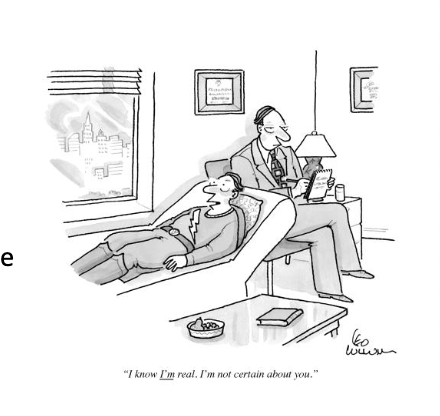
Free association
Relax on a comfortable chair. Let your mind wander. Say whatever comes into your mind, no matter how absurd, trifling, or obscene.
By relaxing the censor that screens your everyday thoughts, this technique allows potentially WHAT material to come into WHAT.
Limitation: WHAT
Free association
Relax on a comfortable chair. Let your mind wander. Say whatever comes into your mind, no matter how absurd, trifling, or obscene.
By relaxing the censor that screens your everyday thoughts, this technique allows potentially IMPORTANT material to come into CONSCIOUS AWARENESS.
Limitation: This is like looking for a needle in a haystack.
Dream Analysis
Freud believes that the purpose of dreaming is to satisfy WHAT and to fulfill WHAT and WHAT.
Unconscious wishes and desires appear in dreams in WHAT form.
Dream analysis was a technique Freud used to uncover his patient’s disguised WHAT and WHAT.
Dream Analysis
Freud believes that the purpose of dreaming is to satisfy URGES and to fulfill UNCONSCIOUS WISHES and DESIRES.
Unconscious wishes and desires appear in dreams in DISGUISED form.
Dream analysis was a technique Freud used to uncover his patient’s disguised WISHES and DESIRES.
Dream analysis
There are two types of dream contents
WHAT
WHAT
Dream analysis
There are two types of dream contents
Manifest content
Latent content
Manifest content
The original contents in a dream (e.g., a child climbing out of a bathtub)
Latent content
the true meaning of a dream lay hidden and is only expressed in symbols (e.g., bathtub = womb of the mother; latent content > the dreamer wishes to have a child)
Case History of the Wolfman: Reconstructing the past
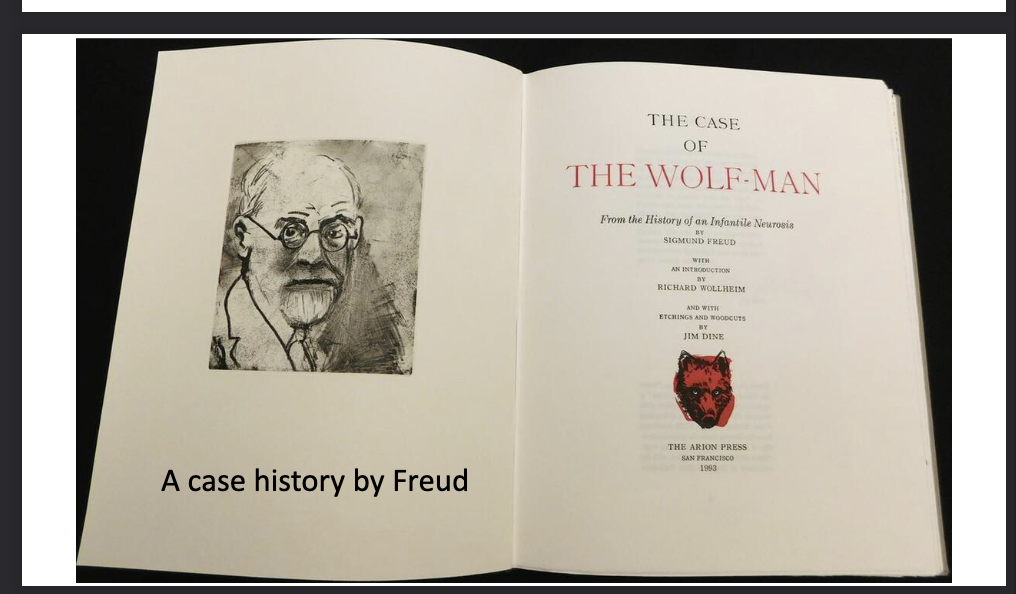
Pankejeff dreamed that he was lying in bed when all of a sudden the window swung open. Peering out, he saw six or seven white wolves sitting in the tree outside his bedroom, their eyes fixed on him. Terrified by their gaze, he woke up screaming.
Pankejeff was 23 years old when he began his treatment with Freud in February 1910.
He was in a state of complete mental collapse. A nervous breakdown some years earlier, followed by the suicides of his father and sister, had left him severely WHAT.
He was unable to travel alone, or even to dress himself, and felt as though he was cut off from the world by a veil.
Beginning with his dream, Freud analyzed the symbolic meanings of the Wolfman’s childhood experience. The climax of the story is the reconstruction of the PRIMAL WHAT—the event that had led to the patient’s WHAT.
Case History of the Wolfman: Reconstructing the past
Pankejeff dreamed that he was lying in bed when all of a sudden the window swung open. Peering out, he saw six or seven white wolves sitting in the tree outside his bedroom, their eyes fixed on him. Terrified by their gaze, he woke up screaming.
Pankejeff was 23 years old when he began his treatment with Freud in February 1910.
He was in a state of complete mental collapse. A nervous breakdown some years earlier, followed by the suicides of his father and sister, had left him severely DEPRESSED.
He was unable to travel alone, or even to dress himself, and felt as though he was cut off from the world by a veil.
Beginning with his dream, Freud analyzed the symbolic meanings of the Wolfman’s childhood experience. The climax of the story is the reconstruction of the PRIMAL SCENE—the event that had led to the patient’s DISORDERS.
Projective technique
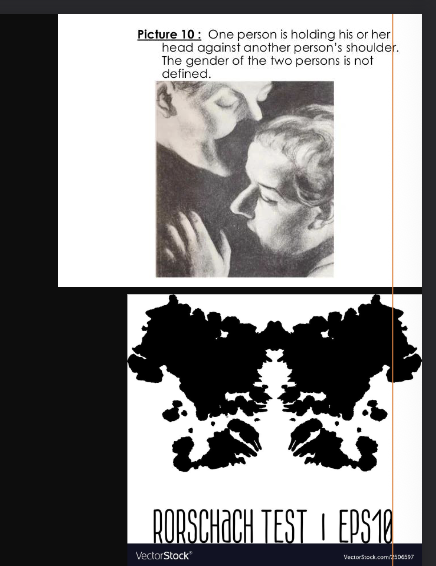
People are thought to project their own WHAT into what they
report seeing in an WHATThe ambiguous stimulus can be an inkblot, or a picture.
Projective technique
People are thought to project their own PERSONALITIES into what they
report seeing in an AMBIGUOUS STIMULUS.The ambiguous stimulus can be an inkblot, or a picture.
What are the three techniques to interpreting the inkblot test
WHAT
WHAT
WHAT
What are the three techniques to interpreting the inkblot test
Content and Themes
Response Style
Patterns of Thought
Content and themes
The specific content of what a person sees in the inkblots can reveal underlying THOUGHTS and EMOTIONS.
For example, frequent references to violence or aggression may indicate underlying anxiety or conflict, while responses focused on connection or harmony might suggest a more positive emotional state
Response Style
How individuals respond—such as the SPEED of their responses, the COMPLEXITY of their interpretations, and their EMOTIONAL expressions during the test—can provide insights into their COGNITIVE PROCESSES and EMOTIONAL FUNCTIONING.
For instance, a person who takes a long time to respond may be experiencing indecision or anxiety
Patterns of Thought
The WHAT test can help identify recurring cognitive WHAT, WHAT, or WHAT that shape an individual's worldview. This can be particularly useful in therapeutic settings to address issues related to WHAT relationships or WHAT strategies.
Patterns of Thought
The RORSCHACH test can help identify recurring cognitive PATTERNS, BIASES, or ASSUMPTIONS that shape an individual's worldview. This can be particularly useful in therapeutic settings to address issues related to INTERPERSONAL relationships or COPING strategies.
Testing Unconscious Memory Scientifically - Word-fragment Completion Task: A Projective Technique
Participants see fragments of a word and try to fill in the missing letters to make the string of letters a word that they WHAT think of.
How this technique works?
People are more likely to think of “SHAPE” than “SHADE SHAME SHARE” when they see SHA_E if they have seen the word SHAPE at an WHAT time.
Note: there should be a WHAT group or a WHAT to provide baseline measure of the likelihood that people will first think of the target word without previous WHAT to that word.
Testing Unconscious Memory Scientifically - Word-fragment Completion Task: A Projective Technique
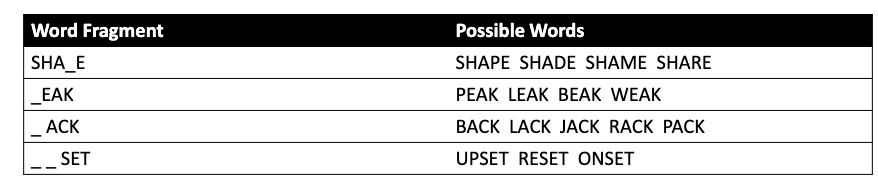
Participants see fragments of a word and try to fill in the missing letters to make the string of letters a word that they FIRST think of.
How this technique works?
People are more likely to think of “SHAPE” than “SHADE SHAME SHARE” when they see SHA_E if they have seen the word SHAPE at an EARLIER time.
Note: there should be a CONTROL group or a NORM to provide baseline measure of the likelihood that people will first think of the target word without previous EXPOSURE to that word.
How the projective technique works
Warrington & Weiskrantz (1970) asked WHAT patients to read a list of words and then tested their WHAT and WHAT of the words. The patients did worse than WHAT individuals.
However, amnesic patients’ performance on the word fragment completion task was the WHAT as healthy individuals (both groups of participants were equally likely to think of a previously read word when presented with its fragments).
Amnesic patients did not have WHAT memory of the learned words but had WHAT memory of them.
Why do we consider this a scientific method?
What are missing in Freud’s case studies that make his method not scientific?
How the projective technique works
Warrington & Weiskrantz (1970) asked AMNESIC patients to read a list of words and then tested their FREE RECALL and RECOGNITION of the words. The patients did worse than HEALTHY individuals.
However, amnesic patients’ performance on the word fragment completion task was the SAME as healthy individuals (both groups of participants were equally likely to think of a previously read word when presented with its fragments).
Amnesic patients did not have EXPLICIT memory of the learned words but had UNCONSCIOUS memory of them.
Why do we consider this a scientific method?
What are missing in Freud’s case studies that make his method not scientific?
Comparison between the five-factor model and the psychodynamic model
Five-factor model:
WHAT driven
WHAT investigative process
WHAT
Portrays a WHAT/WHAT view of personality
Psychodynamic model
WHAT driven
WHAT investigative process
WHAT
Portrays a WHAT/WHAT view of personality
Comparison between the five-factor model and the psychodynamic model
Five-factor model:
DATA driven
BOTTOM-UP investigative process
DESCRIPTIVE
Portrays a STATIC/INNATE view of personality
Psychodynamic model
THEORY driven
TOP-DOWN investigative process
EXPLANATORY
Portrays a DYNAMIC/DEVELOPMENTAL view of personality

