10. recap - power struggles against equality
 Studied by 0 people
 Call with Kai
 Learn
Learn Practice Test
 Spaced Repetition
 Match
Match Flashcards
 Knowt Play
1/15

There's no tags or description
Looks like no tags are added yet.
Name | Mastery | Learn | Test | Matching | Spaced | Call with Kai |
|---|
No study sessions yet.
16 Terms
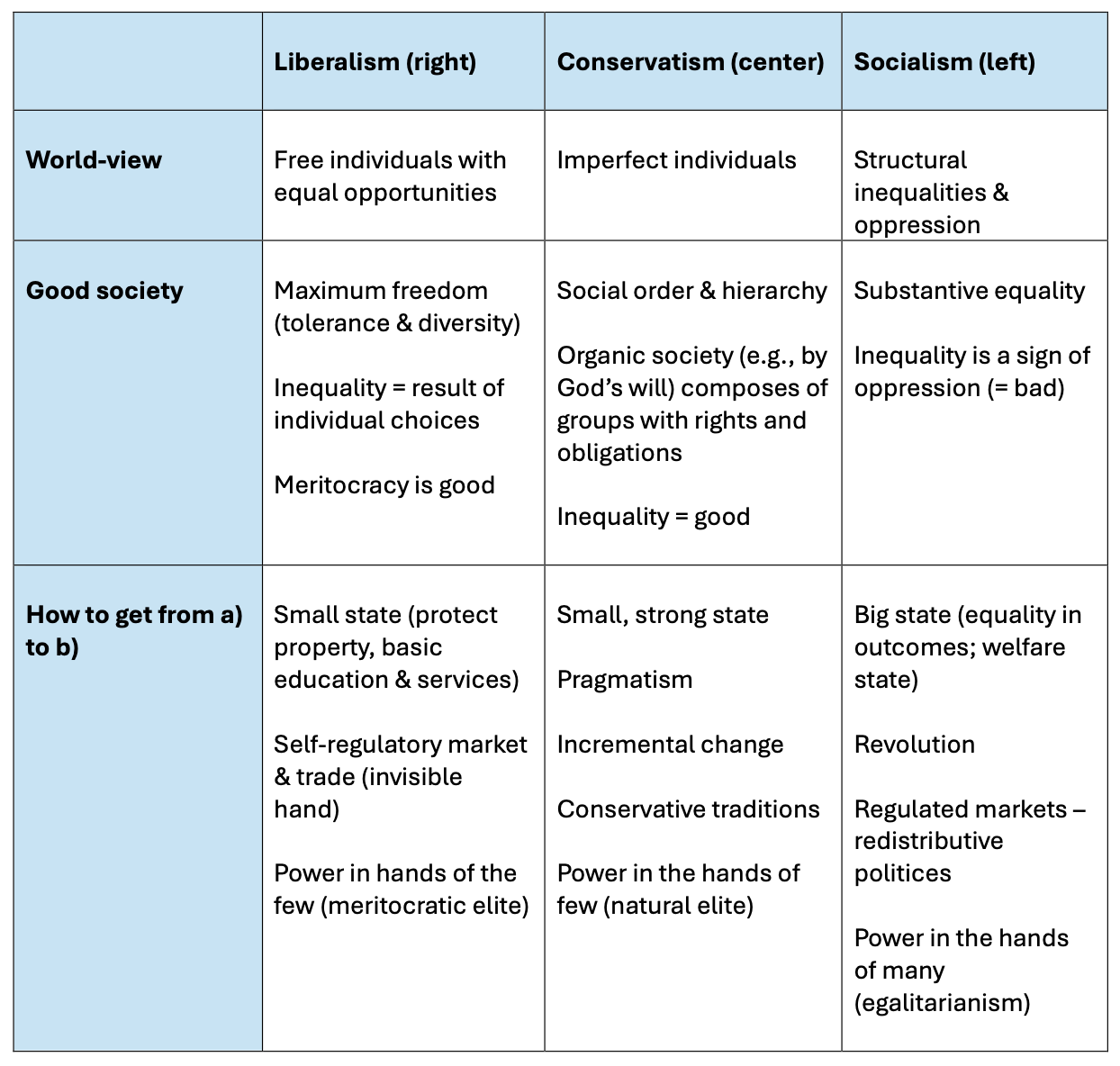
Political ideologies: building blocks
A world-view: what the society looks like now (positive & negative)
A desired future, a vision of the ‘good society’
How political change can and should be brought about – how to get from ‘world-view’ to ‘good society
Liberalism, conservatism & socialism: building blocks
What ‘does’ an ideology
Provides criteria to organize societies and institutions
political parties organize around ideologies
but not all ideologies have associated political parties; some ideologies inform many parties (liberalism, patriarchy)
Provides belief system to individuals: informs preferences and actions
Ideologies link thought and behaviour
Deep beliefs, not facts (tension between beliefs & facts; misinformation; ‘post-truth’)
Critique: indoctrinates people (tool of power)
contemporary ideologies
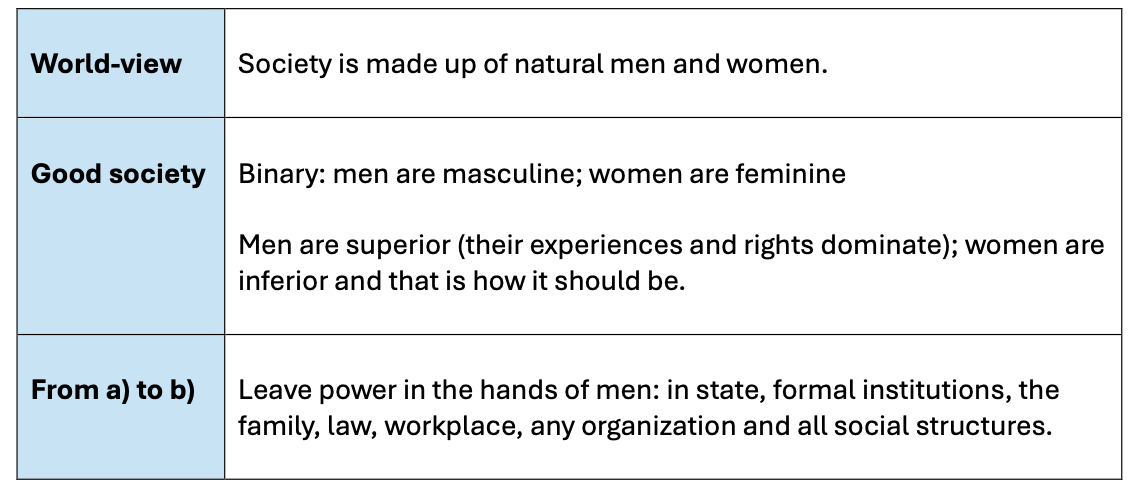
patriarchy
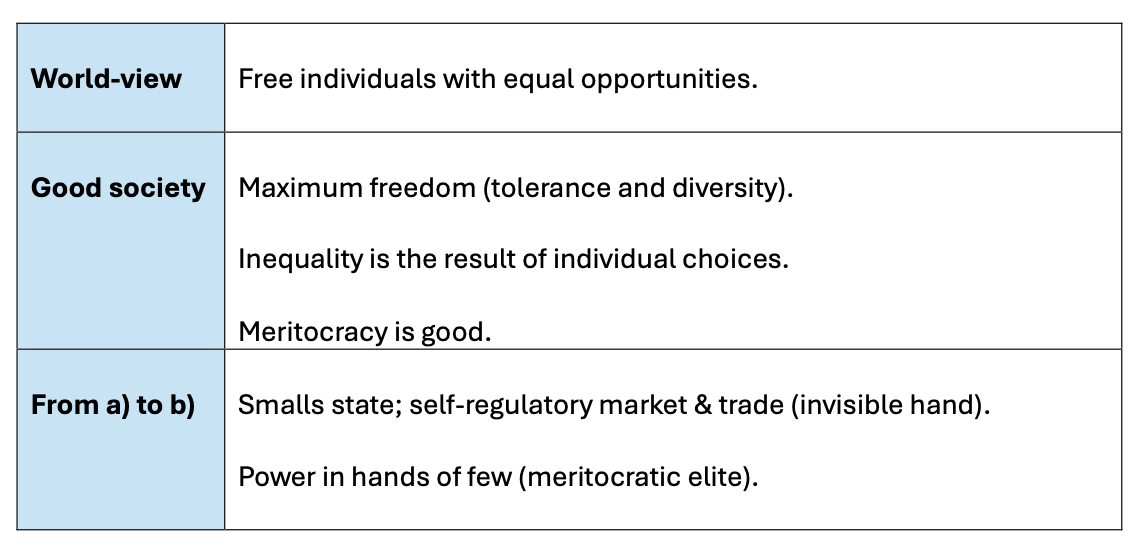
neoliberalism
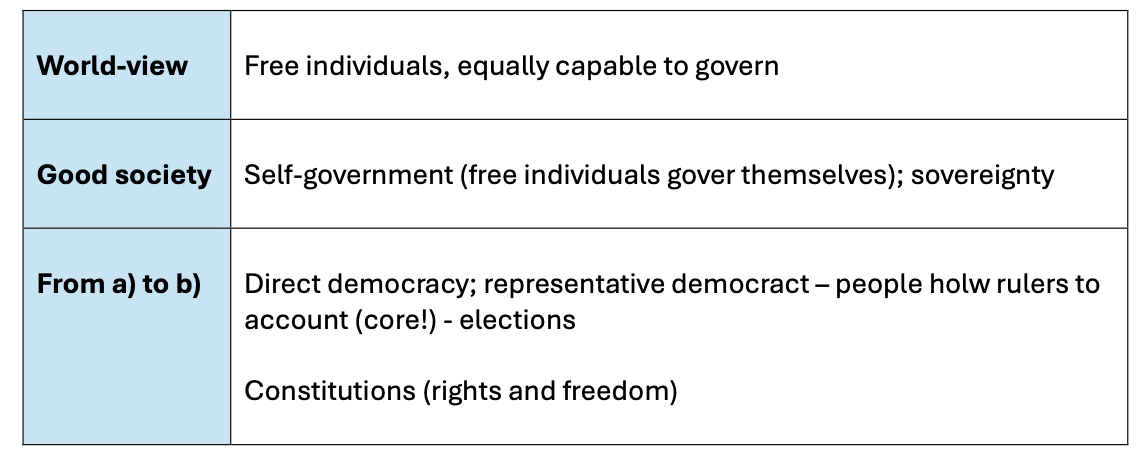
democracy
populism
Patriarchy
Neoliberalism
Democracy
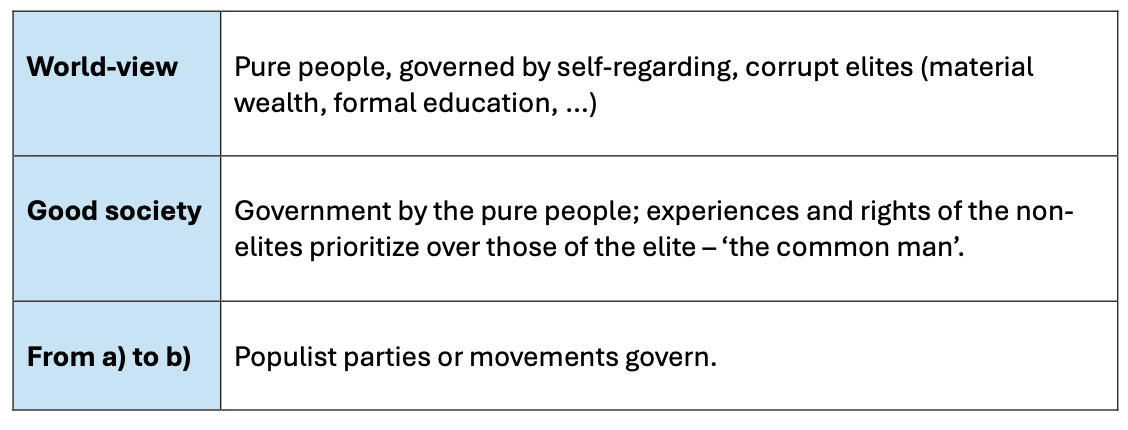
Populism (Gustin, Linders)
Populist radical right (PRR) & far-right in Europe & gender equality
Gender is trivotal
trivial → non defining for PRR ideology
Pivotel → a core social relation that is instrumentalised to center and emphasise PRR ideology
all PRR parties differ in opinions on these topics (trivial) but they all engage with it or use it (pivotal)
context
existing national culture determines the accompanying ideology and stance on gender equality
conservatism
populism mixes with conservatism in different variations:
neo-traditionalist → nostalgic return to patriarchy
modern-traditionalist → advanced in terms of women’s rights as accepted, but still traditional understanding of gender roles
e.g., women are allowed in the workforce, but duty of care is still their burden
reduced to immigration, integration or islam
gender equality as a weapon against the alleged ‘islamization’ of europe
liberal equality between men and women is seen as a national value that is under threat against foreign influences
Power struggles
Opposition to gender equality
“any activity in which a perspective opposing feminist politics and gender + equality policy is articulated in a way that can be expected to influence or is actually influencing politics or policymaking at any stage” (Verloo 2018) – opposition can happen at any stage, also without any effect
there is first a group that fights for and then a move against
Anti-gender politics
promotes a vision of society that is patriarchal, white, heteronormative and builds on the ideal of “traditional family”; attack and vilify the concept of “gender”; promote a “gender ideology” narrative
works independently from organizations and movements that promote inequality; do not necessitize groups or organizations to move against
Power struggles: agonism vs antagonism
Agonism
political adversaries disagree within a shared democratic framework
e.g., disagreeing what (in)equality means, ethnic minority women disagreeing with white feminist movements, …
= healthy democratic struggle
Antagonism
hostile conflict between enemies who do not recognise each other’s legitimacy (cf. GL An Van Bavel)
beyond the democratic framework
Discursive approach (Gustin)
A discurvise-theoretical approach explores the ways in which “gender is theorized as a discourse and a practice that is continuously contested and constructed in political debates.
Far-right trilogy
nativism (racist & xenophobic)
populism
authoritarianism
Distinction between liberal racisms (cultural, e.g., islamophobia) and illiberal racism (biological, more extreme right). Within the liberal ideology there’s a cultural racism that can thrive.
Far-right accuses feminism of
being an ideology → feminism IS an ideology, but FR accuses it of brainwashing society with a gender ideology
feminism has gone too far → backlash against progress; but also backlash without progress: anti-gender campaigns where gender serves as a glue to bring thinkers and actors together
feminism being outdated → post-feminist society - depoliticisation (> < 1 & 2, which is politicisation)
Discursive approach: paradoxes (Gustin)
Paradoxes:
Being sexist, racist and homophobic, yet being defenders of women’s & gay rights (e.g., Pim Fortuyn)
paradox between the racialisation of patriarchy (e.g., Muslims are sexist and a danger to women) & anti-gender discourses
Linders → PRR leaders can even be openly gay (e.g., Pim Fortuyn) and have a patriarchal discourse
Differences amongst far-right leaders (Linders)
There are differences amongst far-right politicians, ending up in the same place
E.g., Appealing to ’the common man’ in different ways (see videos)
Paradox often returns in these PRR and their discursive approaches – but Gustin & Linders argue to discuss the coherence! The focus on paradoxes seems to overlook both the discursive coherence of far-right parties’ gender discourses, as well as their strategical dimension. By having different discourses, parties like Vlaams Belang are able to attract different audiences and take on internal diversity.
Discursive coherence and strategy
Racialisation of patriarchy and homophobia = Femo/homoracism (rather than femo/homonationalism): discourse of Western ‘sexual exceptionalism’
Gustin argues to label these discourses as racism!
Conservative party logic; consistently patriarchal/binary; supportive of hegemonic masculinity/sexuality power relations
Articulation of liberal signifiers (freedom of speech, choice, gender equality, secularism) with reactionary politics
Direct opposition: rejection; refer to gender ideology
Indirect opposition: bending, self- victimization, de-politicization
1) bending → the meaning of gender equality is bent toward issues and goals other than gender equality, such as migration and islamophobia
2) victimization → ‘we cannot say anything anymore these days’ – oppressed men are the victim
3) depoliticization → e.g., entire concept of trans is ignored, doesn’t exist, not a political topic, …
institutional approach (Berthet)
EP historically defender of equality
but, also…
opposition to gender equality (e.g., Istanbul convention)
tensions between and within PGs, debates on human rights and gender issues, …
result → arena allowing the development of an alternative (far right, anti gender) political project
anti-gender campaigns and activism
promotion of authoritarianism against minority rights
This is not only about sexual / gender rights, but about authoritarianism vs democracy & gender is the battlefield
Depict advocates of women and minority rights as threats to traditional values and national identity & justifying violence against them
Multiple actors: politicians, parliamentarians, civil society actors, members of the clergy and intellectuals, both at national and transnational level
Multiple actors are linked
tactics
lobbying, advocacy, mobilisation and street protests, litigation, new
policies and persecution of feminist and LGBTIQ+ activist, scholars and advocates
EU ‘uncivil’ society actors’ strategies: use bullying strategies, misinformation tactics with an anti-right agenda and with the aim to polarize democratic political debate
Feminist institutional responses (Berthet)
knowledge
consistent discourse of EU democracy & values
calling out misinformation and raising awareness
coalition building
within institutions and outside acotrs
within and across PGs
cross-generational
making and using rules
setting the agenda
blue cards → polite way to comment on a speech and receive a response - confront racism and hate speech
rules of procedure → request assessments of hate speech from plenary chair
everyday pragmatic engagement
disengagement with FR politicians
but also opposite → engagement within a democratic framework - forcing anti-democratic actors to behave in a democratic way
Academic responses (Mügge)
Interdisciplinary & transdisciplinary co-creation
Academics, activists, performative artists
Building democratic & inclusive masculinity alternatives
>< anti-democratic, violent masculinities
Building evidence-based interventions
Barber training, focus on sports clubs, bystander training for boys, …
 Note
Note  Flashcards (41)