3. Causes of Earthquakes & Volcanoes
 Studied by 0 people
 Call with Kai
 Learn
Learn Practice Test
 Spaced Repetition
 Match
Match Flashcards
 Knowt Play
1/16

There's no tags or description
Looks like no tags are added yet.
Name | Mastery | Learn | Test | Matching | Spaced | Call with Kai |
|---|
No analytics yet
Send a link to your students to track their progress
17 Terms
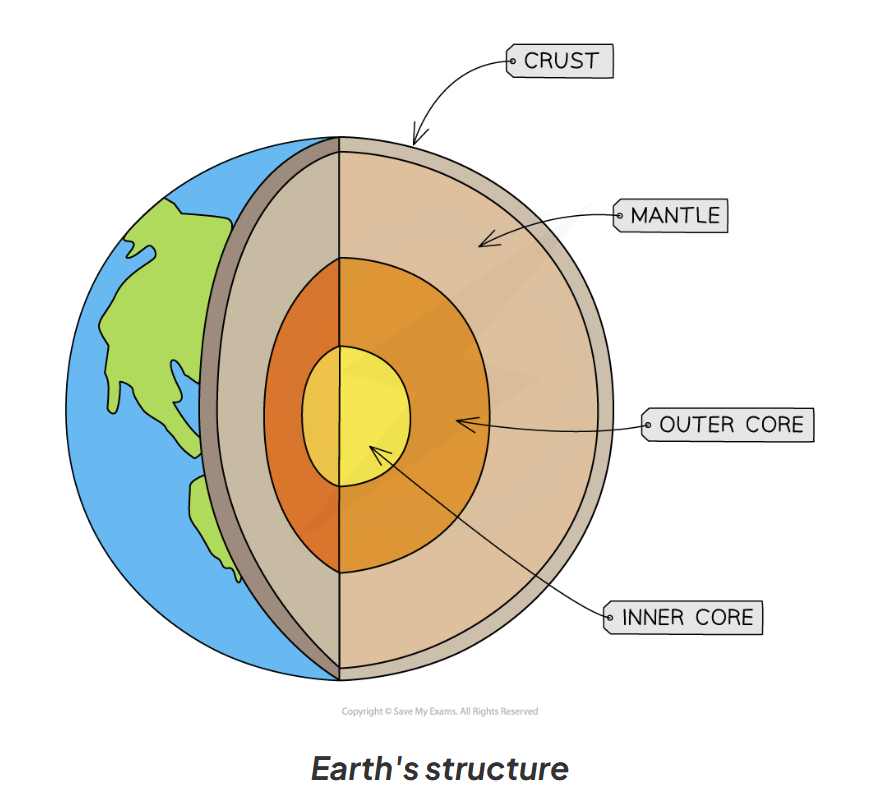
What are the four main layers of the earth composed of?
each layer
diameter
composure - made of
temperature
Inner core:
around 1400km in diameter
composed of iron and nickel
temperatures of about 5500°C
Outer core:
about 2100km thick
composed of a semi-molten metal layer
temperatures of between 5000 - 5500°C
Mantle:
about 2900km thick
composed of a semi-molten layer but less dense than outer core
Crust:
the thickness varies
made of 2 types of crusts: continental (25-90km) & Oceanic crust (5-10km)
Describe the Earth’s crust and explain the difference between continental and oceanic crust (4-5 marks)
The earth has 2 types of crusts: continental and oceanic
the Continental crust is thicker (25-90km), older and less dense
the Oceanic crust is thinner (5-10km) and denser/heavier
because it is denser, the oceanic crust pushes beneath the continental crust at the plate boundaries.
What is plate tectonics and why do tectonic plates move? (4-marks)
The Earth’s crust is broken into tectonic plates (e.g. Eurasian, African, Pacific).
These plates move on top of the semi-molten mantle.
Plate movement is partly caused by convection currents in the mantle.
A plate boundary (margin) is where two tectonic plates meet.
What are the types of plate boundaries?
divergent (constructive)
convergent (destructive)
Collision
Transform (conservative)
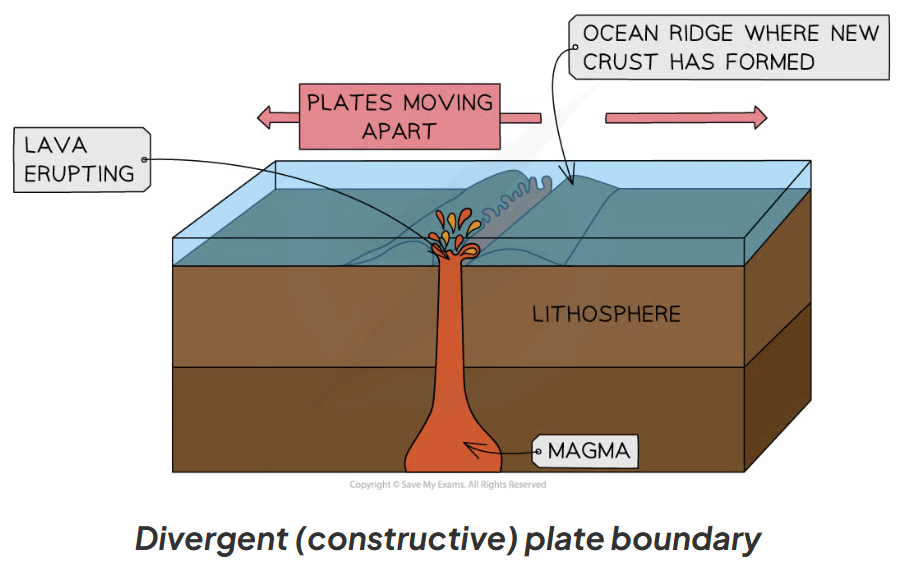
Describe a divergent (constructive) plate boundary and give an example.
At a divergent (constructive) boundary, tectonic plates move apart.
Magma rises from the mantle to fill the gap, creating new crust.
Volcanic eruptions and shallow earthquakes occur at this boundary.
An example is the Mid-Atlantic Ridge.
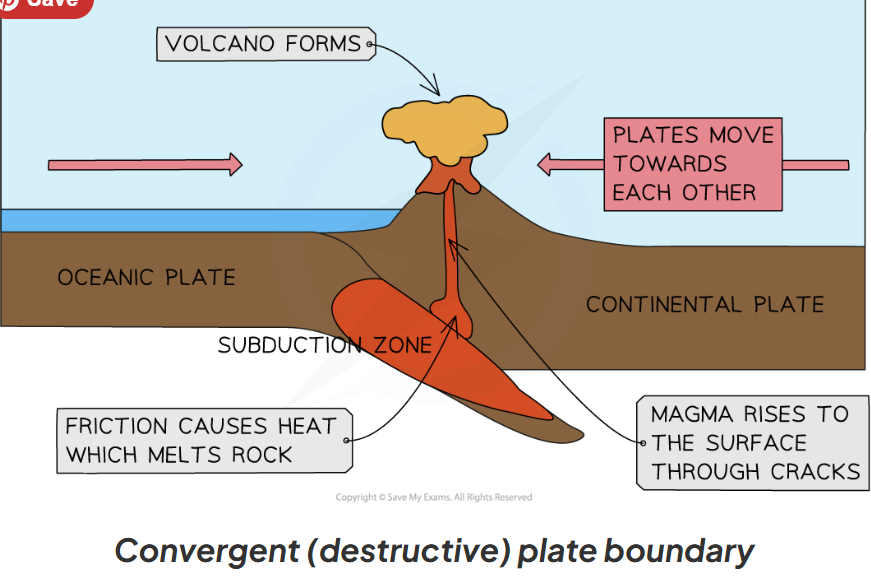
Describe a convergent (destructive) plate boundary and give an example.
At a convergent (destructive) boundary, plates move towards each other.
The denser oceanic plate subducts beneath the less dense continental plate. → cause its heavier
This creates volcanoes and powerful earthquakes.
An example is the boundary between the Nazca Plate and the South American Plate.
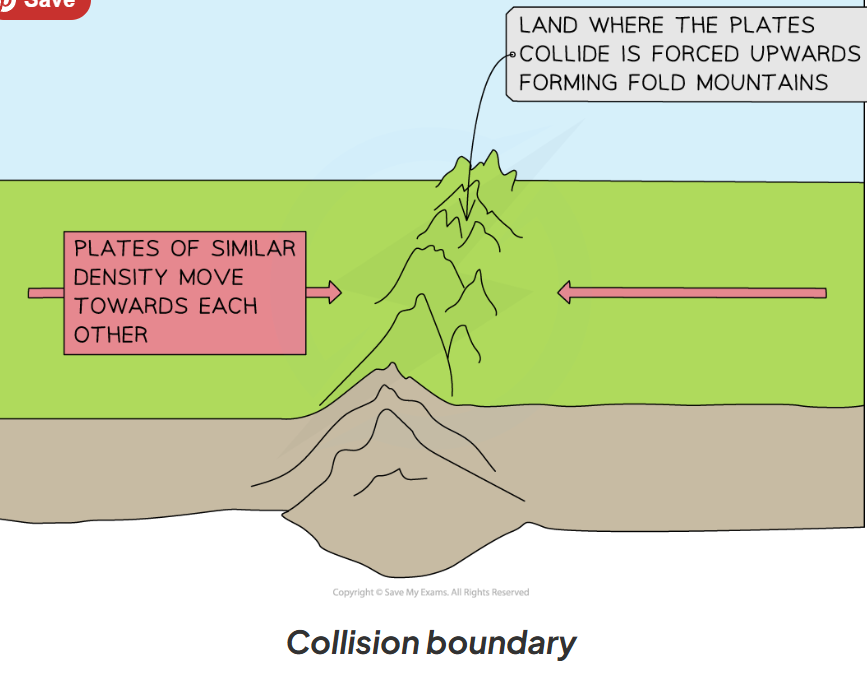
Describe a collision plate boundary and name a landform it creates
At a collision boundary, two plates of similar density move towards each other.
Neither plate subducts, so the crust is pushed upwards.
This forms fold mountains, such as the Himalayas.
Earthquakes are the main hazard at this boundary.
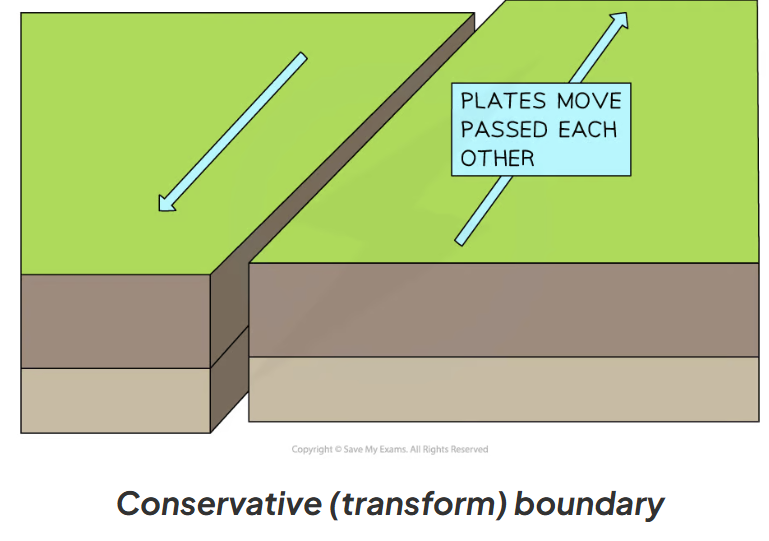
Describe a transform (conservative) plate boundary and state the hazard it causes
At a transform (conservative) boundary, plates slide past each other.
They may move in opposite directions or the same direction at different speeds.
No magma is produced, so no volcanoes form.
Earthquakes are the only hazard at this boundary.
Where do volcanoes occur and where do they not occur?
Volcanoes occur at constructive (divergent) boundaries, destructive (convergent), and hot spots.
Volcanoes do not occur at collision boundaries or transform (conservative) boundaries.
Explain how volcanoes form at constructive (divergent) plate boundaries.
Plates move apart, usually under the ocean.
Lava rises through the gap left by separating plates.
Lava cools and hardens, forming new crust.
Lava is runny, so eruptions are gentle.
Forms shield volcanoes with gentle slopes.
Explain how volcanoes form at destructive (convergent) plate boundaries.
Plates move towards each other.
Denser oceanic plate subducts beneath the continental plate.
Friction and heat melt plate material, forming magma.
Magma rises through cracks in the crust.
Explosive eruptions occur due to sticky lava.
Forms composite (strato) volcanoes.
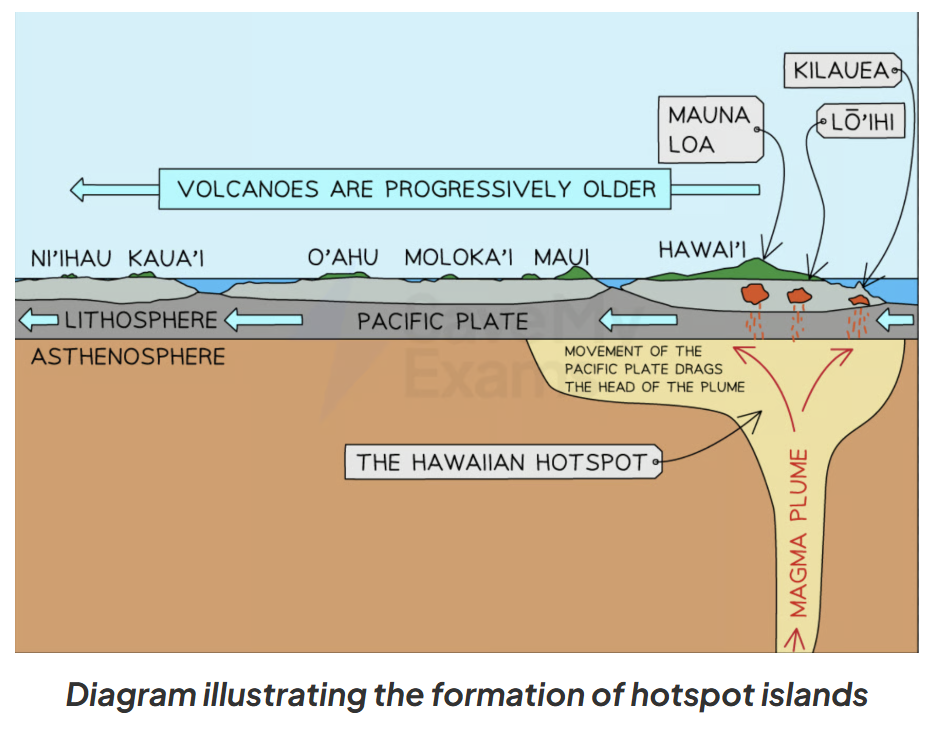
Explain how volcanoes form at hot spots.
A tectonic plate moves over a stationary magma plume.
Magma rises through cracks in the crust.
As the plate moves, a chain of volcanoes/islands forms.
Example: Hawaii.
Compare lava type and eruption style at constructive and destructive boundaries.
Constructive boundaries: runny lava → gentle eruptions → shield volcanoes.
Destructive boundaries: sticky lava → explosive eruptions → composite volcanoes.
Where do earthquakes mainly occur and why?
Earthquakes can occur anywhere, but mostly at or near plate boundaries.
This is where plates move, collide, or slide past each other, building up pressure.
Compare earthquake strength at different plate boundaries.
Constructive (divergent): earthquakes tend to be weaker as plates move apart.
Destructive, collision, and conservative: earthquakes tend to be stronger due to greater friction and pressure build-up.
Explain why earthquakes at some plate boundaries are more hazardous.
Plates can lock together, allowing pressure to build up.
When released suddenly, strong earthquakes occur.
This is most common at destructive, collision, and conservative boundaries.
 Note
Note  Flashcards (194)