AP Bio Unit 6 MCQs
 Call Kai
 Learn
Learn Practice Test
 Spaced Repetition
 Match
Match Flashcards
 Knowt Play
1/31

There's no tags or description
Looks like no tags are added yet.
Name | Mastery | Learn | Test | Matching | Spaced | Call with Kai |
|---|
No analytics yet
Send a link to your students to track their progress
32 Terms
Which of the following best describes a characteristic of DNA that makes it useful as hereditary material?
Responses
A
There are many different types of nucleotide bases that can be incorporated into DNA.
B
The nucleotide bases can also be used to provide the energy needed for reproduction.
C
Nucleotide bases can be randomly replaced with different nucleotide bases to increase variation.
D
Nucleotide bases in one strand can only be paired with specific bases in the other strand.
D
Nucleotide bases in one strand can only be paired with specific bases in the other strand.
Which of the following best describes a characteristic of the process shown in Figure 1 that is unique to prokaryotes?
Responses
A
The mRNA is synthesized in a 5′ to 3′ direction.
B
A single strand of the DNA is being used as a template for the transcription of the mRNA.
C
The translation of the mRNA is occurring while the mRNA is still being transcribed.
D
The enzyme that is transcribing the mRNA is RNA polymerase.
C
The translation of the mRNA is occurring while the mRNA is still being transcribed.
Which of the following is closest to the number of amino acids encoded by the mRNA produced from the pre-mRNA shown in Figure 1 ?
Responses
A
265
B
396
C
838
D
1,188
A
265
When DNA replicates, each strand of the original DNA molecule is used as a template for the synthesis of a second, complementary strand. Which of the following figures most accurately illustrates enzyme-mediated synthesis of new DNA at a replication fork?
goes 3 to 5, okazaki on 5 to 3
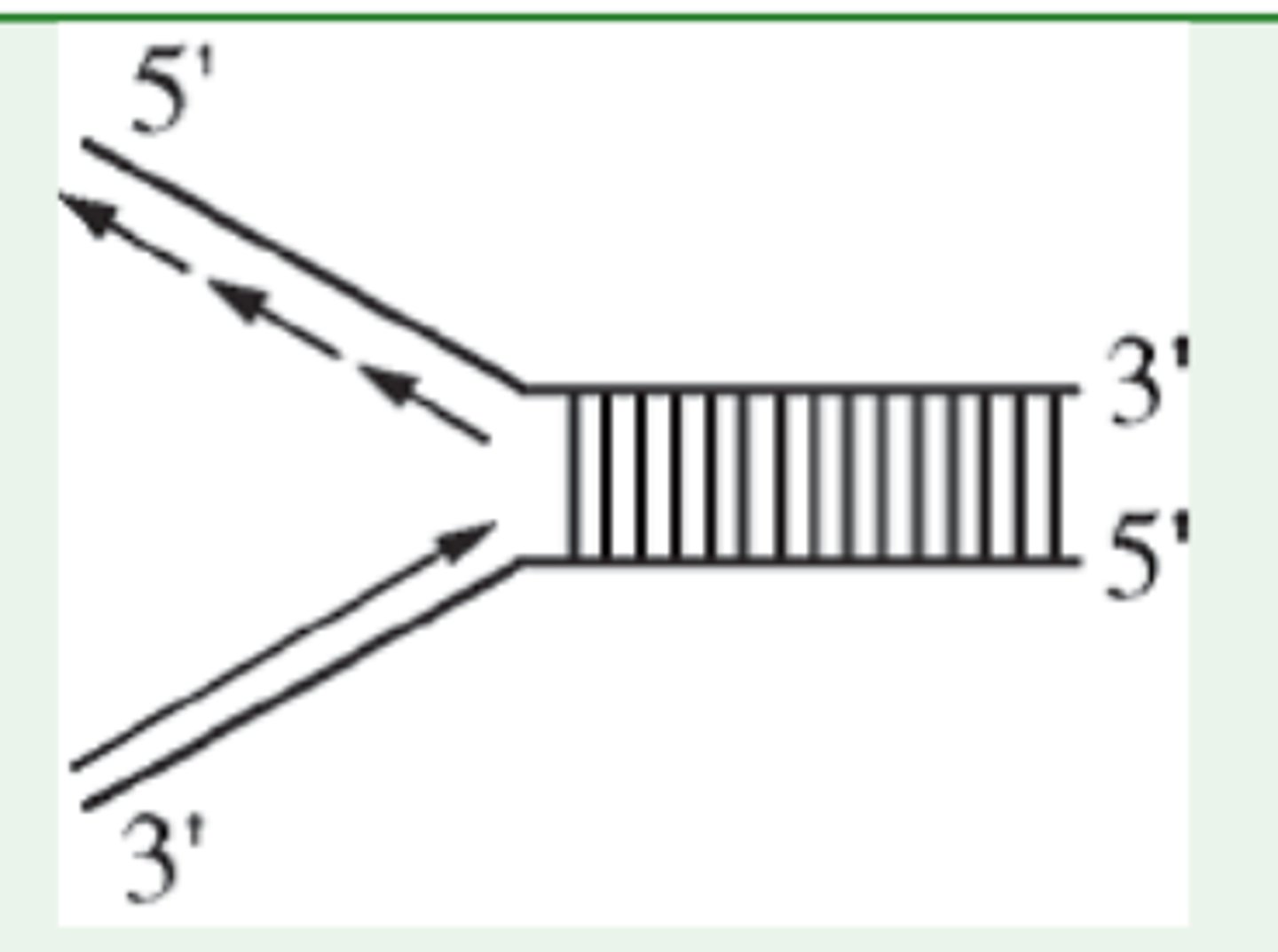
Which of the following best describes the model shown in Figure 1 ?
Responses
A
The model shows how genetic information directs the synthesis of polypeptides.
B
The model shows how a mutation in the DNA results in a nonfunctional protein.
C
The model shows how information in the mRNA can be used to make both protein and DNA.
D
The model shows how proteins are needed for the synthesis of both DNA and RNA.
A
The model shows how genetic information directs the synthesis of polypeptides.
Which of the following best explains why ligase is required for DNA replication?
Responses
A
The lagging strand cannot be replicated continuously, and ligase is needed to join the fragments.
B
Ligase forms the hydrogen bonds between complementary bases in the two strands of DNA.
C
Ligase facilitates the binding of RNA polymerase to the promoter region.
D
Ligase enables the newly synthesized DNA to twist into a double helix.
A
The lagging strand cannot be replicated continuously, and ligase is needed to join the fragments.
Which of the following correctly explains where DNA replication will begin on the strand oriented 5′→3′, reading from left to right?
Responses
A
DNA replication will be randomly initiated along the unwound portion of the DNA strand since base pairing will occur.
B
DNA replication cannot occur since there is already RNA base pairing with the template strand.
C
DNA replication will be initiated immediately to the left of the RNA, since DNA polymerase requires an RNA primer.
D
DNA replication will be initiated at the site of the topoisomerase since that is where DNA begins to uncoil.
C
DNA replication will be initiated immediately to the left of the RNA, since DNA polymerase requires an RNA primer.
Which of the following samples most likely contains a double-stranded RNA virus?
Responses
A
Sample 1
B
Sample 2
C
Sample 3
D
Sample 4
A
Sample 1
Which of the following describes the most direct effect of a mutation in the DNA that encodes a cell’s rRNA?
Responses
A
The cell’s ability to transport the amino acids needed for translation will be reduced.
B
The cell’s ability to transcribe RNA transcripts that will be translated will be reduced.
C
The cell’s ability to properly assemble ribosomes and initiate translation will be reduced.
D
The cell’s ability to modify proteins after they have been assembled will be reduced.
C
The cell’s ability to properly assemble ribosomes and initiate translation will be reduced.
Which of the following best describes an event during step 2 in the simplified model above?
Responses
A
A new RNA molecule is synthesized using a DNA template.
B
A new polypeptide is synthesized using an RNA template.
C
Thymine nucleotides in an RNA molecule are replaced with uracil nucleotides.
D
Noncoding sequences are removed from a newly synthesized RNA molecule.
D
Noncoding sequences are removed from a newly synthesized RNA molecule.
The features of this model provide evidence for which explanation of why all growing strands are synthesized in a 5′ to 3′ direction?
Responses
A
The two strands need to be antiparallel to bond properly.
B
Thymine and adenine would not bond properly if the strand grew from 3′ to 5′.
C
The translation of mRNA occurs in the 5′ to 3′ direction; therefore, the growing DNA strand must also grow in the 5′ to 3′ direction.
D
The phosphate group, attached to the 5′ carbon of the dTMP, forms a covalent bond with the oxygen atom attached to the 3′ carbon of the growing strand.
D
The phosphate group, attached to the 5′ carbon of the dTMP, forms a covalent bond with the oxygen atom attached to the 3′ carbon of the growing strand.
Which of the following claims about the TYR, TRP2, and TRP1 mammalian genes is most likely to be accurate?
Responses
A
The TYR, TRP2, and TRP1 genes are located next to each other on a single chromosome and are organized into an operon.
B
The TYR, TRP2, and TRP1 genes may be located on different chromosomes but are activated by the same transcription factor.
C
The TYR, TRP2, and TRP1 genes are identical genes since they are activated by the same transcription factor.
D
The TYR, TRP2, and TRP1 genes may be located on different chromosomes but with identical operator sequences.
B
The TYR, TRP2, and TRP1 genes may be located on different chromosomes but are activated by the same transcription factor.
Which of the following claims best explains why keratinocytes do not produce melanin?
Responses
A
Keratinocytes do not contain the TYR, TRP2, and TRP1 genes.
B
Keratinocytes do not contain the MC1R gene.
C
Keratinocytes do not express the MITF gene.
D
Keratinocytes do not express the POMC gene.
C
Keratinocytes do not express the MITF gene.
Which of the following pieces of evidence would best support the researchers’ claim above?
Responses
A
When researchers applied a drug that activates adenylyl cyclase to the mutant mice’s ears, the level of melanin increased.
B
When researchers viewed sections of mutant mouse ears under the microscope, they found melanocyte numbers comparable to nonmutant mice.
C
When researchers exposed the mutant mice to UV radiation, the amount of POMC mRNA in keratinocytes did not change.
D
When researchers exposed the mutant mice to UV radiation, the level of melanin production did not change.
A
When researchers applied a drug that activates adenylyl cyclase to the mutant mice’s ears, the level of melanin increased.
Based on the information provided in Figure 1 and Figure 2, which of the following best explains the effects of a mutation in the promoter of the TYR gene that prevents it from being transcribed?
Responses
A
DNA damage due to UV radiation will be strongly inhibited, resulting in a positive selection pressure.
B
DNA damage due to UV radiation will be strongly inhibited, resulting in a negative selection pressure.
C
Skin pigmentation will not be able to change, resulting in a positive selection pressure.
D
Skin pigmentation will not be able to change, resulting in a negative selection pressure.
D
Skin pigmentation will not be able to change, resulting in a negative selection pressure.
Which of the following best explains a process occurring between point 1 and point 2 in Figure 3 ?
Responses
A
α–MSH is produced.
B
The TYR gene is transcribed.
C
Polypeptides are removed from a protein.
D
A poly‑A tail is added to RNA.
D
A poly‑A tail is added to RNA.
Which of the following statements best explains the experimental results observed in Figure 1 ?
Responses
A
E. coli in both lanes B and C have been successfully transformed and contain additional genetic information.
B
E. coli in lane B have been successfully transformed and contain additional genetic information.
C
E. coli in lane C have been successfully transformed and contain additional genetic information.
D
Which E. coli have been transformed cannot be determined from this gel.
C
E. coli in lane C have been successfully transformed and contain additional genetic information.
Which of the following best explains how the results should be interpreted?
Responses
A
The individual does not have an increased risk of developing cancer because one dominant allele is insufficient to cause the disease.
B
The individual has an increased risk of developing colon cancer.
C
Because the person’s DNA has the mutation, other family members must have cancer.
D
Results cannot be interpreted until testing determines if additional mutated alleles are present.
B
The individual has an increased risk of developing colon cancer.
Given the results shown in Figure 1, which of the following correctly describes a relationship between the two species?
Responses
A
Species B is the ancestor of species A because it has fewer bands.
B
Species A is more complex than species B because it has more bands.
C
Species B has more short fragments of DNA than species A does.
D
Species A has more short fragments of DNA than species B does.
C
Species B has more short fragments of DNA than species A does.
Which of the following best helps explain how the process represented in Figure 1 produces DNA molecules that are hybrids of the original and the newly synthesized strands?
Responses
A
Each template strand is broken down into nucleotides, which are then used to synthesize both strands of a new DNA molecule.
B
Each template strand is broken into multiple fragments, which are randomly assembled into two different DNA molecules.
C
Each newly synthesized strand is associated with another newly synthesized strand to form a new DNA molecule.
D
Each newly synthesized strand remains associated with its template strand to form two copies of the original DNA molecule.
D
Each newly synthesized strand remains associated with its template strand to form two copies of the original DNA molecule.
Which of the following best predicts what will happen when a normal cell is exposed to a retrovirus?
Responses
A
The reverse transcriptase will cut the host DNA into fragments, destroying the host cell.
B
The reverse transcriptase will insert the viral RNA into the host’s genome so it can be transcribed and translated.
C
The reverse transcriptase will produce DNA from the viral RNA, which can be incorporated into the host’s genome and then transcribed and translated.
D
The reverse transcriptase will force the host ribosomes to translate the viral RNA prior to polypeptide assembly.
C
The reverse transcriptase will produce DNA from the viral RNA, which can be incorporated into the host’s genome and then transcribed and translated.
Which of the following statements best explains what is shown in Figure 1 ?
Responses
A
UV exposure triggers DNA replication, which results in rapid cell proliferation.
B
Naturally occurring dimers are removed by the UV photons, causing misshapen DNA, which results in replication errors.
C
The hydrogen bonds between base pairs absorb the UV photons, separating the two DNA strands, which results in rapid DNA replication.
D
UV photons cause dimers to form, leading to misshapen DNA, which results in replication and transcription errors.
D
UV photons cause dimers to form, leading to misshapen DNA, which results in replication and transcription errors.
Which of the following evidence best supports a claim that tryptophan functions as a corepressor?
Responses
A
Normal expression of trpR causes the trp operon to be transcribed regardless of tryptophan levels.
B
When the operator sequence is mutated, the trp operon is not transcribed.
C
The trpR gene codes for a repressor protein that has a DNA binding domain.
D
When trpR is mutated, the trp operon is transcribed regardless of tryptophan levels
D
When trpR is mutated, the trp operon is transcribed regardless of tryptophan levels
A cell needs to metabolize the substrate illustrated in Figure 1 for a vital cellular function. Which of the following best explains the long-term effect on the cell of splicing that yields only enzyme C mRNA?
Responses
A
The cell will die because it is unable to metabolize the substrate without enzyme A, which is structurally specific for the substrate shown.
B
The cell will remain healthy because all three of the above enzymes can metabolize the substrate, as they are from the same gene.
C
The cell will remain healthy because the enzyme C mRNA will undergo alternative splicing again until it transformed into enzyme A mRNA.
D
The cell will remain healthy because enzyme-substrate interactions are nonspecific and enzyme C will eventually metabolize the substrate.
A
The cell will die because it is unable to metabolize the substrate without enzyme A, which is structurally specific for the substrate shown.
Which of the following statements best explains the role of Enzyme 1 in the DNA replication process?
Responses
A
Enzyme 1 is a DNA ligase that joins together the DNA fragments at a replication fork to form continuous strands.
B
Enzyme 1 is a DNA primase that catalyzes the synthesis of RNA primers on the lagging strand of a replication fork.
C
Enzyme 1 is a DNA polymerase that synthesizes new DNA by using the leading and lagging strands of a replication fork as templates.
D
Enzyme 1 is a topoisomerase that relieves tension in the overwound DNA in front of a replication fork.
D
Enzyme 1 is a topoisomerase that relieves tension in the overwound DNA in front of a replication fork.
Which of the following best supports the claim that binding of miRNA‑delta to the miRNA binding site inhibits translation of gene Q mRNA?
Responses
A
When the promoter for gene Q is altered, transcription is inhibited.
B
Translation of Q mRNA is inhibited regardless of whether the miRNA binding site sequence is altered.
C
Translation of Q mRNA is inhibited in the absence of miRNA‑delta.
D
When the miRNA binding site sequence is altered, translation of Q mRNA occurs in the presence of miRNA-delta.
D
When the miRNA binding site sequence is altered, translation of Q mRNA occurs in the presence of miRNA-delta.
Which of the following statements provides the best explanation of the processes illustrated in Figure 1 ?
Responses
A
Introns are removed from the pre-rRNA, and the mature rRNA molecules are joined and then translated to produce the protein portion of the ribosome.
B
Introns are removed from the pre-rRNA, and each mature rRNA molecule is translated to produce the proteins that make up the ribosomal subunits.
C
Sections of the pre-rRNA are removed, and the mature rRNA molecules are available to combine with proteins to form the ribosomal subunits.
D
Sections of the pre-rRNA are removed, and the mature rRNA molecules are available to bring different amino acids to the ribosome.
C
Sections of the pre-rRNA are removed, and the mature rRNA molecules are available to combine with proteins to form the ribosomal subunits.
A woman develops Huntington’s disease. Her father had the disorder. Her mother did not, and there is no history of the disorder in the mother’s family. Which of the following best explains how the woman inherited Huntington’s disease?
Responses
A
She inherited an allele with fewer than 40 CAG repeats in the HTT gene because her mother did not have Huntington’s disease.
B
She inherited an allele with more than 40 CAG repeats in the HTT gene from her father.
C
Her mother produced eggs that all have more than 40 repeats in the HTT gene.
D
Her mother produced eggs that all have fewer than 40 CAG repeats in the HTT gene.
B
She inherited an allele with more than 40 CAG repeats in the HTT gene from her father.
Which of the following best explains how this model illustrates DNA replication of both strands as a replication fork moves?
Responses
A
I and IV are synthesized continuously in the 5′ to 3′ direction.
B
II and III are synthesized in segments in the 3′ to 5′ direction.
C
I is synthesized continuously in the 5′ to 3′ direction, and III is synthesized in segments in the 5′ to 3′ direction.
D
II is synthesized in segments after DNA polymerase is released from synthesizing strand IV.
C
I is synthesized continuously in the 5′ to 3′ direction, and III is synthesized in segments in the 5′ to 3′ direction.
Which claim is most consistent with the information provided by the diagram and current scientific understanding of gene regulation and expression?
Responses
A
Reversible changes in the DNA sequence may influence how a gene is expressed in a cell.
B
Some sequences of DNA can interact with regulatory proteins that control transcription.
C
This is an inducible operon controlled by several regulatory factors.
D
The transcription factor may produce mutations in the binding site at the promoter sequence inhibiting the synthesis of the protein.
B
Some sequences of DNA can interact with regulatory proteins that control transcription.
Based on the information in Figure 1, which type of mutation explains the nature of the change in DNA that resulted in cystic fibrosis in the affected individual?
Responses
A
Substitution, because the amino acid tryptophan is replaced with glycine.
B
Insertion, because an extra guanine is present, which changes the reading frame.
C
Deletion, because a thymine is missing, which changes the reading frame.
D
Duplication, because the amino acid leucine occurs twice, which changes the reading frame.
C
Deletion, because a thymine is missing, which changes the reading frame.
Nucleotide base pairing in DNA is universal across organisms. Each pair (T−A; C−G) consists of a purine and a pyrimidine. Which of the following best explains how the base pairs form?
Responses
A
Ionic bonds join two double-ringed structures in each pair.
B
Hydrogen bonds join two single-ringed structures in each pair.
C
Hydrogen bonds join a double-ringed structure to a single-ringed structure in each pair.
D
Covalent bonds join a double-ringed structure to a single-ringed structure in each pair.
C
Hydrogen bonds join a double-ringed structure to a single-ringed structure in each pair.

