Astrophysics
 Call Kai
 Learn
Learn Practice Test
 Spaced Repetition
 Match
Match Flashcards
 Knowt Play
1/176

There's no tags or description
Looks like no tags are added yet.
Name | Mastery | Learn | Test | Matching | Spaced | Call with Kai | Chat |
|---|
No analytics yet
Send a link to your students to track their progress
177 Terms
What is the purpose of a convex lens?
It focuses incident light
What is a convex lens also known as?
A converging lens
What is the purpose of a concave lens?
It spreads out light
What is a concave lens also known as?
A diverging lens
What is the principal axis?
The line passing through the centre of the lens perpendicular to its surface
What is the principle focus of a converging lens?
The point where incident beans passing parallel to the principal axis will converge
What is the principle focus of a diverging lens?
The point from which light rays appear to come from before passing through the lens
Define focal length.
The distance between the centre of a lens and the principle focus
What is the relationship between focal length and lens strength?
The shorter the focal length, the stronger the lens
Explain the difference between a real and a virtual image.
A real image is formed when light rays cross after refraction, and therefore can be formed on a screen
A virtual image is formed on the same side of the lens as the rays approach, so they do not cross and the image cannot be formed on a screen
State the lens formula.
1/(distance from object) + 1/(distance from image) = 1/(focal length)
Define lens power?
A measure of how closely a lens can focus a beam parallel to the principal axis
How does the lens power value differ between converging and diverging lenses?
Converging = positive
Diverging = negative
What is lens power measured in?
Dioptres (D)
What is a refracting telescope made up of?
2 converging lenses (objective and eyepiece)
Give the properties of an objective lens in a refracting telescope.
It collects light to create a real image
Has a long focal length
Large to collect as much light as possible
Give the properties of an eyepiece lens in a refracting telescope.
Magnifies the image produced by the objective lens
Produces a virtual image at infinity
Reduces eye strain so the observes doesn’t have to refocus
What is the normal adjustment for a refracting telescope?
The point where the distance between the objective and eyepiece lens is the sum of their focal lengths
What is important about the principal focuses at normal adjustment?
The principal focus of both lenses is in the same place
Draw a ray diagram for a refracting telescope at normal adjustment.
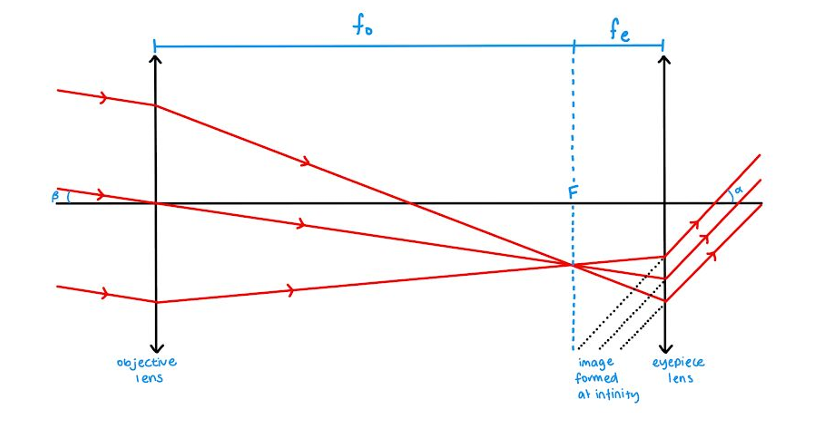
Give the 2 equations for the magnifying power (M) of a telescope?
M = angle subtended by the image/ angle subtended by the object = fo/fe
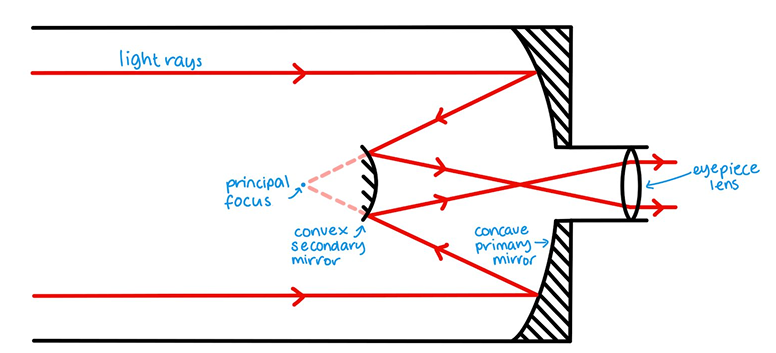
Describe how a cassegrain telescope is arranged.
A concave primary mirror with a long focal length and a small convex secondary mirror in the centre
Draw a ray diagram for a cassegrain telescope.
How is distortion minimised in a reflecting telescope?
Using very thin (<25nm) aluminium and silver atoms, making it as smooth as possible
What is chromatic aberration?
Different wavelengths (colours) of light are refracted different amounts, so are focused at different points
How might an image appear through a lens when chromatic aberration occurs?
With different colours around the edges
Why does chromatic aberration have very little effect on reflecting telescopes?
It only has one small lens
What is spherical aberration?
When the curvature of a lens/mirror causes light rays at the edges to be focused in different points
What are the consequences of spherical aberration?
A blurred or distorted image
How can spherical aberration be avoided in reflecting telescopes?
Using parabolic objective mirrors
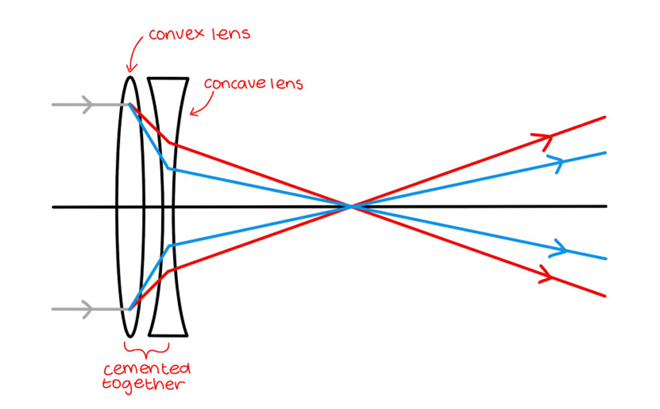
What is an achromatic doublet?
A convex lens made of crown glass and a concave lens made of flint glass cemented together
What is the purpose of an achromatic doublet?
It reduces spherical AND chromatic aberration by focusing the rays in the same position
Draw a diagram of an achromatic doublet.
List the disadvantages of refracting telescopes.
Large lenses can bend/distort under their own weight (very heavy)
Chromatic and spherical aberration affect the lenses
They are very heavy and difficult to manoeuvre
They require long focal lengths and large lenses
They can only be supported at the edges
List the advantages of reflecting telescopes.
Mirrors are very thin and give excellent image quality
Mirrors are unaffected by chromatic aberration and spherical aberration can be reduced using parabolic mirrors
Mirrors are light and can be moved easily
Large mirrors can be made that are easy to support from behind to minimise distortion
Why are radio telescopes able to be used at ground level?
Most radio waves are not absorbed by the atmosphere
Why should radio telescopes be built in isolated areas?
To minimise interference from other sources of radio waves
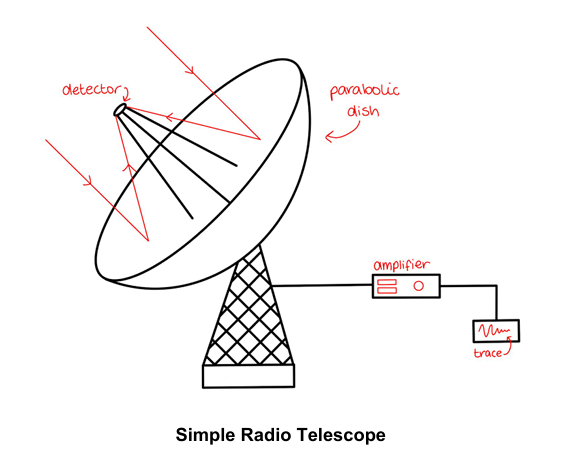
Draw a diagram of a radio telescope.
Give some similarities between radio and optical telescopes.
Both types focus incident radiation to detect its intensity
Both can be moved to focus on different sources
Parabolic dish is similar to objective mirror in reflecting telescope
Both are ground based
Give some differences between radio and optical telescopes.
Radio wavelengths are larger than visible light, so radio telescopes have a much greater diameter
Radio telescopes are easier and cheaper to construct (wire mesh used)
Radio telescopes experience man-made interference, whereas optical interference is often natural
What is an IR telescope made up of?
2 large concave mirrors that focus radiation onto a detector
Why must IR telescopes be cooled using cryogenic liquids?
To prevent interference from its own components
Why must IR telescopes be shielded?
To avoid thermal contamination from other objects
Why must IR telescopes be launched into space to work?
Earth’s atmosphere absorbs IR radiation
What regions of space are viewed using an IR telescope?
Cooler regions
Why do UV telescopes need to be positioned in space?
The ozone layer absorbs radiation with a wavelength <300nm
What are UV telescopes used to view?
Interstellar medium and star formation regions (hotter regions)
Why do X-ray telescopes need to be positioned in space?
All X-rays are absorbed by the atmosphere
Why must X-ray telescopes use a combination of parabolic and hyperbolic mirrors?
X-rays have so much energy that they would pass through a normal mirror
What is the purpose of a CCD?
To convert EM rays into electrical pulses
What can be observed using X-ray telescopes?
Active galaxies, black holes and neutron stars
What is collecting power?
A measure of a lens or mirror’s ability to collect incident EM radiation
State the relationship between collecting power and diameter of the objective lens.
Collecting power is directly proportional to D²
What is improved by a greater collecting power?
The brightness of the image
What is resolving power?
The ability of a telescope to separate images of close-together objects
Give the equation for minimum angular resolution.
MAR = wavelength / diameter
What is the Rayleigh Criterion?
2 objects can just be resolved if the central maximum one on diffraction pattern falls within the first minimum of the other
What is a CCD?
A charge-coupled device
An array of light sensitive pixels that become charged when exposed to light by the photoelectric effect
What is quantum efficiency?
The percentage of incident photons that cause an electron to be released
What is a spectral range?
The detectable range of wavelengths of light
What is pixel resolution?
The number of pixels used to form an image on the screen
What is spatial resolution?
The min distance apart objects must be to be distinguishable
Compare the CCD and human eye based on quantum efficiency, resolution and convenience.
The CCD has a quantum efficiency of ~80%, compared to 4-5% of the eye
The CCD can detect IR, UV and visible light
CCD has a better pixel and spatial resolution
a CCD is less convenient as it must be set up
Define luminosity.
The power output of a star (energy released per second)
What is the intensity of a star?
The luminosity per unit area
How does the intensity of a star change with distance?
Intensity is inversely proportional to the square of the distance from the star
What is the apparent magnitude of a star?
How bright it appears in the sky
What is the Hipparcos scale?
A classification system for stars depending on their apparent magnitude
How is the Hipparcos scale read?
1 is the brightest, 6 is the faintest
How bright is a magnitude 1 star compared to a magnitude 6 star?
100 times brighter
What is the difference in intensity of a star for a difference of 1 on the Hipparcos scale?
2.51x
What is absolute magnitude?
The apparent magnitude of a star if it were 10 parsecs from earth
Give the equation relating the apparent (m) and absolute magnitude (M) of a star.
m - M = 5log(d/10)
What is parallax?
The apparent change of a position of a nearer star in comparison to distant stars in the background as a result of the orbit of the earth around the sun
How does angle of parallax relate to the distance from earth?
Larger angle = closer to earth
Define the astronomical unit (AU) and give its value.
The average distance from the centre of the earth to the centre of the sun
1AU = 1.5 × 10¹¹ m
What is a parsec?
The distance at which the angle of parallax is 1 arcsecond
What is the value in m of one parsec?
3.08 × 10¹⁶ m
What is a light year?
The distance that an EM waves travels in a vacuum in a year
How many m in a light year?
9.46 × 10¹⁵ m
How can parallax angle be used to find the distance to a star?
distance (in parsecs) = 1/parallax angle (in arcseconds)
What is a black-body radiator?
A perfect emitter and absorber of all possible wavelengths of radiation
State Stefan’s law.
The luminosity of a black-body radiator is directly proportional to its A (surface area) and T4
Give the value of the Stefan constant.
5.67 × 10⁻⁸
State the equation for Stefan’s law.
P = (constant) x A X T4
State Wien’s displacement law.
The peak wavelength of emitted radiation is inversely proportional to the absolute temperature of the object
What is the peak wavelength of a source?
The wavelength released at maximum intensity
State the equation for Wein’s law.
peak wavelength x T = 2.9 × 10⁻³ mK (metres kelvin)
What happens to the peak wavelength of a body as it gets hotter?
It decreases
What assumption is made when applying Wein’s law?
Light is emitted equally in all directions
Give an equation relating the intensity, power output and distance of a star from earth.
I = P/4pi(d²)
What are spectral classes dependent on?
The strength of absorption lines on a spectrum and therefore the temperature of the star
What are hydrogen-balmer lines?
Absorption lines that are found in spectra of O,B and A type stars
What causes hydrogen-balmer lines?
The excitation of hydrogen atoms from the n=2 state to higher/lower energy levels
Why do cooler stars not have hydrogen-balmer lines?
The hydrogen atoms do not become excited, or may not be present at all
Give the colour, temperature and prominent absorption lines of a class O star.
Blue
25,000 - 50,000 K
He+, He, H
Give the colour, temperature and prominent absorption lines of a class B star.
Blue
11,000 - 25,000 K
He, H
Give the colour, temperature and prominent absorption lines of a class A star.
Blue/White
7,500 - 11,000 K
H, ionised metals
Give the colour, temperature and prominent absorption lines of a class F star.
White
6000 - 7500 K
Ionised metals
Give the colour, temperature and prominent absorption lines of a class G star.
Yellow/White
5000 - 6000 K
Ionised and neutral metals