Chemistry: Liquids, Phase Changes, and Thermodynamics Review
 Studied by 0 people
 Call Kai
 Learn
Learn Practice Test
 Spaced Repetition
 Match
Match Flashcards
 Knowt Play
1/27

There's no tags or description
Looks like no tags are added yet.
Name | Mastery | Learn | Test | Matching | Spaced | Call with Kai |
|---|
No analytics yet
Send a link to your students to track their progress
28 Terms
What are intermolecular forces?
Forces that hold molecules together, including hydrogen bonds, dipole-dipole interactions, and London dispersion forces.
What is a hydrogen bond?
A strong type of dipole-dipole interaction that occurs between molecules containing hydrogen bonded to electronegative atoms like nitrogen, oxygen, or fluorine.
Define viscosity.
The resistance of a liquid to flow, often compared to the thickness of the liquid.
What is surface tension?
The tendency of liquid surfaces to shrink into the minimum surface area possible, caused by cohesive forces between liquid molecules.
What is capillary action?
The ability of a liquid to flow in narrow spaces against gravity, due to adhesive and cohesive forces.
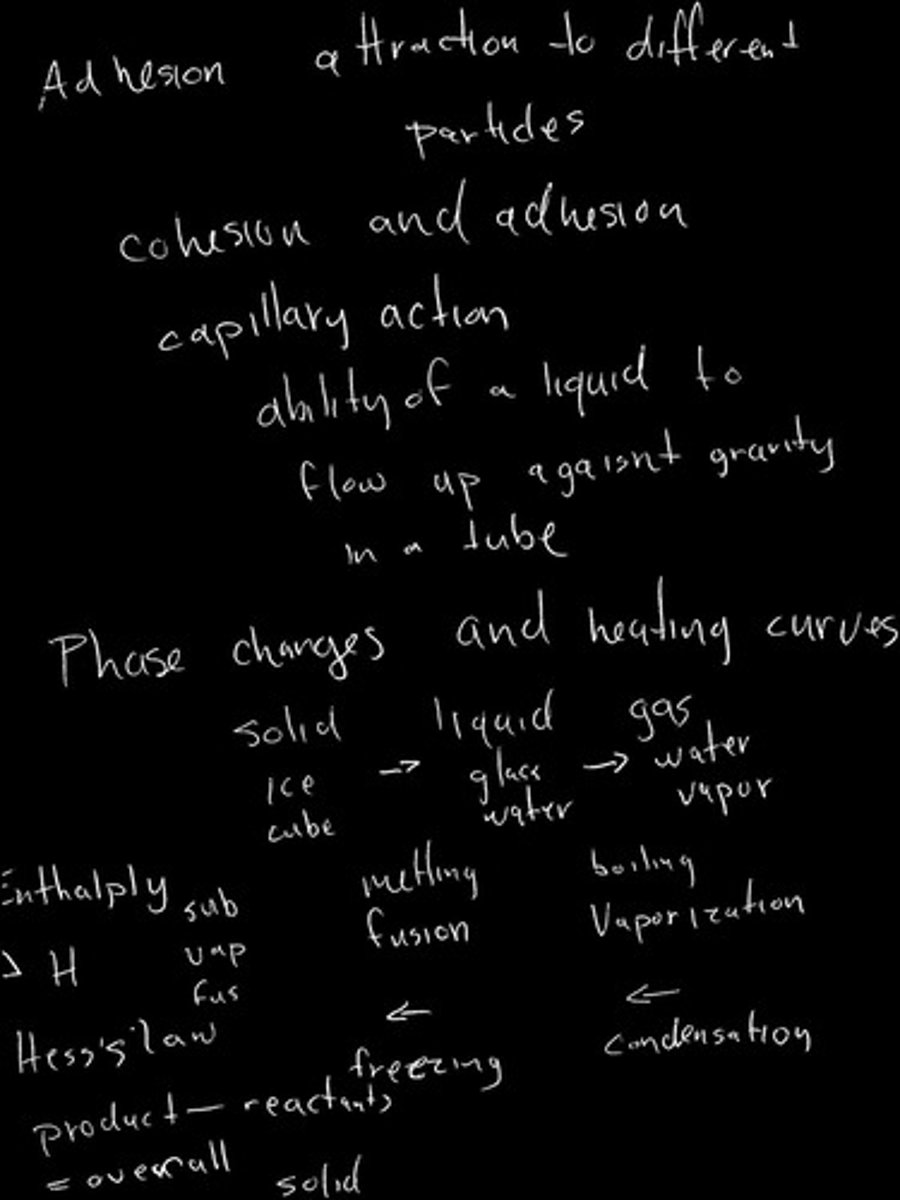
What is the phase change from solid to liquid called?
Melting.
What is Hess's Law?
The principle stating that the total enthalpy change for a reaction is the sum of the enthalpy changes for the individual steps of the reaction.
What is vaporization?
The process of converting a liquid into a gas, which can occur through boiling or evaporation.
Define enthalpy.
A measure of the total energy of a thermodynamic system, including internal energy and the product of pressure and volume.
What is the significance of the critical point in phase diagrams?
It is the temperature and pressure at which the distinction between liquid and gas phases disappears.
What is the formula for calculating heat transfer during a phase change?
q = m * ΔH, where q is heat, m is mass, and ΔH is the heat of the phase change.
What does the term 'spontaneous process' refer to?
A process that occurs without needing to be driven by an external force.
What is Gibbs free energy?
A thermodynamic potential that measures the maximum reversible work obtainable from a thermodynamic system at constant temperature and pressure.
What is the relationship between Gibbs free energy and spontaneity?
If ΔG is negative, the reaction is spontaneous; if ΔG is positive, the reaction is non-spontaneous.
What is the difference between volatile and non-volatile substances?
Volatile substances easily vaporize, while non-volatile substances do not vaporize easily.
What is the purpose of distillation?
To separate volatile liquids from mixtures based on differences in boiling points.
What is a crystalline solid?
A solid material whose constituents are arranged in a highly ordered structure, forming a crystal lattice.
What is an amorphous solid?
A solid that lacks a long-range order or a defined crystalline structure, such as glass.
What are ICE tables used for?
To calculate the concentrations of reactants and products at equilibrium in chemical reactions.
Define reaction rate.
The change in concentration of a reactant or product per unit time.
What factors affect reaction rates?
Concentration of reactants, temperature, surface area, and the presence of catalysts.
What is activation energy?
The minimum energy required for a chemical reaction to occur.
What is Le Chatelier's principle?
The principle stating that if a dynamic equilibrium is disturbed by changing the conditions, the position of equilibrium shifts to counteract the change.
What is polarizability?
The ability of an electron cloud in a molecule to become distorted by an external electric field, affecting intermolecular attractions.
What is the significance of temperature in phase changes?
Temperature determines the state of matter (solid, liquid, gas) and influences the energy required for phase transitions.
What is the triple point?
The unique set of conditions at which all three phases of a substance (solid, liquid, gas) coexist in equilibrium.
What is a cation?
A positively charged ion that has lost one or more electrons.
What is an anion?
A negatively charged ion that has gained one or more electrons.
 Note
Note  Flashcards (36)