GW BGZ 2024 Practical - Design an experiment
 Call Kai
 Learn
Learn Practice Test
 Spaced Repetition
 Match
Match Flashcards
 Knowt Play
1/30

There's no tags or description
Looks like no tags are added yet.
Name | Mastery | Learn | Test | Matching | Spaced | Call with Kai |
|---|
No analytics yet
Send a link to your students to track their progress
31 Terms
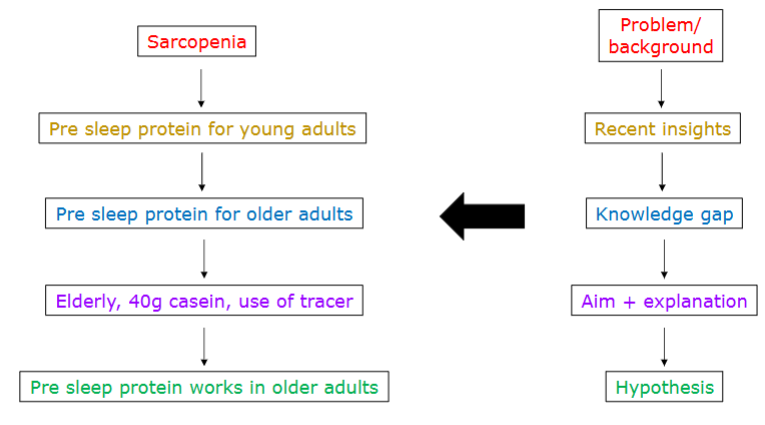
What is the correct structure of a study proposal introduction (funnel shape)
A study proposal introduction should follow a funnel-shaped structure, meaning it starts broad and gradually becomes more specific. The structure includes:
Problem/Background: Introduce the general topic and explain its importance (e.g., relevance to diabetes, obesity, or athletic performance).
Recent Insights: Summarize key findings from current scientific literature to show what is already known.
Knowledge Gap: Identify what is still unknown or insufficiently studied. This is critical because it justifies your research.
Aim: Clearly state what your study intends to investigate. This must directly address the identified gap.
Hypothesis: Provide a testable prediction aligned with the aim.
Each part must logically lead to the next, creating a continuous and coherent narrative.
Why is the background section important in a proposal?
The background section is essential because it convinces the reader that the research topic is relevant and meaningful. It should:
Provide context (e.g., metabolic health, energy expenditure).
Demonstrate societal or scientific importance (e.g., implications for obesity or athletic performance).
Show familiarity with existing literature.
A weak background reduces the perceived importance of the study and undermines the justification for the research.
What is meant by a “funnel shape” in writing?
A funnel shape means structuring information from broad to specific:
Start with general concepts (e.g., metabolism, energy balance).
Narrow down to specific processes (e.g., substrate oxidation).
End with a precise research question or aim.
This ensures clarity, logical progression, and reader engagement.
What are key questions to evaluate the structure of your introduction?
Are all required elements present (background → gap → aim → hypothesis)?
Does the text follow a funnel shape?
Is all included information relevant to the research question?
Is the introduction logically ordered?
Is there unnecessary repetition?
Are any essential elements missing?
These questions help ensure clarity, relevance, and completeness.
Why should repetition be avoided in scientific writing?
Repetition:
Reduces clarity and readability.
Makes the text unnecessarily long.
Suggests poor organization or lack of precision.
Instead, ideas should be expressed clearly and only once, using precise wording.
Why should irrelevant information be excluded from a proposal?
Irrelevant information distracts from the main argument and weakens the logical flow toward the research question. Every sentence should contribute directly to building the rationale for the study.
How should a research aim be formulated?
A research aim should:
Be specific and concise.
Focus only on what is being measured.
Exclude unnecessary background or explanations.
Directly reflect the experimental design.
Example: measuring energy expenditure or substrate oxidation under specific conditions.
What are the key rules for writing a hypothesis?
It must align directly with the research aim.
It should only include measurable variables.
It must be testable.
It should not include explanations or reasoning (these belong in the discussion).
Why should explanations not be included in the hypothesis?
he hypothesis is meant to be a prediction, not an interpretation. Including explanations introduces bias and belongs in the discussion section after results are known.
Why must scientific language be precise and specific?
Scientific writing requires precision to avoid ambiguity. Vague phrases such as “you know what I mean” are unacceptable because they:
Lack clarity
Cannot be scientifically interpreted
Reduce credibility
Why should CHO and glucose not be used interchangeably?
CHO (carbohydrates) is a broad category that includes multiple molecules (e.g., glucose, fructose, glycogen), whereas glucose is a specific monosaccharide. Using them interchangeably leads to scientific inaccuracies.
Why should brackets be avoided in scientific writing?
Brackets interrupt reading flow and often indicate poor sentence integration. Important information should be incorporated into the sentence itself. Exceptions include references and abbreviations.
Why should personal pronouns (I, we, you) be avoided?
Scientific writing should be objective and impersonal, focusing on data and findings rather than the researcher.
What is the ideal paragraph structure in an introduction?
Typically 1–2 paragraphs (maximum 3).
Each paragraph should focus on a single topic.
Avoid unnecessary white space unless shifting topics.
How should “whereas” and “while” be used?
They are used to indicate contrast between two parts of a sentence.
Example: One variable increases, whereas another decreases.
What are rules for using “and” and “but”?
They should never be used at the beginning of a sentence in formal scientific writing.
What are rules for transition words like “however” and “moreover”?
They should not be placed at the beginning of a paragraph or new section, as this disrupts formal structure.
What is the difference between “which” and “that”?
“Which” follows a comma and adds non-essential information.
“That” does not follow a comma and introduces essential information.
What is the function of a semicolon?
A semicolon separates closely related ideas more strongly than a comma but less strongly than a full stop. It is often misused where a comma is insufficient.
What are good practices for referencing?
Use scientific articles (e.g., PubMed).
Prefer numerical citation style.
Avoid overuse of “et al.”
Cite original sources when possible.
Build a logical, evidence-based argument.
What is the basic unit of heat and of energy expenditure?
Basic unit of heat is the calorie (cal), basic unit of energy expenditure is joule (J) ➔ 1 kcal (Cal) is 4.18 kJ
All metabolic processes → energy
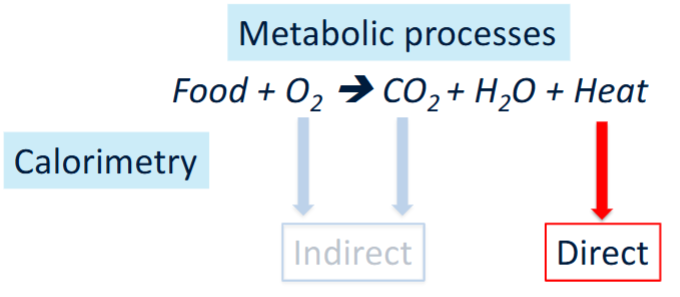
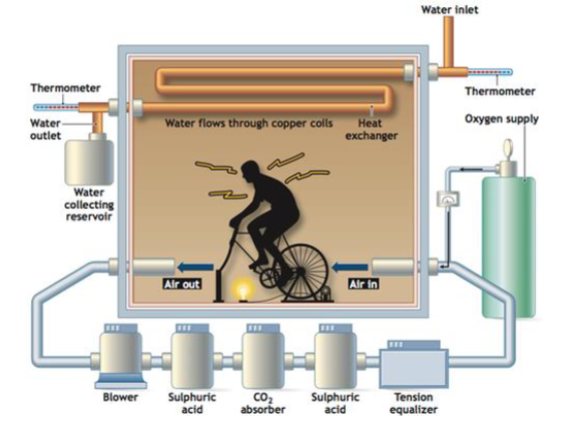
What is direct calorimetry and what are the pros and cons?
Measuring directly the heat production
Pros and cons
Pros
Accurate over long recording periods
Good for resting metabolic measurements
Cons
Limited practical applications:
Require considerable time and expense
Requires formidable engineering expertise
Inapplicable for energy determinations for most sports, occupational, and recreational activities
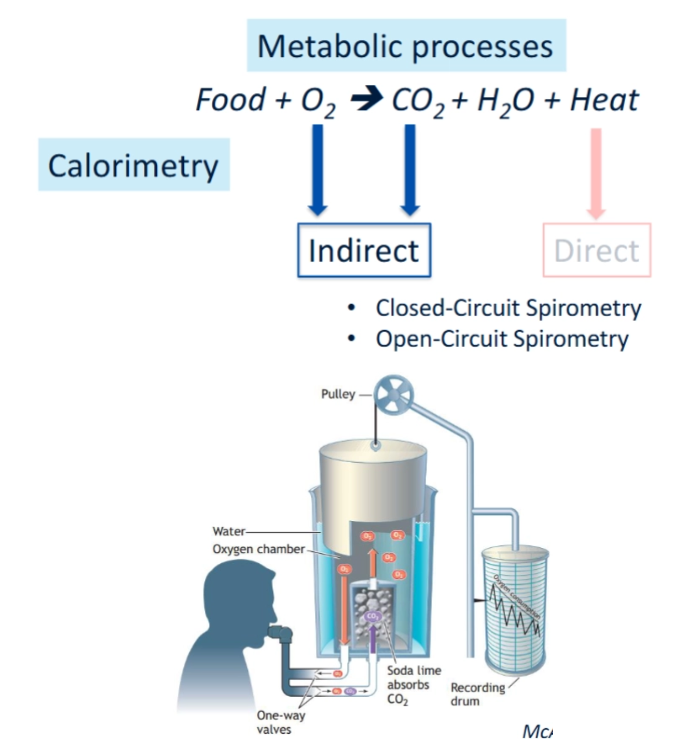
What is the principle behind indirect calorimetry, and why is it useful?
Indirect calorimetry is based on the principle that energy metabolism requires oxygen and produces carbon dioxide. By measuring oxygen consumption (VO₂) and carbon dioxide production (VCO₂), it is possible to estimate:
Total energy expenditure
The type of substrate being oxidized (carbohydrates vs fats)
This method is useful because it provides insight into metabolic processes without directly measuring heat production, making it more practical than direct calorimetry.
Pros and cons
Pros
Simple method to directly measure oxygen consumption
Cons
Limited practical applications:
Cannot be used during physical activity
Subjects must remain close to bulky equipment
Large breathing volumes are difficult
Carbon dioxide removal insufficient during intense effort
What are the key differences between direct and indirect calorimetry?
Direct calorimetry measures heat production directly, making it highly accurate but impractical due to cost and complexity.
Indirect calorimetry estimates energy expenditure through gas exchange, making it more practical and widely used despite some limitations in accuracy under certain conditions.
What is open-circuit spirometry and what are the pros and cons?
Volume of expired air
Oxygen analyzer
Carbon dioxide analyzer
Pros and cons
Pros
Ease of operation
Speed of data analysis
Cons
High costs of equipment
Delays from system breakdowns: data still reflect the accuracy of the measuring device
Careful and frequent calibrations are required
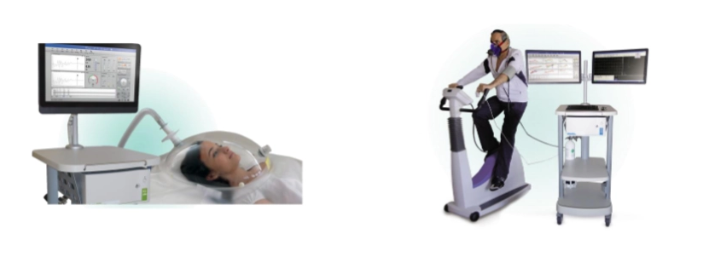
What can be calculated using indirect calorimetry?
Energy expenditure (EE)
Carbohydrate oxidation
Fat oxidation
Relative substrate use
What is the Respiratory Exchange Ratio (RER)?
RER=VCO2/VO2
It indicates which fuel (fat or carbohydrate) is being used for energy.
~0.7 → mainly fat oxidation
0.7–1.0 → mixed substrates
~1.0 or higher → mainly carbohydrate oxidation
Protein is typically negligible.
What is the RER in a fasted resting state?
0.7–0.8, because fat is the primary fuel source when no recent food is available.
What happens to RER after glucose ingestion?
RER increases, because the body shifts toward carbohydrate oxidation.
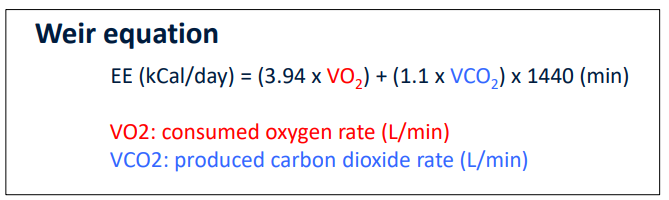
hat is the main outcome of indirect calorimetry calculations and how can it be calculated?
They determine energy expenditure (calories used) and the type of fuel being oxidized.
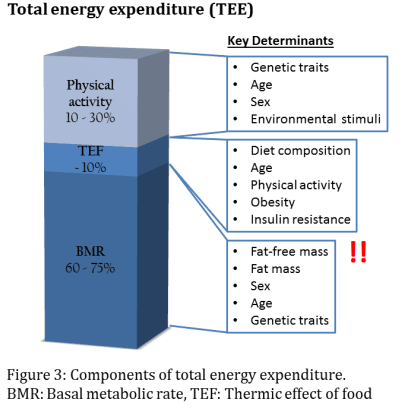
What is the most important determinant of energy expenditure?
Fat-free mass is the most important measurement
Explore top notes

