Microbiology Exam 3
 Call Kai
 Learn
Learn Practice Test
 Spaced Repetition
 Match
Match Flashcards
 Knowt Play
1/404

Earn XP
Description and Tags
lectures 22-32
Name | Mastery | Learn | Test | Matching | Spaced | Call with Kai |
|---|
No analytics yet
Send a link to your students to track their progress
405 Terms
1. Which of the following is associated with antigen presentation by phagocytes, but not by
epithelial cells?
A. MHC1 picks up an external antigen circulating in the blood serum.
B. MHC2 picks up an antigen from the phagocyte’s cytoplasm.
C. MHC1 picks up an antigen from the phagolysosome.
D. MHC2 picks up an external antigen circulating in the blood serum.
E. MHC2 picks up an antigen from the phagolysosome.
E. MHC2 picks up an antigen from the phagolysosome.
2. Which of the following is NOT common to all three complement activation pathways?
A. The inflammatory response is triggered by C3a and C5a.
B. The adaptive immune response is needed for activation of the pathway.
C. Complement protein C3b is needed as part of the C5 convertase.
D. A molecule from your blood serum must bind the surface of a pathogen.
E. The MAC is formed from C5b and C6 - C9.
B. The adaptive immune response is needed for activation of the pathway.
3. Bacteria respond to phagocytosis by . . .
A. forming granulomas
B. releasing their capsule antigens
C. producing leukocidins
D. enhancing motility to swim out of the phagocyte
E. producing an oxidative burst to kill the phagocyte
C. producing leukocidins
4. MHC Class II receptors . . .
A. Are found only on phagocytes and B-cells
B. Pick up antigen from the infected cell’s cytoplasm
C. Serve as binding receptors for TC cells
D. bind to the CD8 receptor on T cells
E. are found on T cells and used as transporters for cytokine secretion
A. Are found only on phagocytes and B-cells
5. How does interferon fight a viral infection in an infected host?
A. It is a viricidal protein.
B. It induces antiviral proteins (A VP) in virus-infected cells.
C. It boosts the production of B cells in a virus-infected host.
D. It activates inactive A VPs in virus-infected cells.
E. It is produced in virus-infected cells and induces A VP in neighboring cells.
E. It is produced in virus-infected cells and induces A VP in neighboring cells
6. Choose the option with one PHAGOCYTE antigen presenting cell (APC) and one L YMPHOCYTE APC.
A. Macrophages and B cells
B. Dendritic cells and T cells
C. Macrophages and T cells
D. B cells and T cells
E. Macrophages and dendritic cells
A. Macrophages and B cells
Which of the following is correct regarding the body's interferon defense system?
A. It can be activated when antibodies bind to an organism.
B. Cells that produce interferon apoptose when infected by a virus.
C. Interferon induces the production of antiviral proteins in adjacent cells.
D. Interferon is only produced by antigen presenting cells (APCs).
E. Interferon is produced in the phagolysosome of macrophages with activated TLRs.
C. Interferon induces the production of antiviral proteins in adjacent cells.
8. The three complement activation systems share many common features, but there are also
differences. Which of the following is NOT common to all three complement pathways?
A. Diapedesis is induced by peptide C3a
B. Properdin is required to stabilize the C5 convertase
C. C3b opsonizes foreign cells for phagocytosis
D. A pore complex is assembled and inserted into a foreign cell to lyse it
E. PMNs are recruited to the site of complement activation by peptide C5a
B. Properdin is required to stabilize the C5 convertase
9. Why does a bacterium produce antioxidants?
A. To help your body fight off infections from other bacteria.
B. To signal phagocytes to engulf it.
C. To survive the harsh environment inside the phagolysosome.
D. The bacterium is producing its own chemoattractants.
E. To kill the phagocyte that is trying to engulf it.
C. To survive the harsh environment inside the phagolysosome.
10. Some bacteria live and divide inside the phagolysosome. What will be a symptom associated with
a chronic infection of a patient with such a bacterium?
A. Clumps of infected macrophages and TH cells will be seen in the patient's tissues.
B. There will be a lower-than-normal number of phagocytes in the patient's body. C.
The patient will suffer from constant high fever.
D. The patient will not produce antibodies against the bacterium.
E. The patient will suffer hypovolemia and DIC.
A. Clumps of infected macrophages and TH cells will be seen in the patient's tissues.
11. Which of the following is associated with antigen presentation by dendritic cells, but not by
epithelial cells?
A. MHC1 picks up an external antigen circulating in the blood serum.
B. MHC2 picks up an antigen from the phagocyte’s cytoplasm.
C. MHC1 picks up an antigen from the phagolysosome.
D. MHC2 picks up an external antigen circulating in the blood serum.
E. MHC2 picks up an antigen from the phagolysosome.
E. MHC2 picks up an antigen from the phagolysosome.
12. Which of the following is NOT a consequence of activating the complement cascade on the surface
of a bacterium?
A. Peptide C3b attaches to the bacterium, making it easier to phagocytize.
B. Peptide C5b recruits a pore complex to kill the bacterium.
C. Convertases are assembled that proteolyze other complement proteins.
D. Peptide C3a induces B cells to produce antibodies that attach to the bacterium.
E. Peptide C5a recruits PMNs to the site of the infection, where they engulf
bacteria.
D. Peptide C3a induces B cells to produce antibodies that attach to the bacterium.
13. One of the complement activation pathways is called the “alternate” pathway. What is
different between this pathway and the “classical” pathway?
A. It kills bacteria in a different manner than the classical pathway.
B. It requires a bacterial surface to be coated with lectins.
C. It only kills infected “self” cells, rather than pathogenic bacteria.
D. It can be activated even before the humoral immune response is active.
E. It alternates between inducing inflammation and keeping fever from getting too high.
D. It can be activated even before the humoral immune response is active.
14. Which of the following is required for granuloma formation?
A. production of antibodies against a bacterium
B. epithelial cell damage
C. persistent antigen presence inside macrophages
D. binding of the B7 on APCs to CD28 on TC cells
E. high titer of a pathogen circulating in the blood
C. persistent antigen presence inside macrophages
15. Which of the following could be considered to be a phagocyte?
A. TC cell
B. TH cell
C. lymphocyte
D. antigen presenting cell
E. mast cell
D. antigen presenting cell
16. We said that MHC2 is mainly for presentation of exogenous antigens, whereas MHC1 is mainly
for presentation of endogenous antigens. Why is this so?
A. MHC2 is on the outside of cells, MHC1 is on the inside.
B. MHC2 binds to bacteria to allow macrophages to engulf the bacteria.
C. MHC1 is found in the nucleus of infected cells, MHC2 in the cell membrane.
D. MHC1 is involved in elimination of antibodies that recognize self antigens.
E. MHC2 passes through the endocytic vesicle on its way to the cell surface.
E. MHC2 passes through the endocytic vesicle on its way to the cell surface.
17. What is the purpose for our immune system to opsonize bacterial cells?
A. It makes the bacteria easier for the oxidative burst and hydrolases to digest.
B. It causes phagocytes to produce more lysosomes.
C. It makes the surface of the bacteria more slippery so that we can excrete them better.
D. It adds surface features to the bacterium that makes it easier for our cells to
recognize.
E. It is a way to neutralize bacteria so that they do not attach to our cells and infect us.
D. It adds surface features to the bacterium that makes it easier for our cells to recognize.
18. Granuloma formation involves all of the following EXCEPT . . .
A. antibodies
B. cytokines
C. macrophages
D. bacteria
E. T cells
A. antibodies
19. Which of the following statements is true of MHC-II, but not of MHC-I?
A. It must be matched in transplanted tissues or the transplant will be rejected.
B. It mainly displays antigens from the phagolysosome.
C. It typically displays self antigens as well as foreign antigens.
D. It is more important for fighting viral infections than bacterial infections.
E. It recruits TC cells and attaches specifically to them so the infected APC will be killed.
B. It mainly displays antigens from the phagolysosome
20. How is interferon produced during an infection?
A. It is produced by induction of viral genes in the phagolysosome.
B. Bacteria produce it in response to the phagocyte oxidative burst.
C. A second-messenger pathway induces it when viral RNA binds to an RLR receptor.
D. It is produced when MHC-I phosphorylates a response regulator in infected cells.
E. TH cells produce it when they bind to MHC-II that is displaying viral antigens.
C. A second-messenger pathway induces it when viral RNA binds to an RLR receptor.
21. Which of the following is true of infections that are characterized by granuloma formation?
A. Bacteria that cause these infections lack PAMPs on their surface.
B. APCs associated with these infections fail to engulf bacterial pathogens.
C. Bacteria that cause these infections produce many leukocidins and oxidants.
D. Bacteria prevent lysosomes in infected macrophages from fusing with
phagosomes.
E. Infected macrophages fail to produce MHC-II, and so are not recognized by IgG
D. Bacteria prevent lysosomes in infected macrophages from fusing with phagosomes.
22. What is the function of a Toll-like receptor?
A. It allows macrophages and dendritic cells to bind specifically to pathogens.
B. It allows TH cells to bind specifically to B cells.
C. It allows pathogens to bind specifically to epithelial cells.
D. It allows bacteria to bind the FC part of antibodies.
E. It allows the immune system to recognize when a viral infection has occurred.
A. It allows macrophages and dendritic cells to bind specifically to pathogens.
23. What molecule is typically recognized by the immune system to signal that a cell has been infected
by a virus?
A. Complement protein C3b
B. Viral capsomeres
C. Viral envelope lipids
D. Viral spike proteins
E. Double stranded RNA
E. Double stranded RNA
24. How does interferon (IFN) function during a viral infection?
A. Cells that produce IFN apoptose when infected by a virus.
B. IFN is an oxidant that kills the virus by oxidizing viral capsid proteins.
C. IFN is an inducer that turns on genes for antiviral proteins in neighboring cells.
D. IFN is a cytotoxin that kills neighboring cells to prevent them from getting
infected.
E. IFN is a chemokine signal that induces antibody production by TC cells.
C. IFN is an inducer that turns on genes for antiviral proteins in neighboring cells.
25. Some bacteria have evolved the ability to prevent lysosome fusion to a phagosome. These bacteria
can therefore avoid . . .
A. phagocytosis
B. granuloma encasement
C. neutrophil attacks
D. opsonization
E. the oxidative burst
E. the oxidative burst
26. What is a leukocidin?
A. a type of leukocyte
B. a type of stem cell found in the blood
C. a toxin produced by bacteria to kill macrophages
D. a toxin produced by macrophages to kill bacteria
E. a cytokine that induces apoptosis in infected cells
C. a toxin produced by bacteria to kill macrophages
27. Which of the following is true about antigen presentation on MHC class I?
A. It requires protein digestion by the proteasome.
B. It only occurs in professional APCs.
C. It requires altering the route of membrane vesicles through the endomembrane system.
D. Only foreign antigens are presented on MHC class I.
E. TH cells are stimulated by binding to antigens presented on MHC-I.
A. It requires protein digestion by the proteasome.
28. Antigens displayed on MHC class II come from . . .
A. the cytoplasm of the cell that displays them
B. the endoplasmic reticulum of the cell that displays them
C. the surface of T-lymphocytes that have engulfed bacteria
D. the phagolysosome of the cell that displays them
E. the endoplasmic reticulum of APCs, but the cytoplasm of other cells
D. the phagolysosome of the cell that displays them
29. What is the role of antibodies in the innate immune response?
A. They can activate the B-cell response.
B. They can activate the synthesis of antimicrobial peptides.
C. They can detect damage to the skin.
D. They can induce the proliferation of myeloid cells.
E. Antibodies are adaptive, and have no role in innate immunity.
B. They can activate the synthesis of antimicrobial peptides.
30. Which of the following correctly distinguishes MHC-I from MHC-II?
A. MHC-I picks up an antigen as it passes through the phagloysosome.
B. MHC-II displays only endogenous antigens.
C. MHC-I can display self antigens on the surface of uninfected cells.
D. MHC-II binds to TC cells, which destroy an infected cell.
E. MHC-I is found only on professional phagocytes and B cells.
C. MHC-I can display self antigens on the surface of uninfected cells.
31. Which of the following is true regarding interferon α and β?
A. They are released from a cell to bind to receptors on nearby cells.
B. Their production is induced by viral capsomeres.
C. They kill the cell that produces them.
D. They are produced in cells next to ones that have been infected by a virus.
E. They kill a virus by allosterically inhibiting viral replication enzymes
A. They are released from a cell to bind to receptors on nearby cells
32. There are three complement activation pathways. How do these pathways differ?
A. The way the membrane attack complex is assembled
B. The way C3 and C5 proteins are hydrolyzed
C. The cytokines produced once the pathways have been activated
D. The cells that activate the pathway.
E. Some pathways, but not all, trigger an inflammatory response
B. The way C3 and C5 proteins are hydrolyzed
33. Two things happen once a pathogen binds specifically to a dendritic cell (DC). They are . . .
A. The pathogen is engulfed, and the DC produces co-stimulatory molecules.
B. The DC stimulates the production of both antibodies and T cells.
C. The DC produces both B7 proteins and PRR proteins.
D. The pathogen is engulfed, and the DC begins to produce antibodies.
E. The DC begins to coat itself with MHC-I and with PRR proteins.
A. The pathogen is engulfed, and the DC produces co-stimulatory molecules.
34. Bacteria that can survive inside the phagolysosome can do so because . . .
A. they fail to bind C3b to their surface
B. they produce leukocidins
C. their surface molecules are covered by a capsule
D. they produce antioxidants
E. they recruit neutrophils to neutralize the phagolysosome
D. they produce antioxidants
35. Which of the following is a difference between endogenous and exogenous antigen presentation?
A. MHC-II presents only endogenous antigens.
B. Endogenous antigens bind to the TCR of a TH cell.
C. Endogenous antigens are always "self,
" and exogenous are "foreign.
"
D. Endogenous antigens are displayed only on professional APCs.
E. Endogenous antigens are processed by the proteasome, exogenous by the phagolysosome.
E. Endogenous antigens are processed by the proteasome, exogenous by the phagolysosome.
36. How does interferon prevent viral replication?
A. By preventing the formation of dsRNA
B. By signaling cells to be ready to apoptose if a virus invades
C. By killing host cells after the virus has been assembled but before budding
D. By preventing the virus from binding to host cell receptors
E. By preventing the processing of viral polyproteins
B. By signaling cells to be ready to apoptose if a virus invades
37. Which complement molecule is correctly matched with its function?
A. C5a – chemokine signaling molecule
B. C5b – part of a protease
C. properdin – stimulates the inflammatory response
D. C3b – lyses infected cells
E. C3a – an opsonin that binds to bacteria
A. C5a – chemokine signaling molecule
38. Which of the following are produced inside a phagolysosome?
A. Hydrolases and Interleukins
B. Digestive enzymes and MHC-II
C. Peroxides and Antimicrobial complement peptides
D. Cytokines and Cytotoxins
E. Hydrolases and Peroxides
C. Peroxides and Antimicrobial complement peptides
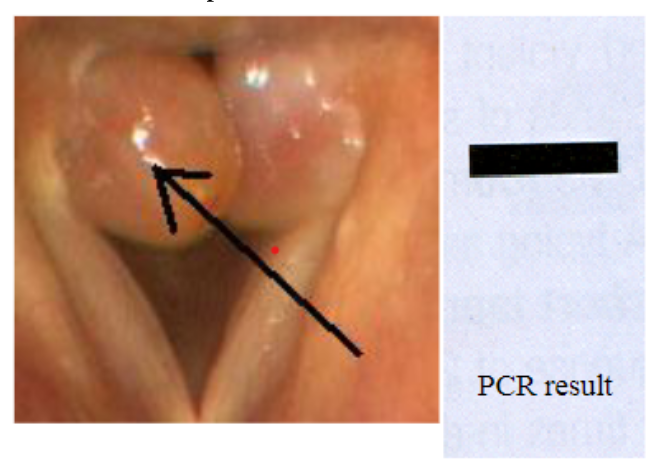
39. A patient comes to your clinic with the structures shown below on his vocal cords. Y ou take a biopsy of
the structure indicated by the arrow. PCR primers are prepared complementary to the 3' ends of a
bacterial gene, and a reaction is performed on the biopsied tissue. The results are shown after
electrophoresis. What is the best interpretation of this data?
A. The PCR has been done wrong. One primer should be complementary to the 3' end and the
other should be complementary to the 5' end of the gene.
B. The patient's macrophages are in the process of digesting the bacteria and releasing
the DNA.
C. The patient has a granuloma, and may need long term antibiotics to treat it.
D. The patient has a tumor, which was caused by insertion of bacterial DNA.
E. The bacterium is actively replicating its DNA, which was detected by the
PCR.
C. The patient has a granuloma, and may need long term antibiotics to treat it
40. Which complement-associated term is NOT correctly matched with its function?
A. C3b – enhances phagocytosis
B. Lectin – digests the C5 protein
C. C3a – induces diapedesis
D. C5b – recruits a lytic pore complex
E. C3b – initiates one of the complement pathways
B. Lectin – digests the C5 protein
1. In general, antibodies can defend against pathogens in any of six ways. However, IgM and IgA can
only use a few of these methods. Which of the following could be used by IgM or IgA to inactivate
pathogens?
A. Agglutination
B. Opsonization
C. Complement activation
D. NK cell activation
E. TH cell activation
A. Agglutination
2. What parts of antibodies have great variability due to somatic recombination?
A. variable and constant regions
B. the Fc part only
C. alpha and beta chains
D. the heavy chain only
E. the Fab part only
E. the Fab part only
3. The antibody type that is secreted by plasma cells one day after primary infection would most likely
be:
A. IgA
B. IgD
C. IgG
D. IgM
E. IgE
D. IgM
4. Some antigens (T-independent) can activate B cells without the involvement of cellular immunity.
Which of the following would still occur in response to these antigens?
A. Memory B cells would be produced
B. B cell receptors would bind to the antigen
C. B cells would internalize the antigen
D. TH cells would bind to the B cells’ MHC2
E. B cell receptors would not bind to the antigen
B. B cell receptors would bind to the antigen
5. A B cell recognizes an antigen, but there is no TH cell that also recognizes the antigen. What will
happen?
A. The B cell will become anergic.
B. The B cell will begin producing antibodies.
C. The TH cell will secrete cytokines to activate the B cell.
D. The B cell will not internalize the antigen.
E. The TH cell will kill the B cell.
A. The B cell will become anergic.
6. The process that ensures no circulating B cells recognize self antigens is called:
A. class switching
B. clonal selection
C. somatic recombination
D. clonal deletion
E. conjugation
D. clonal deletion
7. How do antibodies actually kill foreign bacteria?
A. They bore a hole in the bacterial cell envelope, making the contents leak out.
B. They surround and engulf the bacterium.
C. They opsonize the bacterium, making it easier to phagocytize.
D. The Fab part directs a protease to the bacterium, which is then digested.
E. They anergize the bacterium, causing it to use so much energy that it dies.
C. They opsonize the bacterium, making it easier to phagocytize.
8. What is the major difference between IgG and IgA?
A. They have different variable regions.
B. IgA is produced by class switching, IgG by somatic recombination.
C. IgG is the first antibody to be produced, IgA is the second.
D. IgG is the major secreted antibody; IgA is found mainly in the blood.
E. The Fc region of the IgA heavy chain allows dimerization.
E. The Fc region of the IgA heavy chain allows dimerization
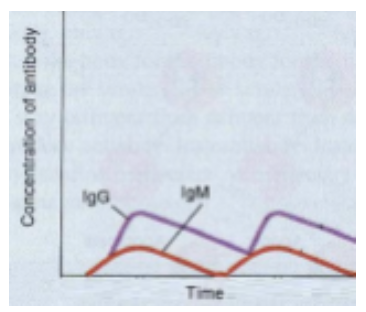
9. A patient is infected with Pasteurella multocida from a dog bite.
Two weeks later, the same patient is bitten and infected with P .
multocida again. The antibody titers were determined after the two
bites, and found to be as shown. What best explains this result?
A. This patient cannot develop memory B cells.
B. This patient has no TH cells.
C. The bacteria have not been engulfed by phagocytes.
D. TC cells have failed to completely clear the first infection.
E. This is the typical result. No special explanation is needed.
A. This patient cannot develop memory B cells.
10. Which antibody class can cross the placenta to protect the fetus?
A. IgA
B. IgD
C. IgE
D. IgG
E. IgM
D. IgG
11. What parts of antibodies have great variability due to somatic recombination?
A. variable and constant regions
B. the Fc part only
C. alpha and beta chains
D. the heavy chain only
E. the Fab part only
E. the Fab part only
12. What causes a B cell to become anergic?
A. It produces extra A TP by oxidative phosphorylation.
B. A TC cell binds to its MHC2 receptors rather than a TH cell.
C. Its MHC2 receptors present an antigen that is not recognized by a TH cell.
D. Its MHC1 receptors bearing foreign antigens are recognized by antibodies.
E. A TH cell binds to it and secretes stimulatory cytokines.
C. Its MHC2 receptors present an antigen that is not recognized by a TH cell.
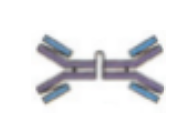
3. Immunoglobulin M (IgM) . . .
A. looks like the drawing to the right:
B. is the main serum antibody
C. is mostly secreted into the tissues and mucus membranes
D. is the first antibody produced in response to an infection
E. has a longer half-life than any of the other antibodies
D. is the first antibody produced in response to an infection
14. The process responsible for antibody diversity . . .
A. puts the Fab and Fc regions together
B. joins heavy chains to light chains
C. begins as soon as a B cell comes into contact with an antigen
D. is initiated by cytokine signals from macrophages
E. is a genetic recombination that can only happen once in each B cell
E. is a genetic recombination that can only happen once in each B cell
15. How are TH cells involved in the humoral immune response?
A. TH cells produce antibodies
B. Macrophages produce antibodies in response to TH cells
C. Antibodies are modified by TH cells so that they are active
D. TH cells kill infected cells by releasing perforin and inducing apoptosis
E. Cytokines from TH cells cause B cells to turn into antibody-producing plasma
cells
E. Cytokines from TH cells cause B cells to turn into antibody-producing plasma
cells
17. What is the most correct statement about the selection process B cells must undergo before they
are released to the blood?
A. Recognizing any antigens in bone marrow causes B cells to apoptose.
B. B cell receptors must recognize self MHCs, but must not recognize antigens on the MHCs.
C. Failure to recognize a circulating antigen causes B cells to become anergic.
D. V -D-J combinations do not occur if they would produce antibodies against self antigens.
E. B cells fail to multiply unless they recognize a self antigen on an MHC2.
A. Recognizing any antigens in bone marrow causes B cells to apoptose.
16. Why are only a very small number of B cells activated in response to an infection?
A. Only a few B cells produce the B7 protein.
B. Only a few B cells have PMPs that recognize a pathogen.
C. Only a few B cells bind to both the specific antigen and a TH cell.
D. The cytokines the body produces bind specifically only to one type of B cell.
E. Most B cells are activated initially, but the ones that don't respond to the infection are
later inactivated again.
C. Only a few B cells bind to both the specific antigen and a TH cell
18. Which of the following can antibodies do to “fight” against both bacteria and viruses?
A. neutralize receptor binding proteins
B. lyse the virus or bacterium
C. initiate the formation of the membrane attack complex
D. bind to and inactivate toxins
E. initiate antibody-dependent cellular cytoxicity (ADCC)
A. neutralize receptor binding proteins
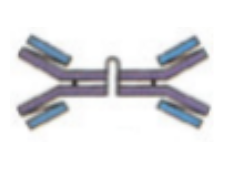
19. The antibody type shown at right has what special feature?
A. It can cross the placenta to protect the fetus.
B. It can activate ADCC better than other antibody types.
C. It is involved in the Type I hypersensitivity response.
D. It is the major antibody found in mucus membranes.
E. It is the first antibody produced in response to an infection.
D. It is the major antibody found in mucus membranes.
20. What cellular process allows billions of different antibody Fabfragments to be produced from only
a few hundred genes?
A. Somatic Recombination
B. Clonal Selection
C. Clonal Expansion
D. Class Switching
E. Promoter Multiplicity
A. Somatic Recombination
21. Antibodies can "fight" bacterial infections in all of the following ways EXCEPT . . .
A. stop bacterial motility
B. attract NK cells
C. direct a pore complex to form in the bacterial membrane
D. activate TH cells to secrete cytokines
E. make bacteria easier for phagocytes to recognize
D. activate TH cells to secrete cytokines
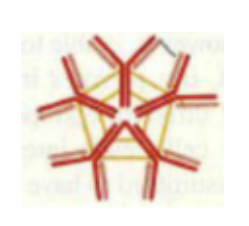
22. What can you conclude if you find the structure at the right in a patient?
A. The patient has been recently infected.
B. The patient is a fetus.
C. The patient is suffering from allergies.
D. This is at least the second time the patient has had the same disease.
E. The patient is suffering an autoimmune disease.
A. The patient has been recently infected.
23. What is the role of T cells in the antibody response?
A. TH cells initiate the V -D-J joining process.
B. TH cells engulf antigens for presentation to B cells.
C. TH cells stimulate B cell division and differentiation.
D. TC cells secrete one of the types of antibodies.
E. T cells play no role in the antibody response.
C. TH cells stimulate B cell division and differentiation.
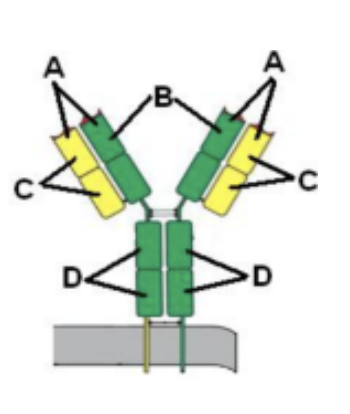
24. Which parts of the antibody shown at the right undergo somatic
recombination?
A. all 4 parts labeled 'A'
B. both parts labeled 'B'
C. all 4 parts labeled 'C'
D. all 4 parts labeled 'D'
E. The whole antibody undergoes somatic recombination
with other antibodies.
A. all 4 parts labeled 'A'
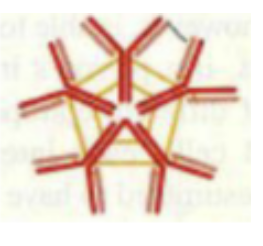
25. The antibody shown below can help your body "fight" against pathogens in all
of the following ways EXCEPT . . .
A. neutralization of toxins
B. immobilization of bacteria
C. activation of ADCC
D. agglutination of viruses
E. interfering with bacterial adhesion to surfaces
C. activation of ADCC
26. How are T cells involved in antibody production?
A. They aren’t - antibodies are produced by B cells without any help from T cells.
B. Cytokines from TH cells cause proliferation and differentiation of B cells into plasma cells.
C. T cells present the antigen that B cells recognize to begin secretion of antibodies.
D. TC cells provide the “second signal” that tells B cells they have found a foreign antigen.
E. Binding of both a B cell and a T cell to the same antigen results in B cell anergy.
B. Cytokines from TH cells cause proliferation and differentiation of B cells into plasma cells.
27. When does a B cell undergo the genetic switch to begin producing IgG instead of IgM?
A. Never – the switch allows B cells to begin producing IgM instead of IgG.
B. before you're born
C. as soon as the B cell binds to a pathogen
D. only after a second infection with the same pathogen
E. several days after the initial infection with a pathogen
E. several days after the initial infection with a pathogen
28. What happens during the process called "clonal deletion"?
A. B cells that have bound to an antigen turn into plasma cells
B. V ariable genes are joined to diversity genes by joining segments to expand antibody
diversity.
C. B cells that have bound to a repeating antigen release surface receptors as antibodies
D. B cells apoptose if their receptors recognize proteins present in bone marrow
E. B cells that fail to recognize a T-cell receptor lose their ability to be activated.
D. B cells apoptose if their receptors recognize proteins present in bone marrow
29. Which of the following statements about antibody types is TRUE?
A. Most B-cells produce IgG as soon as they detect an infection.
B. IgA can cross the placenta to protect the baby for a few months after birth.
C. IgE is produced by class switching of the genes that encode the Fab part of IgM
D. The most effective antibody for agglutinating antigens is IgM.
E. The role of IgD is not clear, but it is involved in the allergic response.
D. The most effective antibody for agglutinating antigens is IgM.
30. Which of the following steps occurs during the immune response to BOTH polysaccharide vaccines
AND protein-conjugate vaccines?
A. B cells engulf the vaccine antigen into an endocytic vesicle
B. B cell receptors bind to polysaccharide components of vaccine antigens
C. T cell receptors interact with the vaccine antigen presented on MHC-II
D. Cytokines induce the formation of plasma cells and B memory cells
E. V accine antigens are engulfed by macrophages or dendritic cells
B. B cell receptors bind to polysaccharide components of vaccine antigens
31. Which of the following B cells would become anergic?
A. A B-cell that has a TH cell bound to its MHC
B. A B-cell that has not bound to any antigen
C. A B-cell that has a macrophage bound to its TLR
D. A B-cell that fails to bind to an antigen during development in bone marrow
E. A B-cell that is displaying an antigen to which no T-cell has bound
E. A B-cell that is displaying an antigen to which no T-cell has bound
32. What is meant by the abbreviation ADCC?
A. Opsonization of a bacterium to enhance phagocytosis
B. Aggregation of bacterial cells to enhance phagocytosis
C. Blocking viral spike glycoproteins from binding to host cell receptors
D. Activating the classical complement pathway to destroy a pathogen
E. Tagging a cell so that NK cells bind to and destroy it
E. Tagging a cell so that NK cells bind to and destroy it
33. Which of the following antibody types is correctly matched with a feature of that antibody?
A. IgM – only Ig produced in response to T-independent antigens
B. IgG – first Ig produced in response to an infection
C. IgD – FC part dimerizes to allow additional agglutination sites
D. IgA – can cross placenta to protect developing fetus
E. IgE – long half life allows long-term protection from circulating pathogens
A. IgM – only Ig produced in response to T-independent antigens
34. Why does a second exposure to the same pathogen usually result in a much stronger immune
response against it?
A. Macrophages retain a memory of the pathogen and phagocytose it more effectively.
B. Antibodies produced during the first infection can remain in the body for years.
C. When a second infection occurs, Bmemory cells produce IgG without class switching.
D. When a second infection occurs, T cells can be directly stimulated by macrophages
without a B cell intermediate.
E. During a second infection, Bmemory cells can be produced without TH cell involvement.
C. When a second infection occurs, Bmemory cells produce IgG without class switching.
35. What happens if you are exposed to an antigen but none of your circulating B cells has receptors
that recognize it?
A. You can produce new B cell receptors that may recognize this antigen.
B. Y our antibodies will still recognize it, even though your B cells don't.
C. Y ou should be vaccinated against it, because you will have no immunity against it.
D. Y ou will never be able to mount a humoral immune response against it.
E. New B cells can be released from your bone marrow that may recognize it, even
though no circulating B cells do.
E. New B cells can be released from your bone marrow that may recognize it, even
though no circulating B cells do.
36. Which of the following is one way our immune system avoids producing antibodies that recognize
self antigens?
A. Somatic recombination is blocked if it produces self-recognizing B cells.
B. B cells become anergic if they are not also stimulated by TH cells.
C. B cells that fail to also bind TH cells in bone marrow apoptose.
D. A B cell binds to MHC-II, which only displays foreign antigens.
E. Such antibodies are produced, but they are opsonized and phagocytosed.
B. B cells become anergic if they are not also stimulated by TH cells.
37. Y ou are working in pharmaceutical research, and you want to make a vaccine against a bacterial
polysaccharide slime layer. Y ou know that you will need to make a conjugated vaccine. Which of the
following is true about such a vaccine?
A. The conjugated protein may be the antigen that is displayed on a B cell's MHC-II.
B. A T cell must recognize the polysaccharide part of the vaccine for it to work.
C. The conjugated protein allows the vaccine to bind to more than one B cell receptor at
the same time.
D. Only the polysaccharide component of the vaccine will be endocytosed by the B cell.
E. The conjugate protein must be from the same pathogen as the polysaccharide.
A. The conjugated protein may be the antigen that is displayed on a B cell's MHC-II.
38. How can IgG prevent a viral infection?
A. It can induce ADCC against the virus.
B. It can stop the synthesis of viral DNA or RNA.
C. It can immobilize the virus in the bloodstream.
D. It can neutralize viral binding to host receptors.
E. It can direct the insertion of a membrane attack complex into the viral capsid.
D. It can neutralize viral binding to host receptors.
39. In a T-dependent B cell response . . .
A. multiple B cell receptors are crosslinked by antigen
B. a B cell receptor must interact with a T cell receptor
C. a B cell must endocytose an antigen and display it on MHC-II
D. a T cell receptor must bind to CD8 on the B cell surface
E. somatic recombination occurs, but not clonal selection
C. a B cell must endocytose an antigen and display it on MHC-II
40. Which of the following is correctly associated with a B cell that has become anergic?
A. Class switching is reversed so that IgG becomes IgM.
B. The B cell turns into a less active plasma cell.
C. The B cell begins to replicate uncontrollably.
D. An oxidative burst from the B cell releases energy.
E. The B cell displays an antigen that no T cell recognizes.
E. The B cell displays an antigen that no T cell recognizes.
41. How many type(s) of antibody is produced from a single B cell?
A. None
B. 1
C. 2
D. 3
E. More than 3
B. 1
42. Can B-cells produce antibodies without TH cell help, and what type of antibody is predominantly
produced in this scenario?
A. Y es, B-cells can produce IgG antibodies without TH cell help.
B. No, B-cells always require TH cell help to produce antibodies.
C. Y es, a small population of B cells can produce IgM antibodies without TH cell help.
D. No, B-cells can produce all classes of antibodies without TH cell help.
E. Y es, B-cells can produce antibodies without TH cell help, and the response is always stronger
with memory and class switching.
C. Y es, a small population of B cells can produce IgM antibodies without TH cell help.
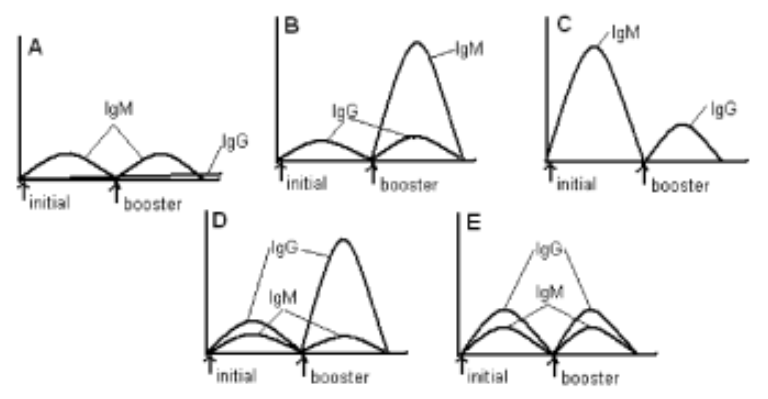
43. In DiGeorge's Syndrome, the patient is born without a thymus. Such a patient obviously lacks
some of his immune system. Which of the following best represents his antibody titer after initial and
booster vaccination?
A.
B.
C.
D.
E.
A. No thymus = no T cells
1. What is the main function of TC cells in the immune system?
A. to activate PMNs
B. to activate TH cells
C. to activate B cells
D. to initiate the complement system
E. to release perforin and granzymes
E. to release perforin and granzymes
2. What happens when an effector TC cell binds to an antigen on an epithelial cell’s MHC1?
A. The TC cell kills the epithelial cell.
B. The TC cell recruits B cells to the site of the infection.
C. The TC cell releases cytokines that activate TH cells.
D. The TC cell becomes anergic.
E. The epithelial cell produces cytokines to activate the TC cell.
A. The TC cell kills the epithelial cell.
3. Which of the following does NOT happen once TH cells have become activated?
A. The TH cells secrete cytokines
B. The TH cells activate macrophages
C. The TH cells activate B cells
D. The TH cells produce MHC2 on their surface
E. The TH cells stimulate themselves to divide and differentiate into memory cells.
D. The TH cells produce MHC2 on their surface
4. Immune tolerance in T cells involves positive selection. What does that mean?
A. T cells are only released if their MHC1 recognizes antibodies in the thymus.
B. T cells are only released if their TCR recognizes thymus cells’ MHC1.
C. T cells are only released if their MHC2 recognizes macrophages in the thymus.
D. T cells are not released if their antibodies recognize antigen in the thymus.
E. T cells are not released if their TCR recognize thymus cells’ MHC2.
B. T cells are only released if their TCR recognizes thymus cells’ MHC1.
5. What is the difference between TH and TC cells?
A. TH cells have MHC1 on their surface, TC have MHC2
B. TH cells recognize antigens, TC cells recognize antibodies.
C. TH cells secrete cytokines, TC cells secrete perforin.
D. TC cells need two signals for them to become “effector” T cells; TH only need one.
E. TC cells bind only to APCs, TH can bind to any other cell.
C. TH cells secrete cytokines, TC cells secrete perforin.
6. If a TH cell binds to an MHC on “cell A” that is presenting an antigen, but binds to nothing
else, what happens?
A. The body assumes cell A is infected; TH releases perforins and granzymes.
B. The body assumes cell A is infected; TH activates nearby B cells.
C. The T cell is engulfed by the MHC on cell A.
D. The body assumes this is a mistake; the TH cell becomes unresponsive.
E. The TH cell remains bound to cell A and attracts antibodies in case an infection is nearby.
D. The body assumes this is a mistake; the TH cell becomes unresponsive.
7. Effector TH cells can do all of the following EXCEPT . . .
A. Phagocytize nearby bacteria
B. Activate TC cells that have bound to an MHC1-Antigen complex
C. Induce B cell clonal expansion
D. Induce the formation of memory T cells
E. Cause macrophages to become more potent
A. Phagocytize nearby bacteria
8. What is the most correct statement about the selection process T cells must undergo before they are
released to the blood?
A. V -D-J combinations do not occur if they would produce TCRs against self antigens.
B. TCRs must recognize self MHCs, but must not recognize antigens on the MHCs.
C. Recognizing any circulating antigen causes T cells to become anergic.
D. Recognizing any antigens in bone marrow causes T cells to apoptose.
E. T cells fail to multiply in the thymus unless they recognize a self antigen on an MHC1
B. TCRs must recognize self MHCs, but must not recognize antigens on the MHCs.
9. What type of cells do NK cells kill?
A. any bacteria with PMPs (or other recognition signals) exposed
B. B cells with B cell receptors whose Fab parts the NK cells recognize
C. TC cells without B7 on their surface
D. T cells that have phagocytized bacteria
E. any cells without MHC1 (or its equivalent) on their surface
E. any cells without MHC1 (or its equivalent) on their surface
10. What is the role of the B7 protein in the immune response?
A. It is a receptor on macrophages that recognizes pathogens.
B. It is produced by infected macrophages to help stimulate T cells.
C. It is a type of antibody produced by effector B cells.
D. It is a protein on TC cells that allows them to bind to TH cells.
E. It is secreted by TH cells to stimulate B cell clonal expansion and differentiation.
B. It is produced by infected macrophages to help stimulate T cells.
11. A TH cell is secreting interleukin-2 (IL-2). This means that . . .
A. it will soon undergo apoptosis.
B. it will now be able to ingest bacteria that bind to its TLR receptors.
C. it is infected by a virus and has sensed the presence of double-stranded RNA.
D. nearby TC cells will become activated once they bind to an antigen-MHC1 complex.
E. an autoimmune disease is allowing the TH cell to recognize a self antigen.
D. nearby TC cells will become activated once they bind to an antigen-MHC1 complex.
12. How do activated macrophages differ from non-activated (naïve) macrophages?
A. They contain more lysosomes.
B. They can activate B cells.
C. They can bind to TH cells.
D. They produce more cytokines.
E. They have contacted a TC cell to become “activated.
”
A. They contain more lysosomes.
13. What is the role of NK cells in the immune response?
A. They can activate the complement system
B. They destroy TC cells that recognize self antigens
C. They secrete cytokines that activate B cells
D. They are responsible for production of T-independent antibodies
E. They participate in antibody-dependent cellular cytotoxicity
E. They participate in antibody-dependent cellular cytotoxicity
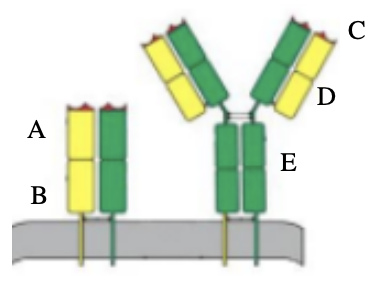
14. Which of the letters in the diagram at the right refers to
the variable region of a T cell receptor (TCR)?
A. A
B. B
C. C
D. D
E. E
A. A
15. What is a major difference between TH and TC cells?
A. TC can bind to almost any infected cell; TH only bind infected antigen presenting cells
B. TC mostly secrete cytokines; TH secrete histamine
C. Effector TH cells induce apoptosis; effector TC cells induce humoral immunity
D. TH cells produce B7, but TC cells produce interleukin-2
E. TH cells undergo clonal deletion; TC undergo clonal expansion
A. TC can bind to almost any infected cell; TH only bind infected antigen presenting cells
16. Which of the following correctly refers to the second signal that is required for T cell activation?
A. It is secreted by a B cell that has already bound antigen.
B. It is a protein that attaches to MHC-II.
C. When T cells bind it, they become more energized, anergic T cells.
D. It is a cytokine that enhances the antibody-producing ability of T cells.
E. It is only produced when a pathogen is recognized by the immune system.
E. It is only produced when a pathogen is recognized by the immune system.
17. Upon receipt of cytokine signals from effector TH cells, macrophages . . .
A. undergo class switching and begin to secrete antibodies.
B. become antigen-presenting cells.
C. differentiate into long-lived memory macrophages.
D. produce a more potent oxidative burst that includes nitric oxide.
E. begin recruiting the membrane attack complex to kill invading bacteria.
D. produce a more potent oxidative burst that includes nitric oxide.

